An Actor’s Revenge
an examination of the “1001 Movies You Must See Before You Die”
An Actor’s Revenge
an examination of the “1001 Movies You Must See Before You Die”
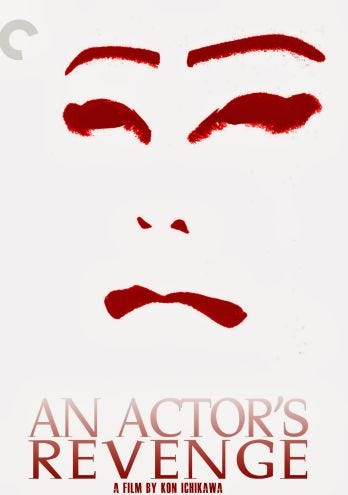
promotional image for “An Actor’s Revenge”, directed by Kon Ichikawa
I have a soft spot for Japanese film. It’s an affinity for Asian film in general if I’m being honest, but Japanese film, in particular, holds a very special place in my heart. As a result, this film had long been on my radar as a must-see. I had, in fact, purchased the DVD from the Criterion Collection at one of those twice-a-year 50% off sales at Barnes & Noble some time ago. Until now, though, I had not screened it.
This is one of the best movies I have watched for this project so far. It is one of the very best Japanese films I have ever seen. The plot is intricately layered. The scenic design is meticulous. The lead performance is inspired and masterful. I rated this film 4 ½ stars on Letterboxed and I am second guessing that decision, perhaps going for broke and awarding An Actor’s Revenge the full five, because this film really was something very special. I haven’t stopped thinking about it.
To be fair, one element of this film that I found fascinating is something that I am only aware of after having done some research: the director of this movie (Kon Ichikawa) was commissioned to helm this project as a celebration of the 300th screen performance of lead actor Kazuo Hasegawa. This film is actually a remake of a creaky old 1935 melodrama entitled The Revenge of Yukinojo. The lead performance in the original film is none other than . . . Kazuo Hasegawa. This means that Kazuo Hasegawa played the same role(s) in two different films 28 years apart.
An Actor’s Revenge centers around an orphan named Yukitarō (Kazuo Hasegawa). Yukitarō is raised by Kikunojō Nakamura (Chūsha Ichikawa), the manager of a traveling kabuki troupe. The adult Yukitarō, now an onnagata (a male actor who plays female roles), takes the stage name Yukinojō and uses his troupe’s planned trip to Edo as the perfect opportunity to enact his long-awaited revenge on three powerful men — Sansai Dobe (Nakamura Ganjirō II), Kawaguchiya (Saburo Date), and Hiromiya (Eijirō Yanagi) — who colluded years ago to drive Yukitarō’s parents to suicide. The events of this film are sardonically commented on throughout the proceedings by a thief named Yamitarō (also played by Kazuo Hasegawa).
Hasegawa’s performance in this film would have been taxing on him. Yukinojō takes his role as an onnagata very seriously. Even when offstage, he wears women’s clothes and speaks effeminately. Yukinojō is also the samurai Yukitarō, however, and Hasegawa’s portrayal of this aspect of the character’s persona is vastly different from the other. The thief, who functions as a — forgive me — Greek chorus of sorts, is a vastly different portrayal from the other two. Hasegawa, essentially, plays three very distinctly different characters in this film. It’s a superb performance.
Perhaps the most impressive thing about this movie is the scenic design. Keeping in mind that portions of this narrative are enacted by actors and actresses performing in the theatre, Ichikawa has great fun with stylistically reflecting a live stage in every aspect of his film. Sequences of a live performance are blurred into street scenes with buildings in the background that are obviously and blatantly fake. Visuals are distorted, memories are depicted as thought bubbles, any trace of realism is tossed out of the window. It reads almost like a parody of kabuki theatre, except that it’s too well done and visually striking for us to even entertain the possibility that Ichikawa is making fun of anything. It’s a good-looking film and competently-made.
I’m not sure I have ever seen a film quite like this before. I can recall commenting back in 2002 that one of the things that impressed me so much about Rob Marshall’s Chicago was that the film (and those who made it) had respect for the source material’s theatrical roots. The design of that film went to considerable length to remind us that the story we were witnessing started out as a live theatre event — sequences of choreography were backlit, pieces of scenery were flown in and out as if attached to a vaudeville fly system, backgrounds were obviously matte paintings. Ichikawa’s experiment — if we can call it such — does this same technique more effectively than Chicago and seems to always be on stage even when the narrative has graduated from the proscenium to the barren, brick streets of Edo.
I said earlier that this is one of the best films on the list I have seen so far. It might actually be my favorite film I have watched so far. Seeing this for the first time really was a very special experience.

Kazuo Hishegawa in “An Actor’s Revenge”
An Actor’s Revenge (1963) directed by Kon Ichikawa written by Natto Wada and Otokichi Mikami starring Kazuo Hasegawa, Chūsha Ichikawa, Nakamura Ganjirō II, Saburo Date, and Eijirō Yanagi not rated, 113 minutes
메타데이터
- post_id
- 7e6cc6a7f8f0
- slug
- an-actors-revenge-7e6cc6a7f8f0
- url
- https://medium.com/@aaron-matthew-polk-5260/an-actors-revenge-7e6cc6a7f8f0
- canonical_url
- https://medium.com/@aaron-matthew-polk-5260/an-actors-revenge-7e6cc6a7f8f0
- author_url
- https://medium.com/@aaron-matthew-polk-5260
- status
- ok
- fetched_at
- 2026-07-25 22:39:11