I Stopped Prompt Engineering. I Started Engineering Better Context.
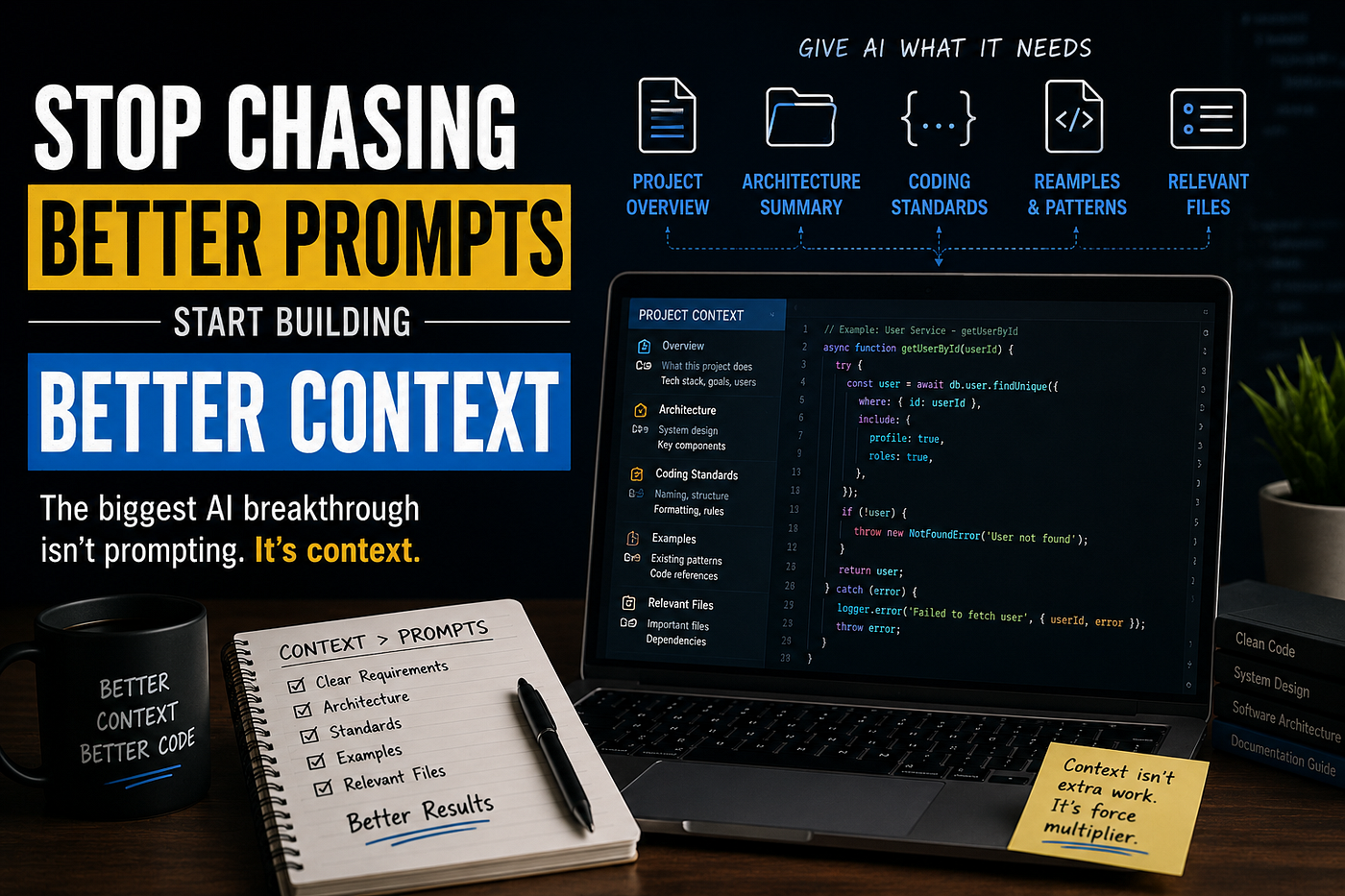
The biggest improvement in AI coding didn’t come from smarter prompts. It came from giving AI the information it actually needed.
I Stopped Prompt Engineering. I Started Engineering Better Context.
The biggest improvement in AI coding didn’t come from smarter prompts. It came from giving AI the information it actually needed.
For almost a year, I thought the answer was better prompts.
Like many developers, I had a collection of templates saved everywhere.
“Act as a senior software engineer.”
“Think step by step.”
“Review your own code before responding.”
“Generate production-ready code.”
Every few weeks, a new prompting technique appeared online promising better results.
And to be fair, some of them worked.
For a while.
But eventually I noticed something strange.
The exact same prompt could produce excellent code in one project and terrible code in another.
If prompt engineering was the answer, that shouldn’t happen.
Yet it happened constantly.
That’s when I realized I was optimizing the wrong thing.
The Problem Wasn’t the Prompt
Imagine hiring a brilliant software engineer and dropping them into a new codebase.
No documentation.
No architecture overview.
No coding standards.
No explanation of business requirements.
No examples.
Then asking them to build a feature perfectly on the first attempt.
Most teams would consider that unreasonable.
Yet that’s exactly how many of us use AI.
We give it a task and expect great results while providing almost no context about the environment in which the task exists.
When the output isn’t perfect, we blame the model.
Or the prompt.
Rarely the information we provided.
Context Is the Real Input
Developers often think the prompt is the input.
In reality, the prompt is only part of the input.
The actual input includes:
- Project structure
- Existing code
- Business rules
- Architectural decisions
- Naming conventions
- Dependencies
- Team standards
- Previous implementation patterns
Without those things, AI has to guess.
And software engineering is one field where guessing becomes expensive very quickly.
A model can be extremely intelligent and still generate poor solutions if it lacks the context needed to make accurate decisions.
The issue isn’t reasoning.
The issue is visibility.
A Small Experiment Changed My Mind
I tested two different approaches on the same feature request.
In the first experiment, I used an extremely detailed prompt.
It included role instructions, formatting requirements, reasoning instructions, and output expectations.
The prompt looked impressive.
The result was average.
Then I tried something different.
I used a much shorter prompt.
But before giving the task, I provided:
- Relevant files
- Existing architecture
- API patterns
- Coding standards
- Folder structure
- Similar implementations already in the repository
The difference was immediate.
The second response was significantly better.
Not because the model became smarter.
Because it finally understood the environment.
That was the moment I stopped obsessing over prompts and started focusing on context.
Why Context Beats Clever Prompting
Prompt engineering tries to improve how you ask.
Context engineering improves what the AI knows.
And knowledge almost always beats instructions.
You can tell AI to act like a senior engineer.
Or you can show it how your actual engineering team works.
The second approach wins almost every time.
The more context AI has about your project, the less energy it spends guessing and the more energy it spends solving the problem.
That’s a much better tradeoff.
And it’s where the biggest productivity gains usually come from.
Building a Better Context System
Once I realized context mattered more than prompts, I stopped collecting prompt templates and started improving the information I shared with AI before asking it to write code.
The goal wasn’t to make longer prompts.
The goal was to make better-informed prompts.
That changed everything.
Instead of spending five minutes rewriting instructions, I spent those five minutes giving AI the same context I would give a new developer joining the team.
The quality difference was immediately noticeable.
What I Started Sharing
Over time, I found that a few pieces of information consistently produced better results.
1. Project Overview
Before asking AI to build anything, I briefly explained what the project actually was.
For example:
- What problem does the application solve?
- Who are the users?
- What technologies are being used?
- Are there performance or security requirements?
Those few sentences helped AI understand the purpose behind the code instead of treating every request as an isolated programming exercise.
2. Architecture Summary
Next, I explained how the application was organized.
Instead of forcing AI to infer the architecture from scattered files, I simply described it.
Something like:
- Frontend framework
- Backend framework
- Database
- Authentication method
- API structure
- Deployment approach
Now the generated code fit naturally into the existing project.
Coding Standards Matter
Many AI mistakes aren’t logic problems.
They’re consistency problems.
Different naming.
Different formatting.
Different folder organization.
Different error handling.
Instead of correcting those issues after every response, I documented our team’s coding standards.
That included:
- Naming conventions
- File organization
- Error handling
- Logging practices
- Comment style
- Testing expectations
Once AI understood these standards, the amount of manual cleanup dropped significantly.
Show Examples Instead of Explaining Them
One of the biggest improvements came from sharing existing code.
Rather than saying,
“Build this API like our other endpoints,”
I attached one of our existing endpoints.
Instead of explaining the authentication flow, I showed an implementation that already worked.
Examples eliminate ambiguity.
AI learns patterns much faster from working code than from paragraphs of instructions.
The same principle has always applied to developers.
It applies equally well to AI.
Documentation Became a Productivity Tool
For years, documentation felt like something we wrote for future developers.
Now it serves another purpose.
It’s also one of the best sources of context for AI.
A well-written README.
An architecture diagram.
A service overview.
A database relationship summary.
These documents don’t just help humans.
They help AI generate code that actually belongs in the project.
Ironically, improving documentation ended up improving development speed.
Context Reduced Rework
The biggest benefit wasn’t faster responses.
It was fewer corrections.
Instead of asking AI to regenerate code three or four times, the first draft was often close enough that only small adjustments were needed.
That saved far more time than any prompt optimization ever did.
Good context reduced misunderstandings before they happened.
And preventing mistakes is almost always cheaper than fixing them later.
The Results Were Bigger Than Better Code
After shifting our focus from prompt engineering to context engineering, the improvements weren’t limited to AI responses.
The entire development workflow became smoother.
Developers spent less time rewriting prompts.
Code reviews became shorter because AI-generated code followed existing project conventions more consistently.
Documentation improved because everyone understood its value beyond onboarding new engineers.
Most importantly, AI became predictable.
Instead of wondering whether the next response would be excellent or completely unusable, we could expect consistent results because the model had the information it needed from the beginning.
Consistency is far more valuable than occasional brilliance.
AI Doesn’t Replace Understanding
One misconception I still see is that AI removes the need to understand your own codebase.
In reality, the opposite is true.
The better your team understands the project, the better context you can provide.
And better context leads to better AI output.
That means experienced engineers are becoming even more valuable.
Their knowledge no longer stays in their heads.
It becomes reusable context that benefits the entire team and every AI interaction.
Knowledge scales when it’s documented.
Context Is a Team Asset
Prompt engineering often feels personal.
Everyone has their own favorite prompts.
Context engineering is different.
It’s something the whole team can improve together.
A better README helps everyone.
Architecture documentation helps everyone.
Coding standards help everyone.
Reusable examples help everyone.
Every improvement benefits developers today and AI-assisted development tomorrow.
Instead of relying on one engineer’s prompt library, the entire team benefits from shared knowledge.
That’s a much more sustainable way to work.
Practical Lessons
If you’re using AI for software development, these changes usually provide a bigger return than endlessly refining prompts:
- Keep project documentation up to date.
- Maintain clear coding standards.
- Share architecture summaries before complex tasks.
- Provide working examples instead of lengthy explanations.
- Give AI the relevant files instead of describing them.
- Treat context as part of your development process, not an afterthought.
None of these require a new AI model.
They simply make better use of the one you already have.
Looking Ahead
As AI becomes a standard part of software engineering, I think we’ll hear less about prompt engineering and more about context engineering.
The teams that achieve the best results won’t necessarily have access to the most advanced models.
They’ll have the best-organized projects.
The clearest documentation.
The strongest engineering practices.
And the richest context.
AI is becoming another member of the development team.
Like any teammate, its performance depends heavily on how well it’s informed.
Final Thoughts
I still write prompts.
They matter.
But I no longer believe prompts are where the biggest productivity gains come from.
The biggest improvements happened when we stopped asking, “How can we phrase this request better?” and started asking, “What information does the AI actually need to succeed?”
That simple shift changed how we build software.
Better prompts may improve an answer.
Better context improves the entire development process.
And that’s a change that continues to pay off long after the conversation with AI has ended.
What has made the biggest difference in your AI-assisted development workflow? Better prompts, better context, or something else entirely? I’d love to hear your experience in the comments.
메타데이터
- post_id
- 7e79a2de19ce
- slug
- i-stopped-prompt-engineering-i-started-engineering-better-context-7e79a2de19ce
- url
- https://blog.stackademic.com/i-stopped-prompt-engineering-i-started-engineering-better-context-7e79a2de19ce
- canonical_url
- https://blog.stackademic.com/i-stopped-prompt-engineering-i-started-engineering-better-context-7e79a2de19ce
- author_url
- https://medium.com/@annahparker
- status
- ok
- fetched_at
- 2026-07-13 08:05:13