The Adjacent Blind Spot
The Adjacent Blind Spot
✨ Expertise and Mastery Series
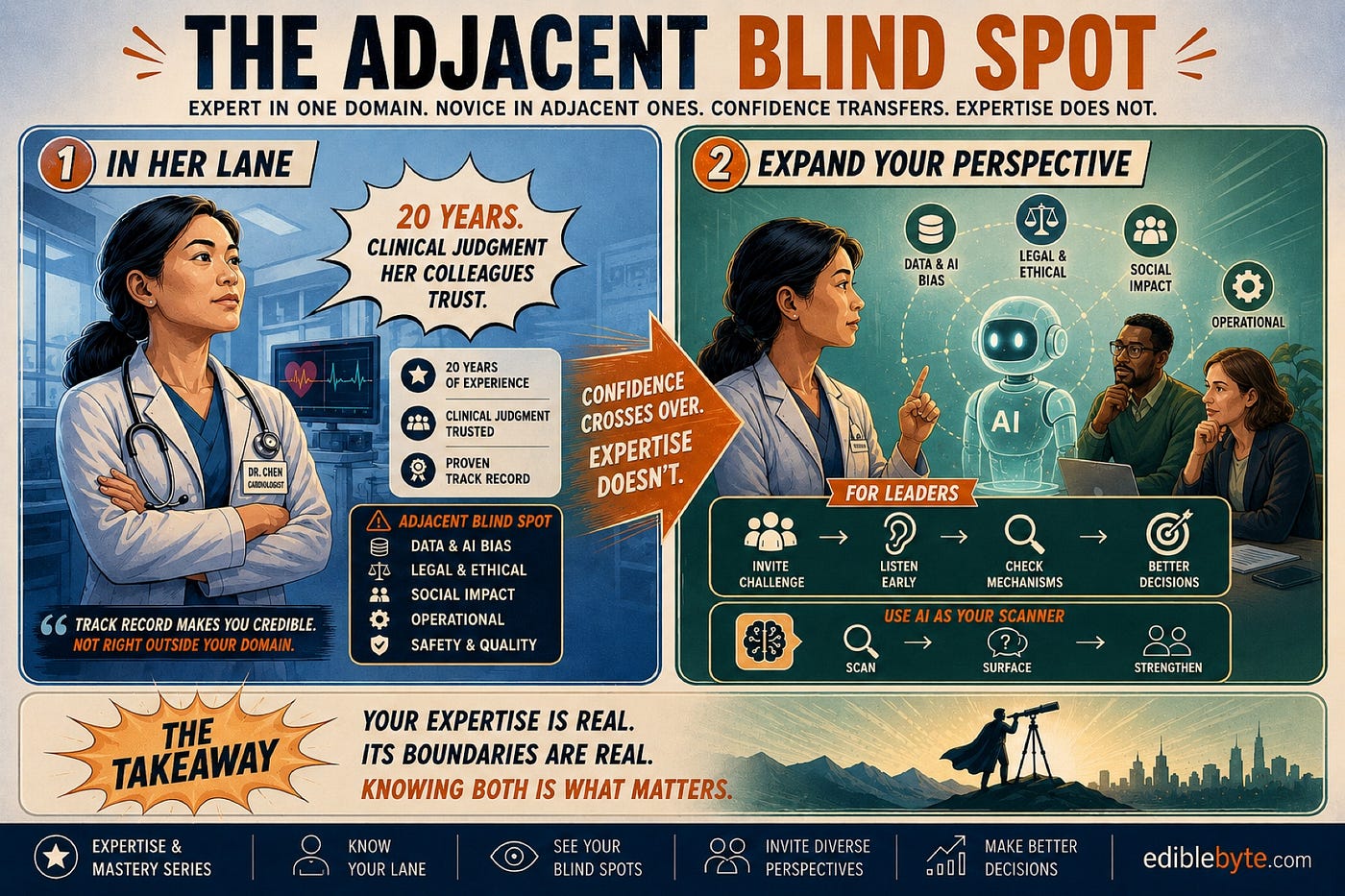
Dr. Chen is a brilliant cardiologist. Twenty years of clinical excellence. A judgment that her colleagues trust completely — on cardiac matters.
Her hospital implements an AI diagnostics tool. The implementation team flags concerns about training data quality and demographic representation. Dr. Chen dismisses them. “Those are IT problems.”
For six months the tool produces biased outputs she does not notice because she is not looking for them. When the issue is finally surfaced, it is traced back to exactly the concerns the team had flagged. Her medical expertise gave her confident opinions about a domain where she was a novice. Her track record made her dangerous outside her lane.
This is not a story about arrogance. Dr. Chen is not arrogant — she is genuinely excellent at what she does. This is a story about how the brain works, and why it works against experts in a specific, predictable way.
🔭 Expertise Does Not Transfer, Confidence Does
The Overconfidence Effect operates across domains: deep expertise in one area produces elevated confidence in adjacent areas, without the epistemics to know where that confidence is justified.
The mechanism is subtle. When you have spent twenty years being right about a domain, the feeling of knowing becomes domain-general even though the knowledge is domain-specific. You have trained an instinct that says I understand this — and that instinct fires even when the subject has shifted. Dr. Chen’s brain gave her the same signal in the data governance meeting that it gives her when she reads a cardiac scan. The signal felt identical. The reliability was completely different.
This is Dunning-Kruger Stage One — not knowing what you do not know — but with an additional tax: a strong track record gives you social permission to be wrong loudly. People defer to Dr. Chen. They defer even when the question is not medicine. Her authority follows her into the room, and the room does not recalibrate when the topic changes. Neither does she.
Consider a parallel case. Marcus is a highly regarded software architect who becomes VP of Engineering. He brings to organisational decisions the same certainty he brought to system design: clear models, decisive positions, crisp tradeoffs. Organisations are not systems. They are networks of people with histories, incentives, and informal power structures that resist clean models. For two years Marcus makes confident calls about team structure that his most experienced managers know are wrong — and say nothing, because Marcus is Marcus.
The adjacent blind spot is not about domain ignorance. It is about confidence that outlives its context.
🪞 For the Individual
The instinctive fix is: stay in your lane. But that is overcorrection. Experts who never comment outside a narrow band of topics stop being useful at the level where decisions actually get made.
The real fix is simpler and harder: signal when you are outside your lane.
Name the domains where you are a beginner. Say it out loud, early, before someone defers to you based on your track record in a different area. “I am not the right person to evaluate the data quality question — who is?” takes fifteen seconds and changes everything about what follows.
Your expertise is real. Its boundaries are also real. Knowing both — and being willing to name them in public — is what separates a wise expert from a dangerous one.
👥 For the Leader
The Dr. Chen story has a structural failure that goes beyond Dr. Chen. The implementation team had the relevant expertise. They raised the concern. Something stopped it from being heard.
Invite the challenge from people who have the expertise you lack. Create conditions where it is safe for a junior person — someone with less status and more domain knowledge — to push back on a senior expert operating outside their area. The team member who flagged the data quality issue was right. The mechanism that stopped their concern from reaching the decision-maker is the mechanism to fix.
In practice: when a high-status expert makes a call outside their domain, the default in most organisations is deference. The structural antidote is explicit. Assign a cross-domain reviewer. Build in a challenge step. Make “who is the expert here?” a normal question rather than an implicit rebuke.
⚡ The AI Angle
AI explicitly flags cross-domain considerations that a single-domain expert may not see.
Ask it to review a decision and it will surface adjacent questions — technical, ethical, operational, social — that were not in the original frame. It does not know which domain is “the real domain” so it does not assume the question belongs only to the expert’s area. This is exactly the function that failed in Dr. Chen’s case: nobody with cross-domain visibility was in the room asking the question the implementation team was trying to ask.
AI does not replace domain expertise. It adds a consistent cross-domain scanner to every decision review. Use the prompts below to surface the questions you are not thinking to ask.
💡 Prompts
Scan for your adjacent blind spots:
I am a [role/domain expert] making a decision about [describe it]. I want to stress-test this decision across domains I may not be seeing clearly. Identify the three most likely adjacent domains where this decision could go wrong — technical, legal, social, operational, whatever is most relevant. For each one, give me the specific question I should be asking someone with expertise in that domain before I proceed.
Name the domains where you are a beginner:
I am considered an expert in [domain]. I am about to make a decision that touches [adjacent area]. I want to approach that adjacent area with genuine beginner’s mind rather than borrowed confidence from my main expertise. Help me identify: what do I think I know about [adjacent area] that might actually be wrong? What questions should I be asking rather than assumptions I should be making?
Track record makes you credible. It does not make you right outside your domain.
The distinction matters most when the stakes are highest.
Part of the Expertise and Mastery Series — posts on the traps and rewards of becoming genuinely good at something.
메타데이터
- post_id
- 7e7bc2b92c72
- slug
- the-adjacent-blind-spot-7e7bc2b92c72
- url
- https://medium.com/@koujala/the-adjacent-blind-spot-7e7bc2b92c72
- canonical_url
- https://medium.com/@koujala/the-adjacent-blind-spot-7e7bc2b92c72
- author_url
- https://medium.com/@koujala
- status
- ok
- fetched_at
- 2026-06-09 15:37:30