How to Build an NLP Pipeline: A Complete Beginner-Friendly Guide
Natural Language Processing (NLP) is one of the most exciting fields in Artificial Intelligence. From chatbots and search engines to…
How to Build an NLP Pipeline: A Complete Beginner-Friendly Guide
Natural Language Processing (NLP) is one of the most exciting fields in Artificial Intelligence. From chatbots and search engines to translation apps and recommendation systems, NLP powers many modern applications that interact with human language.
But how does raw text become something a machine can understand?
That is where an NLP pipeline comes in.
In this blog, we will understand what an NLP pipeline is, why it is important, and how to build one step-by-step using Python.
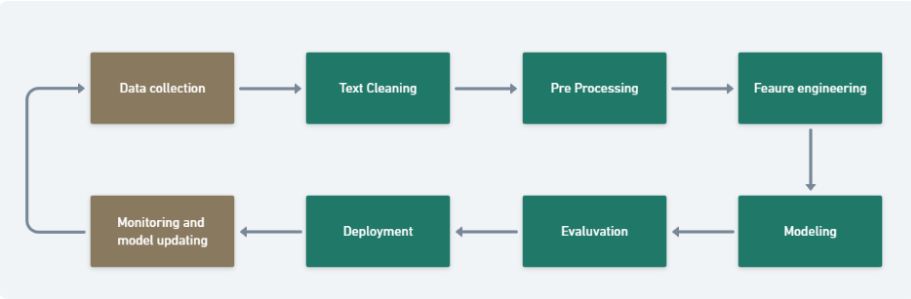
NLP pipeline
What is an NLP Pipeline?
An NLP pipeline is a sequence of processes that transforms raw human language into structured information that machine learning models can understand and process.
For example:
"I absolutely loved this movie!"A machine cannot directly understand this sentence. So we pass it through multiple stages like:
- Cleaning
- Tokenization
- Feature extraction
- Vectorization
- Model training
Finally, the machine predicts:
Sentiment = PositiveWhy Do We Need an NLP Pipeline?
Human language is extremely messy and unstructured.
Text data may contain:
- Uppercase and lowercase inconsistencies
- Emojis
- Punctuation
- Spelling mistakes
- Stopwords
- Slang
- Extra spaces
An NLP pipeline helps standardize and structure this data so that machine learning algorithms can work effectively.
Steps in an NLP Pipeline
A complete NLP pipeline generally contains the following stages:
- Data Collection
- Text Preprocessing
- Feature Engineering / Vectorization
- Model Training
- Evaluation
- Deployment
Let us understand each step in detail.
1. Data Collection
The first step is collecting text data.
Text data can come from many sources such as:
- Social media posts
- Reviews
- Emails
- News articles
- PDFs
- Chat messages
- Surveys
- Web scraping
Example dataset:
ReviewSentimentThis movie was amazingPositiveWaste of timeNegative
You can also use datasets from platforms like:
2. Text Preprocessing
Raw text contains noise, so preprocessing is one of the most important stages in NLP.
The goal is to clean and normalize the text.
Lowercasing
Words like:
- NLP
- nlp
- Nlp
should ideally be treated the same.
Example:
text = text.lower()Removing Punctuation
Punctuation usually does not contribute much to text analysis.
Example:
import retext = re.sub(r'[^\w\s]', '', text)Tokenization
Tokenization means splitting text into smaller units called tokens.
Example:
from nltk.tokenize import word_tokenizetext = "I love NLP"
tokens = word_tokenize(text)print(tokens)Output:
['I', 'love', 'NLP']Stopword Removal
Stopwords are commonly used words that often do not carry important meaning.
Examples:
- the
- is
- and
- of
Example:
from nltk.corpus import stopwordsStemming
Stemming converts words to their root form.
Examples:
- playing → play
- studying → studi
Example:
from nltk.stem import PorterStemmerstemmer = PorterStemmer()Lemmatization
Lemmatization is a more advanced normalization technique.
Examples:
- running → run
- better → good
Example:
from nltk.stem import WordNetLemmatizer3. Feature Engineering / Text Vectorization
Machines cannot understand text directly.
So we convert text into numerical vectors.
This process is called vectorization.
Bag of Words (BoW)
Bag of Words represents text using word frequencies.
Example:
Sentence:
awesome movieVocabulary:
awesome, bad, movieVector:
[1, 0, 1]Example using Python:
from sklearn.feature_extraction.text import CountVectorizercorpus = ["awesome movie", "bad movie"]vectorizer = CountVectorizer()
X = vectorizer.fit_transform(corpus)print(vectorizer.get_feature_names_out())
print(X.toarray())TF-IDF
TF-IDF stands for Term Frequency–Inverse Document Frequency.
It gives more importance to meaningful and rare words while reducing the importance of very common words.
Example:
from sklearn.feature_extraction.text import TfidfVectorizerTF-IDF usually performs better than simple Bag of Words for many NLP tasks.
Word Embeddings
Traditional vectorization methods do not capture semantic meaning.
Word embeddings solve this problem by representing words in dense vector form.
Popular embedding techniques:
- Word2Vec
- GloVe
- FastText
Words with similar meanings get similar vector representations.
Transformer Embeddings
Modern NLP systems use transformer-based embeddings such as:
- BERT
- GPT
- RoBERTa
These models understand context much better than traditional methods.
For example, the word “bank” in:
- river bank
- bank account
will have different meanings based on context.
This is one of the biggest breakthroughs in modern NLP.
4. Model Training
Once the text is converted into vectors, we train machine learning models.
Traditional Machine Learning Models
Common ML models used in NLP:
- Logistic Regression
- Naive Bayes
- Support Vector Machine (SVM)
- Random Forest
Example:
from sklearn.linear_model import LogisticRegressionDeep Learning Models
Advanced NLP tasks often use:
- RNN
- LSTM
- GRU
These models work well for sequential text data.
Transformer Models
Today, transformer architectures dominate NLP.
Popular transformer models:
- BERT
- GPT
- T5
Example using Hugging Face:
from transformers import pipelineclassifier = pipeline("sentiment-analysis")result = classifier("I love NLP")print(result)Output:
[{'label': 'POSITIVE', 'score': 0.999}]5. Model Evaluation
After training, we evaluate the model performance.
Common evaluation metrics:
- Accuracy
- Precision
- Recall
- F1-score
Example:
from sklearn.metrics import classification_reportEvaluation helps us understand how well the model performs on unseen data.
6. Deployment
Once the model performs well, we deploy it so users can interact with it.
Popular deployment tools:
Example applications:
- Chatbots
- Spam filters
- Sentiment analysis apps
- Resume screening systems
Complete NLP Pipeline Flow
A simplified NLP workflow looks like this:
Raw Text
   ↓
Text Cleaning
   ↓
Tokenization
   ↓
Stopword Removal
   ↓
Stemming/Lemmatization
   ↓
Vectorization
   ↓
Model Training
   ↓
Prediction
   ↓
Deployment
Real-World Applications of NLP
NLP is used in many real-world systems such as:
- Chatbots
- Machine Translation
- Voice Assistants
- Spam Detection
- Sentiment Analysis
- Search Engines
- Recommendation Systems
- Text Summarization
Companies like Google, OpenAI, and Microsoft use NLP extensively in their products.
Modern NLP in 2026
Modern NLP pipelines are becoming simpler because transformer models handle many tasks automatically, including:
- Tokenization
- Context understanding
- Embedding generation
- Feature extraction
This reduces the need for heavy manual preprocessing.
Today, frameworks like:
are widely used in production NLP systems.
Conclusion
An NLP pipeline is the backbone of every Natural Language Processing application.
It transforms raw text into structured numerical information that machine learning models can understand.
The major stages include:
- Data Collection
- Text Preprocessing
- Feature Engineering
- Model Training
- Evaluation
- Deployment
As NLP continues to evolve, transformer-based architectures are making pipelines more powerful, efficient, and intelligent.
If you are starting your NLP journey, understanding the NLP pipeline is one of the most important concepts you can learn.
Start with simple preprocessing and vectorization techniques, then gradually move toward advanced transformer models like BERT and GPT.
The future of NLP is incredibly exciting, and this is just the beginning.
메타데이터
- post_id
- 7e91a70819ca
- slug
- how-to-build-an-nlp-pipeline-a-complete-beginner-friendly-guide-7e91a70819ca
- url
- https://medium.com/@kr.shikha0023/how-to-build-an-nlp-pipeline-a-complete-beginner-friendly-guide-7e91a70819ca
- canonical_url
- https://medium.com/@kr.shikha0023/how-to-build-an-nlp-pipeline-a-complete-beginner-friendly-guide-7e91a70819ca
- author_url
- https://medium.com/@kr.shikha0023
- status
- ok
- fetched_at
- 2026-06-09 15:37:30