Russia’s Refineries Burn, Ukraine’s Cities Still Bleed
A war of mirror-image vulnerabilities: Kyiv chokes a third of Russia’s fuel supply and cuts off Crimea, while Moscow’s ballistic missiles…
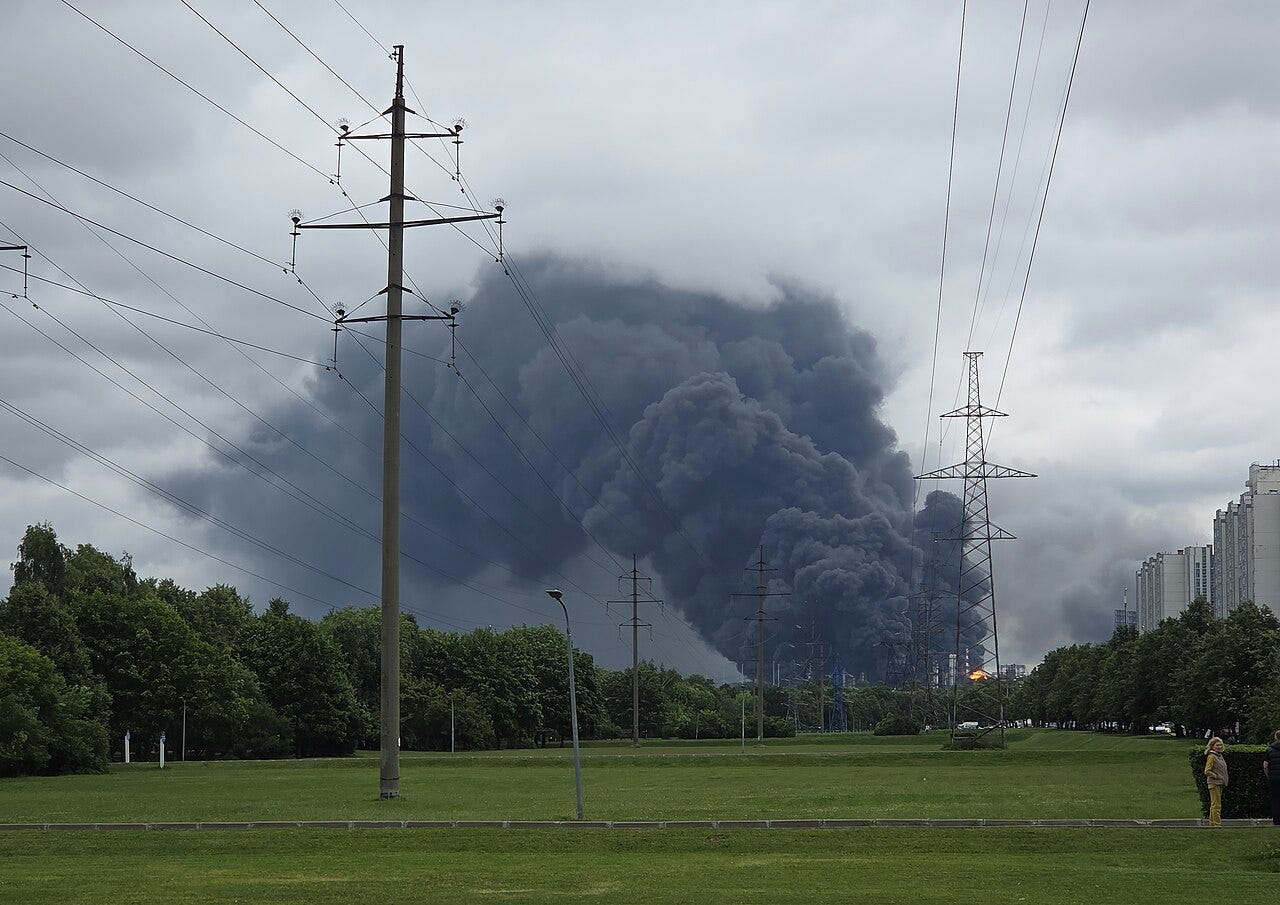
Fire at the Moscow Oil Refinery on June 18, 2026
Russia’s Refineries Burn, Ukraine’s Cities Still Bleed
A war of mirror-image vulnerabilities: Kyiv chokes a third of Russia’s fuel supply and cuts off Crimea, while Moscow’s ballistic missiles keep finding gaps in a Patriot stockpile running dangerously low
Paris turned itself into a stage this week, and the message it wanted the world — especially Moscow — to receive was one of unity and resolve.
On July 14, France’s national holiday, twenty-five heads of state and government gathered along the Champs-Élysées for what was billed as the largest military parade in the history of the French national day: roughly 6,800 soldiers, alongside 30 percent more aircraft and vehicles than usual.
President Emmanuel Macron framed the spectacle as a demonstration of Europe’s “strategic awakening,” insisting that patriotism, not nationalism, was what bound the continent’s militaries together now. Ukrainian President Volodymyr Zelensky sat in the place of honor, and French fighter jets flown partly by Ukrainian co-pilots traced blue-white-red smoke trails overhead.
Five hundred soldiers from the so-called Coalition of the Willing — including a contingent of German troops from an artillery battalion attached to the Franco-German Brigade — marched at the head of the procession, a scene that would have been unthinkable to earlier generations but now passes almost without comment.
Behind the choreography, though, lay a harder question: does pageantry actually move Vladimir Putin, or does the coalition mostly need to reassure itself? The gathering was, after all, also Macron’s last Bastille Day parade before he leaves office, and the timing mattered as much as the content. Chancellor Friedrich Merz attended with his wife, greeting Zelensky warmly, and used the occasion to press Putin to return to the negotiating table, arguing that Ukraine was ready to end the war and that only Moscow was standing in the way.
But the coalition’s founding purpose — coordinating a multinational force to guarantee any eventual ceasefire — remains stuck in the planning stage. Detailed blueprints for deploying European troops inside Ukraine exist, and a headquarters for a prospective peacekeeping force has even been set up outside Paris, at Suresnes, with Macron insisting it stay there rather than move to London as once discussed. Yet none of this has been activated, because there is no ceasefire to guarantee, and Putin has shown no interest in negotiating one.
Macron surprised many observers by announcing, after two days of coalition talks at the Invalides, that joint military exercises involving the more than thirty-five countries in the grouping would begin in the coming months in states neighboring Ukraine, intended to demonstrate readiness “on land, in the air and at sea.” He left unspecified exactly which countries would take part, when the drills would occur, or which nations would ultimately contribute troops to the still-notional multinational force.
Polish Prime Minister Donald Tusk later added detail, announcing that the first exercises would take place in Poland this autumn, with France and Britain among the international participants and Polish forces serving as hosts. Merz, notably, said nothing publicly about German participation in the maneuvers, reiterating only that decisions about the nature and scale of any German contribution rest with the German government and parliament — a position he had already staked out back in December.
The more concrete outcome of the summit was the creation of a new missile-defense coalition. Germany, France, and seven other countries — Denmark, Italy, the Netherlands, Norway, Spain, Sweden, and Britain — joined Ukraine in what officials described as a purely defensive alliance aimed at pooling defense industries, research, and operational experience to build out missile-defense architecture.
Poland notably did not join at the outset. Macron cast the move as a direct response to the ballistic threat Ukraine faces, saying the new coalition would strengthen the capabilities Europe needs. For Zelensky, this framework is the vehicle through which he hopes to accelerate a Ukrainian-led air-defense project called Freya (sometimes rendered Freyja), which he has pitched to Western leaders as a homegrown alternative to the American Patriot system — cheaper to produce, easier to manufacture at scale, and, crucially, less dependent on a strained American supply chain.
Zelensky has said the project blends Soviet-era and Western technology and could, in his most hopeful public statements, be fielded within twelve months with European industrial help. Officials in the Élysée have been notably more cautious, stressing that timelines vary across participating countries and that no one should expect a quick fix.
The urgency behind Freya is not abstract. Russia’s ballistic missile attacks on Kyiv have become almost routine, arriving roughly every two weeks in large-scale barrages that overwhelm what remains of Ukraine’s Patriot interceptor stockpile. In early July, a single night of strikes on Kyiv killed at least 13 people and injured around 90 more; within days, a similarly ferocious attack killed roughly 27 more, with Mayor Vitali Klitschko calling it among the worst nights of the war for the capital and declaring a day of mourning.
Ukrainian officials have acknowledged that, because Patriot interceptors are running low, air-defense units are increasingly firing one interceptor per incoming missile rather than the doctrinal two, forcing operators to make rapid, life-or-death judgments about which threats to engage and which supplies to conserve. Zelensky has pressed allies repeatedly for faster deliveries, warning that every delay in getting interceptors to the front costs lives and emboldens Moscow to keep fighting.
Washington has offered a partial, longer-term answer: at the NATO summit in Ankara, President Trump floated the idea of licensing Ukraine to manufacture Patriot ammunition domestically, a proposal Zelensky welcomed but which will do nothing to solve the immediate shortage, since building the necessary production capacity would take considerable time — and any such facility would likely become a Russian target in its own right.
The imbalance between the two sides’ missile campaigns is stark. Russia’s ballistic missiles regularly penetrate Ukrainian air defenses and strike apartment blocks, while Ukraine, lacking comparable ballistic or long-range missile forces of its own, has instead built an increasingly sophisticated drone campaign that reaches deep into Russian territory.
Newer Ukrainian drones — models such as the FP-1, the Bober, and the Lyutyi — combine domestic engineering with Western components and can travel well over a thousand kilometers, some now flying autonomously in their terminal approach so that Russian electronic jamming, which typically works by severing the link between a drone and its operator, no longer has any effect once the aircraft is in its final approach phase.
Ukrainian officials say mid- and long-range strikes nearly doubled in June alone, having already quadrupled between February and May. Executives at Ukrainian drone manufacturers describe the current moment as a rare alignment of financing, manufacturing capacity, and trained pilots that has given Kyiv a real edge in the contest, though they caution that the advantage may only hold until autumn, since Russia is expected to respond by scaling up interceptor units of its own.
The primary target of that campaign has become Russia’s oil-refining sector, and the results are visible across the country. Ukrainian strikes have hit at least 119 Russian refining facilities over the past year, including eleven of the country’s twelve largest plants, according to tallies compiled by German and other European outlets.
Strikes have reached extraordinary distances from the front: a refinery in Omsk, roughly 2,500 kilometers from Ukrainian-controlled territory and Russia’s single largest refining complex, was hit in early July, and Ukrainian drones have since reached even further into Russia’s interior, striking petrochemical facilities in Bashkortostan near the Ural Mountains, well over a thousand kilometers from the border.
Russian officials in the affected regions have generally confirmed fires and damage while downplaying casualties, though attacks on refineries in Samara and elsewhere have caused deaths among civilians living or working nearby.
The cumulative effect has been the worst fuel crisis Russia has experienced since the war began, and arguably in decades. Refining throughput fell in June to its lowest level in years, even though the country’s refineries retain a nominal processing capacity nearly twice that. Estimates of the damage vary by source, but Russian economists have put the country’s lost refining capacity at around a third of total national output — the lowest level of utilization in over two decades. More than fifty, and by some counts over seventy, of Russia’s roughly eighty-plus regions have reported fuel shortages or rationing.
Long queues have become a fixture at filling stations from Kaliningrad to Siberia, with reports of waits stretching to a day and a half in some remote areas; drivers in rural regions are reportedly turning to horses and bicycles as substitutes, with bicycle sales on at least one major Russian online marketplace rising by more than 130 percent between May and June. Farmers in the middle of harvest season in southern regions such as Rostov, Krasnodar, and Stavropol have had to camp overnight at gas stations to fuel their combine harvesters, and officials in Rostov have warned of crop losses running as high as 15 percent. Fuel and lubricant prices have risen by roughly half since the start of the year.
Putin himself has acknowledged the shortages while insisting they are not a serious threat, telling a cabinet meeting in late June that lines at filling stations and shortages of particular grades of gasoline were a real inconvenience but not a critical one, and promising that damaged facilities would be repaired relatively quickly. Independent energy analysts are skeptical, particularly given reports that some refineries, including the large Gazprom facility on Moscow’s southeastern outskirts, may take at least six months to return to operation.
In response, Russia has for the first time in decades begun importing refined fuel by sea, including several hundred thousand tons of gasoline monthly, some of it reportedly from India, alongside supplies from Belarus and Kazakhstan; it has also banned gasoline, kerosene, and diesel exports and temporarily relaxed fuel-quality standards to stretch domestic supply further.
The fiscal toll is significant too: oil and gas revenues, which make up roughly a quarter of the Russian state budget, fell by nearly 24 percent in 2025 and by 38 percent in the first four months of 2026, contributing to a budget deficit equivalent to 2.5 percent of GDP in the first half of the year. Public trust in Putin has also slipped, with one Russian polling organization recording his approval rating falling from 74 to 69 percent in a single week in late June — the lowest level measured since the start of the full-scale invasion — even as support for continuing the war has, somewhat paradoxically, ticked upward in other surveys.
Nowhere are the consequences more visible than in occupied Crimea, which Ukraine has been methodically cutting off from the Russian mainland by land, sea, and air. Ukrainian drones have destroyed or damaged key bridges linking the peninsula to Russia, including crossings at Chonhar and Henichesk, while repeatedly striking the roughly 390-mile highway connecting Russia’s Rostov region to Crimea, a route now nicknamed the “Highway of Death” by some observers because of how relentlessly Ukraine targets traffic along it.
Strikes have also hit onshore oil-loading facilities at Kerch and knocked out electrical substations and a thermal power plant serving the peninsula. The result has been rolling blackouts — residents in Sevastopol report electricity for as little as six hours a day — alongside water shortages so severe that supply is available only an hour or so daily in some areas.
Private fuel sales have been suspended entirely in places, tourist bookings have collapsed by close to 80 percent this season, and a black market has sprung up on Telegram and e-commerce platforms, with sellers offering illicit fuel deliveries at prices reported as high as $25 a gallon. Ukraine’s defense minister, Mykhailo Fedorov, has predicted the peninsula will effectively become an island cut off from resupply.
In the past two weeks, Ukraine has opened an entirely new front in this campaign at sea, striking well over a hundred vessels in the Sea of Azov — tankers and ferries used to move Russian oil products and grain while circumventing sanctions. Ukraine’s drone forces commander, Major Robert Brovdi, has reported nights in which ten vessels were hit at once and has said traffic through the Kerch Strait has effectively stopped, with cargo unloading reduced to a trickle.
Russia has responded by suspending shipping through the Don–Azov canal, a route that also connects, via the Caspian, to Central Asian markets, effectively shutting a major export corridor. Analysts at the Institute for the Study of War describe the maritime campaign as a new and consequential phase in Ukraine’s broader strategy of severing Crimea’s supply lines and disrupting Russian seaborne logistics more generally, while a former Ukrainian defense minister has argued that Moscow has lost control of a critical maritime corridor whose closure also affects grain shipments moved through the ports of Berdyansk and Mariupol. Even Russia’s own military bloggers have begun openly criticizing the Kremlin’s air-defense posture and decision-making, blaming what they call carelessness by officials for the scale of the damage, and noting that Russia lacks a unified system for protecting its tankers from drone attack.
None of this is to say Ukraine’s own capital and cities are spared; the war remains devastating and painfully lopsided on the ground. Russia continues to strike Ukrainian cities from the air roughly every fortnight with hundreds of drones and dozens of missiles at a time, killing dozens of civilians in a single night on several occasions this summer.
Moscow, for its part, has also faced a rising tempo of Ukrainian drone attacks reaching the capital region and beyond, with the mayor of Moscow reporting waves of several hundred drones intercepted at a time and airports repeatedly forced to suspend operations for hours. Small towns outside Moscow have suffered fatal drone debris strikes, something that had happened only rarely before this year.
Russian propaganda continues to frame Ukrainian strikes as terrorism rather than a response to Russia’s own invasion, opening “terrorism” investigations into such incidents even as Moscow’s own missile strikes on Kyiv are described domestically as retaliation for supposed Ukrainian attacks on civilian infrastructure.
Politically, both sides show signs of strain. In Kyiv, Zelensky has announced yet another government reshuffle, accepting the resignation of Prime Minister Yulia Svyrydenko roughly a year after she took office, and declaring that Ukraine is shifting its political strategy so that specific senior officials take direct responsibility for priority areas such as the security relationship with the United States — including the effort to license domestic Patriot missile production — and Ukraine’s EU accession process.
Svyrydenko, a loyal and low-profile figure who had represented Zelensky at international gatherings when he could not attend, may be moved into a diplomatic role, possibly as ambassador to Washington, according to speculation following the announcement. Critics note that such reshuffles have become a recurring pattern in Kyiv, with real power concentrated in the presidential administration regardless of who occupies the premiership, and that earlier cabinet changes — including the appointment of the popular Mykhailo Fedorov as defense minister and the elevation of former military intelligence chief Kyrylo Budanov to chief of staff — did little to alter the substance of governance.
There is also growing speculation that Zelensky is quietly preparing for the possibility of elections once the legal barriers imposed by wartime martial law are lifted, a change the United States has been pushing for. His most credible potential rival, former armed forces commander Valery Zaluzhny, now ambassador to London, reportedly declined an offer of a senior government post in exchange for not challenging Zelensky at the ballot box; polling suggests Zelensky would defeat another potential contender, Budanov, in a runoff, but would narrowly lose to Zaluzhny.
Within the Western coalition, cracks are becoming harder to paper over. The number of EU states actually providing military aid to Ukraine has fallen sharply, from twenty-one in 2023 to just fourteen this year, according to an internal European External Action Service document. Several large partners, including France, have yet to firm up commitments for 2027. Germany’s attempts to secure emergency interceptor supplies from Spain and Greece — both of which hold substantial Patriot stockpiles — were rebuffed. Bulgaria’s new prime minister, Rumen Radev, publicly declined to join the Coalition of the Willing altogether, arguing that continued military support only prolongs the conflict and that a genuine diplomatic push, not further escalation, is the way out.
Poland remains internally divided: President Petr Pavel-style pro-Ukraine sentiment in the Czech Republic, for instance, contrasts with Prime Minister Andrej Babiš’s reluctance on arms exports, while in Poland itself a historical dispute has poisoned relations after Zelensky named a military unit after a nationalist formation responsible for wartime massacres of Poles, fueling a domestic political narrative on the Polish right that portrays Ukrainian refugees as ungrateful and burdensome. That sentiment has coincided with a rise in reported attacks on Ukrainians living in Poland, prompting Poland’s interior minister to accuse the political right of stoking hostility and to promise zero tolerance for such incidents.
Trust in Western institutions is also fraying in less predictable places. A survey conducted in Turkey shortly before the NATO summit in Ankara found that just 43 percent of Turks believe the alliance would come to their country’s defense if attacked, with confidence lowest around the scenario of a conflict with Israel — only 40 percent expect NATO backing in that case — rather than a hypothetical clash with Russia or Iran, for which the public generally assumes support would be forthcoming.
Skepticism is markedly higher among opposition-leaning voters than among supporters of the governing AKP, though a majority in both camps still view NATO membership as a net security benefit, and most Turks across the political spectrum regarded hosting the summit as a diplomatic win for their country’s standing, a reading foreign observers tended to frame instead as a personal prestige boost for President Erdoğan.
Meanwhile, the strategic picture is complicated further by deepening cooperation between Moscow and Beijing that goes well beyond what either government has acknowledged publicly. Leaked documents shared with a consortium of European and Russian investigative outlets show that Russian and Chinese officials have met secretly since 2023 to plan countermeasures against Elon Musk’s Starlink network, which has become indispensable to Ukrainian reconnaissance, artillery coordination, and drone guidance.
The plans reportedly range from pushing international regulations to limit the constellation’s expansion, to building joint jamming capabilities, to a more extreme option of disabling the network through cyberattacks or anti-satellite weapons — an escalation that would amount to a direct confrontation with the Western militaries that also depend on Starlink. The same documents reveal that Russia agreed in 2023 to share hypersonic missile-defense technology with China, a notable reversal of decades of Russian caution about transferring military know-how to a country that has historically copied Russian designs after acquiring them; the two countries are now described as effectively equal partners in some respects, with China increasingly ahead in certain areas even as it continues to publicly deny providing material support for Russia’s invasion.
Taken together, the picture emerging from the war’s fifth summer is one of accelerating asymmetries rather than convergence toward peace. Ukraine has found, in long-range drone strikes on refineries and shipping, a way to inflict real economic and psychological costs on Russia even without matching its adversary’s missile arsenal, and is now racing to translate that success into a workable home-grown air-defense system before Russian ballistic strikes on its own cities inflict irreversible damage.
Russia on its side, is absorbing genuine strain — fuel shortages, falling approval ratings, an isolated Crimea — without showing any sign that this pressure is translating into a willingness to negotiate; if anything, Kremlin officials have doubled down on threats of further escalation, including hints of tactical nuclear use, even as they quietly seek Chinese help to blunt Ukraine’s Starlink-enabled targeting advantage. And the Western coalition assembled to support Kyiv, however impressive its parades and rhetoric, is contending with fatigue among its own publics and governments, uneven commitments from country to country, and leadership transitions — in Paris, in London, potentially in Kyiv itself — that leave its long-term staying power very much in question.
Sources and Further Readings
https://www.wsj.com/world/how-ukraine-is-taking-out-russias-refineries-5e6ec9ff
메타데이터
- post_id
- 7e9510357741
- slug
- russias-refineries-burn-ukraine-s-cities-still-bleed-7e9510357741
- url
- https://medium.com/the-geopolitics-report/russias-refineries-burn-ukraine-s-cities-still-bleed-7e9510357741
- canonical_url
- https://medium.com/the-geopolitics-report/russias-refineries-burn-ukraine-s-cities-still-bleed-7e9510357741
- author_url
- https://medium.com/@jens_sorensen_geopol.
- status
- ok
- fetched_at
- 2026-07-17 01:27:42