The 20 best ad libraries for finding ad examples worth recreating
Free platform libraries, paid spy tools, swipe files, AI generators — ranked by what you do with the ad after you find it, not by database…
The 20 best ad libraries for finding ad examples worth recreating
Free platform libraries, paid spy tools, swipe files, AI generators — ranked by what you do with the ad after you find it, not by database size.
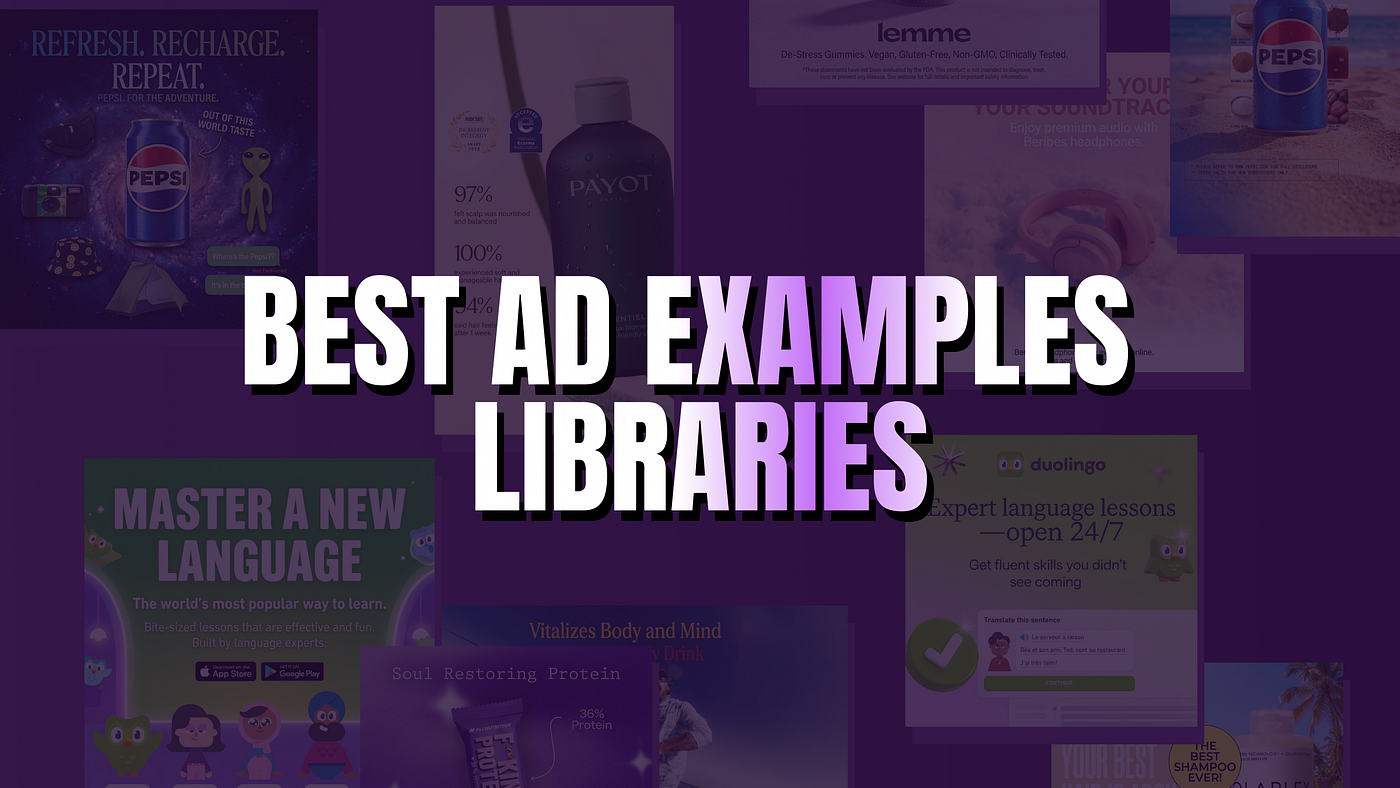
Twenty libraries by category, with the honest “worst for” on every one.
Editor’s note: US/global tooling, verified against publisher pricing pages in May 2026. Where review-platform ratings diverge or sample sizes are thin, the gap is disclosed rather than rounded to the friendlier number. Pricing moves — check the linked source before you buy. Written by the team behind AdDogs, which is one of the twenty tools reviewed; the disclosure at the bottom says how to read that.
TL;DR
Finding the ad to model is the easy half. Shipping your version before the audience fatigues is the half most libraries skip.
- Creative drives 49% of incremental sales lift in digital campaigns — more than brand, more than targeting.
- Conversion likelihood drops about 45% after four repeat exposures, so the clock starts the moment you find a winner.
- Five categories of library exist; the right pick depends on the job, not the database size.
- The cost of a finished ad varies more than 1,000× across the paths operators consider.
What follows is the full survey — by category, with the honest “worst for” on every tool.
What an ad library actually is
An ad library is a searchable collection of advertisements run by real brands on real platforms. The useful ones fall into five categories:
- Free official platform libraries — Meta, TikTok Creative Center, Google Ads Transparency Center, LinkedIn, Pinterest
- Paid ad spy tools — AdSpy, BigSpy, Foreplay, Minea, PiPiADS, PowerAdSpy, AdHeart
- Curated swipe files — Ads of the World, Marketing Examples, Cannes Lions Archive
- AI generators that double as libraries — Atria, AdCreative.ai, Creatify.ai, AdStellar
- Browse-and-build tools — a small, newer category
The mistake most buyers make is shopping on database size. Per Logical Position’s summary of AppsFlyer data, 70–80% of Meta ad performance now traces to creative — so picking the wrong kind of library wastes more than time. The right question isn’t “which has the most ads,” it’s “what will I do with one once I find it.”
Match the library to the job
You need the finished ad, not the brief. You found one ad you want to model and you need your version today. The honest options: Canva plus a Foreplay board if you have a design eye and the time to assemble it; AdCreative.ai if you want AI to generate from a written brief rather than rebuild a specific ad; a Fiverr designer if you need human judgment and can wait a few days. A browse-and-build tool wins only in the narrow case where you found one specific ad and want your product dropped into that layout.
Research and competitive intelligence. You want every ad a competitor has run and how the messaging shifted over time. AdSpy or Foreplay. The native Meta Ad Library shows what’s live now; AdSpy adds 200M+ historical ads with affiliate-grade demographic filters; Foreplay layers a saved-swipe-file workflow on top.
Inspiration and swipe files. One place to save ads, organize by board, share with a team. Foreplay or Marketing Examples. Foreplay’s Chrome extension grabs anything from Meta, TikTok, LinkedIn, or YouTube into shared boards. Marketing Examples is free and curated — narrower, but every entry comes annotated.
TikTok-first. TikTok Creative Center (free) for what the algorithm is rewarding right now; add PiPiADS if you scale and need historical depth.
Dropshipping and e-commerce. Minea or PiPiADS — both index the dropshipping surface aggressively to surface winning products before they saturate.
Agencies and creative teams. Foreplay Workflow ($175/mo, 5 users), built around board-sharing, briefing, and tagged libraries.
The full comparison
Last verified: May 2026.

Twenty libraries by published pricing, library size, coverage, and free tier — verified against publisher sources, May 2026.
Each tool was catalogued by published pricing, library size, platform coverage, filtering, and the workflow it expects after you find an ad. Where G2 and Capterra ratings diverge or sample sizes are thin, the gap is disclosed rather than smoothed over.
Free official platform libraries
Official libraries are table stakes. Anyone who pays for a spy tool without first knowing what’s free is paying twice.
Meta Ad Library — the universal baseline. Free, public, every ad currently running on Facebook, Instagram, Messenger, and Audience Network, searchable by advertiser, keyword, country, ad type, or date. Worst for: performance research. Per Swipekit’s documented limitations, you can’t filter by how long an ad has run, can’t see CTR or spend outside political ads, and link rot kicks in after a few weeks. As GetHookd put it: “you can’t see click-through rate, conversions, or spend, so there’s no way to know if an ad is effective or just running on autopilot.”
TikTok Creative Center — algorithm signal, free. TikTok’s own ranked top performers by industry, objective, region, and timeframe. The only place outside paid tools where TikTok’s algorithm tells you which ads it’s rewarding. Worst for: historical research — it surfaces what’s hot now, not what ran six months ago. Worth disambiguating: TikTok also runs the Commercial Content Library for DSA compliance — researcher-only, EEA/UK/Switzerland, formal approval required. Say “Creative Center,” not “the TikTok Ad Library,” or you’ll send people to the wrong place.
Google Ads Transparency Center — Search, YouTube, and Display, searchable by advertiser, country, and format, with payer-name attribution added in 2025. Worst for: category browsing. No industry filter, no “show me all DTC supplement ads” — you need the advertiser name to start.
LinkedIn Ad Library — B2B research, free, no account to browse. Per Searchlab’s 2026 analysis, LinkedIn converts about 6× better than other platforms for B2B, so the source material matters. Worst for: operational research — Kaya’s comparison flags “no keyword search, no central ad library.” You visit each company page individually.
Pinterest Ads Repository — EU-only, active-only, launched April 2025 for DSA compliance. The targeting data it exposes (age, gender, interests, keywords) is richer than Meta’s for what it shows, per Swipekit. Worst for: US-market or historical research — no archive once an ad pauses.
One footnote on the broken ones. X’s “Ads Repository” is functionally useless for commercial research — the European Commission fined X €120 million in December 2025 under the DSA, citing that it “lacks critical information such as the content and topic of the advertisement, as well as the legal entity paying for it.” Snapchat’s Political Ads Library is political-only; no commercial library exists. Skip both.
Paid ad spy tools
This is where the filter limits of free libraries get fixed — historical data, keyword search, run-duration filters, advertiser deep-dives. The trade is real money. Per the AdStellar 2026 agency cost guide, top DTC brands run 50–100 creatives a month while a standard $4,500/mo agency retainer ships about 15 — so the gap a spy tool helps close is structural.
AdSpy — $149/mo flat, 200M+ Meta ads with the deepest demographic and affiliate filtering in the category. Capterra 4.3 stars (n=6 — thin sample, disclosed); no G2 listing. Worst for: anyone not on Meta. Meta-only, single tier — casual users overpay massively.
BigSpy — from $9/mo for Facebook + Instagram; Pro at $99/mo opens 10 platforms. Claims 1B+ ads. G2 4.6 (n=638), Capterra 4.8 (n=2,484) — large, positive samples. Worst for: freshness. Data-lag complaints are common, and a Trustpilot 1.8-star average (n=24) diverges sharply from the big samples. Read recent reviews first.
Foreplay — from $59/mo ($49 annual); Workflow $175/mo for 5 users. Highest verified G2 rating in the swipe-file category at 4.8 (n=115), serving 30,000+ users including Lululemon and Paramount. Worst for: anyone who expected the workflow to end with a finished ad. As 1800DTC put it: “the platform helps you find inspiration but leaves the crucial step of actually making a new one entirely to external resources.” It teaches the workflow up to “save and organize.” Past that, you still need a designer.
Minea — from $49/mo for 10K credits, covering Meta, TikTok, Pinterest, Snapchat. Trustpilot 3.9 (n=248). Worst for: long sessions on the entry tier — DoDropshipping notes the starter credits “probably only last you a few days, if not hours.”
PiPiADS — from $77/mo, the deepest TikTok-specific historical database. G2 4.6 (n=476) — second-largest verified sample here. Worst for: trusting a single platform — Trustpilot is 2.1 (n=18), a major divergence. Meta coverage is shallow.
PowerAdSpy — from $69/mo, spanning up to 10 platforms (Meta, TikTok, YouTube, Google, LinkedIn, Quora, Pinterest, Reddit, Native, Bing). Trustpilot 4.0 (n=102). Worst for: deep history on one platform — breadth-first means shallower data per platform than AdSpy on Meta or PiPiADS on TikTok.
AdHeart — $53/mo flat for 900M+ Meta creatives, the largest Meta library here at the lowest price tier. Worst for: buyers who want review-platform validation — no G2 or Capterra listing. The product is real and operating; the review flywheel hasn’t caught up.
Curated swipe files
Three libraries where a curator with taste did the work. Worth bookmarking even if you pay for spy tools elsewhere.
Ads of the World — the longest-running free archive of award-winning campaigns: print, OOH, digital, video, guerrilla. Worst for: performance research. Award-winning ≠ converting — the selection bias is craft, not ROI.
Marketing Examples — Harry Dry’s curated collection, free, annotated with what worked and why. Worst for: volume. Small and single-editor — the source of both its quality and its limit.
Cannes Lions Archive — every Cannes-awarded campaign, free browse. Worst for: weekly testing volume. Cannes ads are often built for awards, not direct response.
AI generators that double as libraries
Fast-moving category. Each ships a library and a creation surface — but most split the workflow into “browse” and “generate from a prompt,” two separate actions.
Atria — from $129/mo (annual), 25M+ AI-tagged ads with spend-tier filtering and AI-rated hooks. G2 4.8 on a thin n=14 (disclosed). Worst for: solo founders — steep entry without Meta-spend volume to justify it.
AdCreative.ai — from $39/mo, public ad-library browse paired with AI generation from briefs. G2 4.3 (n=793). Worst for: billing transparency — Capterra 3.3 (n=167), a full point below G2, driven by billing and cancellation complaints. One Capterra reviewer: “they charged me $339 for one of their top tiers… absolutely terrible customer service.”
Creatify.ai — from $33/mo, 10M+ Meta Top Ads plus AI video generation. G2 4.8 on n=1,095+ — the largest verified positive sample here, and the most statistically reliable rating on this list. Worst for: static workflows. Output is video-first; static support is light.
AdStellar — from $49/mo, markets an “Ad Clone” feature and a workflow for spinning up 50 variations from a brief and pushing them into a campaign. Worst for: founders who found one specific ad and want to rebuild that one — it’s built for full-campaign variation, not single-ad recreation.
Where browse-and-build fits
There’s a fifth category most listicles miss because it’s new: tools where browsing the library and building your version are the same action, not two separate steps.
The case for it is narrow and specific. Most libraries stop at the same place — you find the ad, save it to a board, screenshot it, brief a designer, and three days later you have your version. By then the original has often already produced its winner and the audience has started to fatigue. A browse-and-build tool collapses that gap: point at one ad, swap one product, export the file. The honest limits are real, too — if you want AI-generated original creative from a blank brief, or a white-label deliverable that obscures the source, this category is the wrong pick. It rebuilds from a reference; if you wanted to start blank, you didn’t want this.
The curation signal that makes this category work is run-time. Ads that sit in the Meta Ad Library for years aren’t accidents — agencies don’t keep losing ads live. DataCamp’s “#1 Place to Study Python, R and SQL” static was 2,251 days running as of May 2026; Pampers’ “Pick Your Prints” bundle, 2,001 days; Liquid Death’s “Murder Your Thirst” long-copy static, 1,747 days. Six-year-old ads still spending money. That’s the bar worth modeling against — and the one signal native libraries refuse to expose as a filter.

Run-time is the receipt. Six-year-old ads still spending money are the ones worth modeling.
And to settle the question every brand owner asks first: recreating a competitor’s ad layout is legal — what you can’t copy is their logo, trademarks, and exact copy.
The number that reframes the whole list
Every library above is an input. The output is a finished ad — and the cost of that output varies more than 1,000× across the paths most operators consider. Per the Adobe content supply chain study (n=2,841 marketers), 96% of teams say content demand has at least doubled since 2022 and 71% expect 5× growth by 2027 — so the per-ad math compounds fast.

Cost per finished ad, log scale. The library you pick is cheap; the path from “found it” to “shipped it” is where the money is.
The spread, low to high:
- DIY in Canva (free tier): $0/ad, ~30 minutes of manual work each
- Fiverr freelancer (mid-to-top): $40–$150+/ad, 1–3 days
- In-house designer (labor only): ~$200/ad at 1.5 ads/day on a $70K–$100K loaded salary
- Agency static ad: $150–$500/ad, 3–5 days, per the Marketing LTB 2026 cost guide
- AI browse-and-build tooling: cents per ad, seconds to finished
The structural deficit is the real story. A standard $4,500/mo agency retainer ships about 15 ads; top DTC brands run 50–100 a month. The 35–85 ad gap each month is exactly the space AI tooling fills — and why the per-ad cost, not the database size, is the number that should drive the decision.
The bottom line
Pick a library by the job, not the brochure. Meta historical depth: AdSpy or AdHeart. TikTok algorithm signal: Creative Center plus PiPiADS. Team workflow: Foreplay. Dropshipper product discovery: Minea. Craft reference: Marketing Examples, Ads of the World. And if the bottleneck isn’t finding the ad but shipping your version before the audience fatigues — that’s the half of the problem the whole spy-tool category quietly leaves to a designer.
Every library on this list shows you what works. The interesting question — the one the cost math forces — is what you do in the seconds after you find it.
This piece is part of AdDogs’ research on the ad-creative tooling landscape. AdDogs is a browse-and-build tool — point it at a winning reference ad, swap your product in, export the file in seconds — which makes it one of the twenty tools reviewed above. We wrote the survey anyway because nobody else maps these libraries by the job-to-be-done instead of database size, and the “worst for” line on every tool (including ours) is the part most listicles skip. Disagree with a ranking? The comments are open.
메타데이터
- post_id
- 7ea868503598
- slug
- the-20-best-ad-libraries-for-finding-ad-examples-worth-recreating-7ea868503598
- url
- https://medium.com/@mark_addogs/the-20-best-ad-libraries-for-finding-ad-examples-worth-recreating-7ea868503598
- canonical_url
- https://medium.com/@mark_addogs/the-20-best-ad-libraries-for-finding-ad-examples-worth-recreating-7ea868503598
- author_url
- https://medium.com/@mark_addogs
- status
- ok
- fetched_at
- 2026-06-20 20:29:01