Cut the Cables. Watch the World Slow.
Cut the Cables. The World… Doesn’t Explode — It Just Quietly Slows Down
Cut the Cables. Watch the World Slow.
Cut the Cables. The World… Doesn’t Explode — It Just Quietly Slows Down
Let me start with a small, slightly embarrassing confession.
A while ago, my home Wi-Fi went down for about… 30minutes. Not a big deal, right?
Except suddenly:
- my messages stopped sending
- my meeting froze mid-sentence (I’m still not sure if that saved me or embarrassed me)
- Alexa (Siri) went completely silent — and I had to take manual control of all my smart home devices like it was 2005 again
- and I just sat there… staring at the screen like a confused NPC
Now zoom that feeling out — globally.
Because here’s the uncomfortable truth:
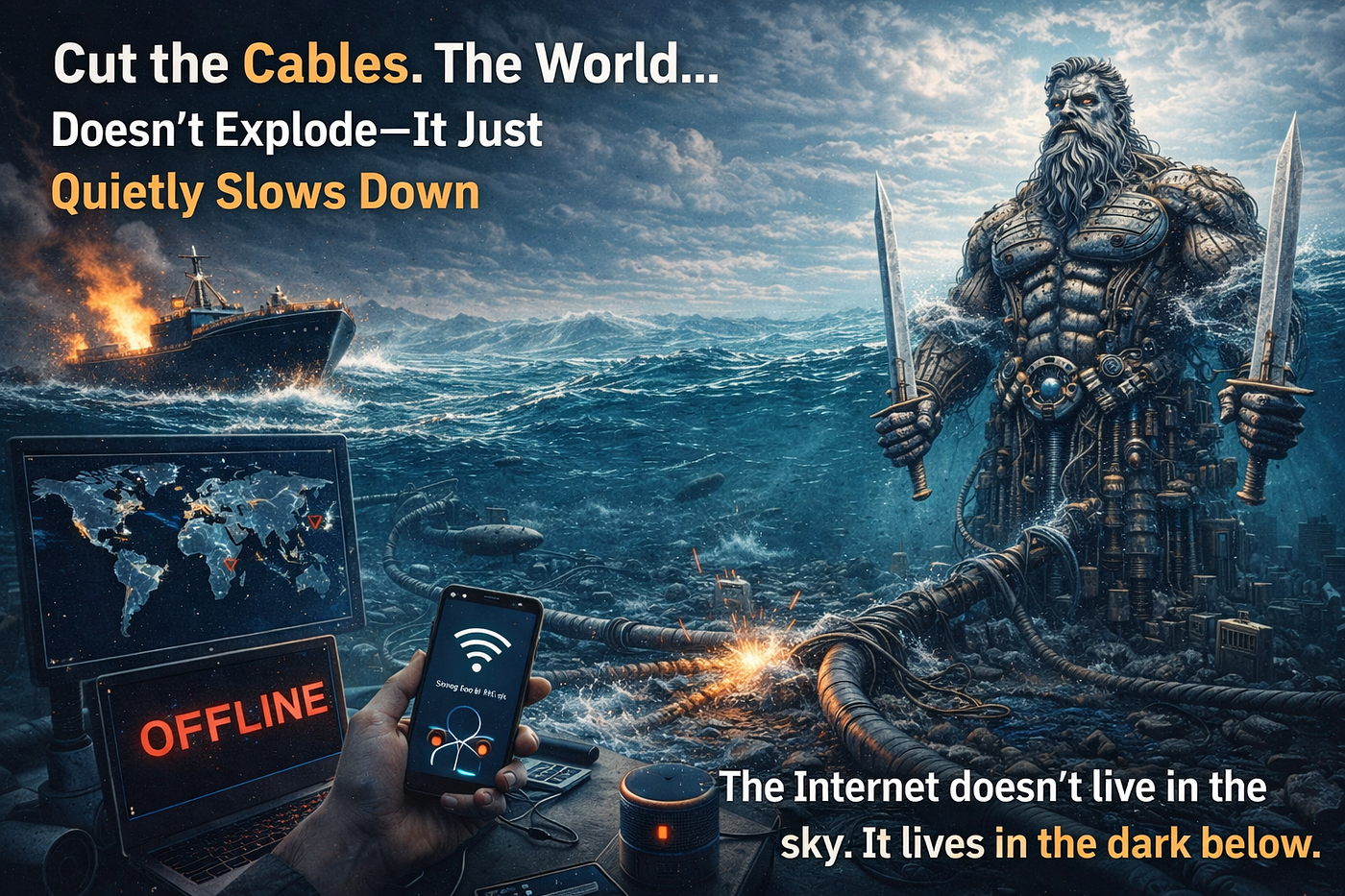
We’re Watching the Wrong Things
Today’s conversations are loud and exciting: → AI taking over workflows → cyberattacks getting smarter → geopolitics getting… spicier by the day
But all of that sits on top of something far less visible — and far more critical.
The Real Backbone Isn’t in the Sky
Before:
- markets react
- commands are issued
- logistics move
- systems execute
Data moves first. Always.
And despite what sci-fi (and maybe Elon’s satellites) might suggest…
That data is not flying above us. It’s running quietly beneath us.
Through subsea cables.
Stretching across the ocean floor like a hidden nervous system, these cables carry ~95% of global intercontinental data traffic. Not some of it. Not most of it.
Almost all of it.
Yes — your emails, financial transactions, cloud services, video calls, even that late-night scrolling… all depend on cables sitting deep under the sea.
The Misconception: Failure Must Be Loud
Most people imagine disruption like a movie scene: 💥 explosions 💻 hacking screens turning red 🚨 alarms going off
But that’s outdated thinking.
Modern systems don’t fail dramatically.
They fail… quietly.
The Real Risk: Degradation, Not Destruction
You don’t need to “break” the system to create chaos.
You just need to slow it down.
No explosion. No clear signal. No immediate blame.
Just:
- slightly delayed data
- minor packet loss
- increased latency
Sounds harmless?
Not quite.
Because modern systems depend on:
- synchronization
- speed
- continuous, real-time flow
When that continuity is degraded: → coordination slows → decisions get delayed → systems fall out of sync
And suddenly…
Things don’t stop.
They just start misaligning.
This Isn’t a Cyber Problem. It’s a Dependency Problem.
This isn’t about hacking into systems.
It’s about how much we depend on them functioning perfectly, all the time.
Think about the ecosystem:
- Builders design and lay the physical infrastructure
- Corporations control and route massive data flows
- States position themselves strategically around these networks
And here’s the twist:
Control ≠ Ownership
You don’t need to own the system to influence it.
Chokepoints: Where Everything Converges
The global network isn’t evenly spread out.
It compresses into key corridors — critical chokepoints where:
- geography
- data routes
- energy infrastructure
- and even military presence
…all overlap.
These aren’t just lines on a map.
They are system dependency points.
Which means:
When something goes wrong there, it doesn’t stay local.
The Scariest Part? You Might Not Even Notice
That’s what makes this a resilience issue, not a tactical one.
There’s no dramatic “system failure” moment.
Instead:
- your app loads a bit slower
- your transaction takes longer
- your system sync drifts by milliseconds… then seconds… then more
Individually? Harmless.
Collectively?
That’s how system-level risk builds.
So What Should We Actually Be Thinking About?
Not fear. Not paranoia.
But awareness.
Because resilience today isn’t just about:
- cybersecurity
- redundancy
- backups
It’s about understanding where your dependencies actually live.
And spoiler alert:
They’re probably not where you think they are.
Next time your internet slows down for a few seconds…
You might still blame your provider (fair enough 😄)
But just know — somewhere, far beneath the ocean surface, a cable is quietly doing one of the most important jobs in the modern world.
And everything we’ve built… depends on it.
메타데이터
- post_id
- 7eab3f92d6a7
- slug
- cut-the-cables-watch-the-world-slow-7eab3f92d6a7
- url
- https://medium.com/@wind.amiras/cut-the-cables-watch-the-world-slow-7eab3f92d6a7
- canonical_url
- https://medium.com/@wind.amiras/cut-the-cables-watch-the-world-slow-7eab3f92d6a7
- author_url
- https://medium.com/@wind.amiras
- status
- ok
- fetched_at
- 2026-07-26 10:11:49