A 5G Network Does Not Fail in One Place
A 5G network does not fail in one place.
A 5G Network Does Not Fail in One Place
A 5G network does not fail in one place.
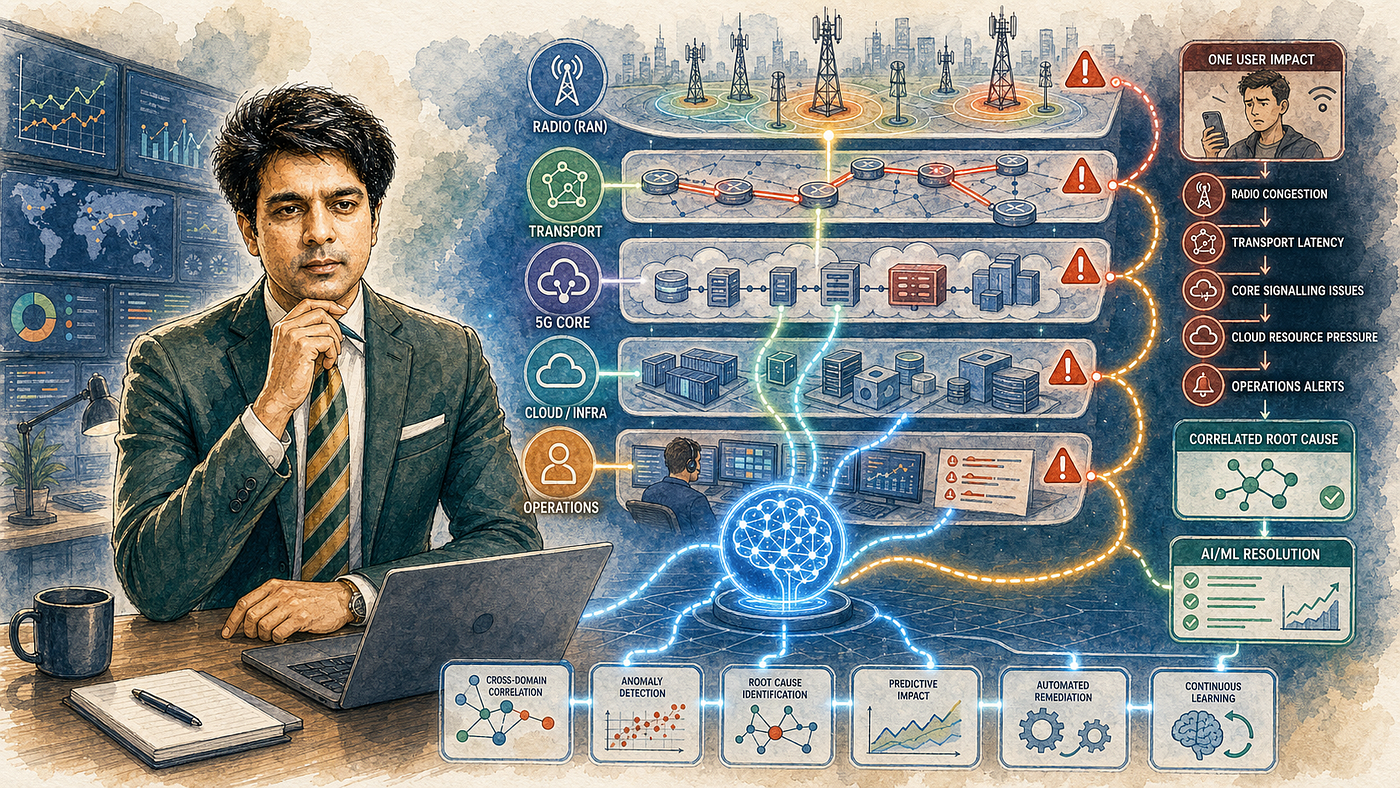
It fails across radio, transport, core, cloud, and operations at the same time.
That is what makes modern telecom so difficult.
In older networks, troubleshooting was still complex, but the operational boundaries were easier to understand. Radio teams looked at radio issues. Core teams looked at core issues. Transport teams looked at connectivity. Operations teams handled alarms and tickets.
5G changed this model.
Today, a customer experience problem may start in the RAN, appear as latency in the transport network, create signaling pressure in the 5G core, trigger scaling issues in cloud infrastructure, and finally show up as an incident in operations.
The failure is no longer isolated.
It is connected.
That is why AI/ML is becoming necessary for 5G operations.
5G Is a System of Systems
5G is not just a radio upgrade.
It is a system of systems.
A modern 5G network includes:
- Radio access network
- Transport network
- 5G core
- Cloud-native network functions
- Edge computing
- Network slicing
- Automation platforms
- Observability systems
- Security controls
- Operations workflows
Each layer has its own metrics, logs, alarms, configurations, and failure modes.
But the user does not experience these layers separately.
The user only experiences one thing:
Is the service working or not?
If a video call drops, the user does not care whether the cause was radio interference, transport congestion, UPF latency, cloud resource pressure, or poor handover tuning.
They only know the network failed.
Operators need to understand the full chain.
That is where the challenge begins.
Radio Problems Can Become Core Symptoms
In 5G, a radio issue may not stay in the radio layer.
Poor signal quality, interference, congestion, or handover failures can create symptoms that appear elsewhere.
For example:
A user moves through a dense urban area. The device experiences poor radio quality. Retransmissions increase. Latency rises. Session performance degrades. Applications start timing out. Operations teams see customer complaints or service quality alarms.
At first glance, the problem may look like an application or core issue.
But the root cause may be radio behavior.
Without cross-domain visibility, teams can waste time looking in the wrong place.
AI/ML can help by correlating radio conditions with service-level impact.
Instead of seeing separate alarms, the system can identify patterns:
“Latency degradation is concentrated in users connected to specific cells during high interference periods.”
That is a more useful operational insight.
Transport Is the Hidden Middle Layer
Transport is often invisible until something goes wrong.
But in 5G, transport matters deeply.
Fronthaul, midhaul, and backhaul networks carry traffic between radio sites, edge locations, and core functions.
If transport has congestion, packet loss, jitter, or routing instability, the impact can appear as poor radio performance, slow user sessions, or core network issues.
A transport issue may look like:
- Increased latency
- Packet loss
- Service degradation
- Poor application experience
- Failed sessions
- Intermittent performance drops
The difficult part is that transport problems may not always create simple alarms.
They may create small degradations that affect specific locations, slices, services, or time windows.
AI/ML can help detect these patterns by learning what normal transport behavior looks like and identifying abnormal deviations before they become major incidents.
The 5G Core Is Now Cloud-Native
The 5G core is no longer just a traditional telecom appliance.
It is increasingly cloud-native.
That means core network functions may run as containers, microservices, APIs, databases, service meshes, and cloud workloads.
This brings flexibility, but it also introduces new failure modes.
A 5G core issue may involve:
- AMF registration failures
- SMF session setup delays
- UPF performance bottlenecks
- NRF discovery problems
- PCF policy issues
- UDM or AUSF latency
- API communication failures
- Kubernetes resource pressure
- Database saturation
- Service mesh misconfiguration
This is where telecom and cloud operations collide.
A network engineer may see signaling failures.
A cloud engineer may see pod restarts.
A DevOps engineer may see resource limits.
A customer may see poor connectivity.
All of them are looking at the same incident from different angles.
AI/ML can help connect these signals into one operational story.
Cloud Failures Can Become Network Failures
5G depends heavily on cloud infrastructure.
When cloud infrastructure becomes unstable, network services can suffer.
A node under memory pressure can affect network functions. A failed storage volume can impact databases. A misconfigured Kubernetes deployment can affect core services. A scaling delay can create session setup problems. A service mesh issue can break API communication.
In a cloud-native 5G environment, infrastructure health becomes network health.
This is a major shift.
Telecom teams can no longer treat cloud platforms as a separate layer.
They must understand how cloud behavior affects network performance.
AI/ML can help by correlating infrastructure events with telecom service impact.
For example:
“Registration failures increased after AMF pods were rescheduled to nodes with high CPU pressure.”
That kind of insight is difficult to produce manually during an incident.
Operations Teams Face Too Many Signals
Modern 5G operations teams receive signals from everywhere.
They must look at:
- RAN counters
- Transport metrics
- Core network logs
- Kubernetes events
- Cloud infrastructure metrics
- Service assurance tools
- Customer experience data
- Alarms
- Tickets
- Deployment history
- Configuration changes
- Security events
The problem is not lack of data.
The problem is too much disconnected data.
When an incident happens, teams do not need more dashboards.
They need context.
They need to know:
- What changed?
- Which domain is affected?
- Is this isolated or widespread?
- Which customers or slices are impacted?
- Which layer is the likely source?
- Has this happened before?
- What action is safe?
AI/ML can help turn raw operational data into connected intelligence.
Why Static Rules Are Not Enough
Telecom operations have always used thresholds and rules.
Rules are useful.
But 5G behavior is too dynamic for static thresholds alone.
A latency value may be normal in one location but abnormal in another. A traffic spike may be expected during an event but suspicious at another time. A cell may behave differently during weekdays and weekends. A slice may require stricter performance than normal consumer traffic. A cloud function may scale normally in one case but slowly in another.
AI/ML can learn patterns across time, location, service type, and network behavior.
Instead of only asking:
“Did this metric cross a threshold?”
AI/ML can ask:
“Is this behavior unusual for this cell, slice, service, time, and traffic pattern?”
That is the level of intelligence 5G operations needs.
AI/ML Can Connect the Failure Chain
The biggest value of AI/ML in 5G is correlation.
A 5G incident may generate hundreds of signals.
AI/ML can help connect them into a failure chain.
For example:
Radio layer: Interference increases in a group of cells. Transport layer: Packet loss rises on a related backhaul path. Core layer: Session setup latency increases. Cloud layer: UPF resource usage spikes. Operations layer: Customer complaints increase for a specific region.
A human team can eventually connect these signals.
But it takes time.
AI/ML can reduce that time by identifying relationships faster.
The goal is not to replace engineers.
The goal is to help engineers see the full picture sooner.
Closed-Loop Automation Needs AI/ML
The future of 5G operations is closed-loop automation.
Closed-loop automation means the network can:
- Observe conditions
- Analyze the problem
- Decide the best action
- Execute the action
- Verify the result
But closed-loop automation cannot work well with poor intelligence.
If the system does not understand the relationship between radio, transport, core, cloud, and operations, it may take the wrong action.
AI/ML provides the intelligence needed for smarter automation.
For example:
- Predict congestion before it affects users
- Detect abnormal radio behavior
- Identify transport degradation
- Correlate cloud resource pressure with core issues
- Recommend scaling actions
- Trigger slice assurance workflows
- Suggest rollback after a bad deployment
- Prioritize incidents based on customer impact
The best model is not blind automation.
The best model is intelligent automation with guardrails.
Human Engineers Still Matter
AI/ML will not replace telecom engineers.
It will change how they work.
Engineers will spend less time manually connecting alarms and counters.
They will spend more time validating insights, improving models, designing automation policies, and making high-quality operational decisions.
Human judgment is still essential.
AI/ML can detect patterns, but engineers understand business impact. AI/ML can recommend actions, but engineers understand risk. AI/ML can correlate data, but engineers understand network design. AI/ML can automate workflows, but engineers define guardrails.
The future of 5G operations is not AI alone.
It is AI-assisted engineering.
What Operators Should Do Now
Operators should start by improving cross-domain visibility.
RAN, transport, core, cloud, and operations data must be connected.
They should invest in clean telemetry.
AI/ML needs reliable metrics, logs, traces, counters, alarms, topology, and configuration data.
They should build common service context.
The network should understand which cells, transport paths, core functions, cloud resources, slices, and customers are connected.
They should start with focused AI/ML use cases.
Good starting points include anomaly detection, congestion prediction, root cause correlation, energy optimization, and slice assurance.
They should keep humans in the loop.
High-risk actions should require approval, auditability, and rollback options.
They should train teams across domains.
The future telecom engineer needs to understand network engineering, cloud platforms, automation, observability, and AI/ML.
Final Thought
A 5G network does not fail in one place.
It fails across connected layers.
Radio affects transport. Transport affects core. Core depends on cloud. Cloud behavior affects network services. Operations teams must understand all of it under pressure.
That is why AI/ML is becoming necessary.
Not because telecom engineers are not capable.
But because modern 5G networks are too dynamic, too distributed, and too interconnected for manual correlation alone.
AI/ML will become the intelligence layer that helps operators understand the full failure chain faster.
And the operators who build this capability early will run more reliable, adaptive, and intelligent 5G networks.
Strategic Calls to Action
For telecom leaders: Start treating AI/ML as an operational intelligence layer, not only as an innovation project.
For network engineers: Build skills across RAN, transport, 5G core, cloud-native platforms, observability, and AI/ML. Cross-domain understanding will become a major career advantage.
For operators: Connect your data before you automate decisions. AI/ML needs clean telemetry, topology, service context, and incident history.
For platform and automation teams: Design closed-loop automation with guardrails, human approval, audit logs, and rollback paths.
For readers: Which layer do you think creates the hardest 5G troubleshooting challenge: radio, transport, core, cloud, or operations?
If you found this useful, follow me for more practical articles on 5G, AI/ML, cloud-native telecom, DevOps, and intelligent network operations.
메타데이터
- post_id
- 7eb23d146a5e
- slug
- a-5g-network-does-not-fail-in-one-place-7eb23d146a5e
- url
- https://medium.com/@nitin.guptaknmiet/a-5g-network-does-not-fail-in-one-place-7eb23d146a5e
- canonical_url
- https://medium.com/@nitin.guptaknmiet/a-5g-network-does-not-fail-in-one-place-7eb23d146a5e
- author_url
- https://medium.com/@nitin.guptaknmiet
- status
- ok
- fetched_at
- 2026-06-20 20:29:01


