Why Data Engineering?
The major challenge facing most organizations today is not a shortage of data. It is a shortage of systems that make data usable. Companies…
Why Data Engineering?
The major challenge facing most organizations today is not a shortage of data. It is a shortage of systems that make data usable. Companies collect enormous volumes of information from applications, sensors, user interactions, third-party platforms, and internal operations. Very little of that information is structured, validated, or accessible in a form that supports decisions. The gap between collecting data and actually using it is where most organizations struggle, and it is the gap that data engineering exists to close.
Data engineering is the development and maintenance of systems that take raw data from where it originates and deliver it, reliably and consistently, to where it creates value. That value might be an analyst building a report, a data scientist training a model, or an automated system making decisions in real time. In every case, someone or something downstream depends on the data being correct, complete, and available when expected.
This is not a new idea. Businesses have been moving data between systems for decades. What has changed is the scale, the complexity of the source landscape, and the expectations placed on data infrastructure. The number of systems generating data inside a typical company has grown dramatically. Application databases, event streams, SaaS platforms, mobile apps, IoT devices, spreadsheets maintained by individual departments. Each source has its own schema, its own cadence of data generation, its own quirks and failure modes. Getting a consistent, trustworthy picture of the business requires integrating data across all of these sources, resolving conflicts between them, and delivering the result in a format that downstream consumers can work with.
What data engineers actually build
The core unit of work in data engineering is the pipeline. A pipeline extracts data from one or more sources, transforms it into a useful structure, and loads it into a destination where it can be queried. The word suggests a simple linear flow, but in practice, pipelines involve branching logic, error handling, quality checks, retries, scheduling dependencies, and monitoring. A production pipeline is a piece of software that requires the same level of care as any other production system.
The sources that feed a pipeline vary enormously. A transactional database backing a web application is one of the most common. Third-party APIs return JSON payloads with nested objects and inconsistent field naming. Event streams from mobile applications produce high-volume, semi-structured data that may arrive out of order. Flat files uploaded by business users arrive in formats that change without warning. Each source presents distinct challenges in extraction, and each demands a different approach.
The transformation layer sits between raw ingestion and final delivery. This is where data engineers apply business logic, enforce data types, handle nulls and duplicates, join records across sources, and reshape data into models designed for analytical workloads. Transformation is where raw inputs become trusted outputs. It is also where most of the complexity lives, because business logic is rarely simple and source data is rarely clean.
The destination is typically a cloud data warehouse such as BigQuery, Snowflake, or Redshift. These systems separate storage from compute, support SQL-based transformations at scale, and handle the concurrency demands of multiple analysts querying data simultaneously.
Sitting above all of this is orchestration. Orchestration coordinates pipeline tasks to run in the correct order, at the correct time, with appropriate handling of dependencies and failures. An orchestration engine is not simply a scheduler. A scheduler knows about time. An orchestration engine knows about dependencies. It understands that transformation job B cannot start until ingestion job A has completed successfully, and that the daily report should not be generated until all upstream pipelines have finished.
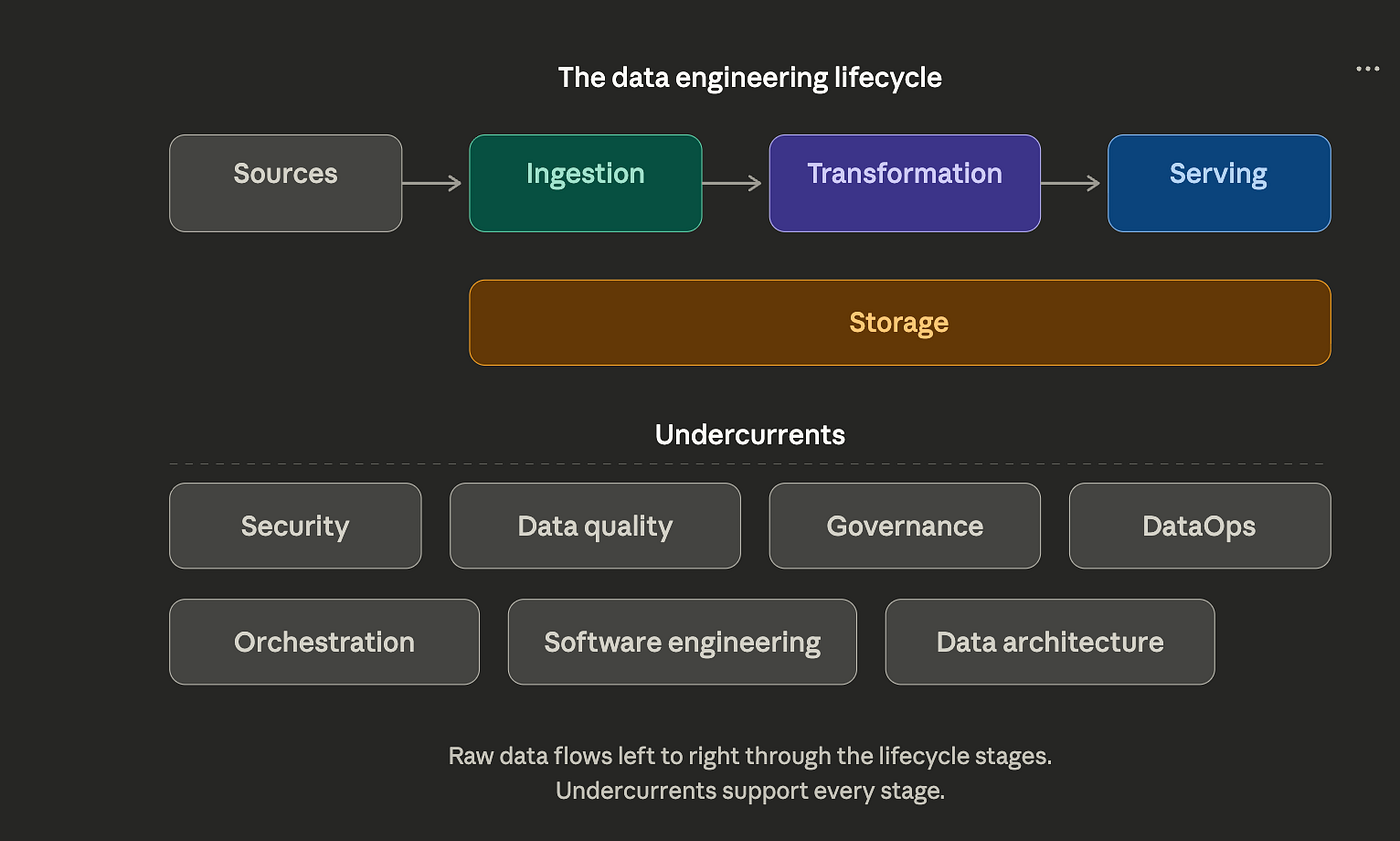
The combination of ingestion, transformation, storage, and orchestration constitutes the core of what data engineers build. A well-built data platform handles all of this reliably. A poorly built one creates a situation where nobody trusts the numbers and the data team spends most of its time fighting fires instead of delivering value.
Why companies need this role
In a small company with a single application database, data infrastructure is straightforward. An analyst can connect directly to the database, write SQL queries, and get the answers they need. There is one source of truth, the schema is known, and the data is current.
The moment a company adds a second system, the situation changes. A customer record exists in the application database and also in the CRM. The two records may use different identifiers, different field names, and different definitions of what constitutes an active customer. Answering a question that spans both systems requires joining data across sources, resolving identity conflicts, and deciding which system is authoritative.
As the company grows, it adds marketing tools, payment processors, analytics platforms, support ticketing systems. Each new system increases the integration burden. Without deliberate effort to manage this complexity, the organization ends up in a state where different departments report different numbers for the same metric, and nobody can determine which is correct.
Data engineers build and maintain a centralized platform that integrates information from across the business, applies consistent definitions and quality standards, and delivers reliable data to everyone who needs it. The role exists because data infrastructure is real infrastructure. Treating it as an afterthought or a part-time responsibility of application developers does not scale.
The urgency has increased because of the widespread adoption of machine learning. ML models are only as good as the data they consume. A recommendation engine trained on incomplete transaction data will produce poor recommendations. A fraud detection model fed stale data will miss emerging patterns. Industry surveys consistently report that the majority of ML project failures are caused by data problems, not model problems. The training data was biased or incomplete. The feature pipeline broke and nobody noticed. These are data engineering failures, and they determine whether a company’s investment in AI produces value or produces expensive mistakes.
The undercurrents that make it work
Building pipelines is the visible part of data engineering. Beneath them, several foundational practices determine whether the overall platform is reliable, secure, and sustainable.
Security is the most fundamental. The principle of least privilege applies everywhere. Users and systems should have access to only the data they need, for only as long as they need it. A common mistake in immature data organisations is granting broad administrative access to every user. This creates unnecessary risk and makes it nearly impossible to trace the source of a problem when one occurs.
Data quality means ensuring that the data flowing through pipelines meets the expectations of downstream consumers. This is not a one-time activity. It is a continuous process that must be embedded into pipeline logic and monitored in production. When data quality degrades silently, the consequences propagate into every report, dashboard, and model that depends on the affected data.
Data governance provides the organizational framework for managing data as an asset. This includes defining who owns specific datasets, establishing standards for definitions and naming conventions, tracking data lineage, and ensuring compliance with privacy regulations. Governance is often perceived as overhead, but in practice it prevents the confusion that occurs when multiple teams create their own incompatible versions of the same data.
DataOps applies the principles of DevOps to data systems. Version-controlling pipeline code, automating testing and deployment, monitoring system health in production, and establishing incident response procedures. DataOps is as much a cultural practice as a technical one. It requires the data team to adopt habits of continuous improvement and a bias toward automation over manual intervention.
These undercurrents are not optional. They are the foundation that determines whether a data platform remains stable and useful as it scales.
The current state of the field
The data engineering market exceeds $120 billion globally in 2026 and continues to grow at approximately 15% per year. This growth reflects a structural shift in how organizations invest in data. The emphasis has moved from analytics and visualization toward the underlying infrastructure that makes analytics possible.
The talent gap remains significant. Demand for data engineers has outpaced supply for several consecutive years. In the United States, senior data engineers regularly earn above $170,000, and the role has remained resilient through periods of broader tech hiring contraction.
The tooling has matured considerably. dbt has become the standard for SQL-based transformation. Airflow remains the dominant orchestration platform, with Dagster and Prefect offering alternatives. Cloud data warehouses provide storage and compute at a level of scale that was not available a decade ago. Terraform and Docker have brought software engineering rigour to data platform operations.
The convergence with software engineering is one of the most significant developments. Pipeline code is version-controlled, tested, reviewed, and deployed through CI/CD. Infrastructure is defined as code. Monitoring follows the same patterns used in site reliability engineering. Software engineers considering a move into data engineering carry more transferable skills than at any previous point.
Why I am doing this
I have worked as both a software engineer and a data engineer at different points in my career. I spent several years building applications and the work was meaningful.
We operate in this same position. We interact with data constantly but never see the systems that produce it. We trust that the data is correct because it is in a database and databases feel authoritative. We do not realize that the data passed through multiple transformations, several systems, and possibly a manual process before arriving in the table we query. Any of those steps could have introduced errors, and without monitoring and quality checks, nobody would know until something visibly breaks downstream.
Applications serve users. Data serves decisions. Decisions made on bad data are worse than decisions made on no data, because they carry a false confidence that compounds over time.
This is the first in a weekly series documenting my transition back into data engineering. Next week, I will write about retooling my Python for data work, and why everything I thought I know about the language turns out to cover only half of what the field requires.
메타데이터
- post_id
- 7ec09dea8875
- slug
- why-data-engineering-7ec09dea8875
- url
- https://medium.com/@jacobmoracha/why-data-engineering-7ec09dea8875
- canonical_url
- https://medium.com/@jacobmoracha/why-data-engineering-7ec09dea8875
- author_url
- https://medium.com/@jacobmoracha
- status
- ok
- fetched_at
- 2026-06-13 09:11:36



