Google is Bleeding as ChatGPT Comes Out Punching for the Search Engine Crown
ChatGPT Cracks the Top 5 While Competition Heats Up
AI | Search Engines | Tech
Google is Bleeding as ChatGPT Comes Out Punching for the Search Engine Crown
ChatGPT Cracks the Top 5 While Competition Heats Up
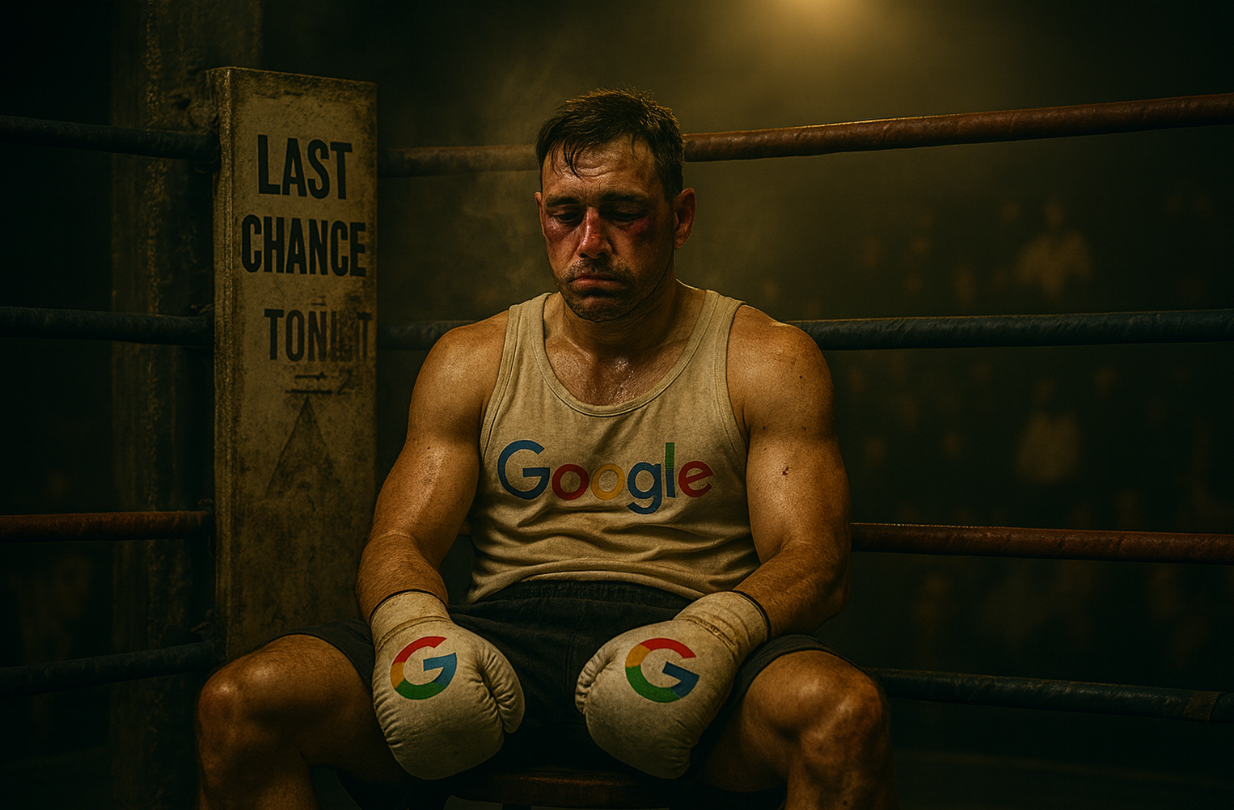
The fight is on. Image by ChatGPT x Jeff
Google is bleeding audience. Down 1.58% this month. YouTube hemorrhaging 5.63%. Facebook is losing 4.77%. While the internet’s giants watch their traffic drain away, a three-year-old chatbot just crashed the top 5 most-visited sites on Earth, and it’s the only one growing.
ChatGPT Joins the Internet Elite (And Everyone Else Is Shrinking)
ChatGPT.com now ranks as the 5th most-visited domain globally, commanding 1.40% of all internet traffic with 5.904 billion monthly visits. Even more striking: it’s the only site in the top 10 showing positive month-over-month growth (+0.98%).
Let that sink in. 5.9 billion monthly visits means ChatGPT now handles roughly the same traffic as Amazon or Netflix. An AI chatbot is as central to the internet as shopping or streaming. And it launched less than three years ago.
ChatGPT now sits among the internet’s true giants:
- Google.com (19.60% share, down 1.58%)
- YouTube.com (6.82% share, down 5.63%)
- Facebook.com (2.71% share, down 4.77%)
- Instagram.com (1.53% share, down 3.34%)
- ChatGPT.com (1.40% share, up 0.98%)
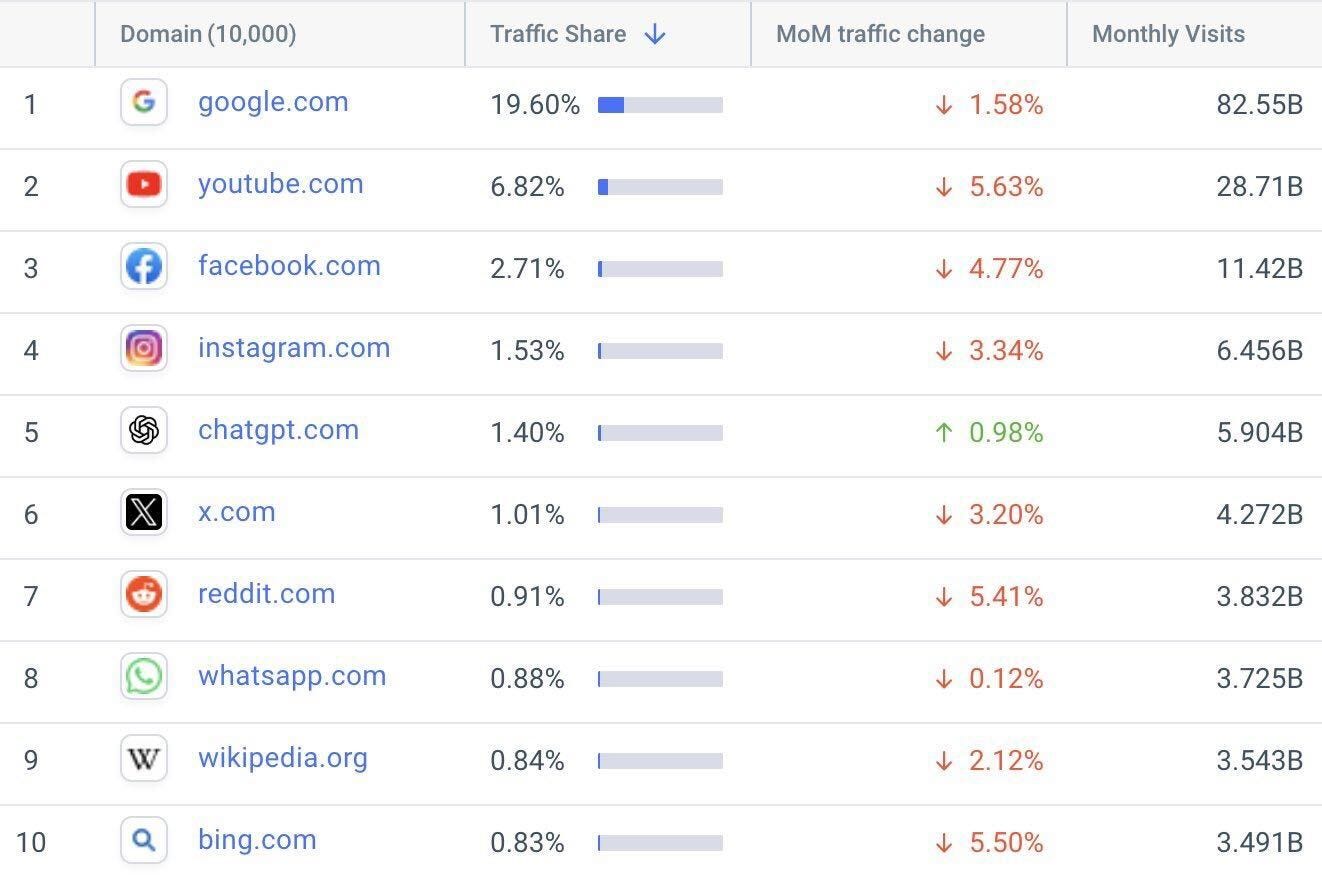
Simlar Web Traffic Share (September 2025)
When Gartner predicted traditional search engine volume would drop 25% by 2026, it seemed bold. The transformation isn’t coming — it’s already here.
And ChatGPT’s Empire Is Already Crumbling
Here’s where the story gets interesting. ChatGPT’s rise to #5 validates Gartner’s prediction about AI disrupting search. But zoom into the GenAI market itself, and you’ll see something else entirely: ChatGPT is losing its grip.
ChatGPT’s market share collapse:
- 12 months ago: 87.1% of GenAI traffic
- Today: 74.1% of GenAI traffic
- Net loss: 13 percentage points in one year
ChatGPT isn’t losing. Everyone else is finally learning to play the game.
THE 12-MONTH REPORT CARD
WINNERS
- Gemini: +102% growth (6.4% → 12.9%) — Google’s distribution advantage is crushing it
- Perplexity: +41% growth (1.7% → 2.4%) — crossed the 2% viability threshold
- Claude: +18% growth (1.7% → 2.0%) — quietly building despite entering late
STRUGGLING
- ChatGPT: -13 points of market share despite massive absolute traffic growth
- DeepSeek: -46% decline from peak (6.8% → 3.7%)
- Grok: -35% decline from peak (3.1% → 2.0%)
- Copilot: Flatlined at 1.2% — Microsoft’s $13B OpenAI investment looking shaky
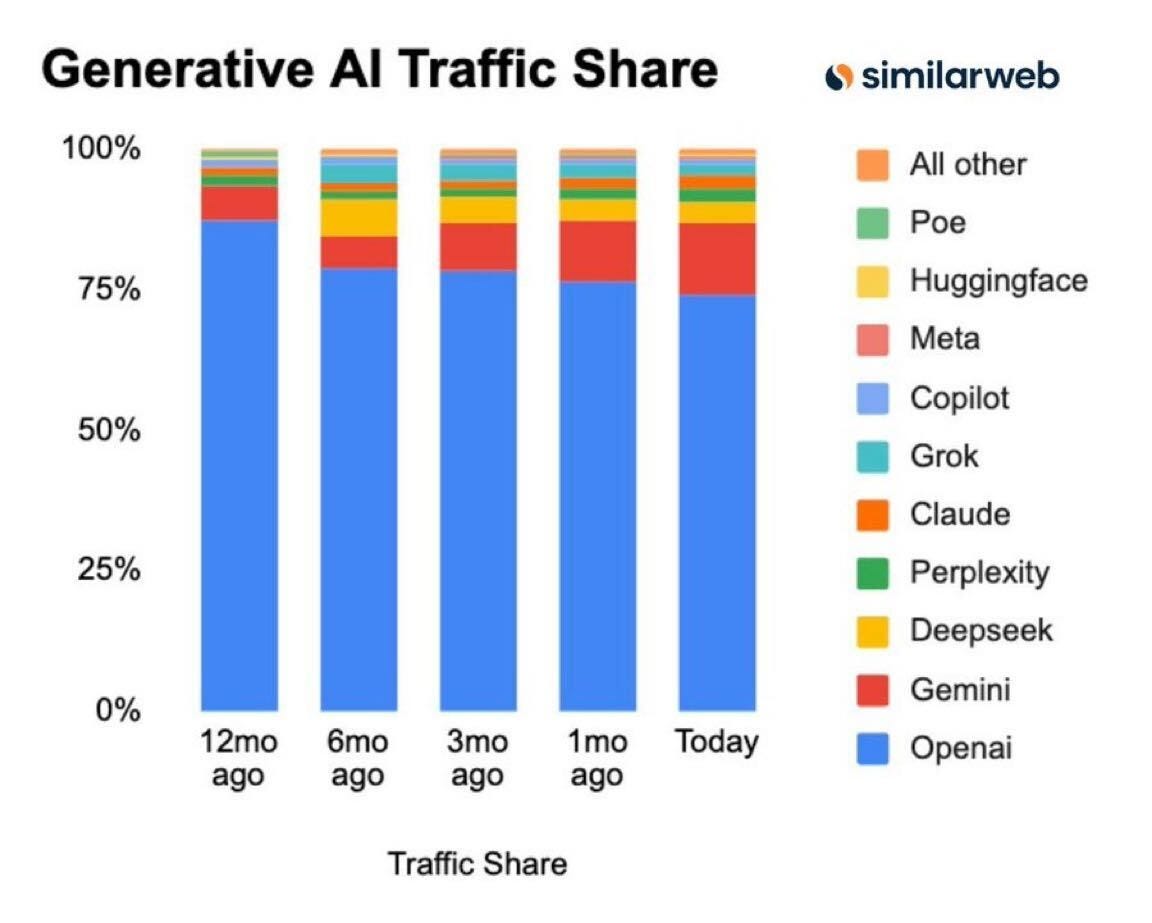
Simliar Web GenAI Traffic Share (October 2025)
The Real Battle: Who’s Taking ChatGPT’s Crown?
Google Gemini emerges as the most dangerous challenger. Doubling market share from 6.4% to 12.9% in twelve months isn’t luck — it’s distribution dominance. When you control Android, Chrome, and the world’s most-visited website, you don’t need the best product. You just need a good-enough product and a billion default installations.
Perplexity crossed the critical 2.0% threshold and keeps climbing (now 2.4%). Its search-first approach with transparent citations targets exactly what SearchGPT promised: answers you can trust with sources you can verify. If citation transparency actually matters to users, Perplexity is positioned to capture the “serious research” segment.
Claude (Anthropic) grew from 1.7% to 2.0% — modest but steady. While others chase flashy features, Claude’s reputation for nuanced, thoughtful responses is building a loyal user base. Slow and steady might win this race.
The cautionary tales:
- DeepSeek exploded to 6.8% six months ago, then cratered to 3.7%. Viral growth is easy. Retention is hard.
- Grok leveraged X’s entire user base and still dropped from 3.1% to 2.0%. Platform integration isn’t enough.
- Copilot is stuck at 1.2% despite Microsoft’s resources and OpenAI partnership. Sometimes even unlimited money can’t buy relevance.
Four Uncomfortable Truths About What Comes Next
1. The 25% Decline Is Already Baked In
Google’s 1.58% month-over-month traffic decline compounds. Run that forward and you don’t get to 25% by 2026 — you blow past it. Gartner’s prediction wasn’t bold. It was conservative to the point of politeness.
Every percentage point Google loses isn’t going to Bing. It’s evaporating into AI platforms that don’t show ten blue links, don’t serve ads between results, and don’t care about your SEO strategy.
2. No Single AI Will Dominate Like Google Did
Traditional search consolidated into Google’s 90%+ monopoly. The AI search landscape is fragmenting in the opposite direction. ChatGPT started at 87% and has already dropped to 74%. Gemini is surging. Perplexity is rising. Claude is climbing.
Users are platform-promiscuous, experimenting with multiple tools:
- ChatGPT for conversational depth and creative tasks
- Perplexity for research with verifiable sources
- Gemini for Google ecosystem integration
- Claude for thoughtful, nuanced analysis
The winner-take-all dynamics of traditional search don’t apply when every AI can give you a good-enough answer.
3. Quality Is the Only Moat That Matters
As the SearchGPT article emphasized, content quality, authenticity, and demonstrable expertise are becoming the only differentiators. When AI-generated content floods the internet, algorithms will ruthlessly prioritize sources that prove their credibility.
Generic content dies. Unique expertise survives. If an AI can generate your content in 30 seconds, why would another AI cite you as a source?
4. Publishers Are Getting Spotify-ed
Just as musicians lost control when streaming fragmented their audience across multiple platforms, publishers are about to watch their readership scatter across 6+ AI platforms — each with different citation methods, different monetization models (or none at all), and different rules for attribution.
You’re not optimizing for one search engine anymore. You’re negotiating with a dozen AI platforms that may or may not credit you, link to you, or send you traffic.
Your SEO Strategy Is Already Obsolete
Here’s what this means for you, specifically:
If You’re a CMO
That $2M you spent on SEO last year? Half of it just became legacy infrastructure. AI platforms don’t care about your backlinks, domain authority, or keyword density. They care about whether you’re quotable.
What to do now:
- Diversify beyond Google: Add ChatGPT, Perplexity, Gemini, and Claude to your analytics tracking. Understand which AI platforms drive traffic and how those users behave.
- Build for citation, not ranking: Create content that AI wants to quote. That means original research, unique data, expert insights, and authoritative sources — not SEO-optimized fluff.
- Prepare for Answer Engine Optimization (AEO): Traditional SEO got you into the top 10 results. AEO gets you quoted in the answer. These are fundamentally different strategies.
If You’re a Publisher
You built your business on Google sending you traffic. That traffic is about to scatter across six different AI platforms, each with its own rules about attribution, linking, and monetization.
The harsh reality:
- Some AI platforms will cite you with links (Perplexity)
- Some will paraphrase you without attribution (most of them)
- Some will summarize your content so thoroughly that users never need to visit your site
- None of them have figured out how to pay you
You can either fight this (good luck) or figure out how to build direct relationships with readers before the AI intermediaries make you irrelevant.
If You’re Google
You built a $300B empire on being the answer to “where do I find information?” When the answer becomes “everywhere,” your moat evaporates.
Gemini is growing. Google Search is declining. At some point, you’ll have to make Gemini the default search experience — effectively killing the golden goose that funds everything else. The question isn’t whether you’ll do it. It’s whether you’ll do it fast enough to stay relevant.
Three Signals to Watch in Q1 2026
The data tells us where we are. Here’s what to monitor to see where we’re going:
1. The Perplexity Inflection Point
If Perplexity hits 3% market share, it proves citation-heavy, research-focused AI can compete with pure conversational models. It means users actually care about sources and transparency.
If Perplexity stalls at 2.4%, it reveals an uncomfortable truth: people say they want citations, but they really just want fast answers. Accuracy and attribution are nice-to-haves, not requirements.
2. Google’s Breaking Point
Gemini is growing fast (12.9% and climbing). Google Search is bleeding slow (down 1.58% monthly). These trendlines intersect somewhere.
Watch for Google to make Gemini the default search experience. When that happens — and it will — Google admits the old model is dead. The question is whether they move fast enough or cling to search ad revenue until it’s too late.
3. The ChatGPT Floor
Will ChatGPT stabilize at 70% market share, or is there no floor?
If it drops below 70% in Q1, we’re headed for genuine market fragmentation where four or five platforms split the AI search market. If it holds at 74%, OpenAI’s first-mover advantage and brand recognition might be durable enough to maintain dominance — just not the monopoly they started with.
The 70% line is the difference between “ChatGPT as the Google of AI” and “ChatGPT as one of several major players.”
The Unpopular Truth
Gartner’s 25% decline prediction is conservative to the point of meaningless. Here’s what they won’t say publicly: by 2026, “Googling” will sound as dated as “looking it up in the Yellow Pages.”
The question isn’t whether traditional search loses 25%. It’s whether Google can transform fast enough to remain relevant — or whether we’re watching the beginning of tech’s most spectacular collapse since Yahoo.
AI didn’t disrupt search by being 10% better. It disrupted search by making the entire concept obsolete. You don’t need to find information anymore. You just ask for it.
The Bottom Line
ChatGPT’s presence in the top 5 global domains isn’t just a milestone. It’s a declaration that the old internet is dying. Google Search down. YouTube down. Facebook down. Instagram down. Every legacy platform bleeding traffic to a two-year-old AI that simply answers questions.
But the real story isn’t ChatGPT’s rise. It’s the battle for second place.
As ChatGPT’s market share erodes from 87% to 74%, we’re watching the birth of a genuinely competitive AI search market. Google’s Gemini with its distribution muscle. Perplexity with its citation-first approach. Claude with its thoughtful depth. Each represents a different vision of how AI should answer questions.
For users, this competition means better tools and more choices. For businesses, it means the complexity of digital marketing just increased exponentially. You’re no longer optimizing for one search engine with known rules. You’re adapting to six AI platforms with evolving algorithms, different citation methods, and uncertain monetization models.
Adapt or die. There’s no third option.
Thirteen months ago, “ChatGPT” was a curiosity. Today it’s a top-5 global destination with 6 billion monthly visits. Thirteen months from now? The question won’t be “How did AI disrupt search?”
It’ll be “Remember when we used to Google things?”
That world is already over. We’re just living in the lag time between the change happening and everyone noticing.
For more, read: **How SearchGPT is Changing the Search Landscape**
메타데이터
- post_id
- 7ed9247e2a6d
- slug
- google-is-bleeding-as-chatgpt-comes-out-punching-for-the-search-engine-crown-7ed9247e2a6d
- url
- https://medium.com/@bundleiq/google-is-bleeding-as-chatgpt-comes-out-punching-for-the-search-engine-crown-7ed9247e2a6d
- canonical_url
- https://medium.com/@bundleiq/google-is-bleeding-as-chatgpt-comes-out-punching-for-the-search-engine-crown-7ed9247e2a6d
- author_url
- https://medium.com/@bundleiq
- status
- ok
- fetched_at
- 2026-06-17 13:50:26