Guangfu Flood: How Taiwan Can Entrench Disaster Prevention Education
Taiwan must transform disaster education through visual communication, community-driven preparedness, and authentic practice.
Guangfu Flood: How Taiwan can Entrench Disaster Prevention Education?
On September 23th this year, flooding struck Guangfu Township, claiming 19 lives and injuring over a hundred people. According to interviews conducted by *Mirror Media* with disaster victims, it’s clear that some residents who had been evacuated the day before snuck back home when they saw the weather improving, thinking they’d be fine.
Among them was Su Jian-chang, who managed to outrun the floodwaters in flip-flops. He said that while residents knew about the barrier lake, they had no idea how serious it was.
Now, people are examining Taiwan’s flood prevention education. A proposal has been launched on the Public Policy Online Participation Platform, hoping that both the government and citizens will take disaster prevention education more seriously.
Disaster Communication: The Role of News and Media in Catastrophes
News media play four key roles during disasters:
- Preparation: Informing the public about upcoming disasters — like when a typhoon forms and when it’s expected to make landfall — so people can prepare in advance.
- Response: During the disaster itself, providing real-time information to help victims access rescue resources.
- Recovery: Reporting on the long road to rebuilding disaster areas, giving voice to victims’ perspectives while offering government and rescue teams a chance to reflect on their disaster prevention mechanisms.
- Mitigation: Reviewing what went wrong before and after disasters, or compiling historical disaster coverage to prevent history from repeating itself.
Media coverage also shapes how we perceive disaster severity. If the media doesn’t report extensively or lacks shocking footage, we tend to think the disaster isn’t serious. Conversely, when media repeatedly broadcasts disturbing images through agenda-setting, the severity becomes etched in our minds and draws widespread attention.
However, disaster communication isn’t just about news — it’s the dialogue between government and citizens that translates into real action.
Photo by Kaity Nguyen on Unsplash
Insufficient Understanding, Underestimating Nature’s Power
On July 30th, when an earthquake struck Russia’s Kamchatka Peninsula, Taiwan’s Central Weather Administration issued a tsunami warning for the north coast, predicting waves of 30 centimeters to 1 meter. At the time, I saw people on social media dismissing a 30-centimeter tsunami as harmless.
I came across demonstration videos online showing that even with relatively low wave height, a tsunami’s impact force is several times greater — 30 centimeters is enough to knock down adults and sweep away vehicles.
In this recent disaster, residents may not have witnessed firsthand the sheer volume of water and sediment a breached barrier lake can unleash. Without visual aids, it’s hard for people to grasp the severity, leading them to underestimate the danger. During the disaster, an Indonesian caregiver who had survived the South Asian tsunami noticed something unusual and reacted immediately, saving both her elderly charge and neighbors.
If news outlets had used demonstration videos during or even before the evacuation period, or compiled footage of barrier lake overflow disasters from Taiwan and abroad, they might have better warned residents and heightened their vigilance. This could have also helped firefighters, police, and village chiefs take the potential disaster more seriously.
I once helped organize a summer camp at an elementary school in Xiaoliuqiu. I remember one of the counselors would describe distances by converting them into “how many laps around Xiaoliuqiu” — not just cold, hard numbers, but something the kids could actually picture and understand.
Additionally, some residents mentioned that evacuation broadcasts were only in Chinese and English, which elderly people couldn’t understand — so how could they be expected to cooperate?
If the government and media described disasters to potential victims in ways people could actually visualize and comprehend, wouldn’t that make disaster prevention more effective and reduce casualties?
Using imagery and visualization to help people truly see the danger.
Strengthening Community Disaster Preparedness Rather Than Waiting for Outside Help
In Dama Village, Chen Xiao-juan, the women’s soccer coach at Guangfu Commercial and Industrial Vocational High School, shared how tribal youth voluntarily went to elderly residents living alone to help them evacuate. These community-driven actions were more immediate and effective than government orders.
Organizing community disaster prevention teams offers these benefits for both disaster preparedness and the community:
- Crisis Awareness: Strengthening public understanding of disasters and reducing risk factors to minimize damage.
- Assisting Rescue Efforts: Coordinating with professional teams to enhance emergency response capabilities.
- Regular Inspections: Checking the community environment and rescue equipment to ensure they’ll function when disaster strikes.
- Drills and Preparation: Systematic organization and practice so residents know how to respond during disasters.
- Community Cohesion and Building: Using organizational mobilization to strengthen residents’ sense of community identity.
The Ministry of the Interior has also adopted Japan’s “disaster prevention officer” system, promoting the principles of “self-help, mutual aid, and cooperation” — pushing disaster prevention work before disasters strike and assisting with evacuations and action when they occur.
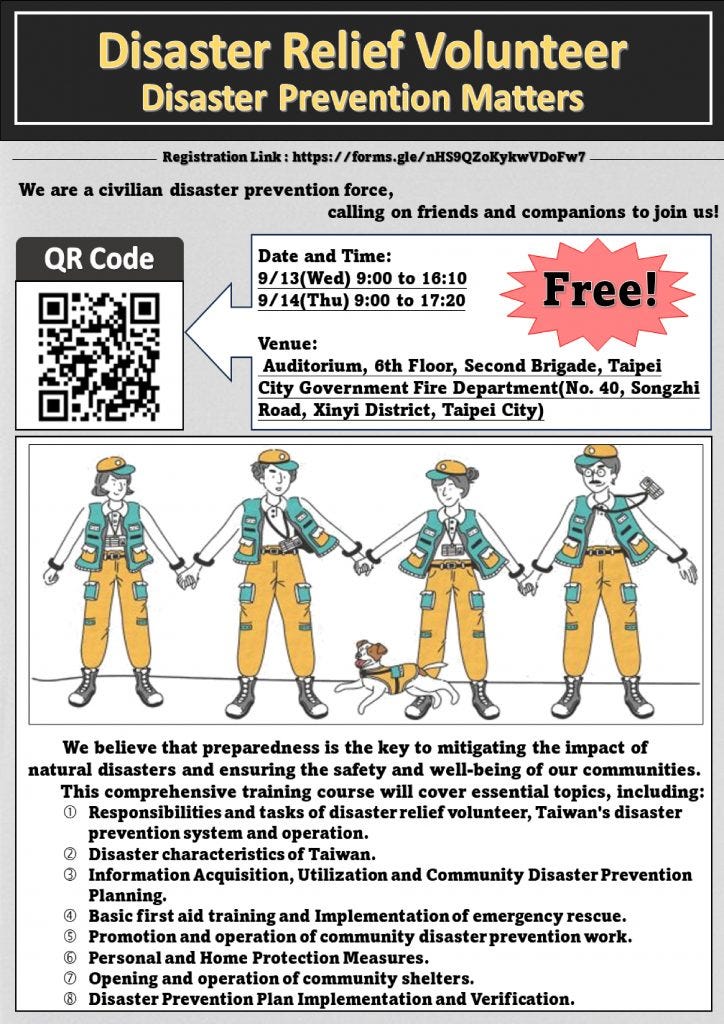
Disaster Prevention Officer
In disaster prevention practice, community village chiefs and disaster prevention officers play crucial roles — from implementing preventive measures before disasters to assisting with neighborhood rescue and recovery afterward.
Disaster Prevention Education
Different countries focus on different aspects of disaster education based on their environmental and climate conditions. Taiwan and Japan, for instance, place earthquake and seismic safety education at the core; Indonesia and Japan, having experienced major tsunamis, incorporate tsunami prevention into school and community curricula; while California and Australia, threatened by wildfires every dry season, have well-established wildfire risk education and drill systems.
We should learn from these countries’ practices while also observing their thinking and institutional arrangements around disaster education.
Tsunamis
Although Taiwan hasn’t experienced major tsunami casualties in the past century, according to the Seismological Center’s tsunami information, small tsunamis have occurred in Taiwan’s northeast and southwest regions. Since nearby Japan, Indonesia, and the Philippines have all experienced major tsunamis, Taiwan still needs to remain vigilant and prepare for the worst.
UNESCO’s Tsunami Ready Recognition Programme offers a set of preparedness indicators covering everything from risk zone assessment to drills, evacuation, and notification systems. This not only provides a reference for Taiwan but, if we pass the evaluation, could also increase Taiwan’s international visibility and demonstrate our commitment to disaster prevention and evacuation.
Photo by NOAA on Unsplash
Floods
As one of the world’s most famous low-lying countries, the Netherlands takes flooding seriously as a natural disaster.
To increase high school students’ awareness of floods, Utrecht University and Amsterdam University of Applied Sciences jointly developed a model showing the potential impact range and water height when dams fail, then having students formulate evacuation plans. This simulation-based teaching gets students involved in the thinking process, truly understanding the logic behind disaster prevention rather than passively receiving instructions.
Photo by Kelly Sikkema on Unsplash
Japan’s disaster prevention education — which Taiwan frequently observes and exchanges with — places great emphasis on implementing disaster education in schools. It’s not just about training kids from a young age to respond to disasters, but also about assisting communities when disasters strike. Like Taiwan, schools serve as important shelters, so Japanese schools also have disaster supply warehouses stocked with emergency equipment.
Additionally, Taiwan’s Disaster Prevention Education Information Network has published When Crisis Comes: Taiwan’s National Safety Guide, which tells people how to recognize different disasters, how to evacuate, and provides emergency kit checklists so people can prepare in advance.
True disaster prevention education shouldn’t just be going through the motions. Since the 921 earthquake, Taiwanese schools have held disaster prevention drills annually where students and teachers follow broadcast instructions. But when an actual earthquake happens, rarely does anyone actually take shelter — more often, people look around to see how others are reacting, afraid of being the first to duck under a desk.
I’ve experienced two false fire alarms — once in Korea, once in Taiwan. When staying at a Korean friend’s rental during my trip, the fire alarm went off and she led me to evacuate following the broadcast, with other tenants quietly and orderly heading downstairs. It turned out to be a false alarm. In Taiwan, during an event, the fire alarm sounded and everyone looked at each other confused while the organizers rushed to check with the venue — turns out they were testing the system without announcing it first. But if there had been a real fire, we would have been two or three minutes late starting our evacuation.
Conclusion
In recent years, extreme weather has made natural disasters increasingly severe and more frequent. Combined with Taiwan’s existing susceptibility to earthquakes and typhoons, plus our mountainous terrain that brings occasional landslides, mudslides, and rockfalls, we need to implement disaster prevention education in schools, strengthen community disaster awareness and resilience, and have news media and government agencies enhance disaster prevention advocacy. Only then can disaster preparedness truly become part of our daily practice.
Reference
The above was traslated by ChatGPT.

I also submitted this article to CommonWealth Opinion.
메타데이터
- post_id
- 7ef9faddf2f0
- slug
- guangfu-flood-how-taiwan-can-entrench-disaster-prevention-education-7ef9faddf2f0
- url
- https://medium.com/@cave_litergory-digital/guangfu-flood-how-taiwan-can-entrench-disaster-prevention-education-7ef9faddf2f0
- canonical_url
- https://medium.com/@cave_litergory-digital/guangfu-flood-how-taiwan-can-entrench-disaster-prevention-education-7ef9faddf2f0
- author_url
- https://medium.com/@cave_litergory-digital
- status
- ok
- fetched_at
- 2026-08-17 07:11:18