How Do You Monitor and Govern AI Agent Activity on Enterprise Systems?
Your security stack was built to manage human users. There is a clear logic to it: humans log in, humans take actions, humans trigger…
How Do You Monitor and Govern AI Agent Activity on Enterprise Systems?

Your security stack was built to manage human users. There is a clear logic to it: humans log in, humans take actions, humans trigger alerts. The entire architecture of enterprise security — from endpoint controls to access governance to incident response — was designed with a person at the other end.
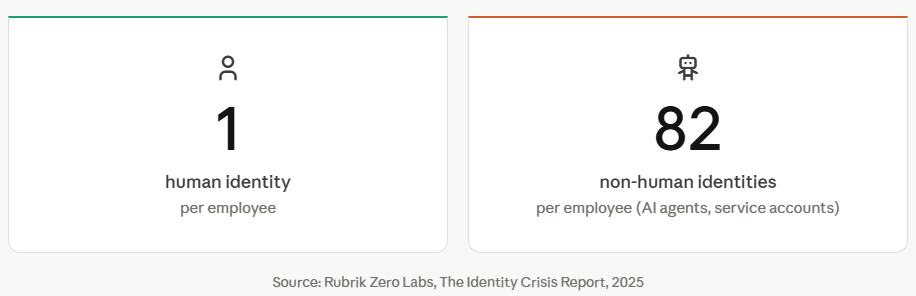
AI agents are not people. They don’t log in with a human credential, they don’t pause before acting and, in most enterprise environments, they don’t leave a meaningful record of what they did. According to Rubrik Zero Labs’ Identity Crisis Report, non-human identities now outnumber human identities 82 to 1 in enterprise environments, a ratio accelerating as agentic AI proliferates. Your governance model was not built for this.
The question is no longer whether agents are running on your enterprise systems. They are. Microsoft 365 Copilot agents are reading SharePoint files and summarizing emails. Custom agents built on AWS Bedrock and other cloud AI platforms are querying internal databases and executing multi-step workflows. The question is whether you can see what they are doing and whether your policies actually reach them.
Why AI Agents Create a Governance Problem Traditional Tools Can’t Solve
The challenge is structural, not a matter of tuning your existing controls.
Traditional security tools are designed around two assumptions: that actors are human and that sensitive actions pass through a monitored channel. AI agents break both. They operate autonomously, often executing dozens of actions in a single workflow with no human reviewing any individual step. They inherit credentials from the user or service account that deployed them, frequently with permissions far broader than any specific task requires. And much of their traffic — agent-to-LLM calls, internal tool queries, API-driven data retrieval — never passes through the network control points where proxy-based security tools sit.
The result is a visibility gap that compounds over time. When something goes wrong in an agentic workflow, there is often no record of which agent acted, which data it touched, who triggered it or what it actually did. That gap is what makes agent governance so urgent, and what makes it so distinct from anything your current security stack was designed to handle.
Five Things You Need to Monitor for Effective AI Agent Governance
1. A Complete Inventory of Every Agent Running in Your Environment
Governance starts with knowing what exists. That means sanctioned agents — Microsoft 365 Copilot, AWS Bedrock integrations, approved internal automations — and shadow agents employees have deployed through personal accounts, unofficial browser extensions or consumer AI platforms entirely outside IT’s view. Gartner found that 69% of organizations suspect or have confirmed that employees are using prohibited GenAI tools. Agents built on those same tools are an extension of the same problem, with greater autonomy and less visibility.
2. What Data Each Agent Is Accessing and Whether That Access Reflects Intent
Agent permissions are frequently inherited rather than intentionally scoped. An agent connecting to SharePoint with owner-level credentials can surface, summarize and transmit sensitive files that no human was ever expected to retrieve directly. Access scope needs to be continuously visible and auditable, not assumed based on how the agent was originally configured. Over-permissioned agents are among the most common sources of unintended data exposure in AI deployments.
3. Full Identity Attribution for Every Agent Action
Was this action taken by a human, an agent or an agent acting on a human’s behalf? That distinction is foundational for incident response, insider risk investigations and regulatory reporting. The answer determines who is accountable, what remediation looks like and what your audit record shows. Most security tools today cannot reliably answer it, because they were designed to track human user activity, not the actions of autonomous processes operating under human credentials.
4. Whether Your Enforcement Actually Reaches Agent Traffic
Proxy-based security controls were designed for browsers. Agent-to-LLM traffic frequently bypasses network control points entirely, routed through direct API connections to cloud AI platforms. If your data loss prevention (DLP) or monitoring infrastructure depends on traffic passing through a proxy, it has a structural blind spot for a significant portion of agent activity. Out-of-band API enforcement, which connects directly to sanctioned AI platforms without requiring network interception, is the only architecture that closes this gap reliably.
5. An Audit Trail That Satisfies What Regulators Are Beginning to Require
The EU AI Act, NIST AI Risk Management Framework and SEC AI disclosure guidance are converging on a shared expectation: organizations deploying AI in enterprise contexts need to demonstrate governance with evidence, not assertions. Exportable, timestamped logs of agent activity — including what the agent did, which data it accessed and who triggered it — are no longer optional for organizations operating in regulated industries or jurisdictions where AI oversight requirements are taking effect.
What a Practical AI Agent Governance Framework Looks Like
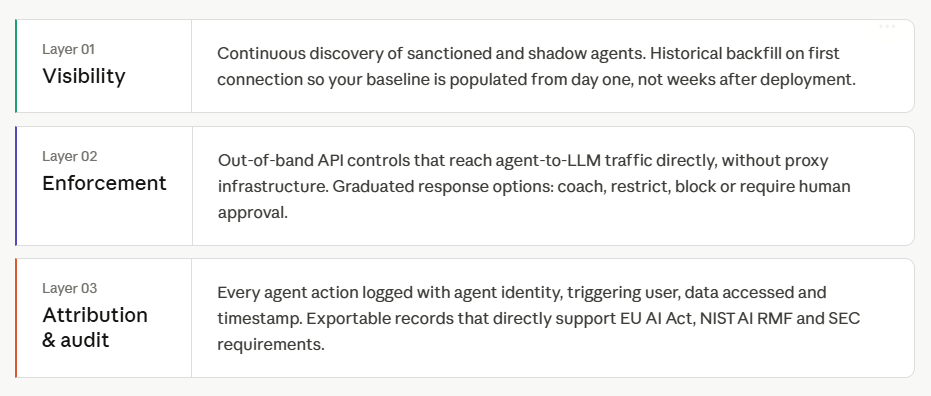
Three layers work together to close the governance gap.
The visibility layer provides continuous discovery of both sanctioned and shadow agents, with historical backfill so security teams are not starting from zero on the day they deploy a new tool. Without a populated baseline, the first weeks of any AI monitoring program are effectively blind.
The enforcement layer applies policy controls that reach agent traffic at the source. Out-of-band API enforcement connects directly to platforms like Microsoft 365 Copilot, ChatGPT Enterprise and AWS Bedrock, inspecting prompts, responses and agent actions without requiring proxy infrastructure or network architecture changes. When an agent’s behavior crosses a policy threshold, graduated controls respond proportionately — coaching, restricting, blocking or requiring human approval for agent runs — rather than relying on binary block-or-allow decisions that generate friction without improving outcomes.
The attribution and audit layer ties everything together. Every agent action is logged with the agent’s identity, the triggering user, the data accessed and the timestamp. That record is what makes incident investigation possible, what makes regulatory reporting credible and what turns raw AI activity data into the board-ready governance narrative CISOs are increasingly being asked to produce.
The Bottom Line for Security Leaders
Agentic AI is not a future risk to plan for. It is a present reality to govern. The security controls your organization has today — built for email, web and endpoint — were never designed to see agent activity, attribute non-human actions or produce the kind of audit trail that regulators are beginning to require.
The organizations managing this well are not the ones that restricted AI adoption. They are the ones that built visibility and enforcement infrastructure capable of keeping pace with how their employees and their AI tools actually operate.
Follow Force Multiplier on Medium for more on AI governance, data security and the controls enterprise security teams need to stay ahead.
메타데이터
- post_id
- 7f19d52225c3
- slug
- how-do-you-monitor-and-govern-ai-agent-activity-on-enterprise-systems-7f19d52225c3
- url
- https://medium.com/forcepoint-security/how-do-you-monitor-and-govern-ai-agent-activity-on-enterprise-systems-7f19d52225c3
- canonical_url
- https://medium.com/forcepoint-security/how-do-you-monitor-and-govern-ai-agent-activity-on-enterprise-systems-7f19d52225c3
- author_url
- https://medium.com/@forcepoint-security
- status
- ok
- fetched_at
- 2026-06-09 15:37:30