Who’s At Your Table?
A case study on queer chosen family, care, and designing conversation as ritual
Who’s At Your Table?
A case study on queer chosen family, care, and designing conversation as ritual

For some of us queer folk, the spaces that are meant to offer comfort, safety, and community are often where we first experience isolation and rejection. The family function where your identity is taboo. The group of childhood friends who struggle to accept you.
It’s no surprise that fewer than a third of queer youth find their home to be supportive.
Yet despite this, queer people have always found ways to build networks of care outside of traditional family structures. When the opportunity for family wasn’t given, we created one.
- 71% perceive the reaction of their family members to be overwhelmingly negative.
- 46% of LGBTQ+ young adults are estranged from at least one family member. (Chapman, 2023; Psychology Today)
- 62% fear stigma and discrimination within healthcare. (National Coalition for LGBTQ Health, 2024)
- 1/3 of LGBTQ+ youth report that their household is supportive. (Trevor Project, 2024)

Overview
Sometimes people need a space and the tools for meaningful and safe conversation to be available. Biological family is often the space where conversation is stifled, upended with tension, and lacking.
I’ll tell you a bit about myself. At the heart of my pursuit as an interaction designer is the belief that design can facilitate social connection. Be it a physical product that invites deeper reflection or a digital experience that collects memories, design often creates opportunities for new stories to be shared and relationships to be formed.
To me, there is power and privilege in shaping how people connect with each other and what they take from that experience. My own experience also shapes and is embedded in my thesis. I’m the first of a lot in my family. I’m a first-generation American, the first openly queer person in my generation, the first to pursue design as a career, and the first to attain a master’s degree.
One of these firsts led to one of the lowest points of my life.
With a whole bunch of firsts, you can bet there were plenty of times when I found myself lost and navigating uncertainty. However, one experience stands out as something that led me to rethink just how much life can change.
In 2023, I came out to my parents. I was well aware of my sexual identity and proud of who I was, and in that moment, I thought they would be ready to know a bit more about me. Well, I was wrong. Within a single night, I went from navigating quiet seclusion in my home to navigating survival.
During this time, I had one lifeline and anchor that helped me get through a very precarious period of my life. This lifeline was my chosen family: the friends and connections I had formed and sustained for close to a decade. We were not aligned or supporting each other because of genetic obligation. In fact, we were so close because we were aligned through values and care.

So when my care, my health, and my safety were put in a place where I could have been harmed, my chosen family stepped up to help me. Navigating questions about housing, finances, and safety was difficult, but during this tumultuous time, at least I could do so from my friend’s couch, on my partner’s shoulder at the time, or at a shared table with a meal made together.
This period confirmed for me how vital the practice of making and sustaining chosen family is to queer people. But despite this realization, I couldn’t help but notice that I kept running into the same issues I did with my biological family. I didn’t know how to initiate conversations that required more care and more vulnerability.
How do you ask your chosen family to show up for you if you were never taught to do that in your biological one?
Statement of Inquiry
Carefully crafted experiences and thoughtful conversations can lead to natural, deep engagement. And maybe, just maybe, they could serve as a scaffold for conversations with chosen family that require a bit more intention.
Queer folk and their chosen family members were my target audience. These relationships are highly important, sometimes life-altering, but poor communication or a lack of meaningful dialogue can create room for misunderstandings, resentment, boundary ambiguity, and so much more.
Every relationship and connection, queer or not, is affected by communication styles. But if you can support familial relationships that were co-created and have a baseline of respect for each other’s identities, imagine the growth those relationships may experience.
The primary objectives for this project were:
- to interrogate and queer a “normative system” that queer people operate within, in this case, the family system and dining etiquette;
- to create an interaction and practice for meaningful communication and meaning-making.
From the outset of this thesis, I knew that I wanted to embed a physical interaction. Communication and meaning-making are essential for forming and sustaining a strong bond, but physical connection and engagement also help. By reading body language and subtle facial cues, conversing in person can be a great way to connect.
Besides that, when I came into SVA’s MFA Interaction Design program, I knew that for my thesis, I wanted to focus on engaging people physically.
Currently, in interaction design, I believe people often think of the discipline as something confined to screen interfaces, digital products, and experiences. But in my mind, interactions can truly shine when you meld the physical and digital, or blend the furnaces of both into a single one.
When it comes to being an interaction designer, I wanted to use the knowledge I gained and apply it outside of a screen. I wanted to apply it to something that requires people to be engaged physically and requires them to interact not through a swipe or scroll, but with themselves and the space they occupy.

Research & Strategy
I conducted a co-design-based research process. For my project, I wanted to engage with the people this was made for: queer folk and their chosen families. I didn’t want to make it extractive, where it would be a one-off interview, I would get their stories, and then use them toward building something they had no say in.
With my background in community-centered design, I had three years of experience working alongside communities in New York City. I experienced a methodology of actively designing with them and actively involving the communities we were designing for as agents of change in the design process. Design wasn’t something that happened to them. Instead, it happened alongside them, was ushered by them, and was a practice of exchange.
I wanted to replicate this community-centered design process in my own engagement and research. So I did my best to engage with other queer folk and subject-matter experts who identified as queer. When it came to designing and conceptualizing, I wanted to conduct a co-design process, working alongside the people who would use my project.
I gathered the thoughts and opinions of six queer folk, each with different backgrounds and experiences, yet each with their own understanding and definition of chosen family. With them, I was able to understand what was required to define chosen family, the ritualized practices they practice together, and what was required for a gathering to become a space where conversation could flow safely.

Through the co-design session, my queer council, which is what I call them, went through a three-part activity I designed for them.
First, we discussed how each person defined chosen family and, as an extension of that, their current chosen family members. We then discussed their current rituals within chosen family groups and the attributes that make these spaces meaningful and safe. Finally, using the previous two activities as primers for the co-designers, I asked them to design a new gathering for their chosen family that reflected the elements of the rituals they found appealing.
I knew that when designing the conditions for a physical experience, elements such as accessibility, power-sharing, accountability, and reflexivity are very important. These are core principles that my design background made clear were vital to a community-centered design practice, especially if it is participatory.
But unlike facilitating a research workshop or virtual whiteboarding session, designing my thesis would require a self-directed experience. So I had to make sure that the principles and practices I researched were intrinsically applied to the experience in a way that didn’t require explanation for understanding, but was felt through the actions taken within it.
Journey & Process
I segmented my design process into three chapters: Discovery, Co-Design, and Prototype. Basic, but effective.
Discovery
In the discovery phase, I began my thesis by exploring an area of queer life that I think many queer people navigate: tension within family relationships.
At first, I wanted to see how design could help mend relationships for queer people whose gender identity or sexual identity may have created tension or ruptures within their biological families. I titled my thesis Bridge Building Through Reparative Practices and wanted to explore how design could facilitate repair and help queer youth, first-generation queer people, and queer elders heal relationships and build futures rooted in kinship and belonging.
I explored how restorative practices, defined as the skills and practices used to maintain and support relationships, could be used in conversation. I looked at reparation, restorative justice, and other aspects of repair.
Even then, I wanted to see how design could create space for these conversations. And even if the conversation was not between the queer person and the family member they had a rupture with, maybe it could be a conversation with themselves: a more introspective process of figuring out how to move forward and heal from that relationship, or from the concept of family itself.
It’s interesting to look back and see that, even then, I was exploring this idea of family and beginning to play with the idea of chosen family, as well as how design might support those relationships.
As I dove deeper into my thesis, this idea of repair really stayed with me. Would you want to repair something that was damaging or harmful to you in the first place? And what does repair actually look like?
I started moving away from the idea of repair because it can sometimes suggest returning something to its original state. But I did not want these relationships to simply go back to what they once were. I wanted them to transcend that original state and grow into something more generative and renewing.
That is what I came to understand as restoration.
Because of this subtle shift in language, I changed the title of my thesis to Bridge Building Through Restorative Practices, looking toward more restorative ways of relating rather than simply repairing.
I know it may seem like a small or unnecessary change, but to me, it shifted how I understood my thesis. My thesis was not just about maintaining the status quo or bringing something back to what it once was. Instead, it was exploring how to build something beyond what had existed before.

That shift became even clearer during one of my classes, when one of my instructors said something profound:
“Have you ever thought of flipping the privilege?”
This is a butchered paraphrase of what my thesis lab instructor, Allan Chochinov, said after a lecture on what user projects might look like. It occurred to me that, while I was originally focused on the idea of restoration among queer folk and their biological family systems that were scarred, the more I developed this potential exploration, the more drained I felt.
It is one thing to explore restoration in a silo, but when the area you’re exploring is inextricably linked to your identity and experience, sometimes you need to assess your positionality and reflexive capabilities.
I was aware that this exploration was very important to me, but I wanted to explore “flipping the privilege.” Family mending and repair is a completely valid exploration, but I recognize the incredible talent that queer people have in forming their own support networks when connection with their biological family was not provided. When family wasn’t an option, it was created.
So, with this recognition, I shifted from exploring queer folk and how they might repair strained relationships with biological family to exploring how they can strengthen and scaffold the relationships they already built with care: those of their chosen family.
These chosen family relations aren’t only found in queer circles, but historically, queer folk have formed many of these support networks, and they stand as pillars in our experience. Especially when looking at the experience of queer Black people, where community during the Harlem Renaissance, ballroom houses, rent parties, and so much more served as a basis for support, connection, and safety.
Moving beyond repair and into supporting these chosen familial bonds felt more like a celebration and recognition of the queer experience. And for an almost year-long thesis, I felt more obligated to explore that.
The Thanksgiving Moment
When it truly came to being propelled to explore this further for my thesis, I remember the exact moment it happened. It was Thanksgiving 2025, and there I was, for the third year in a row, at one of my close friend’s houses for Thanksgiving.
It was such a vibrant environment. Every one of her family members was jovial, accepting, and warm. It was the quintessential holiday gathering you would expect: laughing, joking, and even a prayer before dinner.
I couldn’t help but think about how my family used to gather like this often when I was younger, but nowadays, that feeling is no longer there. Whether it was due to my hesitancy around engaging with them because of my sexual identity, or simply a loss of enthusiasm after years of tension, my family felt like a stark contrast to my close friend’s family in that holiday setting.
And although I know it was just one day, one moment, and, of course, a holiday when people are often happy, it represented something I wanted to build and maintain.
As we sat around the table eating Thanksgiving dinner, and as I sat under her roof, I couldn’t help but think about who was at the table during that meal, who they had invited, and how I was one of those people.
That was when I came up with the thesis title: Who’s At Your Table?
The Table as Interface
When it came to building out what my thesis actually was, I knew, as I stated before, that it was going to be a physical experience.
When I landed on the idea of Who’s At Your Table?, I knew it had to be a gathering centered around a table. Cross-culturally, tables are sites of connection. They are places where we communicate, connect, support, serve, gossip, gather, and so much more.
The idea of using the table as the interface for my project was deeply interesting to me. I wanted to test what it meant to use a physical medium and design it as if it were an interface. After all, this is a master’s program, and I am an interaction designer.
As the semester and exploration continued, there was an amazing opportunity to embed spatial computing elements into the project. With the support of my instructors, Violet Whitney and William Martin, we explored what it means to bring XR-related experiences into interactions.
This moved the project beyond the screen. You are not locked behind the virtual. Instead, your physical environment serves as input for digital outputs, which then change how you interact with it. That idea felt profound to me, and I wanted to explore whether these kinds of interactions could also change and shape conversation through XR and spatial computing.
But I had to rethink how my spatial computing element fit into this experience. Originally, its purpose was to synthesize conversational inputs into various topic points, such as humor, shared experiences, and mood. It was a means of visualizing and reflecting on elements of conversation that may often get lost.
However, when applied to the initial gathering and thesis intervention, my co-designers strongly informed me that they were against it. I’ll go into this further in the case study, but this made me really question how to design an essential element of interaction design, something an instructor named William Martin told me altered the way I designed.
Every interaction is built on three elements:
Action → Reaction → Adaptation
Every input is an action. It varies by context but can be touch, a click, or an audible input, and depending on the system, a reaction ensues. A vibration, a pop-up message, and an audible ping are all reactions from the system. With these, users then adjust or adapt based on the system’s reaction.
This is a fascinating point to me, and it made me really contemplate how to elicit the system in a way that feels natural and organic, like a conversation.
How User Feedback Influenced the Design
With the co-design sessions I conducted, I received a wealth of feedback on my initial design of how a gathering around conversation should function.
One of the most prominent sentiments was around this feature I had for providing feedback on varying conversational elements. Initially, I designed a spatial computing feedback system in which conversations would be transcribed and coded into two areas: deepening and expanding.
Both functioned by allowing this AI-powered system to listen to the conversation and, through contextual sorting, identify areas where the conversation should linger, which was deepening, and identify shared experiences among members of the conversation, which was expanding.
However, my co-designers were resolute in their belief that this interaction was creating an uncomfortable restriction on how the conversation progressed. They did not want to be surveilled or feel recorded, especially given that these conversations could become vulnerable and explore sensitive subjects.


One callout I had was that my co-designers were all unfamiliar with each other, and that being with their chosen family would make them more comfortable. Despite this acknowledgment, they believed that, whether with co-designers or unfamiliar people, having a system respond to their conversation was unnecessary.
“It would make me a little bit more hesitant if I knew.” — Co-designer
Another point of feedback that I received from my co-design session was around prompting conversation. Initially, I wanted to avoid making this design too gamified, so I opted for a more open-ended conversational approach.
Users would identify the intention for attending that gathering from a current selection of intention inserts. These ranged from celebrating someone to resolving a conflict to leaving it open-ended. Then, with the intention set, those at the table could collaborate and decide what values resonated with them from another selection of inserts. From prioritizing humor to speaking only from shared experiences, these values were meant to create a visual and collaborative activation of what the group believed was important in the moment.
This was meant as a way of setting the table, but more so, as a way of priming everyone for conversation. But I am an interaction designer with a pretty mediocre record of hosting. Although the table was set, I had no way of actually serving my participants.
My co-designers questioned how they would be able to start and prompt each other for conversation. During the session, I luckily had one participant who was a bit more extroverted. They initiated introductions, asked questions to get to know everyone at the table, and tried to keep the conversation flowing.
The participants acknowledged during feedback that, because they didn’t know each other, there was a bit more “coworking” that was necessary. But even with chosen family, that shouldn’t be necessary. They questioned whether there were additional elements to this experience that could help start the conversation, specifically prompt or subject cards that guide it.
“I think for me, it was really just like, starting a conversation.” — Co-designer
Creative Breakthroughs & Unexpected Insights
The table as a container for relationships was one aspect of this thesis exploration that propelled me to focus on a physical engagement and interaction.
Cross-culturally, tables are sites of connection, whether for eating, gossiping, celebrating, or even severing ties. But within a table’s structure itself, there are many affordances that can be applied depending on the context, setting, and form of the table.
Caroline Levine goes deeper into applying affordances across different forms and provides a definition of them in her seminal piece, Forms: Whole, Rhythm, Hierarchy, and Network. Together, these shape how people engage with something as simple as a table, and a term alters the interactions that must be designed for.
For example, to elicit conversation, I wanted to avoid three characteristics of the table: hierarchy, separation, and isolation. These can be implicitly present in certain table settings and even dining routines.
I decided to make the table frame circular and to add decorative inlays that hint at a seating aid to combat these attributes. Circularity promotes a shared sense of space and avoids moments where one person is stationed as the “head of the table.”
In queer kin groups like chosen family, sometimes there aren’t designated roles that reflect an authoritative figure, and I wanted to avoid any indication of superiority or prioritization. This made me realize that a physical form has many affordances, and sometimes they are intentionally designed that way.
Solution
Through my design process, I developed a gathering aimed at helping queer chosen family engage in conversation and conduct it in a way that is safe and generative.
My thesis, Who’s At Your Table?, proposes a ritualized gathering experience that supports queer chosen families in engaging in intentional conversation. The community gathers around a table during dinner and, through a range of interactions, co-creates a chosen future for how they want to care for one another.
These interactions include setting the table with physically embedded chosen values, discussing guided prompts, and, as a final course, creating space for reflection.
Inspired by dialogic and facilitation practices, this work uses a queer design lens to challenge normative ways of gathering and conversing, with the intention of offering a structure for building deeper, more intentional relationships over time.
How the Solution Addresses the Problem
When setting the scene for any gathering, several factors need to be considered, as made clear by the co-design process.
For any type of gathering, there was a preference for understanding the intent and what was expected by joining. No one wants to be caught by surprise in any conversation. And when it comes to a gathering, people like to know why they are gathering and what the gathering’s goal is. Maybe it’s a birthday, maybe it’s a general movie night, or maybe it’s just a cool hangout.
Through co-design, many people said they preferred understanding and having an intent to join. But that wasn’t it. During these gatherings, it was made clear that for a conversation to feel easy and for everyone to have a chance to speak and contribute, there could be no clear authority or boundary overstepping.
One person cannot control how people converse, nor should they control what the conversation is about. There needs to be an equitable exchange and rotation.
Another thing that was made clear was how the gathering closed. When it comes to gatherings, events, or whatever you might want to call them, people would like a way for the gathering to be remembered and for something meaningful to be taken away from it.
Whether it is making sure everyone leaves feeling content, that no emotions were harmed, and that nothing was left on the table, or making sure there is a nice takeaway from the experience, people like a moment to reflect on the gathering and the experience they took part in.
If you’re trying to create a gathering for conversation that could get personal, these were necessary ingredients for creating that space.
These were the main ingredients I applied to the table.
1. Set the Scene

First, the experience begins by setting the scene. Before people arrive at the table, it is partially disassembled. To begin the gathering, participants assemble it together using two key components: the intention for being at the table and the practices they want to follow during the conversation.
This became a clear and visible way for people to name what the gathering was for and how they wanted to show up for one another. Using laser-cut pieces, participants place the intention on the shared plate at the center of the table and insert the practice pieces directly into the table. These pieces make the gathering’s conditions visible to everyone.
2. Ease Into the Conversation
From there, the conversation was designed in two levels to help people ease in and make the exchange feel more equitable.
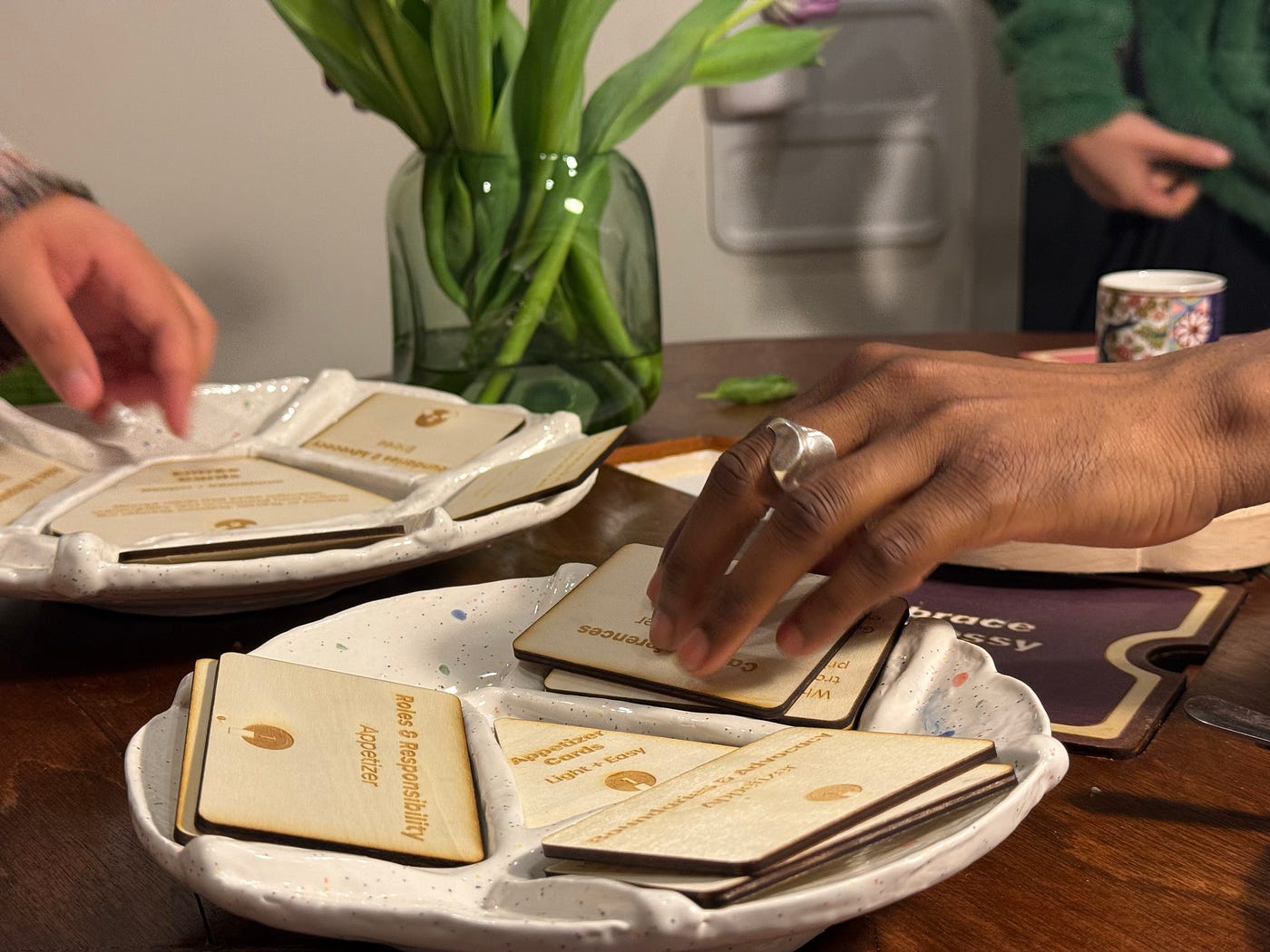
The first level is the Appetizer. These conversation cards are served on appetizer plates and introduce lighter questions around care preferences, boundaries, responsibilities, and advocacy. The appetizer-level prompts help participants ease into conversations about care, aging, and how they want to show up for one another.
The second level is the Entrée. These prompts are served on entrée-level plates and invite people to get more personal, if they are ready. They ask more direct questions about how people prefer to be cared for, what roles and responsibilities exist within the chosen family, and how people would want their chosen family to advocate for them.
The entrée prompts are also paired with food-based gestures. These gestures invite participants to toast, offer, serve, or pass something to someone at the table in response to the question. For example, if a prompt asks who you would want to call if you were in danger, in the hospital, or recovering from top surgery, you might toast to the people you would want by your side and explain why.
3. Carry Something Forward

Finally, the experience ends with Carry Forward cards. These cards are designed to capture anything important that emerges during the conversation. Each card includes four possible areas to record: a need someone shared, a boundary someone named, an offer someone made, or a topic the group wants to return to.
Participants write these moments down, place the cards on the shared plate, read them aloud to the group, and then each person takes one card as a takeaway.
It may seem small, but this physical takeaway becomes a reminder of how people showed up for one another, what expectations were named, and what care can look like moving forward. It creates a small but meaningful callback to the conversation and to the ongoing work of caring for chosen family.
Impact
I’ve shared glimpses of Who’s At Your Table? with other queer folk, instructors, and people interested in conversational engagement, and I’ve received a lot of meaningful feedback and excitement.
I’m excited to put it out into the world, and I know I want this thesis to grow beyond SVA. I don’t want it to be a product that stays within the confines of this program and year and dies within it.
This summer, I plan to reach out to more queer people, queer communities, and gathering spaces where this work can be tested, played with, and expanded. Isn’t that part of the point of thesis: to get the work out there and see how it lives with people?
This thesis is near and dear to me. Blood, sweat, and tears were quite literally shed in order to produce this experience. One affirming aspect of this thesis that kept me going was hearing how many people really believe this is necessary and needed.
Not that validation is required for me to be motivated to work on a project, but I will say, hearing from other queer folk how this table is a perfect reflection of chosen family, or how this table could be a great experience for queer folk experiencing ruptures, is something that really warmed my heart.
Lesson & Takeaway
As I end this semester and wind down from the stress of thesis and exhibition duties, I can’t help but think about this amazing journey I’ve been on.
I recall back in my undergrad experience, designing an app called Amalgi. During COVID, I noticed how a lot of queer people were using crowdfunding in order to get aid during a time of isolation, the general unknown of a pandemic, and tensions around over-policing, police brutality, and overt racism. I created an app specifically for queer folk and their safety to crowdfund.
I recall thinking about the Jeremie from all the way back then, who really believed in the power of design to connect, and how that power of design and those skill sets grew into an experience to help support those conversations with this project. It’s almost like an evolution, and I get a bit emotional thinking about that.
I love design, and this thesis has made me really feel like I am capable of being a designer. I know it sounds weird. I’m in a master’s program, after all. Two years. But seeing the through line of this project from my undergrad in interaction design back then to now takes away my anxieties and apprehension around whether design was for me or whether I was capable of being a good designer.
I learned how to navigate the woodshop with the amazing help of the staff at the Visible Futures Lab, or VFL, at SVA. I sawed, sanded, glued, stained, and polyurethaned everything intentionally. I laser-cut, UV-printed, and painted. I utilized ceramics and the beautiful power of clay to mold the containers for these conversational cards.
I designed a dinner, and I queered a setting where I often felt uncomfortable, where I couldn’t be myself, or where I had to repress my sexual identity, and turned it into a place where queer people could actively talk about those experiences with people they care about.
I am truly proud of this project, and I want to push it further. I am very thankful for all the help, motivation, feedback, and challenges provided to me. I am very grateful for the peers I have who supported me and lent their shoulders and their ears.
I am grateful for the experiences of Jeremie of the past, who, while dealing with houselessness and a potential major change in his trajectory, allowed me to utilize that experience to build something to support queer people going through something similar.
I can truly say that I am proud of this thesis, and this is work that will continue. And when I think about myself as a designer, this thesis is a perfect representation of what I stand for and what I think design can stand for.

메타데이터
- post_id
- 7f1a792d8eb3
- slug
- whos-at-your-table-7f1a792d8eb3
- url
- https://medium.com/@jcandio/whos-at-your-table-7f1a792d8eb3
- canonical_url
- https://medium.com/@jcandio/whos-at-your-table-7f1a792d8eb3
- author_url
- https://medium.com/@jcandio
- status
- ok
- fetched_at
- 2026-06-09 15:37:30