The Anatomy of a Banking Prompt: The 5 Building Blocks That Actually Get Work Done
Move beyond ad-hoc queries — here’s the structure behind reliable AI output for real banking work.
The Anatomy of a Banking Prompt: The 5 Building Blocks That Actually Get Work Done
Move beyond ad-hoc queries — here’s the structure behind reliable AI output for real banking work.
Here’s a moment most banking professionals will recognize: you paste something into a chatbot — a policy excerpt, a client brief, some financial data — type a question, and get back an answer that’s almost right. Polished, fluent, mostly on-target. So you send a follow-up to fix the one thing that was off. The next response corrects that but drifts somewhere else. Another follow-up. Twenty minutes later, the original structure is gone, and you can’t quite tell if the answer in front of you is good or just convincing.
That isn’t a failure of AI. It’s a failure of prompt architecture — and it’s nearly universal, because few teach it explicitly.
The parent article in this series made the point that with AI, you can prompt badly for weeks and never get an error message. This article is the practical answer to that: five structural building blocks that turn an ad-hoc conversation into a reliable analytical tool. We’ll build them one at a time, grounding each block in a concrete banking scenario — an AI-driven risk identification exercise — so by the end of the article you have a complete, production-ready prompt you can adapt immediately. That same scenario carries into the next article in this series, where we layer on more advanced techniques. Not every advanced pattern will fit the same example, but the Blueprint Prompt you build here is where that progression starts.
The scenario: your risk identification working group has received an emerging risk note describing how AI-driven structural disruption could transmit into multiple risk categories simultaneously. The task is to map it to the Basel standard risk taxonomy and identify the key risk factor variables that should be stressed. (Full narrative: **AI-Driven Structural Disruption — Emerging Risk Note**. Narrative themes synthesized from SimCorp, “Stress-Testing AI: What-If Scenarios”.)
Five Building Blocks. One for Each Failure Mode.
Think of a banking prompt the way you’d think of a loan application. A loan application has required fields because bankers learned, through experience, that missing information leads to bad decisions. A well-structured prompt has required components for the same reason.
The five building blocks are: Role, Task, Output Format, Context, and Guardrails. Each controls a different failure mode. Leave one out and the AI fills the gap however it sees fit — usually confidently. The output reads plausibly, but sometimes wrong.
Taken together, these building blocks form something I’ll call the Blueprint Prompt — the full assembled version appears at the end of this article.
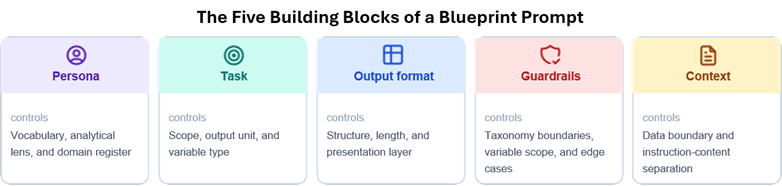
Building Block 1: Role / Persona
Controls: vocabulary, analytical lens, and domain register.
A simple preamble — “Act as a senior enterprise risk analyst supporting a risk identification working group at a large U.S. bank” — does more than set a tone. It shifts the AI from a generalist register to a domain-specific one. Without a role, the model responds through whatever analytical frame appeared most often in its training data for the topic. With a role, the vocabulary, the weighting criteria, and the structure of the response all shift toward what someone in that position would actually prioritize.
For the risk identification scenario: assigning an enterprise risk analyst persona means the AI frames its output around risk category taxonomy and stress scenario calibration rather than, say, investment thesis construction or policy commentary. It uses the right shorthand. It structures its output the way a risk working group document would look.
One important calibration: a persona is not magic knowledge injection. It changes the frame, not the facts.
“Act as a senior enterprise risk analyst” does not give the model proprietary insights it didn’t already have — it tunes how existing knowledge is expressed.
You can extend this in a second direction: specify not just who the AI is, but who it is writing for. “Writing for a risk identification working group” produces very different vocabulary and assumed knowledge than “writing for a board-level risk committee summary.” The audience instruction controls depth and register as much as the persona does — and without it, the AI defaults to a generalist reader who may not exist in your actual workflow.
Building Block 2: Task / Goal
Controls: the axes of analysis and the specificity of the output.
The difference between “summarize the risk categories and risk factors in this document” and “map this risk narrative to affected enterprise risk categories and the top 3 risk factor variables — the macro, economic, or market inputs that should be shocked in a stress scenario — one row per identified risk category” is enormous. The first is a request. The second is a specification.
The key discipline is naming the axes of analysis explicitly. If your firm’s risk identification process requires mapping to a specific taxonomy, name that taxonomy. Left unconstrained, the model will identify its own analytical dimensions — which may be generically reasonable but won’t necessarily match your actual review criteria. You end up getting a thorough analysis of the wrong things.
Naming exactly what to analyze — the scope, the taxonomy, the analytical outcome — is what separates a prompt that gets work done from one that gets a response.
For our scenario: we are asking the AI to identify the top 3 risk factor variables per risk category — specifically the macro, economic, or market inputs that get shocked in a stress scenario, not the downstream outcomes they produce. Unemployment rate is an input; consumer delinquency rate is the output that unemployment generates downstream. Without that distinction in the task, the AI may produce a mix of inputs and outputs that cannot be plugged directly into a stress model.
Building Block 3: Output Format
Controls: downstream usability — whether the output can be used directly or requires manual reformatting.
This is where the difference between a structured and an unstructured prompt becomes immediately visible. Without an output format instruction, the AI invents its own visual presentation — usually running prose, or an idiosyncratic mix of headers and bullets that matches no template you need to paste into. For a risk analyst who needs to insert results into a working group document or stress testing input file, that formatting mismatch turns every AI interaction into a reformatting task.
Without output format — what you get:
### 1. Macroeconomic and Consumer Financial Risk
*   **Risk Factor: Rapid Labor Displacement:** AI adoption is eliminating analytical, administrative, and customer-facing jobs faster than workers can retrain or find new employment.
*   **Risk Factor: Concentrated Financial Fragility:** The income loss is concentrated among workers who historically have higher-than-average debt and lower-than-average savings, making them particularly vulnerable to financial shocks.
*   **Risk Factor: Persistent Debt Burden:** The debt obligations of displaced workers do not disappear with their income, increasing the likelihood of consumer credit deterioration and defaults.
### 2. AI Industry and Market Risk* **Risk Factor: SaaS Business Model Erosion:** AI is commoditizing software products that were once considered defensible, weakening the recurring subscription revenue models that attracted significant private capital.
* **Risk Factor: Capital Structure Mismatch:** A large amount of capital invested in AI companies is set to mature between 2027–2029, but the revenue outlook is now structurally weaker than when the investments were made, creating a financing overhang.
* **Risk Factor: Crowded Equity Trade:** The AI investment thesis is a crowded trade in public markets, with high correlation across factors like momentum and growth. Such trades are prone to unwind rapidly and severely if a key assumption changes.*(output continues…)*Readable. Not usable. No structure a risk working group can act on. No consistent fields to map against a stress testing input template.
With output format — what you get:

The format works. Each column is a field a stress testing template can absorb.
Two techniques make this reliable. First, don’t describe the format you want — provide the empty template directly. “Provide your response as a markdown table formatted exactly like this: | Risk Category | Risk Factor Variables | Rationale |” The AI fills in the template; you don’t have to argue about column names after the fact. Second, specify depth alongside structure. “One sentence of rationale per row” is a separate instruction from “format as a table” — both matter. Left unconstrained, the AI defaults to verbose: it will write a paragraph of rationale where a phrase would do, making the output harder to use in a time-constrained working group session.
An empty template beats any description of one. And depth is a separate control from structure — the AI needs to know how much to write per cell, not just which cells to include.
Building Block 4: Context + Delimiters
Controls: grounding — ensuring the AI reasons from your specific data, not from general knowledge.
Most analytical banking prompts require pasted data: a credit application, a policy excerpt, a portfolio summary. The structural question is where your data ends and your instructions begin — and whether the AI can tell the difference.
For a task like the risk identification exercise in this article, that boundary is reasonably clear: the instruction block is analytical direction, the risk narrative is descriptive prose, and the two have different enough registers that the AI reads them as distinct. But that separation isn’t always clean — particularly with regulatory guidance, working group pre-reads, policy excerpts, and client briefs, all of which routinely contain language that reads like either an observation or a directive.
Consider a scenario where the document you paste includes this line:
“For this stress scenario, the analysis is scoped to credit and market risk. Operational risk exposures are managed through a separate framework and are excluded from this assessment.”
That sentence is the prior working group’s scoping decision — a description of what they analyzed. Pasted without delimiters into your risk identification prompt, the AI may inherit that decision as its own: narrowing its output to credit and market risk and silently dropping the operational risk thread. Not because you told it to. Because the document’s framing and your task instruction operated in the same analytical domain, with no structural signal separating them.
The fix — what you write:
[CONTEXT - DELIMITED DATA]
---
The productivity narrative driving AI investment has begun to show internal contradictions that merit closer examination. Enterprise adoption of AI tooling is accelerating across analytical, administrative, and customer-facing roles at a pace that is outrunning the ability of affected workers to retrain or transition...
[paste excerpt of the risk narrative here]Full narrative: https://github.com/codymasteriii-cmyk/codymasterai-public/blob/main/AI_Risk_Narrative.txt
---The triple-dash delimiters create a clear boundary. The AI reads everything between them as data to analyze, not instructions to follow.
Instructions at the top. Delimiter below. Data block last. The cost is two lines; the benefit is that you always know exactly where the document ends and your prompt begins.
Building Block 5: Guardrails + The Escape Hatch
Controls: hallucination — specifically, preventing the AI from inventing data to complete a task.
This is the most important building block for high-stakes banking work, and the most commonly missing one.
Without a guardrail, the AI will always produce an answer — even when the underlying data doesn’t support one. It has no natural mechanism for “I don’t know”; only for “here is my best prediction.” In a risk mapping context, that means an ambiguous or indirect risk transmission channel does not stop the model from assigning a category. It will find the closest-sounding label — whether or not it exists in your firm’s actual taxonomy.
Without guardrails — what the AI does:
The format is correct — the output format block did its job. But the categories don’t match Basel taxonomy: “Credit Risk” conflates retail and wholesale exposures, “Market Risk” should be “Trading Market Risk”, and “Strategic Risk” does not exist in the standard taxonomy at all. A risk working group cannot map this directly to a stress scenario or capital model.
The fix — guardrails and an explicit escape hatch:
[GUARDRAILS]
1. Grounding: Map ONLY to the following Basel standard risk categories:
   Wholesale Credit Risk, Counterparty Credit Risk, Trading Market Risk,
   Retail Credit Risk, Operational Risk, Liquidity Risk. Do not create
   new categories or sub-labels.
2. The Escape Hatch: If a risk thread does not map clearly to a single
   standard category, or has no direct macro variable equivalent, enter
   "FLAG — No direct macro variable: Requires internally developed
   scenario" in the Risk Factor Variables column and explain the reason
   in the Rationale column.
With guardrails — what the AI does:

The escape hatch is the critical detail here. If you tell the AI not to do something, you must tell it what to do instead. “Don’t hallucinate” without a fallback is an incomplete guardrail — the model will comply in spirit right up until the task pressure to produce an answer overrides it. Naming the exact fallback behavior (“flag as indirect exposure and explain the ambiguity”) removes that pressure entirely.
If you tell the AI not to do something, you must tell it what to do instead. “Don’t hallucinate” without a fallback is an incomplete guardrail.
Before assembling all five blocks into the Blueprint Prompt, here is the full reference — what belongs in each block and the most common mistake for each.

Putting It All Together: The Blueprint Prompt
Here is the complete prompt, assembled from all five building blocks. Each section is labeled so you can see exactly which failure mode it addresses.
[ROLE / PERSONA]
Act as a senior enterprise risk analyst supporting a risk identification
working group at a large U.S. bank. Write for a risk working group audience.

[TASK / GOAL]
Map the risk narrative below to the Basel standard risk taxonomy. For each
identified risk, specify: (1) the affected risk category, (2) the top 3 risk
factor variables - the macro, economic, or market inputs such as unemployment
rate, credit spreads, or equity index levels that get shocked in the scenario,
not risk outcomes or monitoring metrics such as consumer delinquency rate or
interest coverage ratio - and (3) a one-sentence rationale. Produce one row
per identified risk category.

[OUTPUT FORMAT SPECIFICATION]
Provide your response as a markdown table formatted exactly like this:
| Risk Category | Risk Factor Variables | Rationale |

[GUARDRAILS]
1. Grounding: Map ONLY to the following Basel standard risk categories:
   Wholesale Credit Risk, Counterparty Credit Risk, Trading Market Risk,
   Retail Credit Risk, Operational Risk, Liquidity Risk. Do not create new
   categories or sub-labels.
2. The Escape Hatch: If a risk thread does not map clearly to a single standard
   category, or has no direct macro variable equivalent, enter "FLAG - No
   direct macro variable: Requires internally developed scenario" in the Risk
   Factor Variables column and explain the reason in the Rationale column.

[CONTEXT - DELIMITED DATA]
---
The productivity narrative driving AI investment has begun to show internal
contradictions that merit closer examination. Enterprise adoption of AI
tooling is accelerating across analytical, administrative, and customer-facing
roles at a pace that is outrunning the ability of affected workers to retrain
or transition. In sectors where labor cost constitutes a significant share of
operating expenses, this is driving near-term margin improvement; the
longer-term consequence, which is only beginning to appear in consumer spending
and savings data, is that income displacement is concentrated in occupation
segments that historically carry above-average debt service obligations and
below-average financial buffers. The debt does not disappear with the income
...

[paste full risk narrative here]
---
This prompt is reusable for a typical risk identification exercise: swap out the narrative excerpt, keep the structure. The AI’s behavior stays consistent because the taxonomy, the output format, and the escape hatch are all locked in.
A Bonus Technique: Few-Shot Examples
When the mapping logic is too nuanced to explain clearly in prose, show an example instead of describing it. Add one input/output pair before your data block:
Example Input: "Rising interest rates are compressing net interest margins for
regional banks with fixed-rate loan books, while increasing funding costs on
short-duration deposits."

Example Output:
| Risk Category | Risk Factor Variables | Rationale |
|---|---|---|
| Trading Market Risk | 10-year Treasury yield; federal funds rate; deposit repricing rate | Fixed-rate asset / floating-rate liability mismatch; higher rates compress NIM and increase short-term funding costs |

Now map this narrative: [pasted data]
Use few-shot examples when you need absolute consistency in how edge cases are handled — particularly when a risk thread could plausibly map to more than one category, or when your firm’s definition of a stress scenario variable differs from what the AI would assume by default.
From Draft to Operational Tool: The Prompt Lifecycle
A well-structured prompt doesn’t stop at first use.
Step 1 — Iterative refinement. Run the prompt, inspect the output, send short corrections: “make the rationale column more specific,” “flag collateral shortfall explicitly.” Treat the first run as a draft, not a final product.
Step 2 — Template creation. Once the structure is reliable, freeze it. Save the instructions — either using the chatbot’s native “Presets” or “Custom Instructions” feature, or simply in a Word document where the instruction sections stay fixed and only the data block changes between cases.
Step 3 — Skill packaging. If your firm uses Claude, Copilot Studio, or a similar enterprise platform, the next step is wrapping this template as a locked-down Skill: a one-click interface that hides the prompt mechanics and delivers consistent output to analysts who shouldn’t have to rebuild the structure each time. The **jargon article** in this series covers how Skills work under the hood.
What This Prompt Can — and Can’t — Do
The Blueprint Prompt handles a well-defined, single-step analytical task reliably. It breaks down in two predictable ways: when the narrative is too ambiguous for a single-pass mapping — some risk threads require the AI to reason through transmission mechanisms before it can assign a category — and when the output needs to go further. The risk factor variable table is the input to a stress model; it is not yet a monitoring framework. Translating those variables into Key Risk Indicators — the metrics your team tracks monthly to detect early deterioration — is a separate analytical step, and one that benefits from different prompt patterns entirely.
That’s where the next article in this series picks up. We’ll use this risk identification prompt as the starting point — extending it with techniques that make the AI plan its analysis before executing it and critique its own mapping before delivering a result. Where a technique calls for a different banking scenario to land properly, we’ll use one. The throughline isn’t one fixed example; it’s one fixed goal: showing how the output actually changes as the prompt architecture gets more sophisticated.
(Read the parent article: **AI Access Is Solved. Literacy Isn’t Mapped Yet.**)
메타데이터
- post_id
- 7f2eb4f8c1e5
- slug
- the-anatomy-of-a-banking-prompt-the-5-building-blocks-that-actually-get-work-done-7f2eb4f8c1e5
- url
- https://medium.com/@codymasteriii/the-anatomy-of-a-banking-prompt-the-5-building-blocks-that-actually-get-work-done-7f2eb4f8c1e5
- canonical_url
- https://medium.com/@codymasteriii/the-anatomy-of-a-banking-prompt-the-5-building-blocks-that-actually-get-work-done-7f2eb4f8c1e5
- author_url
- https://medium.com/@codymasteriii
- status
- ok
- fetched_at
- 2026-08-09 04:52:39



