The $8.4 Million Entry Fee: Why Ordinary Americans Can’t Run for Senate
The median senator’s net worth of $4.4 million dwarfs the typical American household’s $192,700 — and the gap is only growing
The $8.4 Million Entry Fee: Why Ordinary Americans Can’t Run for Senate
The median senator’s net worth of $4.4 million dwarfs the typical American household’s $192,700 — and the gap is only growing
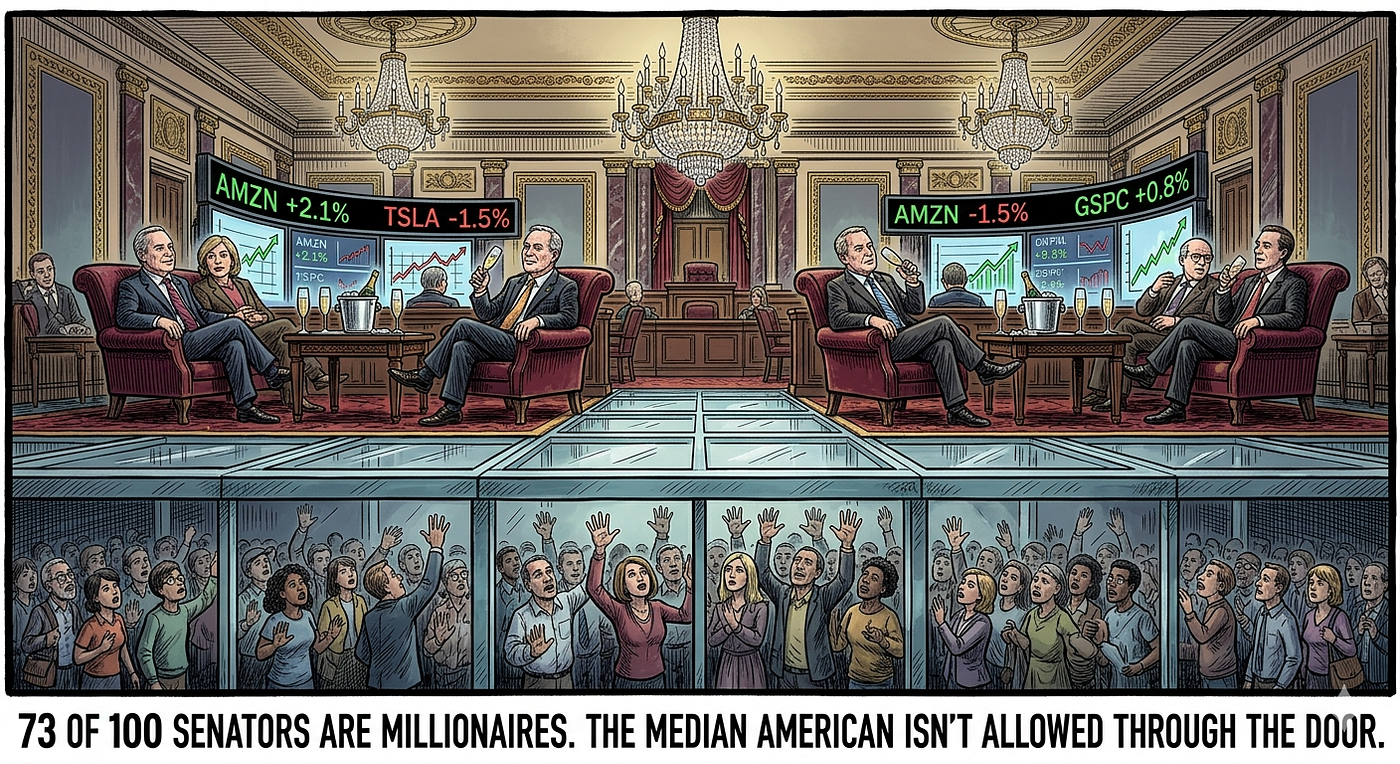
Image created by the using AI
There’s a number that should bother you. Not the national debt, not the price of eggs — though God knows those are keeping plenty of people up at night. The number is 73.
Seventy-three of the 100 sitting U.S. senators are millionaires. At minimum. According to a NOTUS analysis of their most recent financial disclosures, at least 73 have a median net worth exceeding $1 million. Meanwhile, UBS’ 2025 Global Wealth Report puts the millionaire share of the American population at around 7%. So the institution designed to represent everyone is, by a factor of ten, wealthier than everyone it represents.
I didn’t find this shocking at first. Of course senators are rich; they always have been. But the scale of it stopped me cold. The median net worth of a sitting senator is nearly $4.4 million. The Federal Reserve’s most recent Survey of Consumer Finances puts median American household net worth around $192,700. That’s a ratio of more than 20 to 1 — and it gets worse when you look at who’s sitting at the top of that distribution. This isn’t a statistic. It’s a diagnosis.
The velvet rope republic
Think of the Senate less as a legislative body and more as an extremely exclusive membership club — one where the application fee alone disqualifies most Americans before they’ve written a single word.
Running a Senate campaign in 2024 cost an average of $8.4 million, according to OpenSecrets. In competitive races, that number became almost surreal: the Pennsylvania contest between Bob Casey and Dave McCormick burned through more than $100 million combined when outside spending is included. A Republican lobbying strategist put it bluntly: “You need a mountain of sugar, and you can either do it with a shovel and build a mountain to run a competitive Senate race, or you can hand these politicians a teaspoon.”
A teaspoon. That’s the democratic process, for a nurse from Tucson or a teacher from Toledo who might actually know what it feels like when the electric bill and the grocery run land in the same week. The system doesn’t just disadvantage ordinary people. It functionally removes them from consideration before the race even starts.
And the extremes are genuinely staggering. Senator Jim Justice of West Virginia — coal billionaire, former governor, owner of the famous English bulldog Babydog who has somehow become a political mascot — carries a median net worth of nearly $1.3 billion. The median household net worth in West Virginia is approximately $18,000. He commutes to Washington on a private jet.
Ohio’s Bernie Moreno: a net worth estimated in the tens to hundreds of millions, representing a state with a $54,000 household median. Florida’s Rick Scott, who built his fortune running a health-care company before two terms as governor and two Senate campaigns, disclosed a median net worth of $578.9 million.
These aren’t public servants who happened to do well. They’re members of a financial aristocracy who happen to hold public office. That distinction matters more than it might seem.
You legislate what you know
Senator Chris Van Hollen of Maryland is one of only 11 senators whose net worth falls below the median household net worth of his own state. His reported figure, excluding home equity, is $7,500. Seven thousand five hundred dollars. He couldn’t buy a reliable used car with his liquid assets — yet he sits in the same chamber as people whose portfolios outpace the GDP of small nations.
Van Hollen has been direct about what this means: “The Senate is packed with multimillionaires, and the fact is some of them have lost touch with the real world challenges faced by Americans all over the country. It is part of the reason that we have a tax system that favors people who make money off of money and penalizes those who earn a paycheck through hard work.”
Here’s what struck me about this: it’s not just that senators are wealthy. It’s that their wealth shapes the world they build for the rest of us. The carried interest loophole — which lets hedge fund managers pay lower tax rates on their earnings than nurses pay on their wages — has survived decades of bipartisan criticism. It even emerged largely intact from the 2025 budget reconciliation debates, despite presidential rhetoric suggesting otherwise.
Senatorial wealth grows through two tax advantages. First, the preferential rate on long-term capital gains taxes investment income far more lightly than wages. Second, the step-up in basis at death allows heirs to inherit assets without ever paying capital gains taxes on the appreciation — a giveaway that has survived every serious reform effort in living memory.
When the people writing the tax code are the people most generously rewarded by its most favorable provisions, the resulting code shouldn’t surprise anyone.
Sixty-four percent of voters describe the cost of living as a very serious problem, according to recent polling. For 73 out of 100 senators, inflation is an abstraction — a talking point, not a choice between the electric bill and the grocery run. And yet these are the people designing the economic architecture that governs 335 million American lives.
The trading floor beneath the capitol dome
If all of this were merely about background and biography, it might be forgivable — an unfortunate byproduct of what campaigns cost. But it’s not just background. It’s an ongoing, active enterprise.
More than 100 members of Congress have made roughly 10,000 stock trades annually since at least 2021. And they tend to beat the market. In 2024, dozens of members from both parties outperformed the S&P 500, with Democratic lawmakers posting average returns around 31% and Republicans around 26%, against the index’s 24.9% rise.
But the rank and file aren’t even the most striking part. A working paper from the National Bureau of Economic Research, produced by researchers at Columbia University and Xi’an Jiaotong-Liverpool University, found that congressional leaders outperform backbenchers by up to 47 percentage points per year.
Not 47% total returns. Forty-seven percentage points of annual outperformance over their own colleagues — people who are themselves already beating the market.
The mechanism is almost elegant in how cynical it is. Before ascending to leadership, future leaders underperform the market alongside their peers. After their ascension, trajectories diverge immediately and sharply. Leaders’ trades begin outperforming matched peers by roughly 40 to 50 percentage points annually.
The control group — peers who didn’t rise to leadership — shows no comparable improvement. The researchers concluded that congressional leaders “may not only trade on privileged knowledge, but also shape policy outcomes to enrich themselves.”
So: if you or I traded on material nonpublic information obtained through our jobs, we’d be prosecuted for securities fraud. Martha Stewart served five months in federal prison for obstruction charges tied to a single trade worth about $51,000. Raj Rajaratnam got 11 years. Congressional leaders — the people with the most consequential nonpublic information in the world — trade with legal impunity.
The examples have become so brazen they’ve stopped generating the outrage they should. In early April 2025, Representative Marjorie Taylor Greene executed purchases of between $21,000 and $315,000 in stock on April 8 and 9 — the day before and the day of President Trump’s announcement of a 90-day tariff pause that triggered a historic single-day market rally. She attributed it to a standing investment strategy. Maybe her explanation is true. But in a democracy that depends on institutional trust, looking corrupt is almost as damaging as being corrupt.
During the 2023 CHIPS and Science Act debates — legislation directing tens of billions to domestic semiconductor manufacturers — members held or traded Nvidia stock. During 2024 debates over TikTok’s fate, members traded shares in competing social media platforms whose valuations depended directly on TikTok’s survival. And in the window between early February and early April 2020, while senators were receiving classified COVID briefings and publicly downplaying the threat, twelve senators executed 227 stock transactions totaling up to $98 million.
The enforcement apparatus is, not to put too fine a point on it, a joke. The STOCK Act requires disclosure within 45 days. More than 78 members of the 117th Congress violated it. The fine for late filing: $200. The parking surcharge at Reagan National Airport costs more. No member of Congress has ever been prosecuted under the STOCK Act. Not one.
What cynicism costs
So here’s the question every analysis eventually has to face. Why should a family in Dayton or Des Moines care about senatorial portfolios? Because cynicism isn’t free. We’re paying for it in the currency of democratic legitimacy, and the bill is coming due.
Congressional approval stood at 15% in Gallup’s March 2026 tracking. Only 20% of Americans report a great deal or quite a lot of confidence in Congress. Research from UC San Diego’s Rady School of Management found that public awareness of congressional stock trading directly erodes institutional trust — and that erosion carries real, cascading consequences.
As researcher Tage Rai put it: “When people no longer believe their leaders are acting fairly, it becomes harder for them to justify following the rules. That’s not just a political problem. It’s a democratic crisis.”
This is the damage that doesn’t register on any stock ticker. When citizens perceive government as a wealth-extraction operation run by and for the already wealthy, they disengage. They stop voting. They stop believing. A democracy without believers is eventually just an expensive set of buildings with a flag on top.
The ban that cannot pass
Here’s the cruelest part: meaningful reform commands enormous public support — and cannot pass.
Polling consistently puts support for banning members of Congress from trading individual stocks at 60 to 70 percent, often higher, across party lines. This is one of the only issues in contemporary American politics with genuine bipartisan public consensus. And yet the ETHICS Act, the TRUST in Congress Act, the Bipartisan Ban on Congressional Stock Ownership Act — each has been introduced, debated, and allowed to die quietly.
The bills that have actually advanced are calibrated to change as little as possible while generating the appearance of action. The version closest to passing as of 2025 would let members retain stocks owned at election, permit sales with seven days’ public notice, and allow unlimited trading in diversified funds, commodities, and futures.
It would, in essence, permit members to keep doing most of what they currently do with slightly more paperwork. It’s the legislative equivalent of banning bank robbery while letting the robber keep whatever’s already in the bag.
The structural incentives are perfectly perverse. The members who benefit most from the current system are exactly the ones with the institutional power to block reform. Committee chairs, party leaders, the people whose trades show the most striking patterns of outperformance — these are the people who control the legislative calendar.
Asking them to schedule a vote on their own trading prohibition is asking them to voluntarily surrender one of the most lucrative perquisites of their position. The $200 fine isn’t an oversight. It’s a policy choice.
What an aristocracy looks like before anyone names it
Aristocracies don’t announce themselves. They don’t arrive in ermine robes with proclamations. They accumulate quietly — through advantages that compound across elections, legislative sessions, and investment cycles.
The Roman Senate became a wealthy men’s club long before the Republic collapsed under the weight of its own contradictions. For centuries, the British Parliament was a gentlemen’s club for landowners. And it didn’t change because the gentlemen decided to reform themselves — it changed because ordinary people demanded it, loudly and long enough.
The U.S. Senate of the Gilded Age was literally called “the Millionaire’s Club,” and it took decades of progressive organizing, muckraking journalism, and eventually the Seventeenth Amendment in 1913 — establishing direct popular election of senators — to begin addressing its worst tendencies.
Today’s Senate is richer, relative to its citizens, than at any comparable period in American political history. And crucially, while typical American household wealth contracted sharply after 2008 and recovered only partially and unevenly, congressional net worth moved in a different direction entirely. The divergence between the people who make the rules and the people who live under them hasn’t narrowed. It has widened.
A Senate populated overwhelmingly by millionaires is structurally less capable — not just intellectually, but viscerally — of understanding what it means to carry a medical debt that takes a decade to resolve. To work two jobs and still fall further behind. To look at a mortgage rate as a verdict on whether your family will ever own a home.
The researchers described it with clinical restraint: “political power and private portfolios are uncomfortably intertwined.” Uncomfortably. What a careful word for what is, at its core, a slow-motion crisis.
The question that won’t go away
Money was the entry point. But money isn’t the point. The point is representation — the first principle of the American experiment, and the one most at risk.
The Constitution doesn’t require senators to be poor. It doesn’t demand renunciation of wealth. But it does require representation. And representation without resemblance — without the capacity to feel what constituents feel, to fear what they fear — isn’t representation in any meaningful sense. It’s theater, performed for an audience that increasingly recognizes it as such.
Seventy-three out of one hundred. A body of millionaires presiding over a nation where 65% describe the economy as not so good or poor. A Senate where members trade millions in stocks tied to legislation they write — and face a $200 fine if they forget to disclose it within 45 days.
A democracy where 80% of the public has little or no confidence in its legislature, and where the legislature, rather than rebuilding that trust, continues quietly compounding the behaviors that destroyed it.
There is a word for a system in which a narrow class governs for the benefit of that same class while maintaining the performance of governing for everyone. The Greeks, who gave us democracy, also gave us the word for its corruption.
They called it oligarchy.
The question for Americans in 2026 isn’t simply whether the Senate contains too many millionaires. The question is whether a body this far removed from the material reality of its citizens — whose leaders may, according to peer-reviewed research, be actively shaping policy to enrich their own portfolios — can still honestly be called a representative institution.
Or whether it has become something else. Something the Founders warned against. Something the public increasingly senses but hasn’t yet found the vocabulary to name.
Seventy-three out of one hundred.
The numbers aren’t ambiguous. They locked the gate from the inside. Deposited the key in a brokerage account. Filed the disclosure a month late. Paid the fine — smaller than a parking ticket — from the spare cash of a career that has made them more than comfortable.
메타데이터
- post_id
- 7f32a7cbcda1
- slug
- the-8-4-million-entry-fee-why-ordinary-americans-cant-run-for-senate-7f32a7cbcda1
- url
- https://medium.com/the-geopolitical-economist/the-8-4-million-entry-fee-why-ordinary-americans-cant-run-for-senate-7f32a7cbcda1
- canonical_url
- https://medium.com/the-geopolitical-economist/the-8-4-million-entry-fee-why-ordinary-americans-cant-run-for-senate-7f32a7cbcda1
- author_url
- https://medium.com/@earlbabson
- status
- ok
- fetched_at
- 2026-06-09 15:37:30