Why Magento Stores Rarely Stay the Same After Launch
Launch Day Is Only the Beginning The Continuous Evolution of a Magento Store
Why Magento Stores Rarely Stay the Same After Launch
Launch Day Is Only the Beginning The Continuous Evolution of a Magento Store
One of the biggest misconceptions in eCommerce is that a website launch marks the end of a project. For Magento merchants, the opposite is usually true. Launching a store is often the point where the most valuable learning begins.
A Magento store may look complete on launch day, but real world customer behavior quickly reveals opportunities for improvement. Businesses gain access to actual user data, purchase patterns, search behavior, conversion rates, and customer feedback. These insights often lead to changes that were impossible to predict during development.
Real Customers Behave Differently Than Expected
Before launch, merchants and developers make decisions based on assumptions, market research, and best practices. Once customers begin interacting with the store, reality often tells a different story.
For example:
- Customers may struggle to find important products.
- Search queries may reveal missing categories.
- Checkout abandonment rates may be higher than expected.
- Mobile users may experience friction points not identified during testing.
- Certain promotional campaigns may attract traffic but generate few conversions.
These discoveries encourage merchants to refine navigation structures, improve product pages, optimize checkout flows, and enhance mobile experiences.
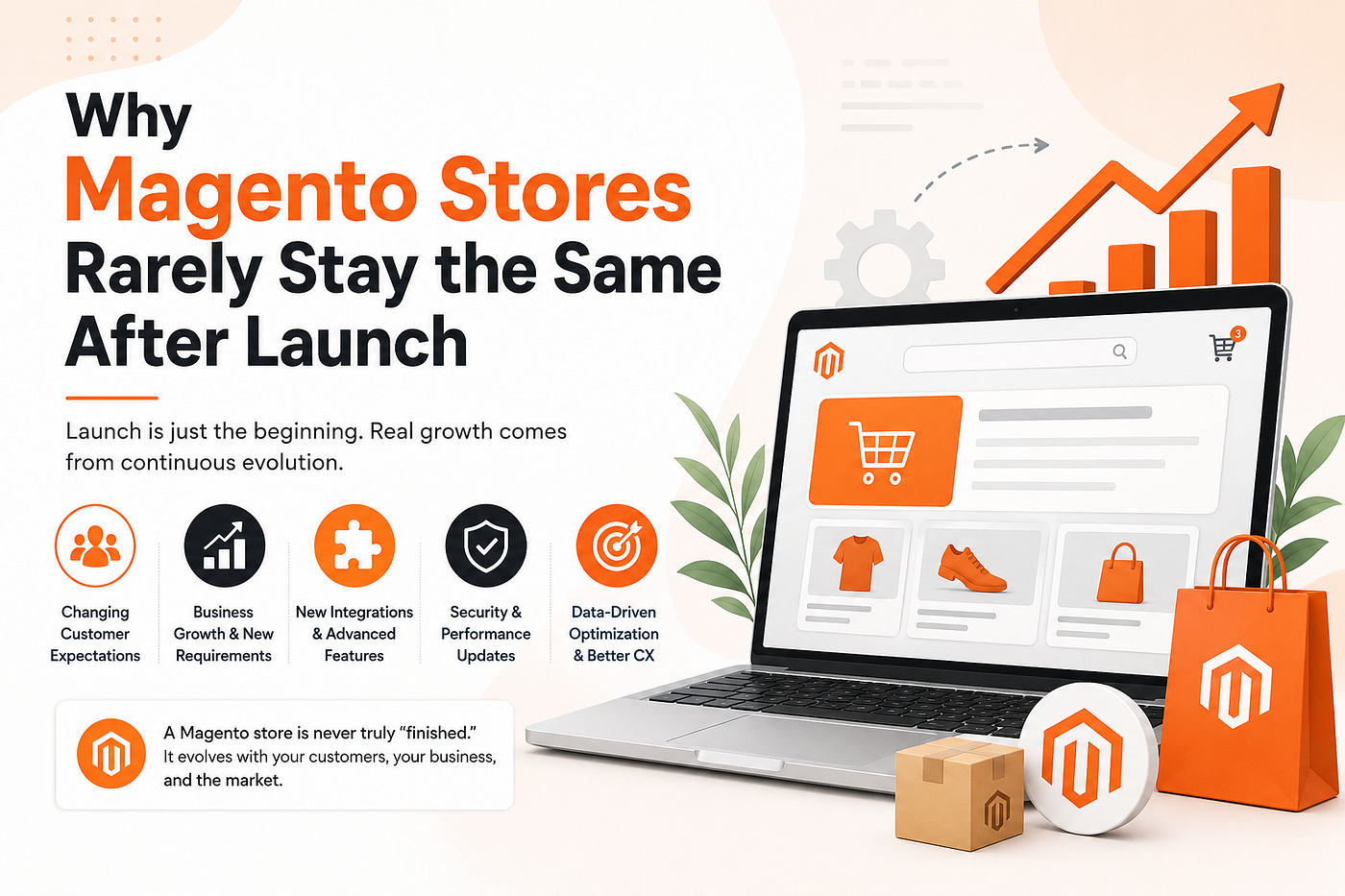
Magento Store same after launch
Business Growth Creates New Requirements
Businesses rarely remain static after launch. As companies grow, their operational needs change.
A merchant who initially sells locally may expand nationally or internationally. This growth can require:
- Additional payment gateways
- Multiple currencies
- Localized content
- Tax rule adjustments
- Advanced shipping methods
- Multi store functionality
Magentos flexibility makes these changes possible, but they often require ongoing development and configuration updates.
As a result, the Magento store gradually evolves alongside the business itself.
Customer Expectations Never Stop Changing
Modern consumers expect more from online shopping experiences every year.
Features that were considered premium a few years ago have become standard expectations today, including:
- Fast loading pages
- Personalized product recommendations
- Simplified checkout processes
- Mobile first experiences
- Real time inventory visibility
- Flexible payment options
Competitors constantly introduce new features, forcing merchants to adapt to remain competitive.
A Magento store that remains unchanged for years risks delivering an outdated customer experience, which can negatively impact conversion rates and customer loyalty.
Marketing Strategies Drive Store Changes
Marketing teams frequently discover new opportunities after launch.
As merchants analyze campaign performance, they may identify opportunities to:
- Create dedicated landing pages
- Improve SEO structures
- Implement advanced analytics
- Launch loyalty programs
- Add promotional tools
- Improve email marketing integrations
Magentos extensibility allows businesses to support these evolving marketing initiatives, but it also means the store continuously changes to align with business goals.
Integrations Become More Important Over Time
Many Magento stores start with only a few integrations. As operations mature, businesses often connect additional systems such as:
- ERP platforms
- CRM software
- Marketing automation tools
- Inventory management systems
- Customer support platforms
- Financial and accounting solutions
These integrations improve operational efficiency but also require ongoing adjustments, testing, and optimization.
Over time, the Magento ecosystem becomes far more sophisticated than it was at launch.
Performance Optimization Is an Ongoing Process
Traffic growth creates new technical challenges.
A store handling 500 visitors per day has very different performance requirements than one handling 50,000 visitors per day.
As traffic increases, merchants often invest in:
- Server upgrades
- Database optimization
- Caching improvements
- Content delivery networks (CDNs)
- Code refactoring
- Extension audits
Performance optimization is rarely a one time activity. It becomes a continuous effort as customer demand grows.
Security and Platform Updates Require Adaptation
Cybersecurity threats evolve constantly. Magento regularly releases security patches, platform updates, and performance improvements.
Ignoring these updates can expose stores to:
- Security vulnerabilities
- Compliance issues
- Performance degradation
- Compatibility problems
Store owners who prioritize long term success regularly review and update their Magento environments to maintain stability and security. Maintaining a secure and high performing Magento store requires more than occasional updates. Regular patch installations, performance monitoring, compatibility testing, and proactive issue resolution are essential for long term success. Businesses that invest in **Magento Maintenance Service** can better protect their stores from security risks while ensuring a stable and optimized shopping experience for customers.
Data Driven Decisions Shape the Future Store
One of Magentos greatest strengths is the amount of business intelligence it can generate.
Store owners can analyze:
- Conversion rates
- Product performance
- Customer lifetime value
- Cart abandonment trends
- Traffic sources
- Search behavior
These insights help businesses make informed decisions about design, functionality, merchandising, and marketing strategies.
The result is a store that looks very different after one year of optimization compared to its original launch version.
The Most Successful Magento Stores Treat Launch as Version 1.0
Businesses that achieve long term success understand that launch day is not the finish line. Instead, it represents Version 1.0 of an evolving digital commerce platform.
The most successful merchants continuously:
- Test new ideas
- Analyze customer behavior
- Improve user experiences
- Optimize performance
- Strengthen security
- Expand functionality
This mindset allows them to adapt to changing customer expectations and market conditions while maintaining a competitive advantage.
Conclusion
Magento stores rarely stay the same after launch because businesses, customers, and technology never stand still. Real world data reveals new opportunities, growth creates additional requirements, and evolving customer expectations demand ongoing improvements.
Rather than viewing post launch changes as unexpected work, successful merchants recognize them as a natural part of eCommerce growth. A Magento store that continuously evolves is better positioned to deliver exceptional customer experiences, support business expansion, and achieve sustainable long term success.
Frequently Asked Questions
Why do Magento stores continue changing after launch?
Magento stores evolve because businesses gain real customer insights, expand operations, implement new technologies, and adapt to changing market demands.
What is the most common post launch Magento improvement?
Checkout optimization, performance enhancements, SEO improvements, and third party system integrations are among the most common updates.
How often should a Magento store be reviewed?
Store performance, security, customer experience, and conversion metrics should be reviewed regularly, with ongoing optimization based on business goals.
Does Magento support long term business growth?
Yes. Magento is highly scalable and flexible, allowing businesses to add new features, integrations, and capabilities as they grow.
Why is continuous optimization important for Magento stores?
Continuous optimization helps improve user experience, increase conversion rates, strengthen security, and ensure the store remains competitive in a changing market.Al
메타데이터
- post_id
- 7f4b176f4e54
- slug
- why-magento-stores-rarely-stay-the-same-after-launch-7f4b176f4e54
- url
- https://medium.com/@madhublogger/why-magento-stores-rarely-stay-the-same-after-launch-7f4b176f4e54
- canonical_url
- https://medium.com/@madhublogger/why-magento-stores-rarely-stay-the-same-after-launch-7f4b176f4e54
- author_url
- https://medium.com/@madhublogger
- status
- ok
- fetched_at
- 2026-08-02 11:09:16