Mortality as a Design Problem: Why Mortality Awareness Shapes Ethics
Modern cultures expend great effort in developing systems that enhance efficiency, production, and economic prosperity. However, one…
Mortality as a Design Problem: Why Mortality Awareness Shapes Ethics
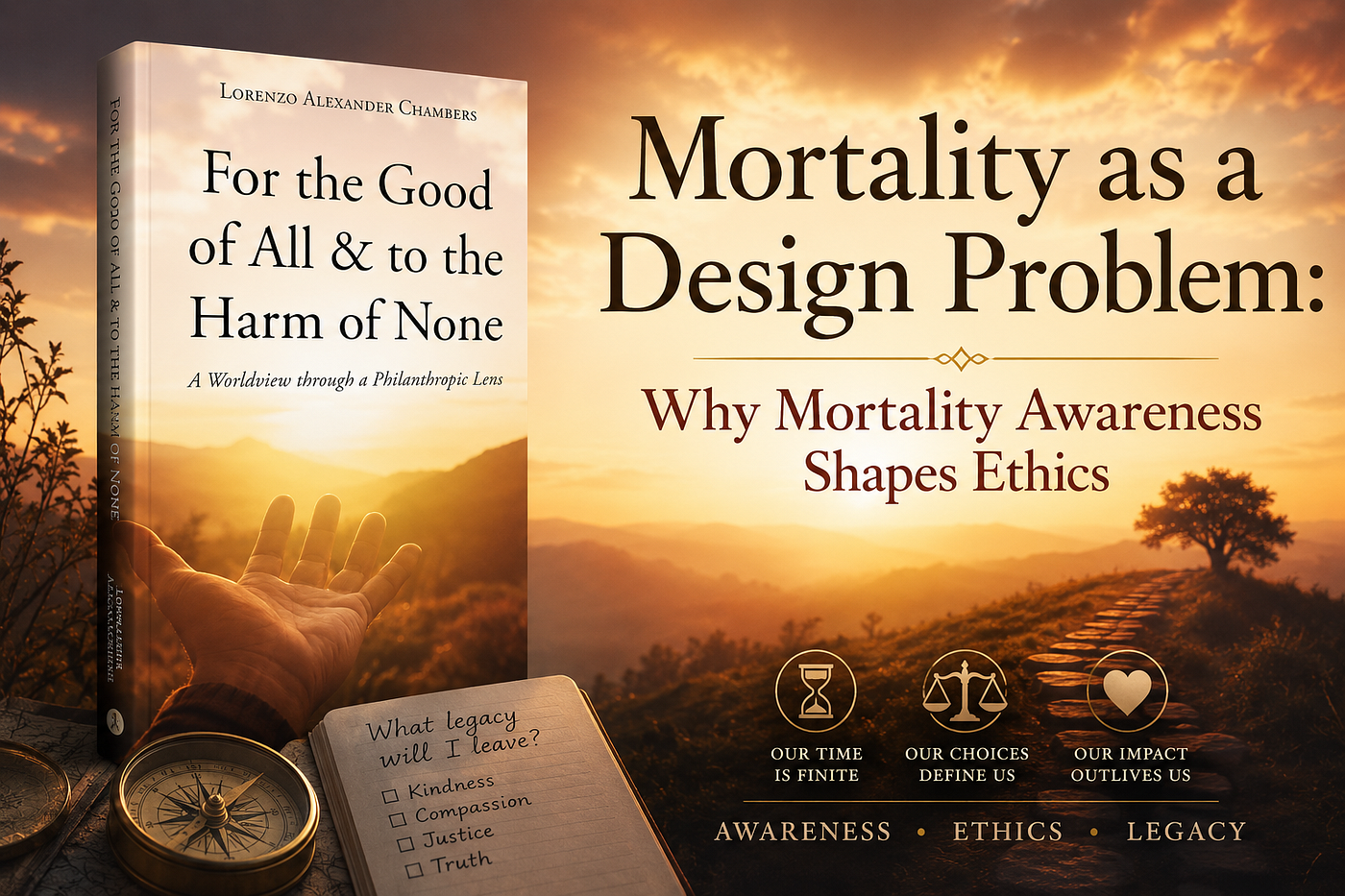
Modern cultures expend great effort in developing systems that enhance efficiency, production, and economic prosperity. However, one reality is rarely regarded as a design principle: death. We organize jobs, institutions, and technologies as if time were infinite, even though every human life has a fixed endpoint. This gap creates a significant philosophical concern. What would change if mortality awareness became a foundation for how we make decisions?
The philosophy of death is not simply about contemplating life’s end. It explores how recognizing mortality influences values, priorities, and responsibility. Lorenzo Alexander Chambers’ book *For the Good of All & to the Harm of None* encourages readers to evaluate how ethical choices affect society as a whole, rather than just individual gain. The core notion is straightforward: when people recognize that life is finite, they may begin to make decisions that outlast themselves.
Why Humans Resist Awareness of Death
Most individuals avoid thinking about dying because it causes emotional anguish. Daily routines, entertainment, and unending aspirations can serve as distractions from the realization that life is fleeting. This avoidance is understandable, but it has repercussions.
Ignoring the awareness of death encourages short-term thinking. People put off crucial conversations, ignore connections, and prefer quick rewards over long-term contributions. Businesses may prioritize quarterly earnings over long-term sustainability. Governments may prioritize policies with immediate political rewards over measures that protect future generations. In this regard, avoiding mortality is more than just a personal habit. It becomes a design defect inside civilization.
Does Mortality Awareness Improve Ethics?
A prevalent concern is that thinking about dying causes more fear and anxiety. While this can happen, philosophy and psychology offer an alternative. Accepting mortality can strengthen behavioral ethics by making individuals more conscious of how their actions affect others. Someone who recognizes that time is limited typically asks the following questions:
· Will this decision matter in ten years?
· Am I creating something worthwhile?
· How will others remember the repercussions of my decisions?
These questions promote temperance, honesty, and accountability. Individuals are more likely to contemplate the long-term consequences of their actions rather than acting solely for self-gain. Mortality awareness does not automatically make people moral, but it provides a powerful reason to act with greater integrity.
When Success Loses Its Meaning
Societies frequently define success in terms of income, status, or influence. These metrics can be useful, but they become distorted when death is excluded.
If people operate as if accumulation is limitless, there is little reason to question whether success promotes human well-being. Endless consumption, unhealthy competitiveness, and environmental neglect become acceptable because the immediate benefits outweigh the long-term consequences.
The philosophy of death challenges this assumption. Every accomplishment lives within the constraints of a finite existence. Recognizing these limitations moves the focus from ownership to contribution. Instead of asking, “What can I acquire?” individuals are asking, “What difference will my actions make after I am gone?”
This move elevates success from personal accumulation to meaningful influence.
Can Systems Without Mortality Produce Long-Term Responsibility?
Every institution reflects certain ideas about human behavior. Systems designed without mortality awareness often reward immediate outcomes while ignoring consequences that emerge decades later.
Financial markets may favor short-term profitability. Political systems usually follow election cycles rather than generational timescales. Even education sometimes prioritizes performance over wisdom.
Designing systems with mortality in mind encourages a unique approach. Policies become more future-focused. Organizations seek both sustainability and profitability. Leaders know that they are temporary stewards, not permanent owners.
This perspective strengthens moral responsibility because decisions are evaluated not only by present benefits but also by their lasting effects.
Legacy: Humanity’s Practical Immortality
People frequently seek metaphorical forms of immortality through families, ideals, institutions, creative endeavors, or acts of service. Individuals pass away, yet their influence can live on through the lives they shape.
Interestingly, realizing that most people will eventually be forgotten can lead to greater humility rather than despair. It shifts the focus away from personal recognition and towards true contribution. Legacy becomes less about preserving one’s name and more about improving the conditions for those who inherit it.
In this way, behavioral ethics becomes less dependent on praise and more closely connected to purpose.
Conclusion
Treating mortality as a design problem alters our understanding of ethics, leadership, and accountability. Mortality awareness is not about becoming obsessed with life’s end. It is about recognizing that limited time lends greater significance to every decision.
The philosophy of death reminds us that finite lives demand thoughtful choices. By embracing the awareness of death, individuals and institutions can strengthen behavioral ethics, deepen moral responsibility, and redefine success in ways that extend beyond personal achievement.
As *For the Good of All & to the Harm of None by Lorenzo Alexander Chambers* suggests, the most meaningful legacy is not escaping mortality but allowing the reality of mortality to guide actions that benefit generations yet to come.
메타데이터
- post_id
- 7f577e20ed7e
- slug
- mortality-as-a-design-problem-why-mortality-awareness-shapes-ethics-7f577e20ed7e
- url
- https://medium.com/@emma.parker_74569/mortality-as-a-design-problem-why-mortality-awareness-shapes-ethics-7f577e20ed7e
- canonical_url
- https://medium.com/@emma.parker_74569/mortality-as-a-design-problem-why-mortality-awareness-shapes-ethics-7f577e20ed7e
- author_url
- https://medium.com/@emma.parker_74569
- status
- ok
- fetched_at
- 2026-08-06 05:09:12