How to Increase Operational Capacity Without Hiring
We Doubled Our Headcount. Delivery Got Slower— and what to fix before the next 15 people walk through the door.
How to Increase Operational Capacity Without Hiring
We Doubled Our Headcount. Delivery Got Slower— and what to fix before the next 15 people walk through the door.
Photo by Dylan Gillis on Unsplash
Yesterday a friend called me. We hadn’t spoken in six years, maybe more.
I did the thing. The thing I swore I’d never do. I said “life goes by so fast” — and the second it left my mouth I heard every grandmother I met as a child saying exactly that sentence to me, in exactly that tone, while I nodded politely and thought about something else.
Anyway. We talked about everything. Kids, knees, the neighbourhood that’s changed, the friend we both lost touch with… And then, about an hour and twenty minutes in, he got to work.
They’d just hired fifteen people.
And the objectives kept slipping.
He said something I wrote down while he was still talking, because I knew I’d want it later:
“We doubled our headcount, but our delivery speed got slower. We’re throwing bodies at broken processes instead of fixing the operating model.”
He’s right.
Then it all came out, the way it does when someone finally has permission to say it:
Overhead growing faster than revenue. Silos causing customer churn and missed launch dates. Executives who spend their week fire-fighting instead of leading. Goals missed, quarter after quarter. Cross-department initiatives collapsing while departments quietly point at each other.
And underneath all of it, the one that actually stings: they set clear quarterly goals, everyone nods, and within thirty days cross-functional alignment has just… dissolved. Not because anyone stopped caring. There was simply no structure holding the departments together, and no leadership discipline keeping the right priorities in the room.
Let me say the uncomfortable part
Hiring is the socially acceptable answer.
Think about it. When a company is drowning, “we need more people” is a sentence you can say to a board, to a partner, to your team, and nobody flinches. It sounds like growth. It sounds like ambition. It gets approved.
“Our operating model is broken” is a very different sentence. That one sounds like a confession. It sounds like I built this and I built it wrong. So it doesn’t get said in the meeting. It gets said on a phone call, six years late, to an old friend.
I’ve been in rooms with founders who knew — genuinely knew — that adding people would make things worse. And they hired anyway. Because doing the visible thing feels safer than admitting the invisible thing.
I’m not judging that. I’ve done it. I’ve also spent eight years now walking companies back out of it — banks, consultancies, startups, government, healthcare. Different industries, same puzzle, almost always the same fix.
So here’s what I want to give you today. The actual process I ran with him this morning, in a real meeting, with a real whiteboard. If you’re in this, follow it. If you know someone in this, send it to them.
And I’ll show you where AI fits, because that’s what my team and I have been building and installing for the last twelve months and it changes the maths considerably.
Why more people made him slower
Before the fix, the mental model. Because if you don’t believe this part, you won’t do the work.
Fred Brooks ran IBM’s operating system division in the sixties and came out of it with a line that has never stopped being true: adding people to a late project makes it later. His reasoning was brutally simple. New people need to be onboarded by the people who are already behind. And every person you add multiplies the number of connections that need coordinating.
Do the arithmetic on that second one. A team of 5 has 10 possible communication lines between them. A team of 15 has 105. A team of 30 has 435.
You didn’t add fifteen people. You added several hundred new places for information to go missing.
Now stack that on top of what happens between departments. Behnam Tabrizi at Stanford studied 95 cross-functional teams across 25 major companies for Harvard Business Review and found that roughly 75% of them were dysfunctional — failing on at least three of five basic measures, including budget, schedule, and staying aligned to company goals.
But the number I care about most is this one: teams with clear governance succeeded 76% of the time. Teams without it succeeded 19% of the time.
Same companies. Same talent. Four times the outcome, from one variable.
That variable is not headcount. It’s whether anybody defined how the work moves between people.
💥 You don’t have a capacity problem. You have an unowned-space problem. The gaps between departments — where nobody’s job description reaches — are where your capacity is leaking out.
The Four Switches
Four moves. In order. Each one is a switch you turn on, and each one only works if the one before it is already on.
1. Define your company engine
Start simple.
Write down every department.
Then focus on the ones that must collaborate with another department, a partner, or a stakeholder in order to make a good decision or get the job done. Here is the template.
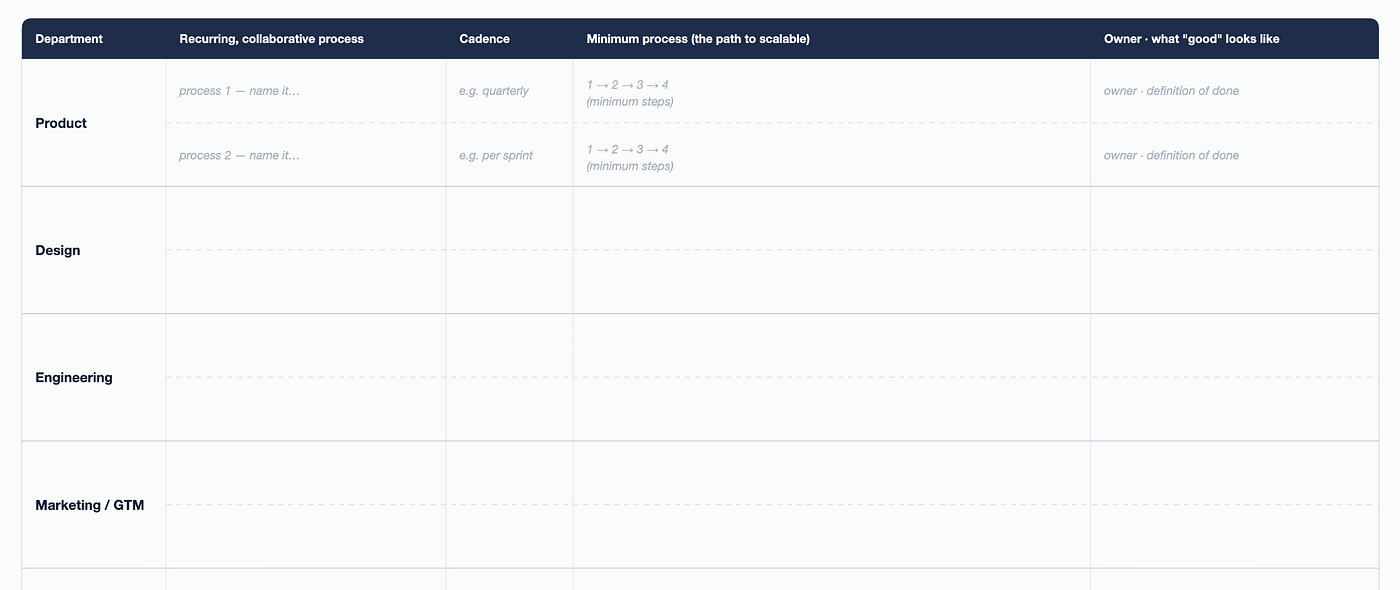
Function Engine — Nova
And I don’t just mean handoffs. Handoffs are the easy version. The hard version is when a department needs other departments to give feedback, information, or review work — so that what eventually gets handed over is actually right, doesn’t have to be redone, and hasn’t been over-promised to a client.
Take product in a tech company. Product needs sales and customer success to evaluate whether a solution covers real use cases, to hear the pain points customers actually voice, to know what isn’t working today. Product needs marketing to take the feature to market effectively, on time, with a strategy behind it. Product needs engineering across multiple phases, not just one.
That’s one department. You can probably name five more without trying.
So here’s the exercise. For each department, write down the 1–2 activities that are core to its function. It’ll shift slightly depending on your company.
Product in a tech company might be:
🔹 Product initiative — launching or improving a feature
🔹 Product roadmap — setting it, then reviewing and updating it
Notice these run on completely different clocks. An initiative happens on a rolling basis. The roadmap gets set annually and reviewed on a cadence. Both matter. They are not the same engine.
Do this for every department that requires collaboration. Those are exactly the places where grey areas live and nobody owns them.
Then, for each one, define the minimum path to success.
Not the perfect path. The minimum. What is expected?
Is it expected that when product works on a feature, someone checks what the competition is doing and decides where you want to sit? Is it expected that product runs a feedback session once the first mockups exist, with sales and customer success in the room? Is it expected that a training programme gets built before launch so the team actually understands what’s shipping?
If you know the answers, this takes you five minutes.
If the person leading each department doesn’t know — that’s not a small thing. That means every single person in that department is guessing at the minimum expectation. And across departments, that guessing is precisely what’s creating your silos and your endless alignment meetings.
Write it down. That’s the engine of your company.
I’m not asking you to write it down so you have a document. I’m asking you to think it through first, because in step three we’re going to turn it into something that actually runs.
2. Set your goals, your rituals, and your cadence
Set your company goals if you don’t have them yet. *(template)*
[embed]Company objectives
If you do have them, then we’re on to the step that almost everyone does halfway: the rituals and the cadence.
What I see constantly is a leadership team with objectives in a spreadsheet or a platform somewhere, meeting monthly, where each manager reports what tasks they completed or vaguely gestures at achievements.
Two mistakes there, and they’re expensive.
One: the meeting isn’t designed to unblock, solve, and align between departments. It’s designed for people to speak in turn.
Two: outside that meeting, there are no habits keeping the team’s attention on what actually moves the company objectives.
Here’s how to fix both.
Give the leadership meeting a structure. Not a stage for each department head to give a speech. A working session. Each owner states how close they are to their objective — on track, off track. If they say off track, they say what’s happening. And then the meeting is spent solving it and deciding actions. The meeting exists to solve and act, not to report tasks. *(template)*
Then set the expectation that every manager runs a monthly priority meeting with their team. Size of company will change the shape of this, so take the simple structure and adapt it.
Before the meeting, the leader thinks through the main deliverables — never tasks — that each person they manage should focus on. In order. One is priority one. Two is priority two.
Then they bring it to the team and discuss it. Out loud. Together.
This part is not optional and it’s not a formality, because this is where the leader finds out what they got wrong. The team will spot what’s missing. They’ll say what’s actually possible given real capacity. The employee is the one who bends the plan back toward reality.
And when you walk out of that room, you know what each person is delivering this month and what’s genuinely achievable — which is exactly what makes the leadership meeting honest instead of theatrical. (template + full manager process)
Three requests are hiding in there, and I want you to see them clearly: a set structure so meetings produce progress, a cadence that’s deliberate about not flooding the calendar, and a minimum expectation of leaders that is non-negotiable for their role.
In most companies I work with, all three are missing. Too many meetings. Meetings built for check-ins and idea-sharing rather than progress. And almost never a defined minimum of what a department head must do for their role — and for the company’s objectives — to succeed.
Two things worth knowing here.
Gallup’s research across millions of employees found that the manager accounts for roughly 70% of the variance in team engagement. Seventy percent. Whatever you leave undefined at that layer, you’re leaving to chance across your entire company.
And Teresa Amabile at Harvard, after analysing nearly 12,000 daily diary entries from people doing real knowledge work, found that the single biggest driver of good inner work life — motivation, emotion, perception — was simply making progress on meaningful work. Not perks. Not recognition. Progress.
Which means a meeting that produces movement isn’t just operationally better. It’s the thing that keeps your best people wanting to be there.
I want to be careful about how I frame the rituals, because this gets misunderstood constantly. This isn’t about reminding people. It’s about setting the right discipline in a team, protecting energy for the work that actually matters, and creating momentum where small actions pile up until they become the culture of the company.
That’s what a ritual is for.
- OKRs Template (with meetings and templates)
- Monthly priority alignment
- Quarterly rocks (90 days -priorities)
3. Turn the engine on
You’ve mapped what each department’s engine needs to be. Now make it run.
I’ll be upfront: I’m going to use Nova here, because I’m biased and I built Nova for exactly this. You can use other tools. But two warnings that apply regardless of what you choose.
- Don’t “document” the processes. People won’t read the document. Or they’ll read it once, and then forget the details at the precise moment they’re actually doing the work — which is the only moment that counts.
- Don’t use compliance software for this either. The goal isn’t to track whether people followed steps. The goal is to put the right resource, the right tip, and the right connection in front of someone at the moment they need it, and to close the gap between departments that nobody currently owns.
Turn those processes into living ones. Embedded in the actual workflow, not sitting in a wiki with a nice table of contents.
If you’re using Nova, you can ask Nova AI to build them in seconds and then adjust until they fit your team properly. And if any part of this is something you’d rather not do alone, reach out to me or the team.
4. Bring AI in as a team member with a defined role
This is the one I’ve spent the last year on, and it’s the one most companies are getting wrong in a way that’s costing them real money.
Here’s what I see when I look inside organisations that think they’re using AI well. An individual asks AI to do x. AI produces a draft. The person shares the file with their manager or their team.
The person owns the work AI did. The person does the prompting. And nowhere is it defined what AI is responsible for versus what the human is responsible for.
If that’s your company, you’re probably also seeing the symptom: the documents don’t follow your basic criteria. They don’t quite make sense for your product, your service, your market. And you keep sending work back to be redone.
Last month I had several managers say a version of the same sentence to me: “I don’t need to pay someone to prompt AI with what I already asked them on Slack, if they’re not going to review it and improve it. I can do that myself.”
They’re right. And that’s not an AI problem. That’s a role-definition problem.
Every person having their own assistant or chat window is the new normal, and individual AI use is completely legitimate — someone using AI inside Figma or a copywriting tool is doing good work. The gap is that nothing connects those individual outputs into coordinated execution across teams.
What comes next is companies leveraging AI as additional roles inside the process. AI clearly owns its part — researching, brainstorming, producing a first draft and putting it forward as a proposal. The human clearly owns theirs — the judgement, the revision, the final version, carrying the work to the goal.
Each owns their piece. It’s explicit. It doesn’t require the employee to manage AI, or wait on it, or sit prompting in a tab nobody else in the company can see.
Do it that way and something genuinely shifts. You’ve effectively expanded your headcount. You’ve freed individuals from managing and waiting on AI. You’ve given people clarity about where their responsibility actually sits. And the work starts to compound instead of resetting every time.
Again — I’d recommend Nova here, because AI inside Nova follows the same minimum process and expectations the team follows, and works from your team’s knowledge and decisions rather than from nothing. But use what fits you.
So: how do you increase operational capacity without hiring — and as you hire?
Five trades. Each one is something to stop, and the thing to do instead.
❌ Don’t leave your key operational engines undefined.
✅ Define your company engine so expectations are clear and the grey areas get an owner.
❌ Don’t set company goals without breaking them into what has to be true each quarter, and who owns it.
✅ Turn your objectives into clear activities each department owns over the next 90 days. Template
❌ Don’t let leaders each invent their own way of working.
✅ Define the habits and disciplines expected of every leader, and give the meetings a structure that forces problem-solving and progress.
❌ Don’t document processes in a file and let “the definition of done” live inside one person’s head.
✅ Turn your operating engine into living processes that guide people and AI in real time as they work — and that make cross-functional collaboration explicit.
❌ Don’t hand AI to individuals and forget to implement it at company level.
✅ Implement AI at the company level, as a team member with a defined role.
What I actually want to say
My friend didn’t have a hiring problem. He had fifteen new people standing in a building where nobody had ever written down what “good” looks like, or who owes what to whom, or how a decision travels from one department to another.
Fifteen capable adults, hired to fix something that hiring cannot fix.
And I think the reason it went that far is the same reason it goes that far almost everywhere: the honest sentence is expensive to say out loud. We built this and it doesn’t work. It costs you something in front of your board, your team, your own idea of yourself as someone who has it handled.
But that sentence is not a failure. It’s a diagnosis. And a diagnosis is the only thing that has ever preceded a cure.
Capacity was never how many people you have. Capacity is how much your company can carry without dropping it — and that is decided entirely by the structure underneath the people, not by the number of them.
So maybe I have turned into one of those grandmothers, repeating the same sentence to anyone who’ll sit still long enough. Fine. I’ll repeat it:
You don’t rise to the level of your goals. You fall to the level of your systems.
Your team is not slow.
Your engine was never switched on.
❓ If I sat down tomorrow with any three people in your company and asked them what “good” looks like for the work they share — how similar would the three answers be?
Sit with that one. The gap between those three answers is your capacity problem, and you can start closing it this week without approving a single new role.
— Ro
Resources mentioned in this post:
Nova (the platform)
If you’re in the middle of this right now — the hiring that didn’t help, the goals that slip by day thirty, the meetings that fill the week and move nothing — you don’t have to untangle it alone. I work with a small number of companies each month on exactly this.
And if you do one thing after reading: tell me in the comments which of the four switches works at your company and what else would you add to this list.
If this was useful, send it to the one person you thought of while reading. That’s the best way to support this work.
메타데이터
- post_id
- 7f6fac1a8fff
- slug
- how-to-increase-operational-capacity-without-hiring-7f6fac1a8fff
- url
- https://blog.novatools.org/how-to-increase-operational-capacity-without-hiring-7f6fac1a8fff
- canonical_url
- https://blog.novatools.org/how-to-increase-operational-capacity-without-hiring-7f6fac1a8fff
- author_url
- https://medium.com/@rociofernn
- status
- ok
- fetched_at
- 2026-08-17 00:23:30



