Why Architecture Firms Need SEO That Actually Understands Their Business
Most architecture practices hire the same kind of SEO agency their local plumber or restaurant would hire, and then wonder why enquiries…
Why Architecture Firms Need SEO That Actually Understands Their Business
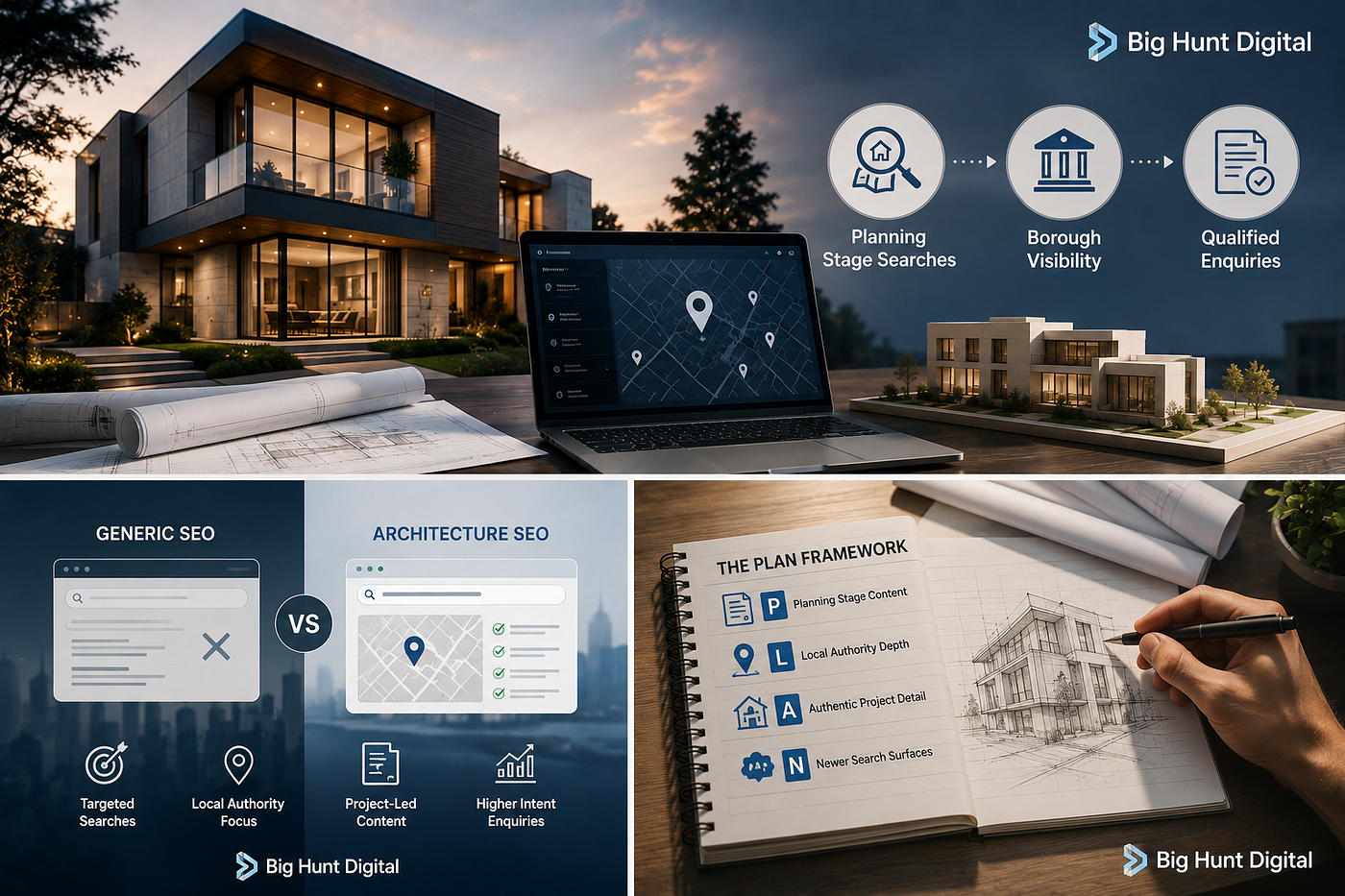
Architecture SEO connects planning-stage searches, local expertise, and project experience to generate more qualified enquiries.
Most architecture practices hire the same kind of SEO agency their local plumber or restaurant would hire, and then wonder why enquiries never come. SEO for architecture firms works completely differently from generic local SEO, because the buyer journey itself is different. Nobody searches for an architect the way they search for a takeaway, and treating the two the same is where most campaigns quietly fail.
The Search Behaviour Nobody Accounts For
A homeowner looking for an architect has usually already had a survey, a planning refusal, or a conversation with a neighbour who just finished an extension. Their search reflects that specific moment. They are typing things like “can I extend without planning permission in a conservation area” or “Article 4 direction loft conversion,” not “best architect near me.”
Generic SEO agencies optimise for the second kind of search. They rarely touch the first, because it requires actual knowledge of planning law, permitted development rights, and how local authorities differ from one borough to the next. That gap is exactly where most architecture firms lose visibility, not because their work isn’t good enough, but because their website never answers the question the searcher actually had in mind.
This matters more than it sounds. A firm ranking for “architect London” competes against hundreds of practices nationwide for a phrase that barely reflects buying intent. A firm ranking for a borough-specific planning question competes against almost nobody, because most agencies never bother writing that content in the first place.
Generic SEO vs Architecture SEO
The two approaches look similar on paper, an audit, some content, a few links, but the substance underneath is very different.

Generic SEO targets broad searches, while architecture-specific SEO focuses on planning-stage intent, local relevance, and project expertise.
The key difference is search intent and local relevance. Instead of focusing on broad, national terms such as “architect UK,” a stronger approach targets borough-level and planning-stage searches that reflect what potential clients are actually looking for. The content should move beyond generic service pages and “why choose us” copy by using detailed project pages that include the property type, planning route, and final outcome. This allows the content to address decision-stage questions that arise after a survey, planning application, or refusal. Local SEO should also go beyond basic NAP citations by creating borough-specific pages and maintaining an active, detailed Google Business Profile. Finally, proof of results should focus on named practices, specific keyword sets, and enquiry data rather than relying only on traffic or ranking screenshots.
Signals an Agency Actually Understands This Niche
Before hiring anyone, check for three things.
Named results, not anonymised graphs. A capable agency can point to a specific practice, a specific set of keywords, and a real change in enquiries. Vague percentage increases with no client attached mean very little, and should be treated as a warning sign rather than proof.
Planning-stage content, not generic service pages. Look for evidence they’ve written about Article 4 removals, permitted development limits, or council-specific decision timelines. If every page reads like a template with the city name swapped out, the agency is applying a generic local SEO playbook to a niche that needs something more specific.
Local authority signals over national rankings. A firm that only serves three boroughs gets nothing from ranking nationally for “architect UK.” What matters is showing up for borough-level searches where actual enquiries live, backed by consistent local citations and an active Google Business Profile.
A fourth, increasingly important signal: whether the agency tracks AI search visibility at all. Homeowners are starting to ask ChatGPT or Perplexity for architect recommendations before they open Google. An agency with no answer to that question is optimising for search as it worked several years ago, not as it works now.
The PLAN Framework for Evaluating Architecture SEO
These four signals can be summarised into a simple framework worth running against any agency’s pitch:
- P — Planning-stage content. Do they write about Article 4 directions, permitted development limits, and council-specific timelines, or only generic “our services” pages?
- L — Local authority depth. Do they build borough or catchment-specific pages, or chase national keywords that rarely convert for a firm working in three postcodes?
- A — Authentic project detail. Do their project pages include property type, planning route, and outcome, or just photography with no crawlable context?
- N — Newer search surfaces. Do they track whether the practice gets cited in AI tools like ChatGPT and Perplexity, or only report on traditional Google rankings?
An agency scoring well across all four is applying a genuinely niche-aware strategy. One that only satisfies one or two is likely running the same generic local SEO playbook used for every client, regardless of industry.

Big Hunt Digital helps architecture firms build search visibility around the locations, services, and planning questions that matter most.
A Real-World Scenario
Consider a small practice working mainly in one London borough, specialising in Victorian terrace extensions. Their old site had strong photography but almost no written content, just project titles with no address detail, no planning references, and no context beyond a gallery of finished rooms.
An agency that understands this niche would rebuild those project pages with real substance: property type, borough, planning route taken, and outcome. They’d add a handful of pages answering local planning questions specific to that catchment, things a homeowner in that exact borough would actually type into Google after a survey or a refusal. They’d also make sure the practice’s Google Business Profile reflected the same specificity, rather than a generic “architectural services” listing.
Within a few months, the firm would typically start appearing for searches tied to their actual specialism, rather than competing nationally against practices twenty times their size with far larger marketing budgets. The traffic would be smaller in volume but far higher in intent, which is the trade every niche practice should be making.
This is the practical difference between SEO that happens to an architecture firm and SEO built for one.
What a Realistic Timeline Looks Like
Meaningful organic movement generally takes three to six months, with results compounding over a year as more content gets indexed and authority builds. The biggest delay usually isn’t the algorithm, it’s approval speed. A blog sitting in internal review for five weeks loses five weeks of visibility, regardless of how good the content is once it finally goes live.
Paid search can bridge that gap if a firm needs enquiries sooner, but it shouldn’t replace the organic groundwork. The two work best run in parallel, with paid weighted more heavily in the first quarter while the organic content has time to be indexed and start ranking.
A Quick Checklist Before You Hire
Ask any prospective agency these questions and listen for specifics, not reassurance:
- Which architecture practices have you actually worked with?
- What will you publish in the first month, and who writes it?
- Do you track whether the firm gets mentioned in AI tools like ChatGPT when someone asks for architect recommendations?
- What happens to the content if the firm leaves?
- What isn’t included in the retainer fee?
If the answers stay vague, the agency likely applies the same playbook to every client regardless of industry. That’s often the clearest sign of an agency still catching up on how AI is reshaping search, rather than one already offering genuine AI SEO Services, and it rarely produces the borough-specific, planning-relevant visibility architecture firms actually need to turn search traffic into real enquiries.
The Bottom Line
Architecture is a niche with its own search behaviour, its own decision triggers, and its own local authority nuances. An SEO approach built for generic local businesses will miss all three, no matter how competent the agency is in other industries. The firms that see real enquiry growth are the ones working with agencies that understand planning-stage searches well enough to write about them properly, not just optimise around them with the same template used for every other client.
메타데이터
- post_id
- 7f823e7b1df3
- slug
- why-architecture-firms-need-seo-that-actually-understands-their-business-7f823e7b1df3
- url
- https://medium.com/@bighuntdigital/why-architecture-firms-need-seo-that-actually-understands-their-business-7f823e7b1df3
- canonical_url
- https://medium.com/@bighuntdigital/why-architecture-firms-need-seo-that-actually-understands-their-business-7f823e7b1df3
- author_url
- https://medium.com/@bighuntdigital
- status
- ok
- fetched_at
- 2026-08-17 18:48:13




