We Stopped Grilling Over Charcoal. Here’s What Changed.
A kitchen decision that had nothing to do with trend and everything to do with physics.
We Stopped Grilling Over Charcoal. Here’s What Changed.
A kitchen decision that had nothing to do with trend and everything to do with physics.
For a long time, every grilled restaurant looked the same from the outside. Flames. Smoke. A cook standing over a grate, moving skewers around to dodge a flare up before it turned dinner into charcoal. It looked dramatic. It photographed well. And it was, in a very specific way, working against the food.
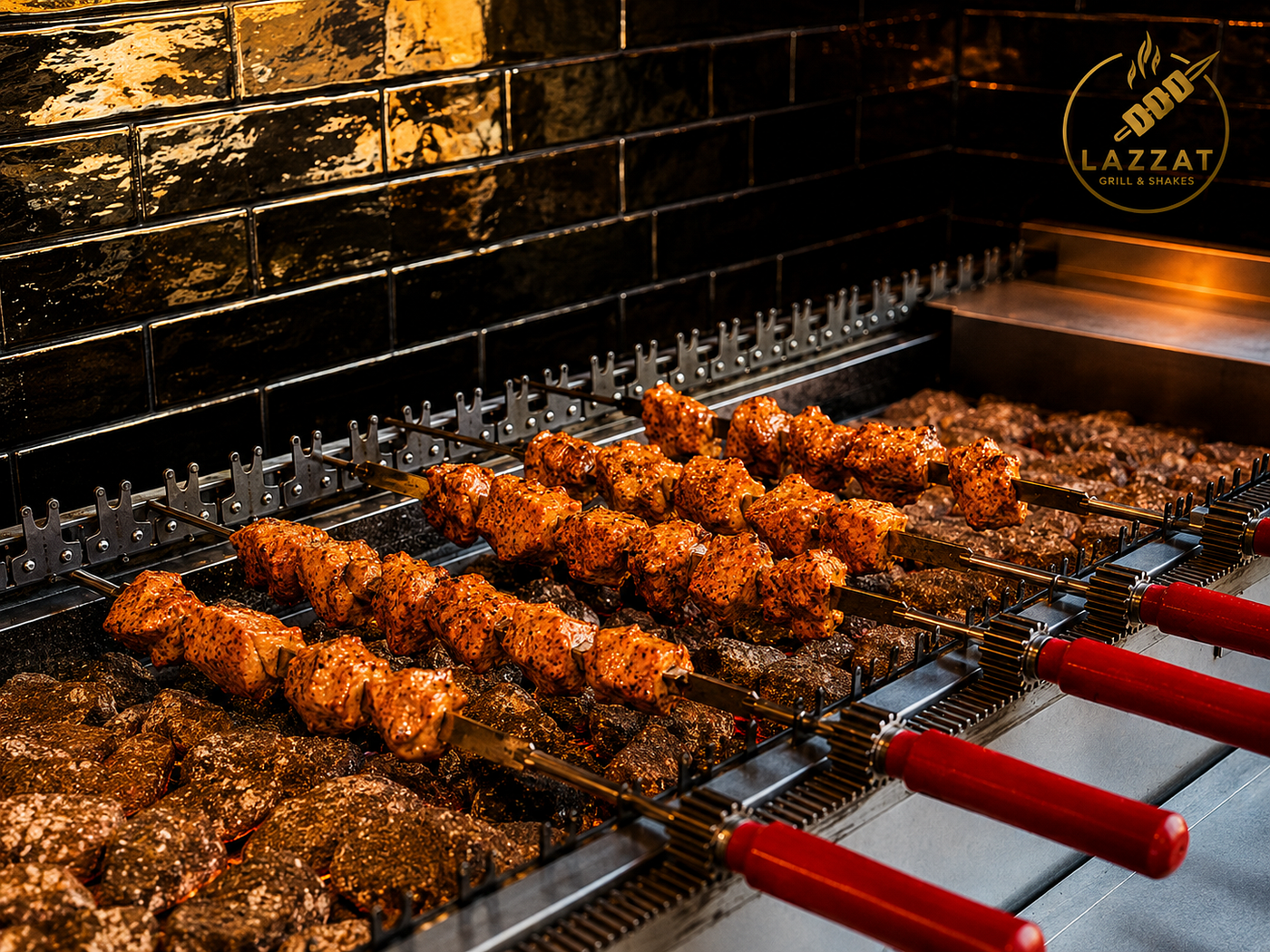
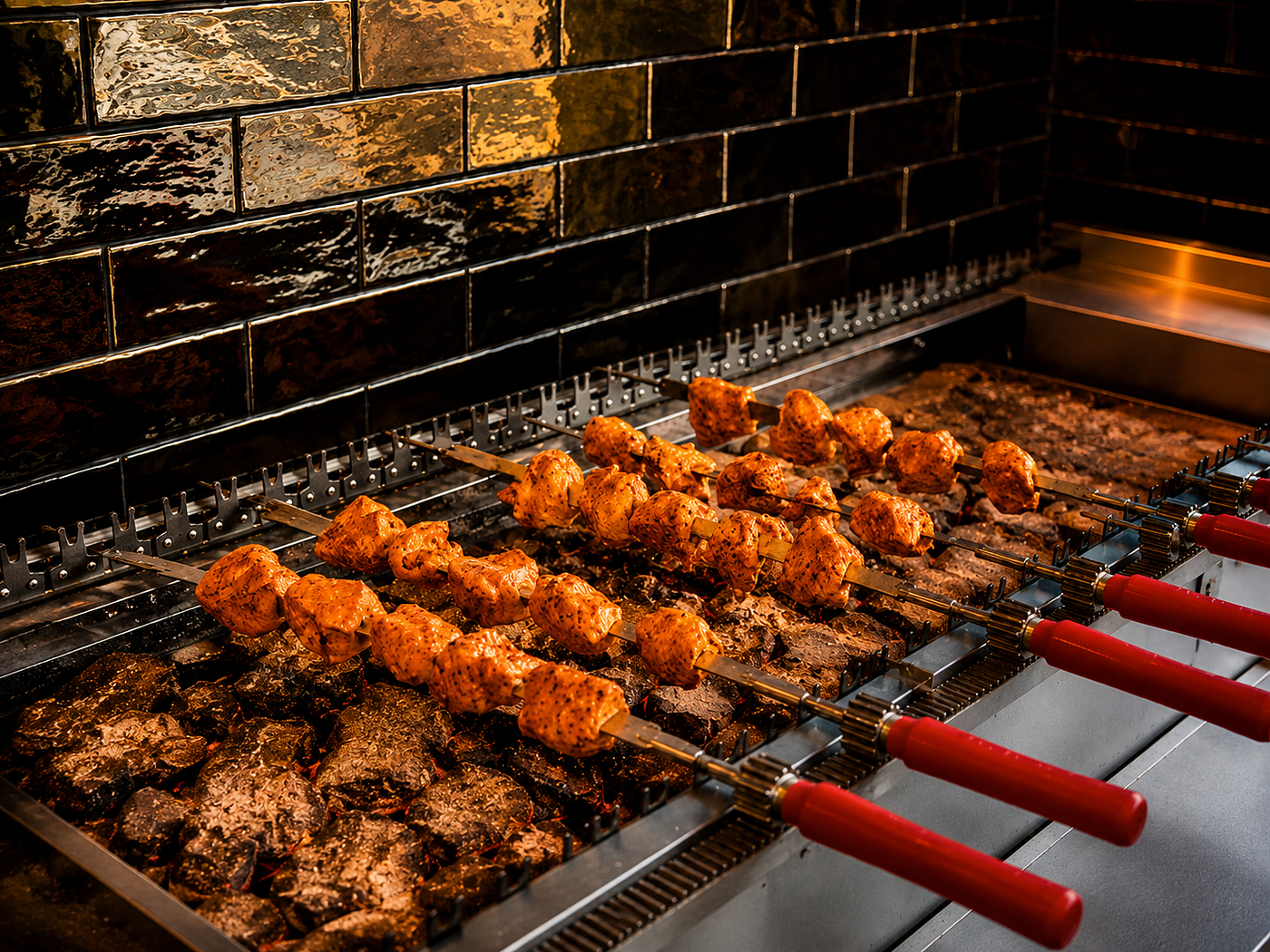
At Lazzat, the grill is not gas and it is not charcoal. It is lava stone. And once you understand why, you start noticing what every other grilled restaurant in your city is quietly fighting against every single service.
The problem nobody talks about
Here is what actually happens on a standard grill. Fat renders off the protein as it cooks. That fat hits an open flame. The flame spikes. For a few seconds, the heat under that piece of meat is not the steady temperature the cook set out to use, it is whatever the flare up decided to make it. The exterior chars faster than the interior can catch up. The cook compensates by moving things around, timing things by feel, managing chaos in real time.
Most people who grill professionally have gotten so good at managing this that they no longer think of it as a problem. It is just the job. But it is a problem, and it shows up on the plate as inconsistency. The skewer at six in the evening does not taste exactly like the skewer at eight, even though the recipe never changed. Ask anyone who has eaten at the same grill restaurant twice in one week and ordered the same dish both times. The difference is real, and it usually comes down to how the flame behaved that night, not how the kitchen cooked.
This is the quiet flaw in charcoal grilling and gas grilling alike. Both depend on an open flame sitting directly under the food, and an open flame is never perfectly stable. Wind, fat content, portion size, even how crowded the grill is at that exact moment, all of it changes how hot the flame runs and how evenly it cooks.
What lava stone actually does
Lava stone does not have this problem. It is a naturally porous volcanic rock that absorbs heat slowly and radiates it back evenly across its surface. Once a slab of lava stone reaches temperature, it holds that temperature with remarkable stability. When fat drips down during cooking, it hits stone, not flame. There is no flare up. There is no spike. Just steady, radiant heat doing the same job it did a minute ago and will keep doing a minute from now.

This is the same principle used in stone ovens and traditional clay cooking methods found across South Asian, Middle Eastern, and Mediterranean kitchens for centuries, long before gas lines and propane tanks became the default. Lava stone grilling brings that same radiant, even heat into a modern kitchen, without sacrificing the char and smoke flavor people actually come to a grill restaurant for.
For a kitchen producing skewers, kebabs, and marinated proteins night after night, that consistency is not a small detail. It is the difference between a restaurant that tastes the same on a Tuesday as it does on a Saturday, and one that does not.
What that actually means for a piece of chicken
There is a chemical reaction happening on the surface of anything grilled well, called the Maillard reaction. It is the browning, the crust, the flavor compounds that make grilled food taste like grilled food instead of just cooked food. That reaction happens best within a specific, narrow temperature range. Too hot, too fast, and the surface skips past that window into bitterness. Too cool, and it never really gets there at all.
A flare up does not just risk burning your dinner. It risks skipping past the exact chemistry that makes grilling worth doing in the first place. This is the part that is easy to miss if you have never thought about it: the difference between a good grilled meal and a forgettable one usually is not the marinade. Everyone marinates. It is whether the protein got to sit in that narrow temperature window long enough for the surface to actually do its job, or whether it got rushed through by inconsistent heat and pulled off the second it looked done enough.
Lava stone keeps that window open. The heat does not spike when fat renders. It does not dip when someone loads six more skewers onto the grill at once. That stability is what lets a cook chase flavor instead of chasing flames.
The health angle nobody puts on the menu
There is a practical reason beyond flavor to care about how a restaurant grills its food. When fat drips onto an open flame, it does not just cause a flare up, it also produces smoke loaded with compounds called polycyclic aromatic hydrocarbons, or PAHs, which then settle back onto the surface of the food. High heat char on protein can also form heterocyclic amines, compounds that researchers have studied in connection with long term health outcomes. None of this means the occasional charcoal grilled meal is dangerous. It means that a grilling method which avoids direct flame contact with dripping fat produces less of this byproduct by design, not by luck.

Lava stone grilling keeps fat away from open flame entirely, which naturally reduces the amount of char and smoke exposure on the finished dish. For a restaurant serving grilled chicken, beef, and lamb as a daily staple rather than an occasional weekend cookout, that difference adds up. It is not the headline on the menu. It is the reason the food is built the way it is.
Why we did not just default to what everyone else uses
There was no dramatic reason to skip gas and charcoal. No supplier fell through, no story about a broken grill at two in the morning. It came down to a simple question the founding team kept returning to while building the menu: if the marinade takes overnight to do its job right, why would the finishing step be rushed.
Every protein at Lazzat goes into the marinade the night before it ever sees heat. That is not a fast process, and it is not meant to be. By the time a skewer hits the lava stone, the muscle fiber has already started to change, the spices have already worked their way in, and the texture has already begun to soften. What the grill needs to do at that point is not fix anything, it is finish something that is already mostly done. Even, steady, radiant heat is the only kind of heat that can complete that job without undoing twelve hours of work that came before it.
This is also why the lineup stays focused rather than sprawling. A kitchen built around overnight marination and lava stone finishing cannot rush new items onto the menu just because a trend calls for it. Every dish has to earn its place through the same slow process, or it does not belong on the grill at all.
The part you can actually taste
Order a two skewer bowl and pay attention to the second bite, not the first. The first bite of anything grilled tends to taste good, that is what char does, it grabs attention immediately. The second bite is where the marinade either shows up or it does not. Where the char either goes deeper than the surface or stays exactly where it started.
That is the difference lava stone is actually solving for. Not a better looking sear. A more honest one, all the way through. It is also the reason regulars tend to order the same dish differently over time, moving from the mildest option to something spicier once they trust that the kitchen is going to deliver the same result every visit.

What to order if this is your first time
For anyone walking in without a strong preference yet, the chicken skewers are the clearest way to taste the difference lava stone grilling makes, since chicken has less natural fat to mask inconsistent heat than beef or lamb does. From there, the beef and lamb options show the same technique applied to richer cuts, where the even heat matters even more because there is more fat to manage. Pairing any of the grilled proteins with the kitchen’s sauces rather than eating them plain is worth doing at least once, since the sauces are built to complement the char rather than cover it up.
Why it matters beyond one meal
We do not lead with any of this on a sign outside. It is not the kind of thing that fits on a banner, and it will never be the reason someone walks past the window and decides to come in. But it is the reason the chicken tastes the way it does, and it is the reason the same decision would be made again if the whole kitchen were being built from scratch tomorrow.
If you want to see the full range of proteins this actually applies to, the complete lineup lives on Lazzat’s menu. But the honest answer to what makes it different was never going to fit on a menu description. It is this.
메타데이터
- post_id
- 7fa82d3c15c5
- slug
- we-stopped-grilling-over-charcoal-heres-what-changed-7fa82d3c15c5
- url
- https://medium.com/@lazzat.ca/we-stopped-grilling-over-charcoal-heres-what-changed-7fa82d3c15c5
- canonical_url
- https://medium.com/@lazzat.ca/we-stopped-grilling-over-charcoal-heres-what-changed-7fa82d3c15c5
- author_url
- https://medium.com/@lazzat.ca
- status
- ok
- fetched_at
- 2026-08-18 14:54:50