Why Medium Built a Repost Button
A PM teardown of Medium's repost feature — the metric they're really chasing, the bet hidden in two words, and how I'd measure it
Why Medium Built a Repost Button (And What It’s Really For)
A product teardown of Medium’s May 2026 launch: the metric they’re chasing, the bet they’re making, and how I’d measure it if it were my feature.
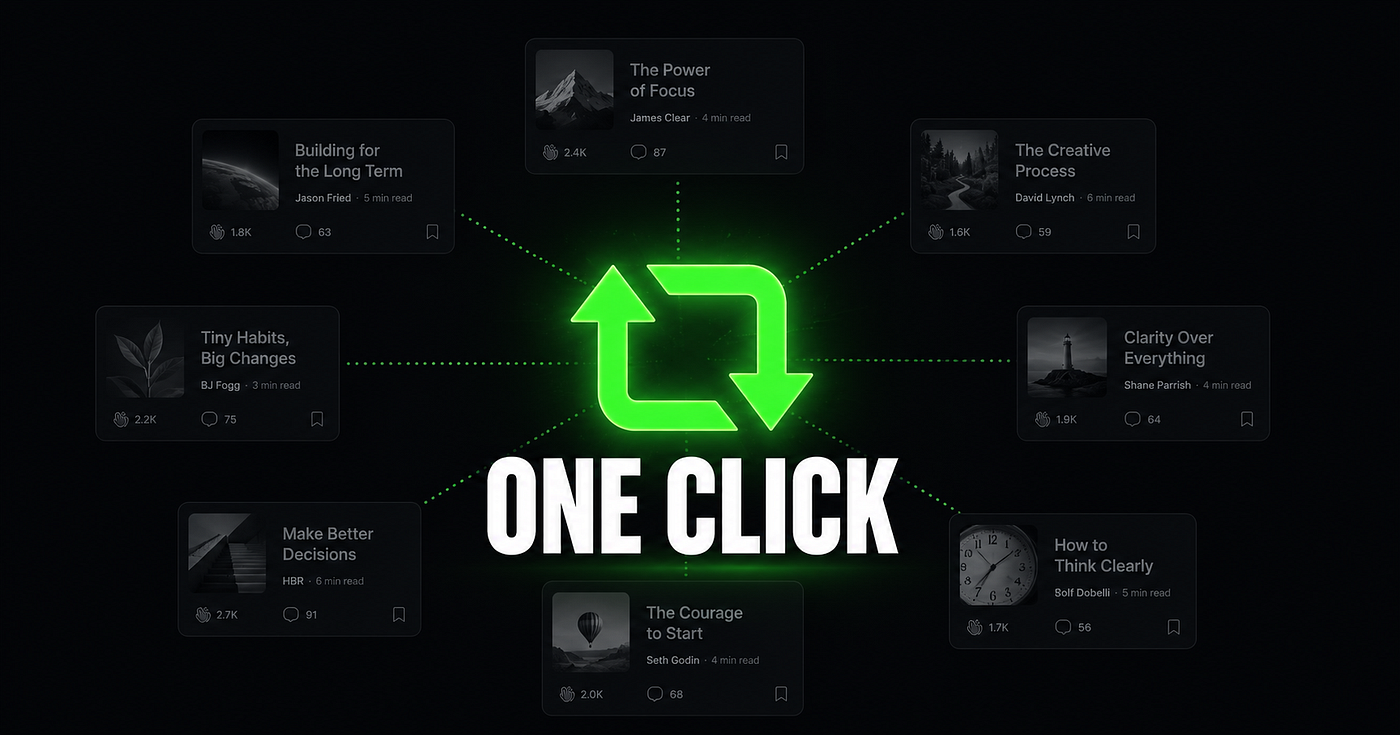
I reposted my first story on Medium about two weeks ago. It was a piece about worldbuilding a fantasy economy, the kind of thing my home feed would never have surfaced on its own, and I shared it with one click. Took less than a second. And as a PM, the second after I did it, I caught myself thinking: okay, why did they build this, and what number are they actually trying to move?
Because here’s the thing about a repost button. It looks tiny. It’s a single icon, the circular-arrows thing, that turns green when you tap it. On the surface it’s a me-too feature, the same retweet-shaped affordance that X, Instagram, LinkedIn and everyone else already has. Easy to dismiss as Medium catching up.
But Medium is a strange platform to add a repost button to. It’s not a social feed in the way Instagram is. It’s a reading platform with a subscription business attached. So a feature that’s obvious on a social network is a genuinely interesting bet here. And when a company makes a bet that looks obvious but isn’t, that’s usually where the good product thinking is hiding.
So I went and read the announcement, the writer newsletter, and the FAQ properly. Here’s my read on what this feature is really for.
What actually shipped
Let’s be precise first, because the details matter for the analysis.
On 13 May 2026, Medium launched reposting. The mechanic is simple: any reader can repost any story (except their own), and that story then appears in the home feed recommendations of everyone who follows them. The writer gets a notification. You can undo a repost by tapping the button again. You can repost as many stories as you like, including paywalled ones, though paywalled stories stay members-only. And you can find everything you’ve reposted in your Activity tab.
Crucially, Medium was explicit about one thing in the FAQ: right now, reposting works similarly to other social signals like claps and highlights. When you repost, the story could appear in your followers’ feed recommendations. Same as a clap. Same as a highlight.
That word “right now” is doing a lot of work. Hold that thought, because it’s the most important phrase in the whole announcement.
The stated goal: recommendations from people you trust, not just an algorithm
Medium’s own framing is refreshingly clear. The subtitle of the announcement is literally readers want story suggestions from people they trust. And in the body, they admit something most platforms wouldn’t: their recommendation system is good at matching stories to interests, but more and more readers want recommendations from people they know and trust.
That’s the product thesis in one sentence. The algorithm has a ceiling, and that ceiling is trust.
This connects to a bigger strategic theme Medium has been hammering all year. In the writer newsletter that announced reposts, they tied it explicitly to their belief that taste matters, and that it matters more in a world where content can be easily and cheaply generated about anything, by anyone. They asked the question directly: when anyone can generate infinite content, what’s actually worth reading?
Their answer is human curation. Staff Picks, editor features, and now reposts are all the same move: layering human taste signals on top of algorithmic recommendation. Reposts just democratise it. Instead of taste coming only from Medium’s editors, it now comes from anyone you’ve chosen to follow.
So that’s the stated goal. But stated goals and the metrics a team is actually graded on are rarely the same thing. So what’s the number underneath?
The metric they’re really chasing
If I were the PM on this, the headline metric I’d be staring at isn’t reposts. Reposts are an action, not an outcome. The outcome Medium needs is reading.
Specifically, I think this feature is aimed squarely at one of the hardest problems a subscription content business has: feed quality for the median reader, and the retention that flows from it.
Here’s the logic chain. Medium makes money when people keep their membership. People keep their membership when they consistently find things worth reading. The recommendation algorithm gets you most of the way there, but it has a known failure mode: it’s good at “more of what you already read” and bad at the delightful sideways discovery that makes someone think “I’m so glad I’m on this platform.” That fantasy-economy piece I reposted is exactly that kind of story. Great, but algorithmically invisible to most people.
So the real target metric, in my view, is something like qualified reads per active reader per week, where “qualified” means a real read, not a bounce. Reposts are the input. Better feed quality is the mechanism. Reading frequency and session depth are the outcome. And retention, the number the business actually lives or dies on, is the lagging result.
There’s a secondary metric too, and it’s about the supply side. Medium said something quietly significant in the announcement: more writers are writing on Medium now than at any point in its history. More supply means more great stories getting buried. A distribution mechanism that doesn’t depend solely on the algorithm helps clear that backlog, which keeps writers happy, which keeps them writing. Reposts are as much a writer-retention play as a reader one.
How I’d actually measure it
This is the part I find most fun, because a feature like this is genuinely tricky to evaluate. Engagement on the button itself tells you almost nothing. Here’s how I’d structure the measurement if it were my feature.
The vanity layer (necessary but not sufficient): repost adoption rate, reposts per active user, percentage of stories that receive at least one repost. These tell you if anyone is using it at all. If nobody reposts, nothing downstream matters. But a high number here proves nothing about value.
The mechanism layer (does the repost actually drive reading?): this is where the real signal lives. For every reposted story that lands in a follower’s feed, what’s the click-through rate versus an algorithmically recommended story in the same slot? And more importantly, the read-completion rate. If reposted stories get clicked more and read more deeply than algorithmic recommendations, the trust thesis is validated. If they get clicked but bounced, the feature is generating noise, not value.
The outcome layer (the one that pays the bills): a clean experiment. Take readers who follow at least a few active reposters and compare their reading frequency, session depth, and ninety-day retention against a matched cohort who don’t. If the reposting cohort reads more and churns less, you’ve got your business case. This is the number I’d put in front of leadership.
The guardrail metrics (what could go wrong): unfollow rate after a spike in someone’s reposting (feed fatigue, the exact problem Instagram hit), the ratio of reposts to original reading time (are people performing curation instead of reading?), and complaint or hide-this rates on reposted content. Every good feature ships with a way to detect its own failure mode. If reposts make feeds worse, these catch it early.
The honest truth is the outcome layer takes months to read cleanly, and the vanity layer is available on day one. The discipline is not declaring victory on the day-one numbers. I’ve fallen into that trap before, on my own team, shipping something, seeing adoption spike in week one, and calling it a win before the retention data came in flat. Adoption is not impact.
The bet hidden in two words
Remember “right now”? Reposting works similarly to other social signals right now.
That phrasing is a tell. It strongly implies that reposts will eventually be weighted differently from claps and highlights in the recommendation algorithm. And that makes complete sense, because a repost is a fundamentally stronger signal than a clap. Medium said as much: a clap signals you liked something; a repost is an explicit, intentional share whose primary function is to bring a story to other readers.
A clap costs nothing. A repost costs reputation, because it goes out under your name, to your followers, and the writer gets notified. That asymmetry of cost is exactly what makes it a higher-quality signal for a ranking system. My strong suspicion is that the real long-game here is to harvest reposts as premium training data for the recommendation engine, a human-curated quality signal that’s far harder to game than claps.
So the feature you see today, a simple share button, is probably phase one of something bigger: rebuilding Medium’s discovery layer on top of trusted human taste rather than pure behavioural signals. The button is the data-collection mechanism. The payoff comes later.
That’s the kind of sequencing I respect. Ship the simple, useful version. Let people use it for the obvious reason. Quietly collect the signal that powers the version that actually matters.
Where I think the risk lies
I’m not entirely convinced this is a clean win, and it would be a weak teardown if I pretended otherwise.
The biggest risk is the one Instagram walked straight into: feed fatigue and the collapse of the line between “things I made” and “things I shared.” If my feed fills up with other people’s reposts, the follow relationship gets diluted. I followed you for your writing, not your bookmarks. Medium has partially hedged this by routing reposts through recommendations rather than dumping them raw into the feed, which is smarter than Instagram’s approach, but the tension is real.
The second risk is gaming. The moment reposts carry algorithmic weight, repost rings will appear, the same way clap-for-clap pods did. Medium will need fraud detection on this from day one, and the FAQ gives no indication of how they’ll handle it.
And the quiet third risk: reposting is performative curation, and performative curation can substitute for actual reading. A platform that monetises reading time should be a little nervous about a feature that rewards the appearance of taste over the act of reading. I don’t think it’ll dominate, but I’d be watching that guardrail metric closely.
None of those risks mean it’s the wrong call. I think it’s a good feature, sequenced well, aimed at a real problem the algorithm can’t solve alone. But the version that ships today isn’t the version that matters. The repost button is a quiet data-collection play dressed up as a sharing feature, and the interesting product story is the one that hasn’t shipped yet.
Which leaves me with the question I keep coming back to as a builder myself: when you add the obvious feature everyone already has, are you copying a competitor, or are you using its familiarity as cover to collect something they didn’t think to collect? What would you be watching for if this were your feature to defend?
If this resonated with you — or even just made you pause and think — I’d really appreciate a clap or two. It genuinely helps the article reach other product managers who’d find it useful.

And if you’re not already following along, I write weekly-ish about product management, AI tooling, and what’s actually working (and what isn’t) in my day-to-day as a PM in London. Hit follow and you’ll catch the next one.
If you’ve got value from my writing and fancy supporting the work directly, you can buy me a coffee here:

Either way — thanks for reading.
메타데이터
- post_id
- 7fb7f4b8249a
- slug
- why-medium-built-a-repost-button-7fb7f4b8249a
- url
- https://medium.com/product-powerhouse/why-medium-built-a-repost-button-7fb7f4b8249a
- canonical_url
- https://medium.com/product-powerhouse/why-medium-built-a-repost-button-7fb7f4b8249a
- author_url
- https://medium.com/@mohit15856
- status
- ok
- fetched_at
- 2026-06-14 11:28:49