Due Process at Work: The Part Everyone Skips
Most people associate due process with courts, hearings, and formal procedures. It feels distant from everyday work.
Due Process at Work: The Part Everyone Skips
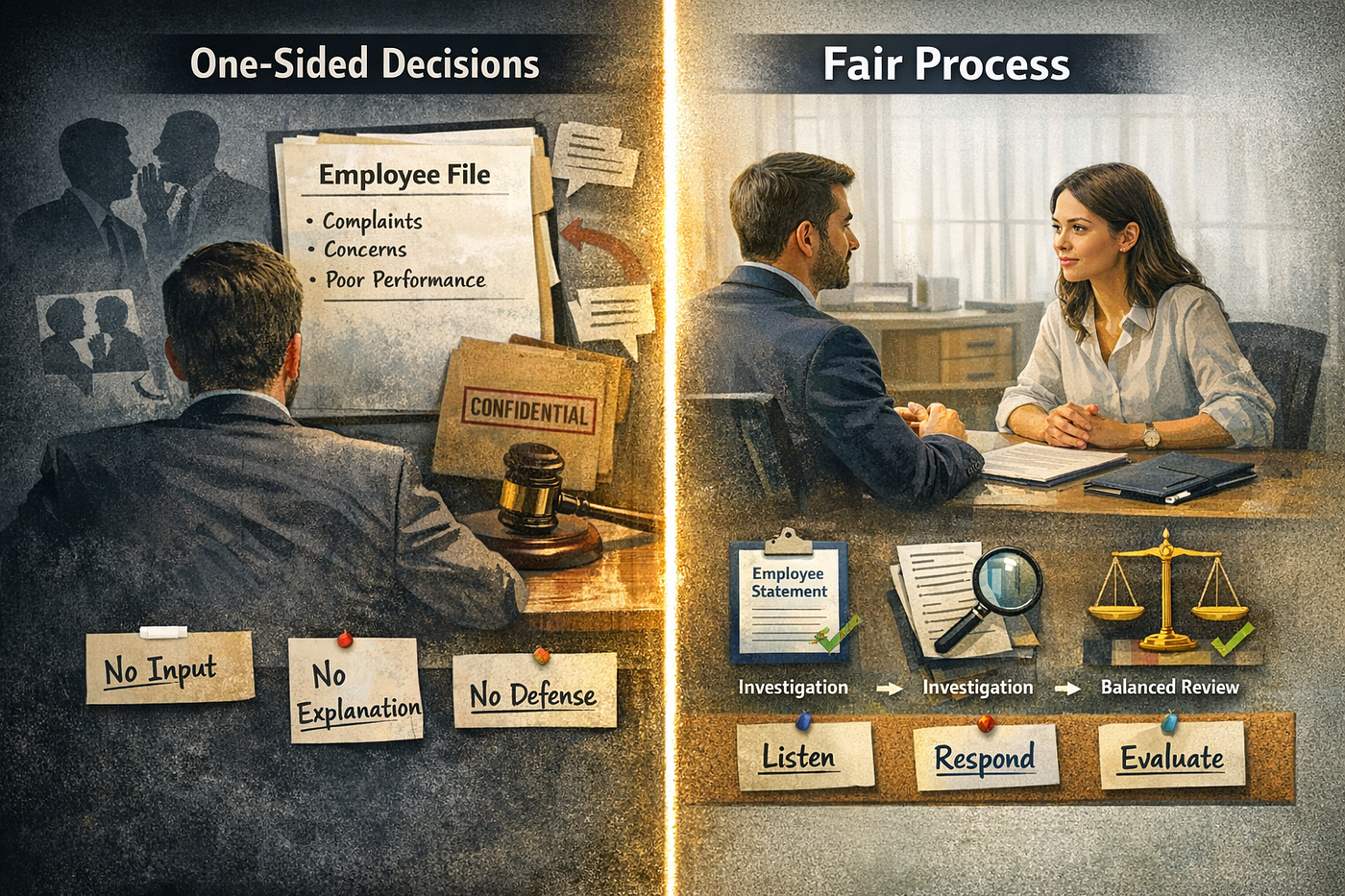
Image created by the author using AI tools.
Most people associate due process with courts, hearings, and formal procedures. It feels distant from everyday work.
But the same principle is supposed to exist in far more ordinary moments.
A concern is raised about you. It is shared and repeated, and it begins to take shape. Decisions start forming before you even know the conversation is happening.
You are not asked. You are not told. You are not given a chance to respond.
By the time you become aware of it, the outcome is already in motion.
At its core, due process is simple. If something is said about you, you are told, and before it is used to make a decision, you are given a chance to respond.
That is where things start to break down.
In many organizations, information moves informally. A concern is raised, a complaint is shared, or an opinion is offered about someone’s behavior or performance. It may come from a colleague, a supervisor, or even a single interaction that left an impression. Once it reaches the right person, it begins to carry weight beyond a passing comment.
The problem is not that information is raised. The problem is what happens next. Most decisions aren’t made on evidence. They’re made based on what was said first.
Instead of being examined, it is often accepted. Instead of being tested, it is recorded. And in too many cases, the person at the center of it is never brought into the conversation.
The story forms without them. And most of the time, they don’t even know it’s happening.
From the employee side, the impact is rarely immediate or obvious. There is no single moment where something is presented and challenged. Instead, the shift happens gradually. Conversations change tone. Opportunities narrow. Feedback begins to reflect concerns that were never discussed directly.
By the time the employee becomes aware that something has been said, it is no longer new information. It has already been absorbed into how they are perceived. What might have been a misunderstanding or a moment taken out of context has already been treated as part of a larger pattern.
At that point, responding becomes much harder. The issue is no longer a single claim that can be addressed. It is a narrative that has already taken hold, often without any record of the employee’s perspective alongside it.
From the employer’s side, the situation can look very different. A concern is raised, and there is pressure to act. Leadership relies on the information available and makes a decision that feels timely and appropriate. In the moment, it can feel like responsible management.
The risk is not in taking concerns seriously, but in treating them as complete without verifying them.
When an employer relies on one-sided information, the decision that follows is built on an incomplete foundation. That may not be obvious at first, especially if the information seems credible or aligns with existing assumptions. Over time, those unverified inputs shape documentation, and documentation shapes outcomes.
And once something is written down, it rarely gets questioned.
Consider a common example. An employee is described as difficult to work with. That characterization is noted internally, perhaps in an email or a supervisory file. What is not captured is the context behind it. The same employee may have been raising legitimate concerns about workflow, inconsistencies, or unclear expectations. Without that context, the description stands on its own and begins to influence how future interactions are interpreted.
When that note is later used to support a decision about performance or fit, it carries weight that was never fully earned.
A similar pattern can emerge when employees raise concerns of their own. If someone reports an issue related to workplace practices and negative feedback about them begins to appear around the same time, the sequence matters. If that feedback is accepted without being examined or discussed with the employee, it can create the appearance that the organization responded to the individual rather than the issue they raised.
This is where process becomes more than an internal preference. Agencies such as the Equal Employment Opportunity Commission emphasize the need for prompt, thorough, and impartial investigations when workplace concerns arise. That expectation is not met by simply collecting statements. It requires evaluating them, which in practice means speaking with all relevant parties, including the person at the center of the concern.
In California, employees also have the right under Labor Code §1198.5 to inspect personnel records relating to their performance or any grievance involving them. Those records are not meant to reflect only what was said about an employee. They are meant to reflect the basis for decisions that affect their employment.
When documentation includes complaints or characterizations without any indication that the employee was informed or given an opportunity to respond, the issue is not just one of completeness. It calls into question how those records were created and used.
Employers often view personnel files as internal tools, but they do not remain internal. They can be reviewed, challenged, and relied upon in ways that extend beyond day-to-day management. When those records show a pattern of one-sided information, they tell a story about the process itself. They suggest that decisions may have been made without fully understanding the situation.
None of this requires a complex solution. A functional process is straightforward. When a concern is raised, the person involved is informed. Their perspective is requested. Both sides are considered before any conclusion is documented.
That step does not slow an organization down in any meaningful way, but it changes the quality of the decisions that follow. It also changes the strength of the record that supports those decisions.
By the time most people recognize what has happened, they are no longer responding to a single issue. They are responding to a version of themselves that was created without them.
Most organizations do not see themselves as denying due process. They see themselves as responding to information, often quickly and with the intention of maintaining order or resolving issues. The gap appears when speed replaces verification and when documentation reflects what was said rather than what was established.
The line is not difficult to recognize once you see it. If something was said about you, but you were never told, never asked, and never given a chance to respond before it mattered, then the process was incomplete.
And when that step is missing, the issue is not just accuracy. It is the reliability of every subsequent decision.
메타데이터
- post_id
- 7fc286ed9e21
- slug
- due-process-at-work-the-part-everyone-skips-7fc286ed9e21
- url
- https://medium.com/activated-thinker/due-process-at-work-the-part-everyone-skips-7fc286ed9e21
- canonical_url
- https://medium.com/activated-thinker/due-process-at-work-the-part-everyone-skips-7fc286ed9e21
- author_url
- https://medium.com/@kpescador
- status
- ok
- fetched_at
- 2026-06-09 15:37:30