LFM2.5 Retrievers: Bi-directional LFMs for Fast Multilingual Search
Liquid AI’s June 2026 release introduces two 350M-parameter retrieval models: LFM2.5-Embedding-350M and LFM2.5-ColBERT-350M, designed for…
LFM2.5 Retrievers: Bi-directional LFMs for Fast Multilingual Search

Liquid AI’s June 2026 release introduces two 350M-parameter retrieval models: LFM2.5-Embedding-350M and LFM2.5-ColBERT-350M, designed for fast multilingual and cross-lingual search across 11 languages, with a small enough footprint to run on laptops, CPUs, and edge-friendly setups.
What Was Released
Liquid AI introduced two retrieval models built on the same base:
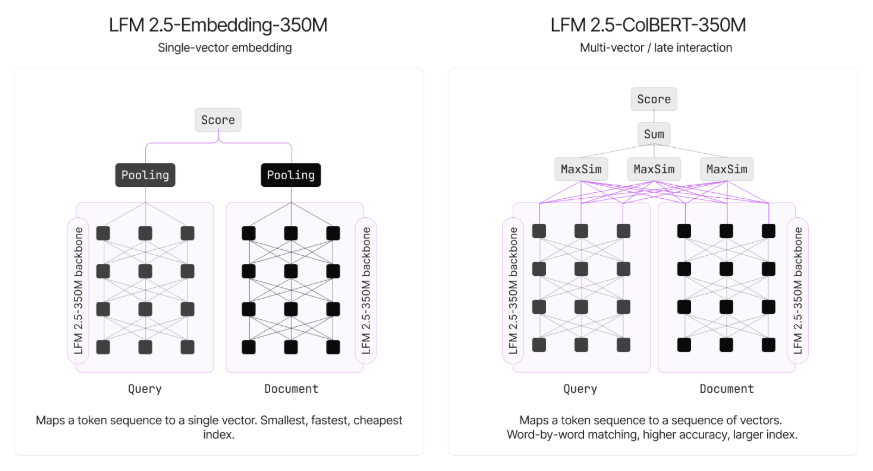
- LFM2.5-Embedding-350M A standard dense bi-encoder that produces one vector per document.
- LFM2.5-ColBERT-350M A late interaction model that keeps token-level embeddings and uses MaxSim scoring.
At a high level:
- The embedding model is optimized for speed and compactness.
- The ColBERT model is optimized for ranking quality and fine-grained matching.
Both support 11 languages and are designed specifically for short-context retrieval tasks like FAQs, support docs, and product search.
Embedding vs ColBERT: The Real Trade-off
The difference isn’t just architectural — it directly affects how you design your system.
LFM2.5-Embedding-350M
- One vector per document
- Small index size
- Fast retrieval
- Easy integration with vector DBs (FAISS, Milvus, etc.)
LFM2.5-ColBERT-350M
- Token-level representations
- Larger index
- Uses MaxSim (query-token to document-token matching)
- Much better at nuanced and cross-lingual matching
A simple way to think about it:
- Embedding model = recall engine
- ColBERT = precision engine
In practice, the strongest pattern is combining both.
Architecture: The Interesting Part
The most important technical change is how Liquid AI converts a causal decoder into a bidirectional retriever.
They start with:
- LFM2.5–350M-Base (a causal model)
Then apply two key modifications:
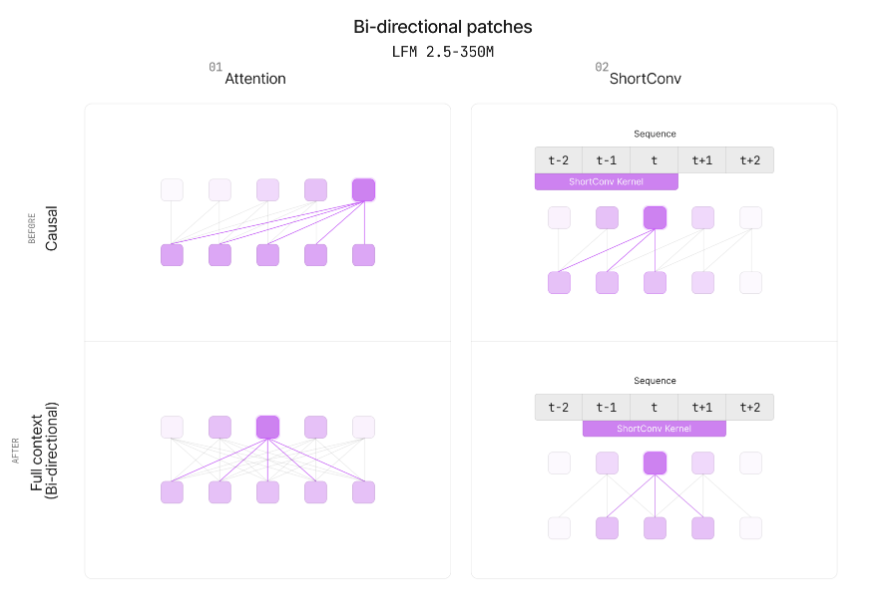
- Causal attention → Bidirectional attention Tokens can now attend to both left and right context.
- Causal convolutions → Non-causal convolutions Local token mixing is no longer directional.
Why this matters:
- Causal models are great for generation.
- Retrieval needs full-context understanding.
This small architectural shift makes the model suitable for embedding and token-level retrieval tasks without retraining from scratch.
Training Strategy
The training pipeline follows a familiar but well-executed structure:
- Large-scale English contrastive pretraining
- Multilingual + cross-lingual distillation
- Fine-tuning with hard negatives
One notable detail:
- They used LLM-based translation to expand multilingual training pairs.
Also interesting:
- The embedding model gets more cross-lingual supervision, because ColBERT inherently handles cross-lingual alignment better through token interactions.
Benchmark Signals (What Actually Matters)
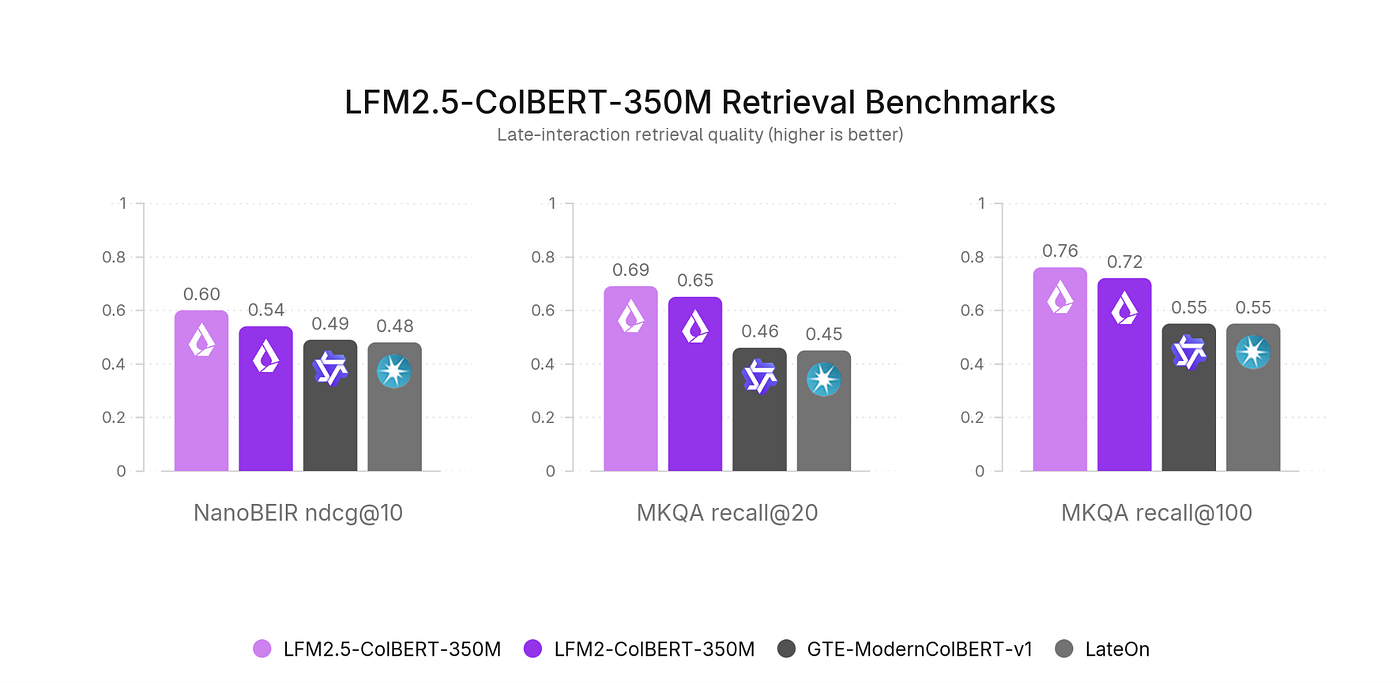
On multilingual retrieval benchmarks like NanoBEIR, reported numbers show:
- ColBERT-350M ≈ 0.605 NDCG@10
- Embedding-350M ≈ 0.577
- Both outperform comparable models like Qwen3-Embedding-0.6B in that setup
Interpretation:
- The gap is real but not massive
- You’re trading ~5% quality for major gains in cost and simplicity
Latency-wise:
- ColBERT is still usable in low-latency setups (few milliseconds in optimized environments)
- But embedding models remain significantly cheaper to scale
Where These Fit in a RAG Stack
Here’s the practical view.
Use LFM2.5-Embedding-350M when:
- You need scalable, low-cost retrieval
- You’re using a vector database
- Your corpus is large
- Latency matters
Use LFM2.5-ColBERT-350M when:
- Ranking quality is critical
- Queries are ambiguous or multilingual
- You care about token-level matching (finance, legal, technical docs)
Best pattern (recommended):
- Stage 1: Dense retrieval (Embedding model)
- Stage 2: Reranking (ColBERT)
Example flow:
- Retrieve top 100 candidates with embeddings
- Rerank top 100 → top 10 using ColBERT
Python Example
Here’s a simple dense retrieval setup:
from sentence_transformers import SentenceTransformer
import numpy as np

model = SentenceTransformer("LiquidAI/LFM2.5-Embedding-350M")
corpus = [
    "Return policy: 30 days with receipt.",
    "Guía de devolución: 30 días con recibo."
]
queries = ["How do I return an item?"]
corpus_emb = model.encode(corpus, normalize_embeddings=True)
query_emb = model.encode(queries, normalize_embeddings=True)
scores = np.matmul(query_emb, corpus_emb.T)
print(scores)
This alone gives you cross-lingual retrieval out of the box.
Key Takeaways
- These are small but powerful retrievers (350M) that actually fit real-world constraints.
- The embedding model is your default for most systems.
- The ColBERT model shines in reranking and complex queries.
- The architectural shift to bidirectional LFMs is simple but impactful.
- The best production setup is hybrid retrieval (dense + late interaction).
메타데이터
- post_id
- 7fe4e99803b3
- slug
- lfm2-5-retrievers-bi-directional-lfms-for-fast-multilingual-search-7fe4e99803b3
- url
- https://medium.com/@gsaidheeraj/lfm2-5-retrievers-bi-directional-lfms-for-fast-multilingual-search-7fe4e99803b3
- canonical_url
- https://medium.com/@gsaidheeraj/lfm2-5-retrievers-bi-directional-lfms-for-fast-multilingual-search-7fe4e99803b3
- author_url
- https://medium.com/@gsaidheeraj
- status
- ok
- fetched_at
- 2026-06-21 07:44:09