The Truth About Collagen Supplements: Science, Marketing, and What’s Really in Your Morning Scoop
From beauty claims to biology , here’s what research says about collagen for skin and joints.
The Truth About Collagen Supplements: Science, Marketing, and What’s Really in Your Morning Scoop
From beauty claims to biology , here’s what research says about collagen for skin and joints.
Photo by NutraSeller Manufacturing on Unsplash
Every morning I stir a scoop into my glass and wonder whether I’m investing in my future joints or just emptying my pockets into a glass for no good reason.
Like a lot of women, I’ve seen countless wellness trends come and go. Some disappear without a trace. Others somehow become part of everyday life.
Collagen is everywhere. Powder, gummy's, syrups, grass-fed, marine, flavoured, unflavoured.
So many options.
So many brands.
So many promises.
Naturally, I’m suspicious.
So I decided to look at what the science actually says.
The Beautiful Lie
The primary marketing pitch for collagen supplements is wonderfully intuitive.
The logic goes like this: your skin, bones, and joints are made of collagen. As you blow out more birthday candles, your body naturally makes less of it, leading to wrinkles and creaky knees. Therefore, if you swallow collagen, it will travel straight to your face or your left knee and patch up the holes like wet cement.
It sounds perfectly logical, which is exactly why so many people believe it.
At least those of us chewing collagen gummy's or guzzling collagen syrups after meals while hoping for a minor miracle.
(Hands up, this is me.)
Unfortunately, it’s not quite that simple.
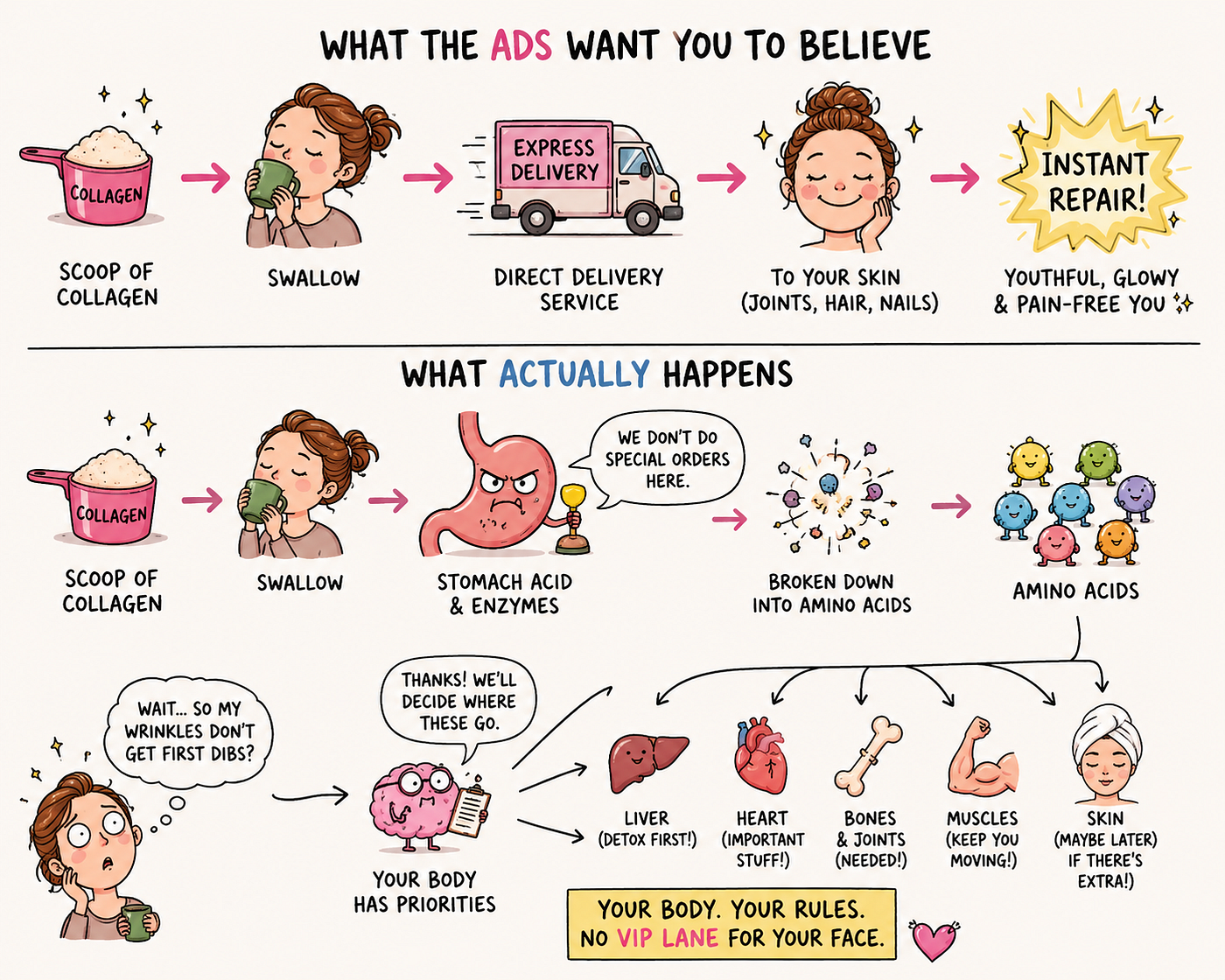
Our digestive systems do not work like a direct delivery service. When you swallow that powder, gummy, or syrup, your stomach acid and digestive enzymes do not recognise it as luxury skincare. They treat it exactly the same way they treat a hamburger or a plate of scrambled eggs.
Your body breaks that expensive collagen down into its microscopic building blocks: amino acids.
AI Generated Image
Once those amino acids hit your bloodstream, your body loses all memory of where they came from. You cannot command those molecules to head directly to your crow’s feet. Your body will deploy them wherever it thinks they are needed most.
If your liver or internal organs need those amino acids to perform critical metabolic functions, your face is going to lose that lottery every single time.
From a purely biological perspective, eating collagen powder to fix your skin is a bit like eating extra bricks and expecting your house to automatically renovate the bathroom. The materials may be useful, but your body decides where the repairs happen.
Where the Science Confuses the Skeptic
I decided to dig a little deeper, fully expecting to discover that the entire industry was built on absolute nonsense.
Instead, what I found is far more interesting.
A huge umbrella review published in the Aesthetic Surgery Journal analysed more than one hundred randomised controlled trials involving nearly eight thousand participants.
Researchers found that consistent, long-term use of hydrolysed collagen peptides led to measurable improvements in skin hydration and elasticity. It also showed benefits in reducing pain and stiffness in people with knee osteoarthritis.
Wait. What?
If our bodies break collagen down into fragments, why is it showing up in the data?
The answer is in a fascinating biological trick. When you consume hydrolysed collagen, it is broken down into tiny strings of amino acids called bioactive oligopeptides. These fragments don’t simply act as raw building materials. Instead, they may act as biological signals.
Think of them as a cellular car alarm.
Your body detects this huge rush of collagen fragments and appears to see this as a sign that structural tissue needs attention. In response, fibroblasts, the special cells responsible for producing collagen may increase activity and start making more.
The supplement isn’t acting as the brick.
It’s acting more like the construction foreman, encouraging your body to produce more of its own collagen.
Which was good news for me.
At least it suggested I wasn’t stirring complete nonsense into my morning drink.
The Truth Is That Collagen Isn’t Magic And It Isn’t Rubbish.
The science suggests it may help. The marketing suggests its a miracle. As usual, the truth is probably somewhere in the middle.
So I’ll keep adding a scoop to my morning coffee and letting my body decide where those amino acids are needed most.
Hopefully my knees get lucky and are allocated first!
I share freelance writing tips, online income ideas, and resources for writers in my newsletter. *Subscribe here *or buymeacoffee.com/fitflicks
Cally 😀
메타데이터
- post_id
- 7ff049b50cb6
- slug
- the-truth-about-collagen-supplements-science-marketing-and-whats-really-in-your-morning-scoop-7ff049b50cb6
- url
- https://medium.com/the-gravity/the-truth-about-collagen-supplements-science-marketing-and-whats-really-in-your-morning-scoop-7ff049b50cb6
- canonical_url
- https://medium.com/the-gravity/the-truth-about-collagen-supplements-science-marketing-and-whats-really-in-your-morning-scoop-7ff049b50cb6
- author_url
- https://medium.com/@fitflicks101
- status
- ok
- fetched_at
- 2026-06-20 20:29:01