Kalman Filter Explained: The Algorithm That Quietly Runs Your World
Your phone can tell you where you are right now. Your car’s cruise control keeps the speed steady even when there are hills and headwinds…
Kalman Filter Explained: The Algorithm That Quietly Runs Your World
Your phone can tell you where you are right now. Your car’s cruise control keeps the speed steady even when there are hills and headwinds. The Mars rovers can find their way around strange land with ease. Tesla’s Autopilot can keep track of many things at once. What do all of these things have in common? The Kalman filter. It is an algorithm that most people have never heard of.
Rudolf Kalman’s groundbreaking paper came out in 1960, and NASA took notice right away. They used it to steer the Apollo spacecraft to the moon. It’s running on billions of devices around the world right now, making our technology smarter and more reliable without making a sound.
But most of the time, mathematicians write Kalman filter explanations for other mathematicians. Let’s fix that.
What Problem Does It Actually Solve?
Think about making a simple app that keeps track of someone walking. You have a GPS sensor that tells you where you are, but there is a problem. GPS isn’t always right. It can say you’re in the middle of a lake when you’re clearly walking on a sidewalk.
Now picture that you also have an accelerometer that can guess how fast something is moving, but it has its own problems. It might think you’ve walked to another city after a few minutes because small mistakes add up over time.
Neither sensor tells you the whole story. But what if you could combine them in a smart way? What if you could figure out how much to trust each sensor based on how well they work? That’s what the Kalman filter does.
The Core Insight
The Kalman filter’s genius lies in its approach to uncertainty. Instead of pretending measurements are perfect, it explicitly models how uncertain everything is. Then it uses that uncertainty to make better decisions.
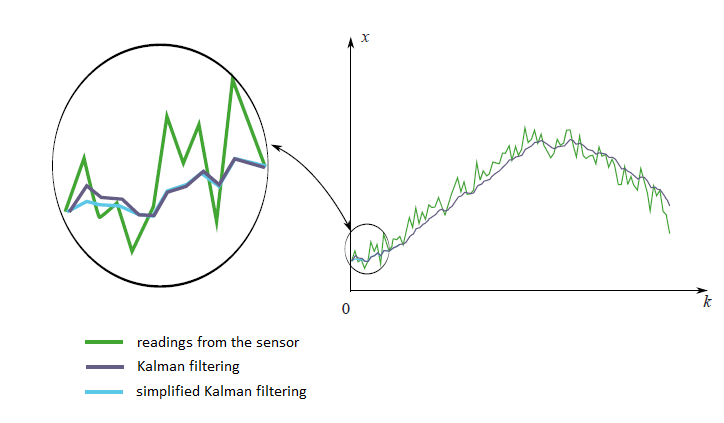
Here’s the beautiful part: it’s not just about averaging two measurements. The filter maintains a prediction of where something should be, compares that to what it actually observes, and updates its belief accordingly. When sensors are noisy, it trusts its prediction more. When sensors are accurate, it leans toward the new measurement.
As one engineer puts it:: “The Kalman filter is basically a smart way of saying ‘I think I know where this thing is, but I’m not completely sure, and here’s how I’ll update my guess when I get new information.’”
How It Actually Works (Without the Math Horror)
Let’s use our walking tracker as an example to explain how a Kalman filter works:
Step 1: Make a Prediction
Based on the last known position and velocity, predict where the person should be now. If they were at point A moving east at 3 mph,, and it’s been 10 seconds, they should be roughly 44 feet east of point A.
Step 2: Estimate Uncertainty
The filter keeps track of how sure it is about this prediction. It might be very sure about the direction but not so sure about the exact speed.
Step 3: Get a New Measurement
The GPS says the person is at a slightly different location than predicted. But GPS has its own uncertainty level.
Step 4: Calculate the Kalman Gain
This is where the real magic happens. The filter calculates how much to trust the new measurement versus its own prediction. If the GPS has been accurate lately, it gets more weight. If the prediction has been reliable, it gets more influence.
Step 5: Update the Estimate
Combine the prediction and measurement using the calculated weights. The result is usually more accurate than either input alone.
Step 6: Update the Uncertainty
The filter also updates how confident it is in this new estimate, setting up for the next iteration.
This cycle repeats continuouslly, with each iteration improving the accuracy of the tracking.
Real-World Magic in Action
Smartphone GPS
Have you ever noticed that the location dot on your phone moves smoothly even when GPS signals are weak? The Kalman filter uses GPS data, accelerometer readings, compass data, and sometimes even WiFi signals to give you smooth navigation.
Autonomous Vehicles
Self-driving cars use more than one Kalman filter at the same time. One keeps track of where the car is and how it moves. Some people keep track of everything they see around them. The filter can tell where a person will be in the next second, even if the camera can’t see them for a second.
Stock Market Analysis
Kalman filters help financial analysts find underlying trends in market data that is noisy. The filter can help you figure out if there is a real trend or just random noise when prices go up and down a lot.
Robotics
Kalman filters help industrial robots stay accurate even when there are vibrations, worn-out mechanical parts, and sensor drift. The filter keeps adjusting the robot’s knowledge of where it is and where the things it is moving are.
The Secret Sauce: Handling Multiple Sensors
Modern applications rarely use just two sensors. Your smartphone might combine:
- GPS position
- Accelerometer data
- Gyroscope readings
- Magnetometer (compass) data
- Barometric pressure (for altitude)
- WiFi signal triangulation
The Kalman filter can handle all of these simultaneously, weighing each sensor’s contribution based on current conditions. In a tunnel where G P S fails, it relies more heavily on inertial sensors. In open sky, G P S gets more influence.
Why It’s Not Magic (The Limitations)
The Kalman filter isn’t a miracle algorithm. It has important assumptions:
Linear Relationships: Classic Kalman filters assume linear behavior. You need variants like the Extended Kalman Filter if you’re following something that moves in curves or has complicated dynamics.
Gaussian Noise: It assumes measurement errorrs follow a normal distribution. Real-world noise isn’t always this well-behaved.
Known Models: You need to understand the system you’re tracking. For our walking example, you need to model how people move. For a spacecraft, you need orbital mechanics.
Computational Cost: While efficient, running multiple Kalman filters on embedded systems requires careful optimization.
The Extended Family
The basic Kalman filter spawned several variants for different challenges:
Extended Kalman Filter (EKF): Handles non-linear systems by linearizing around the current estimate.
Unscented Kalman Filter (UKF): Uses a different approach for non-linear systems that often works better than EKF.
Particle Filters: For systems that don’t fit the Gaussian noise assumption.
Building Your Intuition
You could say that the Kalman filter is a very advanced kind of common sense. You don’t suddenly think you’re swimming when your GPS shows you in a lake like “Wait, waht? Am I swimming right now?”. But you were just walking in a neighborhood. You know the GPS is wrong because it doesn’t match what you thought would happen based on where you were and where you were going.
The Kalman filter makes this idea more formal and mathematically best under certain conditions. It keeps asking, “Based on what I thought would happen and what I’m measuring now, what’s the most likely truth?”
Why You Should Care
Kalman filters are making your life better every day, even if you don’t know it. They are what keeps your GPS navigation from jumping around. They make sure that your camera’s image stabilization works well.
They make it possible for cars to drive themselves and for space missions to go well.
Even if you only know a little bit about them, you can see how modern technology deals with uncertainty and makes choices when it doesn’t have all the facts. That’s a pretty useful point of view to have in a world where sensors are becoming more common.
Also, the next time someone at a tech meetup talks about Kalman filters, you’ll be the one who explains how they work instead of just nodding along as if you understand.
Have you ever noticed the Kalman filter at work in apps or devices yu use daily? What other “invisible” algorithms do you think are quietly making our technology better? Also, let me know if you want a deep dive article into Kalman filter and it’s working
메타데이터
- post_id
- 7ff57a9504e1
- slug
- kalman-filter-explained-the-algorithm-that-quietly-runs-your-world-7ff57a9504e1
- url
- https://levelup.gitconnected.com/kalman-filter-explained-the-algorithm-that-quietly-runs-your-world-7ff57a9504e1
- canonical_url
- https://levelup.gitconnected.com/kalman-filter-explained-the-algorithm-that-quietly-runs-your-world-7ff57a9504e1
- author_url
- https://medium.com/@sohail_saifi
- status
- ok
- fetched_at
- 2026-06-21 07:44:09