How’s Your Hex Life?
Which idiot said there are no straight lines in nature?
The most amazing, astounding, astonishing and awe-inspiring … are to be found in neatly interlocking layers of hexagons
How’s Your Hex Life?
Which idiot said there are no straight lines in nature?
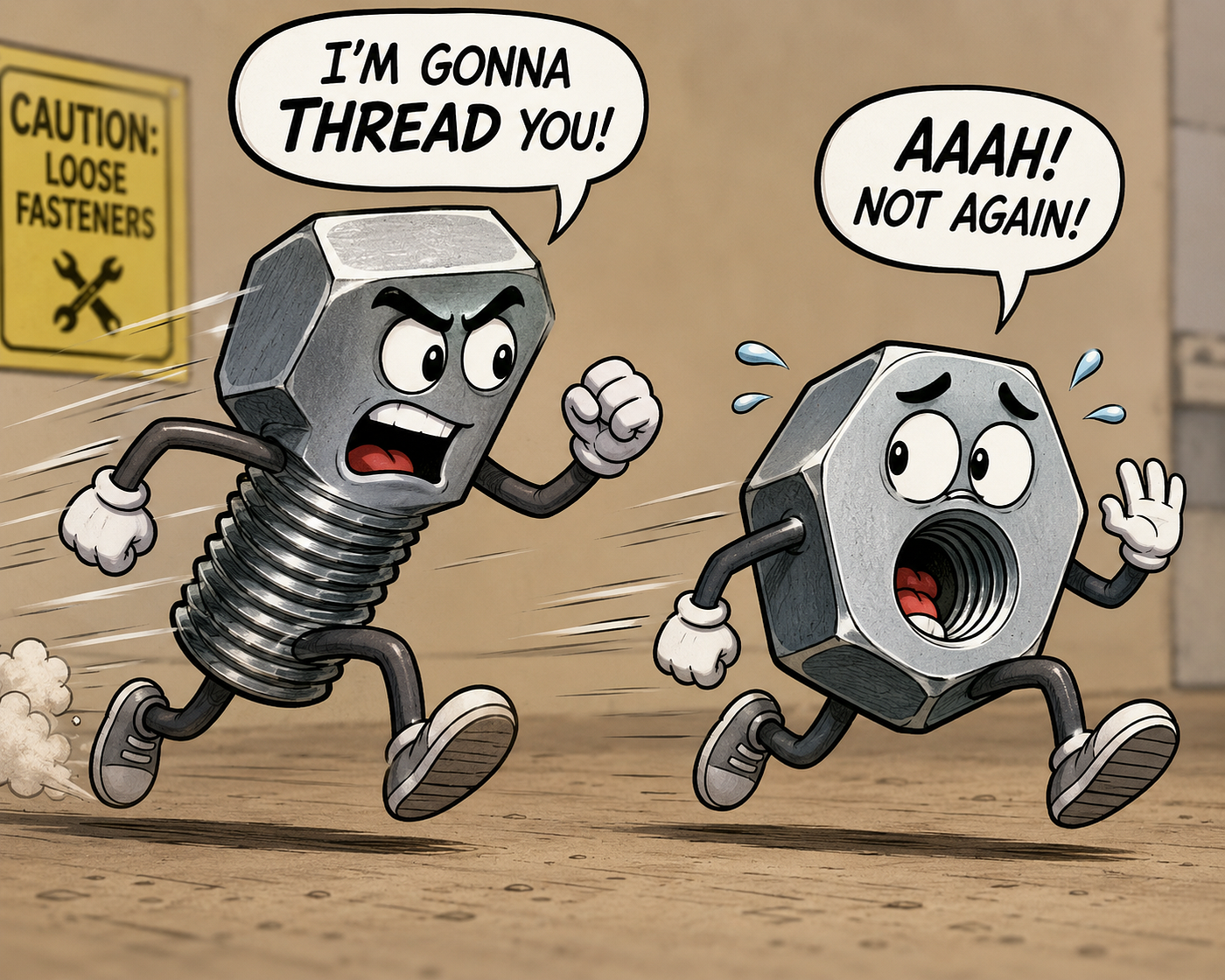
You can’t fit a hexagonal peg into a round hole — image generated using ChatGPT (Open AI)
Though curves may be cute, And sexy, to boot, Their plainness just leads me to yawn, But ask for designs, With six perfect lines, And I’ll give you the bold hexagon! — by Ken Boddie, when in geometric mood.
OK, I can read your minds.
“This time Boddie’s lost it and gone completely stark raving mad! What’s all this nonsense about sexy curves versus six-sided steel symbols? Is this an updated version of that old pseudo-Scots TV commercial for tools, ‘You canna hand a man a grander spanner’?”
Well, I promise you, there are no tools in this blog … other than the one who’s writing it!
No, rather I’m about to show you that there is a certain beauty, even sexiness, about six straight lines of virtually identical length, linked in rotation and forming six congruent angles between each successive pair, each of 120 degrees (or for the mathematically more astute, 2xPi /3 radians).
Before I proceed, I really need to go back a few years to when I was writing copiously, but not necessarily intelligibly, on another SM platform (beBee.com). A few esteemed bloggers were praising the “curves and slings of outrageous architecture”, whereas I was languishing inside a flimsy fortress, fabricating a somewhat limp defence of the engineering profession, we poor sods who have to build these fantasmagorical flourishes of the architect’s imagination (another reason I’m glad I retired).
The congratulatory, curve-commending comments were flying fast and free, backwards and forwards, up and down, like a fiddler’s elbow. And there were many a sage who, in awesome appreciation of the natural beauty of these arches, bends and wiggles, boldly pronounced that …..
“There are no straight lines in nature.” — by the many and the multitudinous, yet mistakingly misdirected.
Well, here’s the rub, after some not inconsiderable research (these were the days before AI), I assembled a post in support of not one straight line but six, the hexagon. Furthermore, I was prompted by an article by Sunita Chakraborty (see below) to dig out my said beBee post and republish it, after some considerable amendment, on Medium:
I am hence about to reveal to you, my precious and possibly previously misdirected readers, that there are many, many straight lines in nature, and the most amazing, astounding, astonishing and awe-inspiring of them are to be found in neatly interlocking assemblies of hexagons.
Let me then introduce you to the fascination of the naturally occurring hexagon, as revealed by Mother Nature and her wonderful world of creatures and natural phenomena.
But first, the most obvious has been observed by our buzzing apiarists, who will have perhaps noted the most fascinatingly and fastidiously formed and fabricated hexagons …..
1. Honeycombs
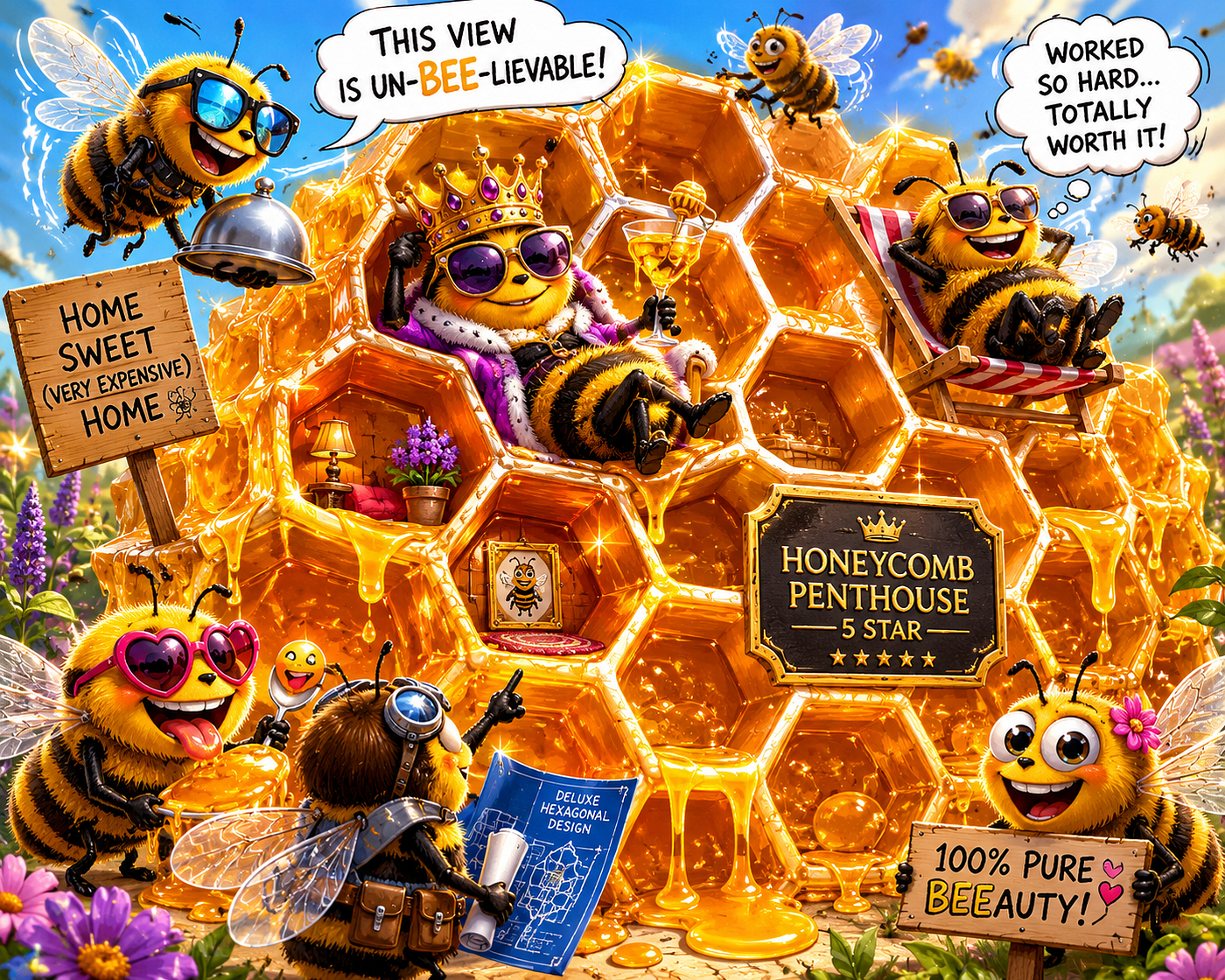
Book you and your ‘honey’ into the Honeycomb Penthouse — image generated using ChatGPT (Open AI).
Yes, my hive-hugging heroes, the humble honey bee stores honey (along with the occasional queen bee’s eggs and pollen) in perfectly hexagonal honeycombs. But are these little winged workers “heaven-instructed mathematicians”, as William Kirby would have had us believe in 1852, or, as Darwin suspected, are they merely using their evolved and inherited instincts?
Wouldn’t circular cross-sectional units (i.e., cylinders) be much simpler for them to construct, even though this would leave heaps of gaps? Or how about cells constructed of equal-sided triangles or squares if they have an affinity with straight-sided edges, and if all of the plane being constructed is to be used for storage?
Well we now know, through mathematics and engineering verification, that hexagonal cells require the shortest total wall length and, furthermore, according to such modern research, that the hexagon uses the least amount of material to hold the most weight. Not bad for an insect that hasn’t had any formal mathematics tuition. Or is there something more ‘natural’ being formed here?
Perhaps Mother Nature just naturally loves making hexagonal arrays of cells? Let’s look at some more samples from nature.
2. Bubble Rafts
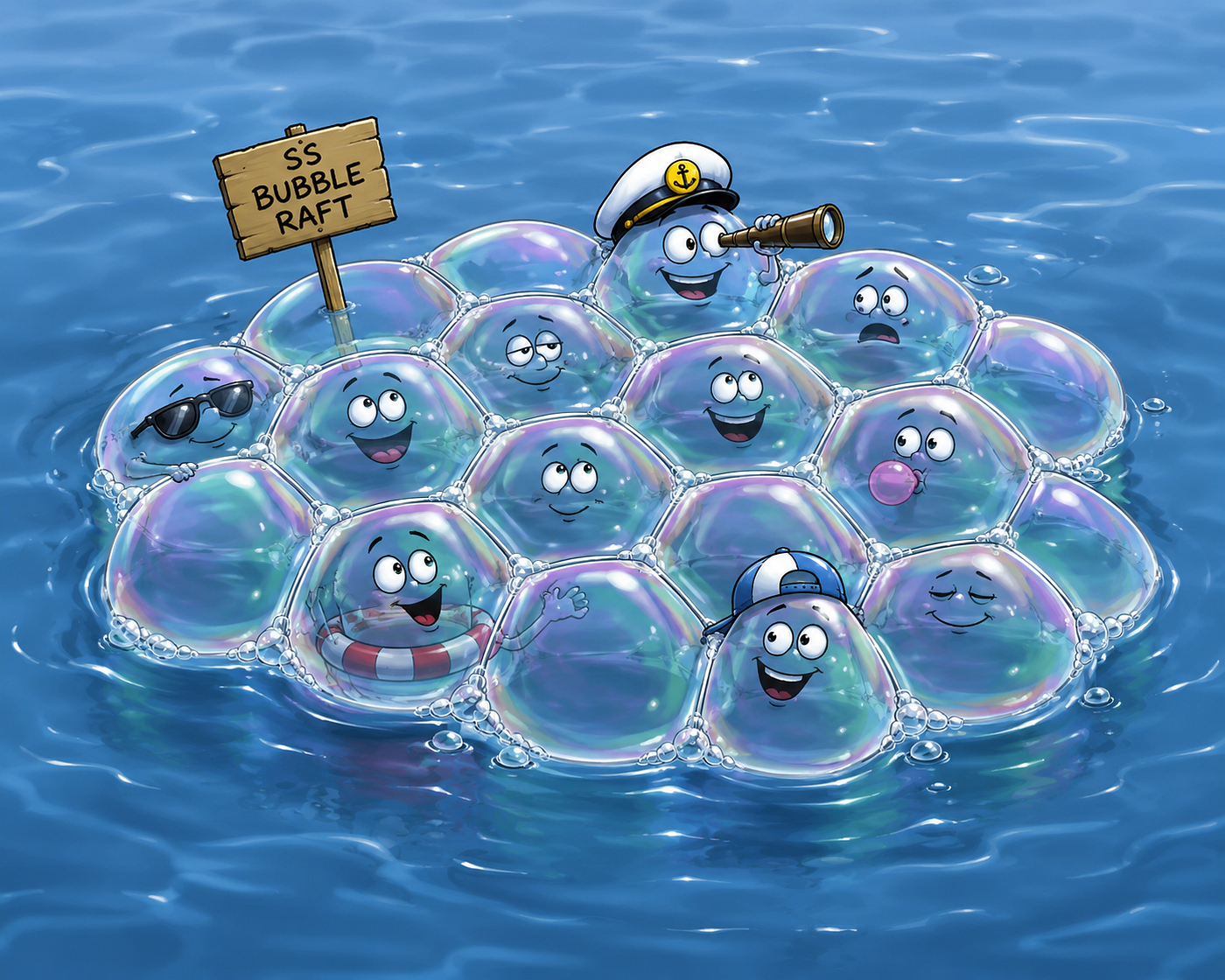
Bubble bath anyone? Nipples surfacing on the port bow! — image generated using Chat GPT (Open AI).
Bubbles blown on a water surface, although initially spherical, come together and form hexagonal shapes, with the odd pentagon (5 sides) or heptagon (7 sides). Here it would appear that the natural laws of physics have a certain bias towards the formation of three-sided nodes (ie junctions) separated by 120-degree angles.
3. Columnar Basalt

Columnar diorite/basal near Cape Bruny Lighthouse, Tasmania — Photo by the author.
Columnar basalt at Fingal’s Cave, Inner Hebrides, Scotland — Photo by Britt Weckx on Unsplash.
There are many famous examples around the world of how basalt cools from its original molten lava to form ‘hexagonal’ columns [Note 1]. The pictures above are from:
- Australia’s Bruny Island in Tasmania (I wasn’t game to get close enough for a better shot, in the absence of ‘sky hooks’); and
- The famous Fingal’s Cave on the island of Staffa, off the west coast of Scotland (I had to unwillingly resort to Unsplash for this one, since Scotland is more than a half hour's drive from my home in Queensland, and, anyway, the weather’s mostly shit there for taking photos).
The same natural cooling process also applies to drying mud or cracking paint or the cracking (as no doubt observed by our Canadian friends) in permafrost. I trust, incidentally, that this post won’t drive anyone to go and watch mud or paint drying, or indeed to go visit Canuck permafrost, dig it up, then wait for it to bake in the sun. If you can’t take my word for the various drying processes that are occasionally, but not necessarily always, readily apparent in nature, then perhaps Dr Google or Unsplash will oblige with some pic proof.
And Mother Nature does all this without a bachelor’s degree in science, technology, engineering or mathematics (STEM), not to mention a master’s or doctorate.
[Note 1: As in many other natural so-called ‘hexagonal’ features, the odd pentagon and heptagon creep in, just to annoy those pedants among you, who are itching to point out that I can’t count to six consistently.]
4. Turtles and Giraffes

Comical turtle figure at SeaWorld, Gold Coast, Queensland — Photo by the author.

Giraffes at Melbourne Zoo — Photo by the author.
The various units comprising the individual components and patterns of animals like the turtle and giraffe are predominantly hexagonal, albeit somewhat different in size and sometimes plus or minus a side or two [see also Note 1 above], but it would appear that, again, Mother Nature is utilising the most efficient geometrical patterns to cover curved surfaces.
[By the way, in case any of you are thinking that the turtle above has rather strange eyes, blame Walt Disney’s movies, or whichever cartoon character this playful figurine was crafted after. I lost interest in searching through my own collection of animal photos for a turtle shot after about three coffees and a full recharge of my MacBook.]
5. What Else?
And I haven’t even touched upon the following natural hexagons:
- the cellular structure of insect eyes, such as the dragonfly; or
- the magical shapes of snowflakes; or
- the carbon chains, such as those present in our DNA and the nicely packed organic material comprising our flesh; or, slightly further afield
- the cloud formation above the North Pole of Saturn — “beam me up, Scotty!”
Now let’s be quite clear. I’m not saying that curves aren’t worth contemplating, nor that they’re not candidates for clever and cost-effective construction. After all arches, domes, arcades, vaults and viaducts, all curvaceous construction complexities, have been features of grand architecture for thousands of years.
Furthermore, I’m not saying that curves have no point. 😂
But let’s give Mother Nature her due and accept that, when it comes to economy of effort, maximising available space, and increasing strength and stiffness, while minimising an increase in weight, there’s nothing like the HEXAGON. After all, 3.5 trillion honey bees, worldwide, can’t be wrong, can they?

The author ‘straight up’ looking for hexagons to snap, and foregoing ‘looking round’ for curves — Photo by a relative no longer on the Xmas card list.
When not researching the weird or the wonderful, the comical or the cultured, the sinful or the serious, I chase my creative side, the results of which can be seen as selected photographs of my travels on my website at:
***http://ken-boddie.squarespace.com***
The author of the above, Ken Boddie, besides being a sometime poet and occasional writer, is an enthusiastic photographer, rarely leisure-traveling without his Canon, and loves to interact with other like-minded people with diverse interests. A retired geotechnical engineer, he honed his knowledge of the English language during decades of labouring over formal reports, with an ever-conscious awareness of the need for clarity and precision in an increasingly litigious world. More recently, he has engaged in various postgraduate English language and grammar studies, leading to his volunteering as an English tutor to adult migrants who have chosen to come to the ‘lucky country’ of Australia.
메타데이터
- post_id
- 800abb261e2f
- slug
- hows-your-hex-life-800abb261e2f
- url
- https://medium.com/the-springboard/hows-your-hex-life-800abb261e2f
- canonical_url
- https://medium.com/the-springboard/hows-your-hex-life-800abb261e2f
- author_url
- https://medium.com/@kenboddie
- status
- ok
- fetched_at
- 2026-06-09 14:34:10