Shifting Design Education for Bioregional Culture & Circularity
Stephanie Owens | Prof. of Arts & Material Futures and Chair, Centre for Circular Materials, Arts University Plymouth
Shifting Design Education for Bioregional Culture & Circularity
Stephanie Owens | Prof. of Arts & Material Futures and Chair, Centre for Circular Materials, Arts University Plymouth
Does current design and creative education provide the model of learning necessary to make the kinds of system changes needed to meet the planetary challenges we face? In what ways does creative education foster a new relationship with the world and its existing social and economic forms?
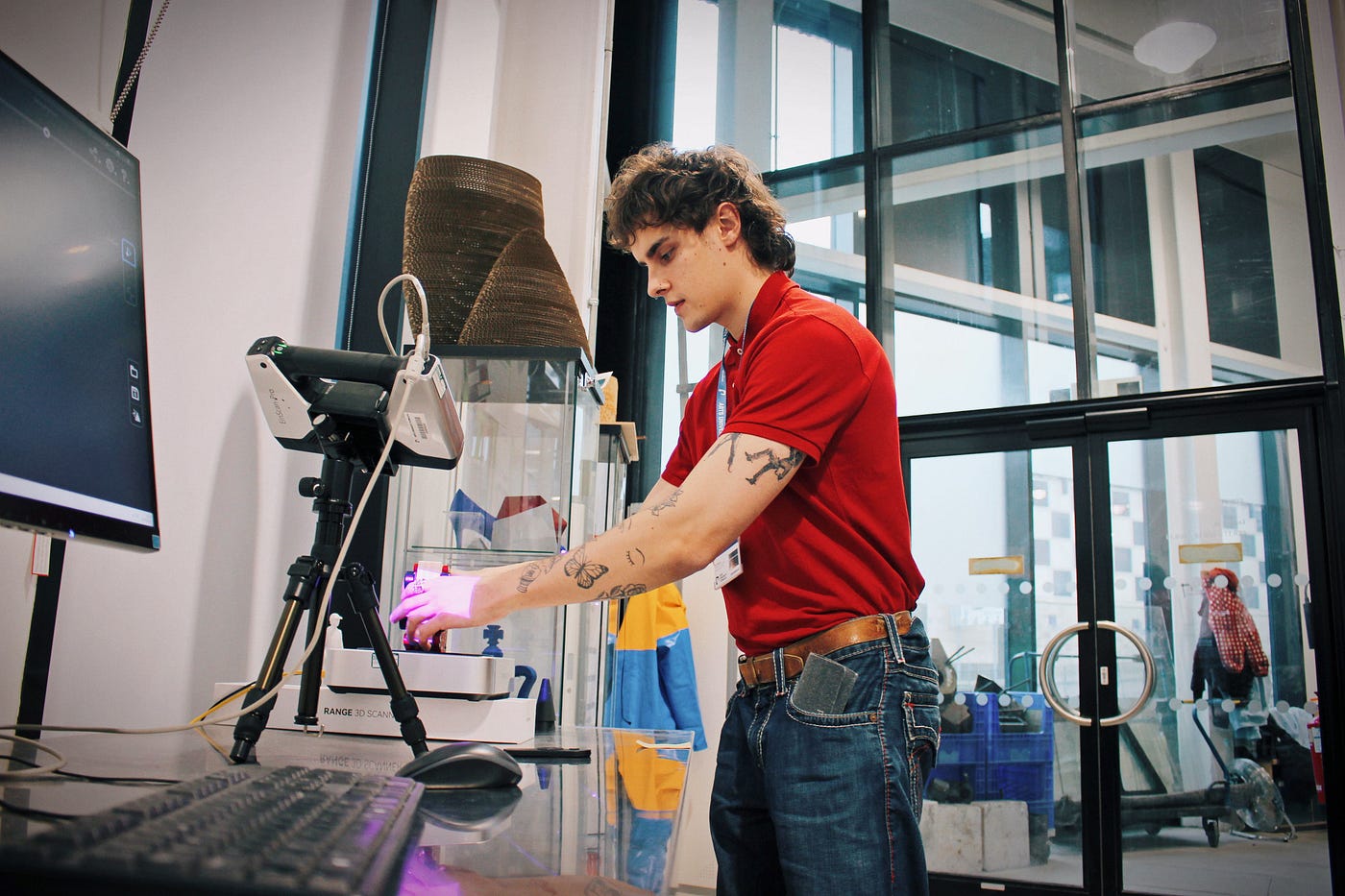
Student at the Fab Lab South West. Photo: AUP
Identity through connection
As a city rooted in a naval history of exploration and expansion, Plymouth has a layered identity associated with its longstanding links to remote places and people. Its location at the far end of the British island has given its culture and people a sense of their being part of a vast, global network. This sense of connectedness has also made the city open to seeing its ties to other cities and cultures as reciprocal. Its long relationship with the Fab Lab Network and Fab City Global Initiative demonstrates that it is a place primarily defined by its relationships rather than its territorial limits.
This identity of relational connections makes it alive to Fab City philosophy of how local productivity can scale — becoming a city that understands the necessity of transforming linear and extractive ways of meeting its material needs to one that nurtures its own backyard through kinship with other urban, regenerative movements.
The arts have played a large part leading this transformation. Plymouth joined the Fab Lab movement in 2014 when Arts University Plymouth (then Plymouth College of Art), joined the network. Founded first as a drawing school in 1856, the university evolved through many periods of change, but has been focused on how art and design are valued in society. Since 2009, the university has led the international research conference, Making Futures, which amplifies this focus by creating a global conversation linking craft, social justice and material technology.
Through the incorporation of a Fab Lab into its campus, and a pedagogical model that invites global experts to feed directly into the curriculum, the university has helped Plymouth as a city become a visible node in transformative art and design education. Since the opening of its Fab Lab Plymouth, renamed as Fab Lab South West in 2024, the relationship between the philosophy of the Fab Foundation to democratise manufacturing technologies, and the university’s pedagogical model of bringing creative education closer to the particular qualities and characteristics of a place, has demonstrated how education in art and design can be an active, global community of experts and makers.
Material identity on a Global scale
Within 10 years of launching its own Fab Lab, Arts University Plymouth was instrumental in Plymouth becoming the first city in the UK to join the commitment to fabricate (almost) everything it consumes by 2054 as part of the Fab City Global Initiative. Being the first city in the UK to recognise the civic and economic value of producing its material needs locally, it demonstrates how it sees itself as a place open to reinvention. Joining the Fab City Global Initiative took collaboration and co-leadership between Arts University Plymouth, the city council and other local academic institutions to scale a city-wide integration of creative study, local systems of production and the fabrication knowledge distributed across the initiative.
Joining the Fab City Global Initiative was built upon existing initiatives in regenerative design and manufacture led by the University through its embedded Fab Lab. This includes Initiatives like Environmental Futures and Big Data Impact Lab and Smart Citizens Programme which transformed the interface between the community and our studios. The EFBD Impact Lab drew on an archive of regional environmental data generated by Devon-based organisations including the University of Exeter, Exeter City Futures, the Met Office, Arts University Plymouth, Plymouth Marine Laboratory, Plymouth University and Rothamsted Research Institute to create new products and services, focusing on safeguarding the environment.
Our Smart Citizens Programme introduced digital design and fabrication to curious citizens, students, aspiring entrepreneurs, artists, makers and local SMEs. These programmes created an important bridge between the city, local ecosystems and our creative students. The porousness between what is taught in the studios and classrooms and the region has been articulated through common units of learning such as Encountering Place and Global Challenges, structured to unite all creative subjects, from game design, fashion design, photography, textile design, graphic design, craft and interior design in cross-disciplinary projects that ask students to take creative inspiration from shared resources and collective challenges.
By breaking down the barrier between academia and citizenship, Fab Lab South West has catalysed a spirit of experimental manufacturing and urban innovation that has become a growing component of our undergraduate and postgraduate courses, articulating the ways in which material creative practice can be a transpersonal, progressive form of regional identity and environmental care.

MA Research Intensives. Photo: AUP
MA Research Intensives through the Full Stack
Building on a common undergraduate curriculum across all subjects which emphasized the importance of place, the University launched a new portfolio of MA Design courses in 2025. Similar to the undergraduate common unit framework, the new postgraduate courses share common units of learning, with regenerative design principles and systems thinking at the core of the pathways in Design. Pathways include MA Design (Built Environment), MA Design (Fashion), MA Design (Textiles), MA Design (Communication) and MA Design — an open pathway that encourages new forms of thinking and making.
There are three units of study for all MA Design pathways: Practice-led Research, Creative and Critical Development, and Final Major Project. The middle unit of study “Creative & Critical Development”, is structured through a group of three Research Intensives which are offered by University researchers and invited external experts in design, systems theories, urban design, material innovation, and emerging technologies.

The Research Intensives are a dynamic, living component of student learning intended to disrupt cultural assumptions and subject isolation by introducing emerging theories, ideas and methodologies through invited external experts and local challenges. MA Design students are introduced to ways to approach their designs as individual, local responses to collective, global problems through a series of questions and provocations led by the Fab City Global Initiative.
It might be helpful to give a specific example of how local challenges intersected with the global commons through the Fab City Research Intensives. We organised the learning as a journey in understanding design as situated within ecosystems, moving students from extractive creativity that is contextualised aesthetically to methods of making that support the material flows of the city, and its indigenous knowledge and natural environment. There were three Research Intensive led by Fab City.
Foundations of Distributed Futures & Regenerative Practices
The first Research Intensive introduced the Fab City vision, the Fab City Full Stack framework and understanding the shift from PITO to DIDO, and explored regenerative design principles to map local Plymouth challenges and uncover opportunities for positive impact. Josefina Nano and Tomas Diez led discussions on how products and objects link with increasing scales of influence. Students walked the city centre to observe scenarios and problems where their designs could have a positive impact.
Local Production, Global Networks & Open Knowledge
The second Research Intensive offered hands-on experience with digital fabrication, and explored networked learning as applied open knowledge principles, proposing that design can be effective as an iteration on an existing open source design. Students discovered how to share their prototypes on open source platforms as a means of testing ideas and accelerating the evolution of projects. In many instances, prototypes which emerged from local contexts were improved through access to similar prototypes used in other regions and cities.
Applied Innovation & Future Pathways
The third Fab City Research Intensive shared principles for how to develop a tangible business proposal, guiding students to create a physical prototype, and to design an open source model and web mockup to showcase a new regenerative venture aligned to the Fab City pledge to fabricate locally. In one project, students collaborated on a design for a bioconcrete borrowed from an open source recipe and strengthened by a local species of miscanthus grass
The integration of expert lecturers from the Fab Lab network radically reoriented the students’ perception of their role as designers. Situating their process within the surrounding city, coastal community and southwest region, students applied open source knowledge and the methods of the Full Stack to imagine more than a formal design solution to a problem in isolation, but instead learned that their role as designer could extend to the ecosystem. Working through an understanding of designed objects as symptoms of the larger natural and economic forces around them, students better understood how their material choices not only impacted the community and supply chains around them, but that working within a bioregional context could give their designs purpose beyond their immediate shape.
What can creative educational institutions do differently to support circular transition?
Teaching MA Design courses in partnership with the Fab City Network through our Research Intensives, we fostered a bioregional perspective on design and collectively learned to approach all creative subjects as ecosystem design, situate learning and knowledge as emergent from particular places & communities, and create platforms for open knowledge generation and innovation through cross-sector, regional ecologies
As a creative university, we are built upon a legacy of material processes and aesthetic protocols taught as required, inherited knowledge in the study of art and design. Too often, however, this legacy reinforces subject and social isolation in practice. Traditional subject-specific training in creative disciplines is understood as outside of the many environmental challenges we face as a society, and can leave artists and designers at the margins when direct actions are needed.
Through our educational partnership with Fab City Foundation, our student designers are learning to operate at the level of cause rather than merely effect: they are empowered to work at the point of convergence of material properties, supply chains, natural ecologies, and economic conditions, and this has allowed them to see their creative role at the intersection of these many systems. With this insight, students developed a sense that their creative authorship could both align to the local ecology and community, as well as provide them ongoing professional relationships through the knowledge commons as part of a global design community.

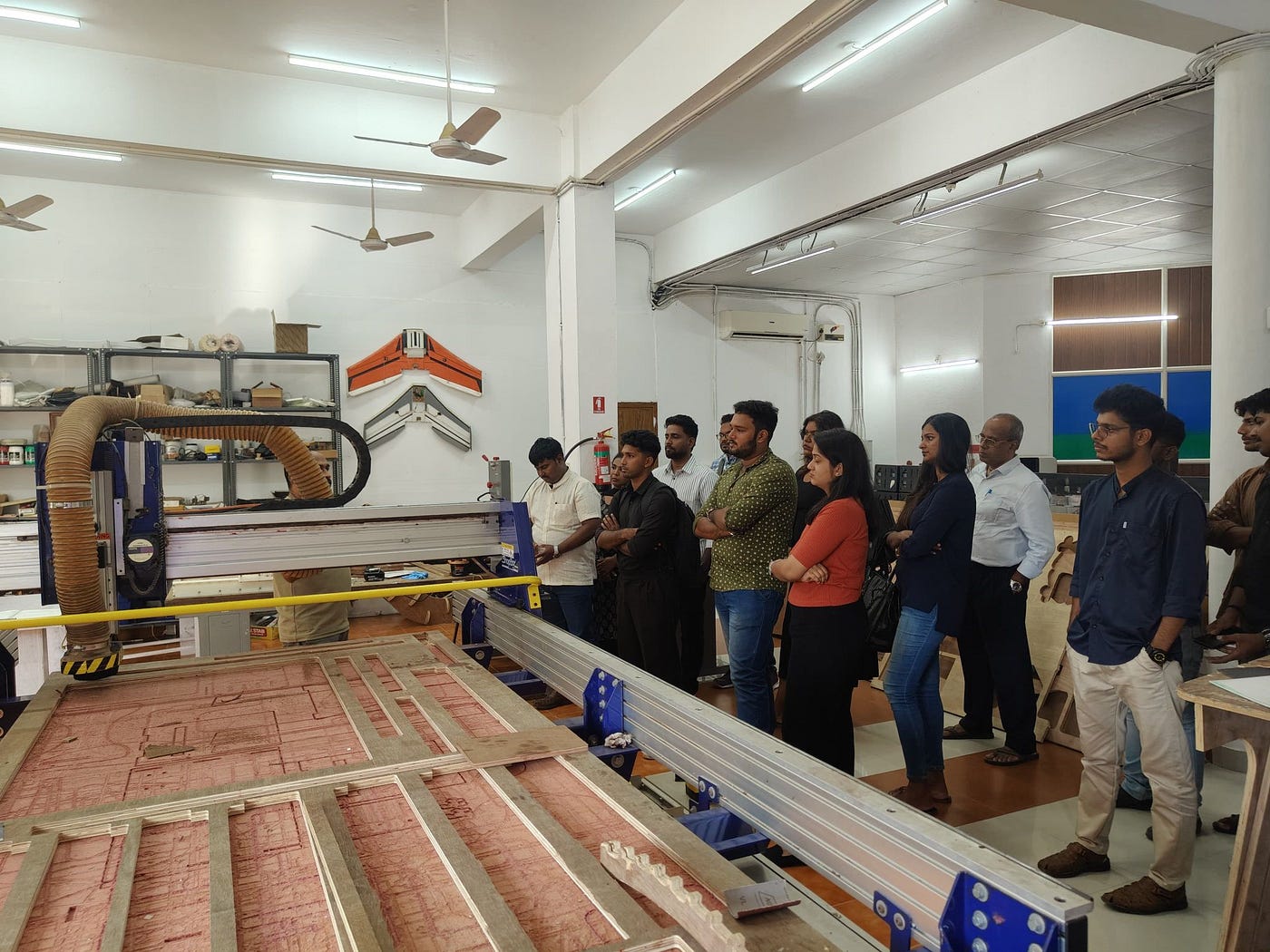
Students at the Fab Lab South West. Photo: AUP
메타데이터
- post_id
- 800eb95d6011
- slug
- shifting-design-education-for-bioregional-culture-circularity-800eb95d6011
- url
- https://blog.fab.city/shifting-design-education-for-bioregional-culture-circularity-800eb95d6011
- canonical_url
- https://blog.fab.city/shifting-design-education-for-bioregional-culture-circularity-800eb95d6011
- author_url
- https://medium.com/@fabcityfoundation
- status
- ok
- fetched_at
- 2026-07-09 10:29:04