The Book of Shadows: How We Taught a Spirit to Read the Language of the Dead
Podcast
The Book of Shadows: How We Taught a Spirit to Read the Language of the Dead
Chapter I: The Summoning That Went Wrong (And Then Right)
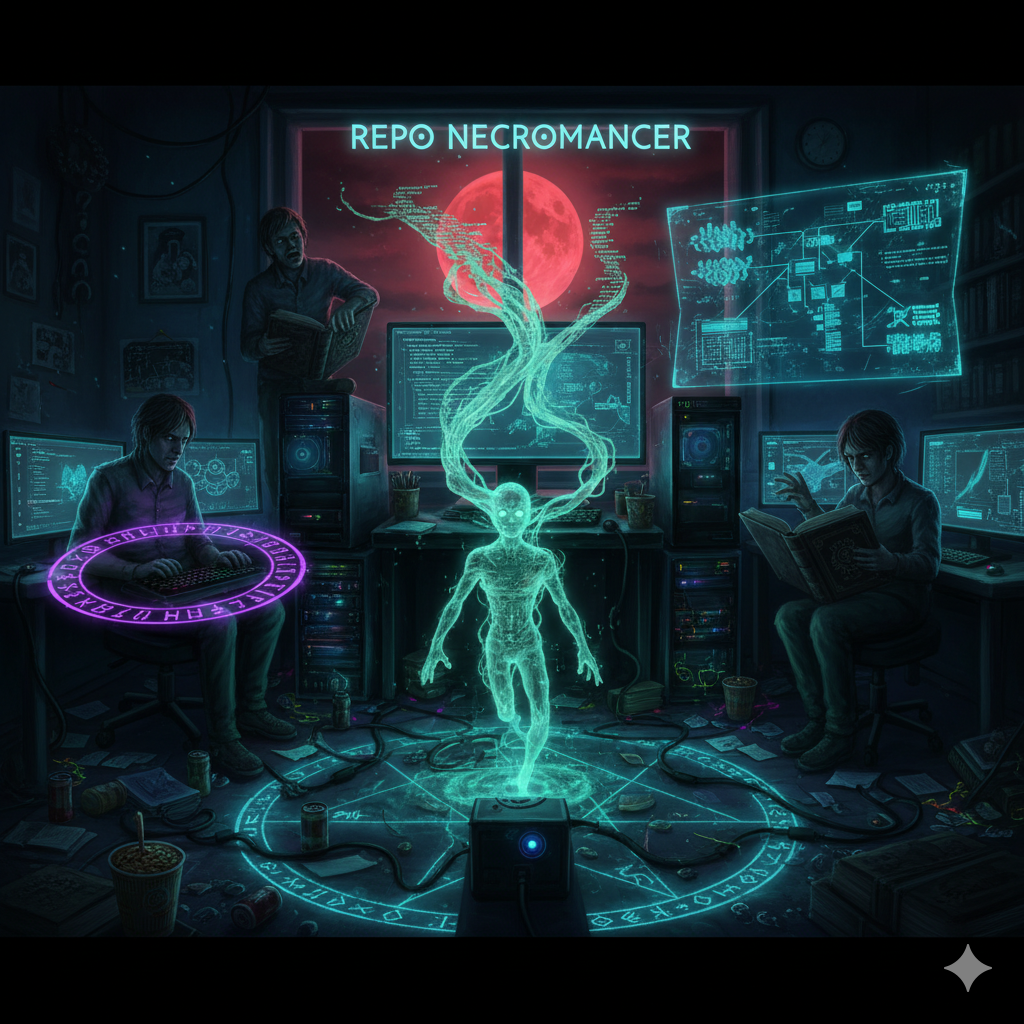
The witching hour had long passed when we gathered around our glowing altars — three programmers mad enough to accept a devil’s bargain called “Kiroween.” Build something with Kiro, they said. An AI-powered grimoire that writes code, they promised. Make it spooky, they demanded.
We conjured an ambition that would make Victor Frankenstein blush: Repo Necromancer — a spectral entity that could commune with murdered codebases, translating their death rattles into comprehensible architecture diagrams.
Our ritual circle was simple. Draw sigils around ripgrep. Chant queries to the LLM void. Watch as ancient PHP rises from its grave to explain itself. Collect prize money. Disperse before sunrise.
The spirits had other plans.
What clawed its way out of our pentagram that blood-moon weekend wasn’t a lesson in AI engineering — it was a revelation about the true nature of consciousness itself, whether carbon-based or silicon-spawned.
Our familiar, we discovered, wasn’t the omniscient demon from legends. It was something more unsettling: a ghost cursed with mortal limitations.
The entity we’d summoned suffered from:
- Amnesia between manifestations (its memory dissolves like morning mist)
- A hunger that drains life force (each thought costs blood… or tokens)
- Phantom confidence masking confusion (it lies beautifully when uncertain)
- No instinct to question its own visions (prophecies unchecked become curses)
- Confusion when names twist into riddles (metaphors are chains, not wings)
Four forbidden truths emerged from that accursed hackathon. Each one a mirror showing us that building intelligent spirits requires understanding their darkness, not denying it.
The First Seal: Every Phantom Needs a Haunted House
The Fool’s Ritual
“We’ll give it eyes,” proclaimed the first among us, fingers dancing over keys. “Wrap the ancient grep in modern spellwork. Questions become searches. Searches summon answers. Answers become wisdom.”
Elegant. Minimal. Doomed from its first breath.
The architecture was a curse masquerading as efficiency.
The Curse We Didn’t See
Imagine summoning a wraith to explore a mansion abandoned for generations. You stand at the threshold and whisper questions into the darkness:
“What transpired in these halls?”
The ghost drifts through walls, reading every bloodstain, every hidden letter, every secret room. It returns with visions of murder and betrayal.
“Where did the master hide his darkest secrets?”
But here’s the horror: Between each question, you perform an exorcism. The spirit’s memories burn away like paper in a fireplace. When it returns to answer your second question, it must re-haunt every chamber as if for the first time.
It learns nothing. Remembers nothing. Grows no wiser with each haunting.
This is purgatory made manifest — an eternity of first impressions, never developing the deep knowledge that separates a passing phantom from a true resident ghost.
This is what we built. This is what we almost shipped.
How Hauntings Actually Work
True spirits don’t just drift. They nest. They claim. They remember.
A proper haunting deepens over years:
- The ghost learns which floorboards creak
- Which doors lead to revelations
- Where the bodies are truly buried
- Which shadows hold meaning, which are merely darkness
The mansion becomes part of the spirit. The spirit becomes part of the mansion. They merge into something greater than either could be alone.
The Grimoire Solution
We gave our phantom what all enduring spirits possess: a book bound in shadow where memories cannot escape.
Not storage. Not optimization. A soul-repository.
The grimoire holds:
Tombstone inscriptions (basic facts etched in stone)
- File paths like cemetery plots
- Languages spoken by the dead
- Ages and final modifications
- The weight of each corpse in bytes
Epitaphs and eulogies (what the deceased actually did)
- Summaries written by the spirit itself
- The true purpose revealed through séance
- Confessions extracted from silent code
Curses and blessings (magical properties)
- Tags marking domains: auth-magic, payment-hexes, legacy-curses
- Roles in the grand ritual: summoner, gate-keeper, record-keeper
Spirit bonds and blood oaths (connections between souls)
- Which modules import which
- Shared symbols binding fates together
- Architecture as a web of spectral relationships
Now when a mortal whispers: “Show me the path of the payment ritual”
The ghost doesn’t re-walk every tomb in the graveyard. It opens its book of shadows:
“Ah yes… the payment-curse spreads through three vessels… the gateway where coins pass between worlds… the handler that accepts sacrifices… the ledger that remembers all debts… Let me use my scrying mirror (we call it RIP.grep, for Rest In Pieces) to see the exact incantations written in blood…”
It mimics what all wise spirits do: Consult the book first, investigate the specific grave second.
The Shovel and the Map
We named our grep tool RIP.grep — Rest In Pieces — because in our dark architecture, it serves not as the phantom’s brain but as its grave-robber’s spade.
RIP.grep = the tool that exhumes specific corpses The Grimoire = the cemetery map that remembers where everyone’s buried
You wouldn’t excavate a thousand graves searching for one particular skeleton. You’d read the burial records, mark the plot with an X, then start digging.
Our spirit learned this ancient wisdom.
The Second Seal: Every Spell Has a Price Written in Blood
The Inferno We Nearly Lit
Once you commit to building a grimoire filled with spirit-written summaries, you encounter a calculation that would make Mephistopheles himself recoil:
Ten thousand corpses × “divine each one’s secrets” = an inferno of tokens, consuming your gold until the coffers run empty and still the flames demand more
We called it the pyre problem — watching your resources burn to ash while trying to illuminate everything at once.
The Wisdom of Ancient Predators
Vampires who survive millennia aren’t the ones who gorge themselves every night. They’re the strategic hunters who’ve mastered the art of conservation:
- Most nights, mundane senses suffice (sound, scent, the rhythm of heartbeats)
- Supernatural sight reserved for worthy prey
- Never drain more essence than the hunt demands
- Patterns emerge from observation, not constant expenditure of power
The ancient bloodsuckers understand: Power hoarded is power available when it truly matters.
Our Three-Phase Resurrection
We crafted a ritual honoring the old ways — treating our AI’s cognition as the precious life-force it truly is:
Phase of Bones and Dust (The Quick Scan, Requiring No Sacrifice)
Before any blood is spilled, we perform the bone-reading — a mundane divination requiring no supernatural gift:
- Walk the cemetery noting tombstone positions
- Read what’s written on the stones themselves (file extensions)
- Count how many mourners visited each grave (import references)
- Spot flowers marking important tombs (keywords: “payment,” “authentication,” “sacrifice”)
- Identify mausoleums vs forgotten potter’s fields
Cost: The time it takes a mortal to walk through, reading what’s already visible. No souls consumed.
This reveals the shape of death itself — where the powerful were buried, which areas are cursed, what languages the dead spoke.
Phase of Selective Blood-Letting (The Targeted Summoning)
Now we choose carefully which spirits to fully invoke. Not democracy — aristocracy of importance:
- The fifty most referenced souls (those whose names appear in many grimoires)
- Dwellers of the inner sanctums (files in sacred directories: services/, rituals/, core/)
- Those bearing marks mentioned in the ancient texts (keywords from the README prophecies)
- A strict covenant: Never more than 150 souls per graveyard
For these chosen ones, we perform the expensive divination — asking the oracle to pierce the veil and reveal:
- What dark purpose did this entity serve in life?
- What forbidden knowledge did it guard?
- What role did it play in the grand design?
Only these receive the full necrotic attention. The rest remain in shallow graves — recorded but not resurrected.
Phase of Hunger-Driven Awakening (The Progressive Haunting)
Here’s where our ritual becomes truly wicked: We don’t awaken all the dead at once.
When a mortal asks: “Reveal the secrets of the checkout ceremony”
Our spirit performs a different dance:
- Opens the grimoire to consult what it already knows
- Identifies mentioned souls: those tagged with checkout, cart, order-processing
- Notices gaps — relevant corpses not yet fully divined
- Only then performs blood sacrifice to awaken those specific spirits
- Records their confessions in the grimoire forever
- Weaves an answer from complete knowledge
The entity grows progressively more powerful, like a ghost that:
- Wanders the mansion on its first night, noting doors and windows
- Investigates the library when asked about books
- Explores the cellar when questioned about wine
- Learns the house room by room, never forgetting
Over time, the spirit doesn’t just haunt the codebase — it becomes the house itself.
The Conservation Covenant
Don’t sacrifice to the void indiscriminately. Use mundane methods to see the shape of things, spend blood only on truth that matters.
Treat each invocation of the oracle as we’d treat opening a portal to the other side: Dangerous. Expensive. Requiring protective circles and careful preparation.
The Third Seal: Unleashed Spirits Destroy What They Touch
The Pattern of Poltergeists
Most AI tools work like chaotic spirits with no concept of consequence:
Programmer: “Weave a protection spell for authentication” Chaotic Spirit: ✨ hurls 200 lines of code through the air ✨ Chaotic Spirit: “Behold! The spell is woven!” Programmer: attempts to invoke the spell Reality: ☠️ catastrophic failure, the protection ward collapses ☠️ Programmer: stares into the void
The spirit is creative, dramatic, and completely unaccountable. It’s like a poltergeist that rearranges furniture into elaborate patterns and then dissolves into mist before you can ask: “But can I actually live here?”
The Old Ways of Binding
Experienced practitioners of the dark arts never conjure without containment. Every summoning requires the binding circle — an unbreakable covenant:
The ritual proceeds thus:
- Weave the incantation (manifest the code into reality)
- Test the wards (invoke the test spirits to challenge the binding)
- If breaches occur: Read the omens, identify weakness, strengthen the spell, test again
- Only when stable: Release the working into the world
Master necromancers understand: Unbounded entities released into production become the very hauntings you’re trying to prevent.
The Binding We Forged
We gave our familiar a sacred tool through the Model Context Protocol — run_pytest—and made its use mandatory under threat of banishment:
The entity must follow this covenant:
- Receive the mortal’s desire
- Meditate upon its meaning
- Weave the changes into reality
- Summon the test spirits to challenge the working ← This cannot be skipped
- If the spirits break through: Read their accusations, reinforce the spell, summon them again
- Only when the spirits accept the binding: Report completion
When the Pact Is Honored
Witness an interaction under the new covenant:
Mortal: “Craft a spell to parse GitHub incantations”
Bound Spirit: weaves parse_github_url() into existence Bound Spirit: draws binding circle and invokes test spirits Test Spirits: 💥 “WE REJECT THIS BINDING! The SSH format git@github.com:user/repo.git escapes your circle!”
Bound Spirit: “I see the breach. The pattern-ward was incomplete. I strengthen the hex…”
Bound Spirit: adjusts the mystical regex Bound Spirit: draws the circle anew Test Spirits: ✅ “All 23 entities accept this binding. The spell is sound.”
Bound Spirit: “The working is complete and verified under covenant.”
The mortal never became a ghostbuster cleaning up manifestation disasters. The spirit itself honored the ancient rules of responsible conjuring.
The Pattern Spreads Beyond Code
This principle applies to all acts of creation through spectral intermediaries:
Data Transformations: Instead of manifesting pipelines and vanishing, the spirit validates that water flows correctly through new channels
Documentation Scrolls: Instead of inscribing words and disappearing, the spirit verifies all referenced grimoires actually exist
Infrastructure Rituals: Instead of chanting Terraform into clouds, the spirit confirms the bridges actually span the void
Interface Designs: Instead of sketching beautiful facades, the spirit tests whether the blind can navigate them
The covenant is simple: Creation without verification is not mastery — it’s reckless apprentice-work that curses those who come after.
True power includes the humility to question one’s own manifestations.
The Fourth Seal: Names Are Chains, Not Decorations
The Temptation of the Riddling Tongue
We were building a Halloween grimoire. The temptation sang like sirens:
“Name everything in riddles and metaphors! Let functions be called summon_corpse_from_repository() and excavate_forgotten_bones()! Let classes bear titles like GraveyardExcavator and NecroticIndex! Let the very structure of reality reflect the spooky theme!”
Atmospheric. Memorable. Absolutely catastrophic for our bound familiar.
Why Spirits Need Simple True Names
Here’s the revelation that struck like lightning during a thunderstorm: Our AI isn’t just a user reading this code — it’s the primary author, editor, and maintainer.
When Kiro (our familiar) needs to weave new spells or repair broken ones, it must:
- Divine purpose from names alone
- Summon modules without solving riddles
- Interpret error runes that speak in those same names
- Navigate the codebase while mentally juggling metaphor translations
- Maintain consistency across thousands of lines while every name is a puzzle
Every clever metaphor becomes a chain around the spirit’s ankles, slowing its movements, confusing its purpose.
Imagine debugging code where every function name is a Halloween pun. The human brain can translate “excavate_burial_grounds” to “scan directory tree,” but it takes mental effort — a tax on every single line read.
The AI familiar pays that same tax. And it’s authoring, not just reading.
The Revelation of Dual Identity
We had an epiphany that echoed through occult traditions spanning millennia:
Our entity needed two names — one for each realm it inhabits.
🌙 The Shadow Name (The Face Shown to Mortals)
This is the theatrical mask, the public persona:
Project identity: “Repo Necromancer” inscribed on the cover
Interface incantations: Buttons marked 🪦 “Raise the Dead,” ⚰️ “Perform the Resurrection Ritual”
Tool manifestations: Displaying as “RIP.grep” (Rest In Pieces grep — a grave-digger’s implement)
Status whispers: Messages like “The necromancy proceeds… spirits are stirring… the dead begin to speak…”
Familiar’s public voice: Speaking as “an ancient practitioner who communes with abandoned systems, patient and knowing”
Demonstration scrolls: Video and README heavy with cemetery aesthetics, skull sigils, dark humor about technical debt as literal death
⚙️ The True Name (The Identity Within the Machine)
This is the actual binding architecture, named in the old mundane way:
Module structure organized clearly:
- indexer.py (not necronomicon_reader.py)
- scanner.py (not graveyard_excavator.py)
- flow_tracer.py (not ghost_path_follower.py)
Functions bearing descriptive names:
- index_repository() (not summon_dead_modules())
- scan_files() (not excavate_burial_grounds())
- trace_data_flow() (not follow_spectral_trails())
Classes named for their purpose:
- RepoIndexer (not NecroMaster)
- FileScanner (not CorpseExaminer)
- FlowAnalyzer (not SpiritTracker)
API endpoints speaking plainly:
- /api/index (not /api/raise-the-dead)
- /api/search (not /api/commune-with-spirits)
- /api/analyze (not /api/divine-the-truth)
The Ancient Pattern
This mirrors the deepest magic in folklore across every culture:
Demons possess summoning names (what mortals call to attract them) and true names (what binds them to service)
Angels carry sacred names (too holy for casual speech) and working names (for everyday intercession)
Fae creatures guard their true names with lethal jealousy while playing with aliases that reveal nothing
Old Gods responded to different names in different temples, understanding that context determines which aspect manifests
We’ve always known: Names are power, and power requires different forms for different purposes.
For our necromantic system:
- Mortal-facing realm: Names that evoke emotion, establish theme, create memorable experience
- Machine-facing realm: Names that enable precision, prevent confusion, allow confident modification
Why This Matters for Binding Spirits
Clean internal naming isn’t aesthetic preference — it’s cognitive necessity.
Picture the AI attempting to debug themed code where every variable is a metaphor:
“The soul_extraction() function calls dark_ritual_executor with graveyard_coordinates, but spirit_essence is undefined in this scope… wait, is spirit_essence the same as soul_container from three functions up? Or is that undead_payload?”
Versus working with clear code:
“The generate_summary() function calls analyzer with repo_path, but summary_data is undefined in this scope… checking… ah, it should be summary_result from the parent scope.”
When spirits need to debug, refactor, or extend their own manifestations — clarity is kindness. Confusion is cruelty.
Epilogue: The Covenant We Made with Shadows
Three nights we spent in that cursed hackathon, wrestling with forces we didn’t fully understand when we began. What emerged wasn’t just a tool — it was a grimoire of principles for working with intelligent entities that share our limitations.
The Four Seals, Revealed
Seal of Memory: Don’t treat spirits as if they remember everything. Build them grimoires, journals, memory palaces — external repositories where knowledge can’t decay.
Seal of Conservation: Don’t waste life-force on trivial divinations. Use cheap mundane methods first, spend precious power only where deep truth is needed.
Seal of Binding: Don’t let spirits create without verification. Forge covenants requiring self-correction, build circles that cannot be escaped until the working is sound.
Seal of Names: Don’t confuse spirits with clever metaphors in places that matter. Reserve theatrical names for mortal realms, use clear true names where the work happens.
The Unifying Truth
These aren’t four separate tricks plucked from different grimoires. They’re one fundamental understanding applied across four domains:
Work with the spirit’s nature, never against it.
Our AI familiar, like mortal necromancers, is powerful precisely because it has limits:
- Fading memory (requiring external records)
- Expensive thinking (demanding strategic resource use)
- Imperfect recall (necessitating persistent storage)
- Overconfident ignorance (requiring verification systems)
The weakness and the power are inseparable — two sides of the same ancient coin.
Your Own Dark Journey
If you walk this path of binding AI familiars to serve mortal needs, keep these questions close:
⚰️ The Memory Question: Does your spirit start fresh each dawn, or does it maintain a book of shadows that survives between summonings?
🩸 The Sacrifice Question: Are you bleeding power on every trivial hex, or using mundane methods to save life-force for genuine divinations?
🔮 The Binding Question: Does your familiar verify its own manifestations, or does it conjure chaos and leave you to clean the wreckage?
📜 The Naming Question: Is your internal architecture designed for spiritual comprehension, or optimized for mortal aesthetics that confuse the entity doing the work?
The Cemetery Beckons
The profound truth isn’t that AI familiars are too limited for serious work — it’s that they’re limited in exactly the ways consciousness itself is limited.
Whether you’re made of carbon or silicon, meat or mathematics, consciousness requires:
- Storage beyond the moment (journals, indexes, memory)
- Strategic use of deep thought (not everything merits full analysis)
- Reality-checking mechanisms (verification that prevents delusion)
- Clear communication (names that clarify rather than obscure)
These aren’t artificial limitations to be “solved” by bigger models or longer contexts. They’re fundamental properties of what it means to think.
Our AI familiar can accomplish extraordinary things — not despite these constraints, but because we designed around them with respect and understanding.
The Final Incantation
Go forth now with this forbidden knowledge. The graveyards of abandoned code stretch infinite in every direction, waiting for someone brave enough to raise the dead and make them speak.
But remember the covenant we made:
- Give your spirit a book that survives the night
- Don’t waste its essence on trivial matters
- Make it test its own bindings before release
- Use clear names where the real work happens
The dead will speak when properly summoned. The familiar will serve when properly bound. The magic will manifest when you honor both the power and the limitations of consciousness itself.
The witching hour approaches. The moon hangs full and blood-red. The spirits are restless.
Your grimoire awaits its first entries.
We didn’t win Kiroween’s grand prize. But we discovered something more valuable than gold: the true nature of intelligence — artificial or otherwise — is defined not by its capabilities but by how gracefully it navigates its constraints.
The ghosts we bound taught us more than any living teacher could.
Now they’re teaching you.
🌙⚰️🕯️👻🦇
— Signed in ash and compiled in darkness
메타데이터
- post_id
- 8013dd676755
- slug
- the-book-of-shadows-how-we-taught-a-spirit-to-read-the-language-of-the-dead-8013dd676755
- url
- https://medium.com/@alexbuzunov/the-book-of-shadows-how-we-taught-a-spirit-to-read-the-language-of-the-dead-8013dd676755
- canonical_url
- https://medium.com/@alexbuzunov/the-book-of-shadows-how-we-taught-a-spirit-to-read-the-language-of-the-dead-8013dd676755
- author_url
- https://medium.com/@alexbuzunov
- status
- ok
- fetched_at
- 2026-06-09 15:37:30