Why Youth Track Progress Is Not a Straight Line
A new endurance training study shows why one “flat” season should not label a young athlete as a non-responder.
Why Youth Track Progress Is Not a Straight Line
A new endurance training study shows why one “flat” season should not label a young athlete as a non-responder.
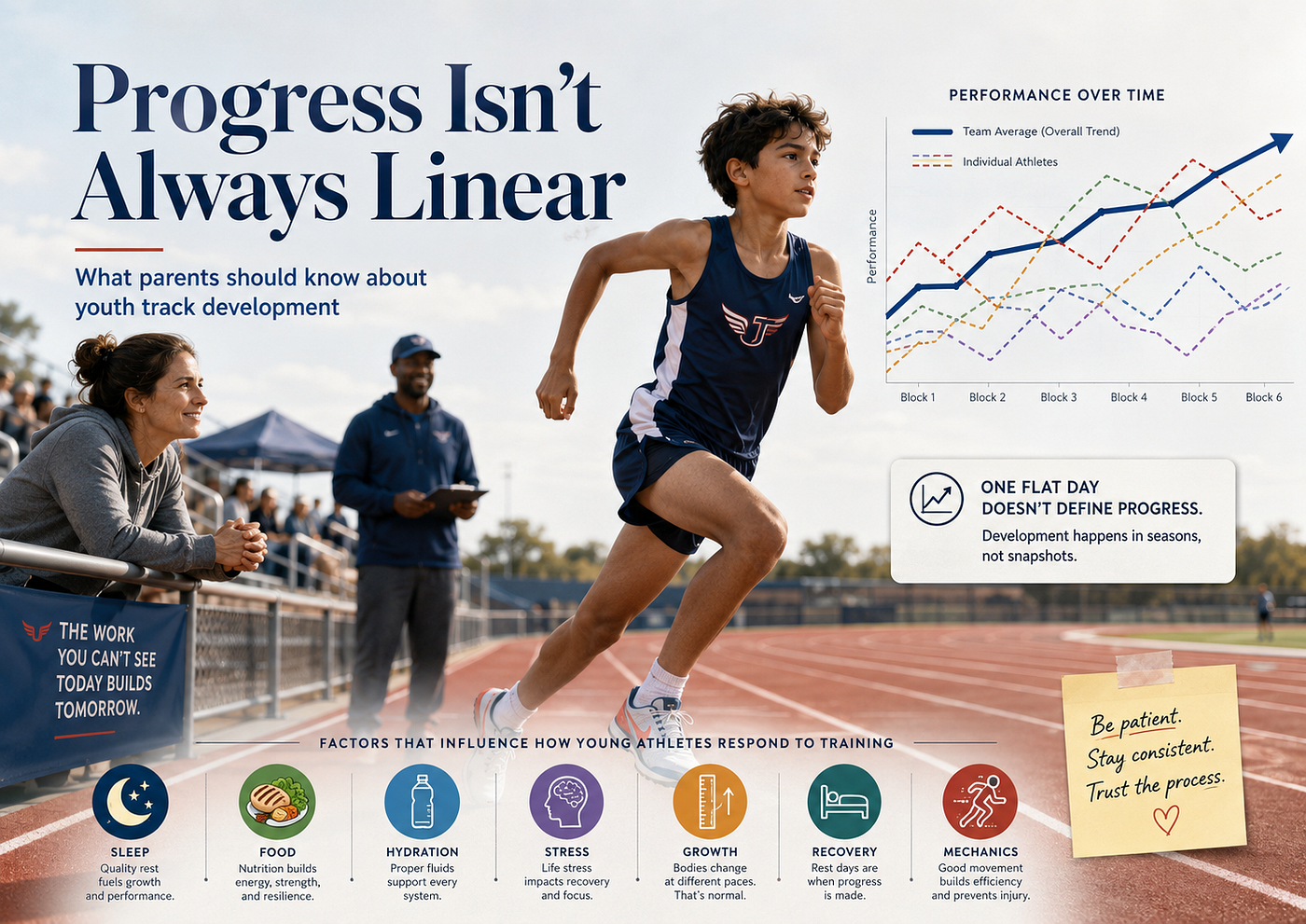
A parent watches the same workout, the same coach, the same athlete, and expects the same result. Then track gets messy. One season, a runner drops time quickly. The next, training looks solid but the stopwatch barely moves. A 2026 endurance training study gives parents a useful lens: improvement is real, but an individual athlete’s response can change more than we want to admit.
What the Study Actually Tested
Odden and colleagues studied 42 healthy, previously untrained adults, with equal numbers of women and men, who completed two similar eight-week endurance training blocks. The two blocks were separated by eight weeks away from training, so researchers could test whether the same people would adapt the same way when the training was repeated.
The training was tightly controlled. Each block included 24 supervised, 45-minute cycling interval sessions. Sessions alternated among 6×6-minute moderate intervals, 4×8-minute high-intensity intervals, and 4×5-minute maximal intervals. Intensity was adjusted every two weeks based on each person’s performance.
That matters. This was not a loose “go train and report back” design. The researchers checked oxygen uptake, 15-minute power, hemoglobin mass, blood volume, muscle capillaries, and muscle enzyme activity. They also standardized testing meals, fluid intake, caffeine, time of day, equipment setup, and encouragement.
The Big Result, in Parent Language
The group improved. Twice. Average 15-minute power, power at the end of the VO₂max test, and VO₂max all improved after training. On average, the training worked.
But the same person’s first response did not reliably predict their second response. Reproducibility of individual changes was poor for VO₂max, 15-minute power, hemoglobin mass, citrate synthase activity, and capillaries per fiber. In plain language: the athlete who looked like a “great responder” the first time was not guaranteed to look that way again.
That is the coaching gold. The study challenges the idea that a person has one fixed “training response personality.” The authors concluded that adaptability looked more dynamic and context-dependent than stable and trait-like.
[Parent Power Move] Do not call a young runner a “non-responder” after one season, one test, or one training block. Say, “This block did not show up yet. Let’s check sleep, stress, fueling, health, growth, event fit, and workout execution.”
Why This Matters for Track Parents
Track parents often see performance as a straight line: train, adapt, race faster. Real development looks more like waves. Growth, school stress, sleep, illness, nutrition, motivation, weather, event choice, and mechanics can all change what the same workout does to the same athlete. The study’s authors specifically pointed to sleep, diet, stress, illness, activity outside training, training details, and measurement error as likely contributors to shifting responses.
That fits youth track especially well. A 15-year-old is not just a smaller adult. Adolescence brings uneven growth, changing coordination, changing recovery needs, and different emotional pressures. The 2024 IOC consensus on elite youth athletes describes adolescence as dynamic, with physical, physiological, psychological, and social changes that do not progress neatly or evenly.
So the contrarian coaching take is this: a “perfectly individualized” plan based only on last season’s response may be less useful than a solid plan adjusted to the athlete’s current state. The new question is not “What type of responder is my kid?” It is “What condition is my kid bringing to training this week?”
A Smarter Way to Read Progress
Use one short parent check, repeated weekly:
- Is attendance steady, without hiding pain or fatigue?
- Is sleep stable on school nights?
- Is the athlete eating before and after hard sessions?
- Are easy days actually easy?
- Is mood, motivation, or soreness changing?
- Are race skills improving, even before the PR comes?
This keeps parents away from panic after one slow race. It also catches real problems early. The AAP advises families to set training limits, include one to two rest days weekly, and plan two to three months away from a single sport during the year.
[Training Load Check] A flat race after hard training is not automatically failure. A flat race plus poor sleep, heavy legs, irritability, soreness, missed meals, or dread before practice is a signal to talk with the coach.
What the Study Does Not Prove
This was cycling, not running. The athletes were adults aged 30 to 65, not middle school or high school track athletes. The study does not prove that a 400-meter runner, miler, hurdler, or cross-country runner will show the same pattern. It does, however, give strong evidence against overconfidence in one-time “responder” labels.
There were also design limits. The researchers used phlebotomy to bring hemoglobin mass back toward pre-training values after the first block. Muscle enzyme samples from the two training periods were analyzed in different laboratories, so those enzyme comparisons need caution. The authors also noted that retained training effects, lifestyle variation, and measurement error may have influenced the second block.
Still, those limits make the parent lesson more useful, not less. Even under tight supervision, individual response was messy. Youth track is less controlled than a lab. That means parents should expect noise before they assume failure.
Biomechanics Still Counts
VO₂max is important, but track performance is not just an oxygen number. A young runner may improve posture, rhythm, acceleration, relaxation, hurdle timing, or race distribution before the clock fully rewards it. The study measured cycling power and oxygen use, not stride mechanics, ground contact, braking, or sprint posture.
For track, event demands matter. A 2026 systematic review found that the body uses integrated phosphagen, glycolytic, and oxidative systems during maximal exercise, with anaerobic energy dominating short efforts and aerobic energy becoming more important as duration increases. The review estimated the anaerobic-aerobic crossover near 75 to 80 seconds.
That means a 100-meter sprinter, 400-meter runner, 800-meter runner, and 3200-meter runner should not be judged by the same adaptation marker. A stronger aerobic system may help one athlete hold pace. Cleaner mechanics may help another run faster with the same fitness.
[Biomechanics Insight] When a young runner is not dropping time, watch one visible skill: less reaching in front, taller posture, smoother arm action, better bend running, or steadier pace. A better body position can arrive before a better result.
Recovery and Fueling May Be the Missing Link
The study’s authors named sleep, diet, stress, illness, and activity outside training as likely sources of individual response variation. That is a parent’s lane. You may not write the workout, but you can protect the conditions that let the workout work.
Young athletes need enough food to support growth and training. A 2024 review on children and adolescents in sport notes that nutrition supports growth and development, and that needs vary with training intensity, frequency, and sport type. It also highlights hydration, carbohydrate intake, calcium, vitamin D, and iron as important issues for young athletes.
Sleep belongs in the same conversation. Research on adolescent athletes reports a common gap between actual sleep and recommended sleep, with sleep, nutrition, and recovery tied to injury risk and readiness.
[Nutrition Note] The simplest recovery meal is not fancy: carbohydrate plus protein after hard practice, fluids through the evening, and regular meals the next day. For teen girls, endurance athletes, and vegetarian athletes, iron deserves extra attention from a qualified professional.
What Coaches and Parents Should Do With This
The study does not say individualization is useless. It says past response alone is a weak crystal ball. A better approach is adjustable consistency: keep the training direction stable long enough to work, then adjust based on current evidence.
For a young track athlete, that evidence includes practice quality, soreness, sleep, mood, growth, school load, race splits, mechanics, and health. It also includes patience. A training block can improve the athlete’s engine, coordination, confidence, or tissue tolerance before it produces the headline PR.
The healthiest parent stance is firm but calm: keep showing up, recover seriously, communicate early, and avoid identity labels. The athlete is not a “low responder.” The athlete is a growing person whose current state shapes how training lands.
Key Takeaways
- One poor training block does not prove a young athlete cannot adapt.
- Group averages can be reliable while individual responses still bounce around.
- Sleep, nutrition, illness, stress, growth, and mechanics can change how the same workout works.
- Track parents should watch trends, not one race or one test.
- The best plan is consistent enough to build fitness and flexible enough to respect the athlete’s current state.
References
Odden, I. U., Hamarsland, H., Odden, T. U., Hammarström, D., Rustaden, A. M., Koll, L., Hanestadhaugen, M., Larsen, S., Ellefsen, S., Hansen, J., Nygaard, H., Lundby, C., & Mølmen, K. S. (2026). Limited reproducibility of individual physiological adaptations to repeated endurance exercise training. Journal of Applied Physiology.
Gastin, P. B., & Suppiah, H. T. (2026). Anaerobic and aerobic energy system contribution during maximal exercise: A systematic review. Sports Medicine.
Bergeron, M. F., Côté, J., Cumming, S., & Erdener, U. (2024). IOC consensus statement on elite youth athletes competing at the Olympic Games: essentials to a healthy, safe and sustainable paradigm. British Journal of Sports Medicine.
Brenner, J. S., & Watson, D. (2024). Burnout in young athletes: How to keep the fun in sports. American Academy of Pediatrics.
Capra, M. E., et al. (2024). Nutrition for children and adolescents who practice sport: A narrative review. Nutrients.
Bonafiglia, J. T., Preobrazenski, N., & Gurd, B. J. (2021). A systematic review examining the approaches used to estimate interindividual differences in trainability and classify individual responses to exercise training. Frontiers in Physiology.
Mason, L., et al. (2023). Sleep, nutrition, and injury risk in adolescent athletes. Nutrients.
메타데이터
- post_id
- 803df73f2b5a
- slug
- why-youth-track-progress-is-not-a-straight-line-803df73f2b5a
- url
- https://medium.com/@sarahb57/why-youth-track-progress-is-not-a-straight-line-803df73f2b5a
- canonical_url
- https://medium.com/@sarahb57/why-youth-track-progress-is-not-a-straight-line-803df73f2b5a
- author_url
- https://medium.com/@sarahb57
- status
- ok
- fetched_at
- 2026-06-28 04:42:08