Why AI-Powered QMS Is the Pharma & CRO Game-Changer of 2026
From paper-based chaos to intelligent compliance — how electronic Quality Management Systems with embedded AI are redefining how drug…
Why AI-Powered QMS Is the Pharma & CRO Game-Changer of 2026

From paper-based chaos to intelligent compliance — how electronic Quality Management Systems with embedded AI are redefining how drug makers and contract research organizations stay audit-ready, cut costs, and accelerate drug development.
The $5.85 Billion Shift No Pharma Company Can Ignore
The pharmaceutical quality management software market reached $2.78 billion in 2026 and is on a trajectory to nearly triple to $5.85 billion by 2032 — growing at a 13.17% CAGR. This is not a speculative bubble. It reflects a structural transformation underway at every level of the life sciences value chain, from small biotech startups running Phase I trials to multinational CDMOs managing multi-site manufacturing at global scale.
For too long, quality management in pharma and contract research organizations (CROs) was synonymous with mountains of paper, siloed spreadsheets, and reactive firefighting. A deviation would occur, a CAPA would be opened, and weeks of follow-up would ensue — with no guarantee of pattern recognition or systemic prevention. That era is ending.
“Pharma teams aren’t short of data — they’re short of time. AI is the bridge that turns data into decisions.”
In 2026, digital transformation in quality management is no longer a forward-looking aspiration. It is a compliance imperative, a competitive differentiator, and — for CROs — a matter of survival. Sponsors are increasingly selecting their CRO partners based on the maturity of their quality infrastructure, and regulators have made clear through the FDA’s February 2026 QMSR rollout that the bar for documented, risk-based quality systems has been permanently raised.
What Is a Quality Management System in Pharma — Really?
A Quality Management System (QMS) in pharmaceuticals is the formalized architecture of policies, procedures, processes, and responsibilities that ensures every product a company makes is safe, effective, and consistently compliant with global regulatory standards — including FDA 21 CFR Parts 210/211, EU GMP (EudraLex Volume 4), ICH Q10, and WHO technical guidelines.
A traditional QMS is document-centric: SOPs are authored and archived, deviations are logged manually, CAPAs are tracked in spreadsheets, and training records live in filing cabinets.
A modern electronic QMS (eQMS) digitizes and integrates all of these into a single validated platform.
An AI-powered eQMS goes further — it learns from historical data, predicts failures before they occur, and automates routine tasks that currently consume hundreds of hours of quality personnel time each month.
Core Components of a Pharma QMS
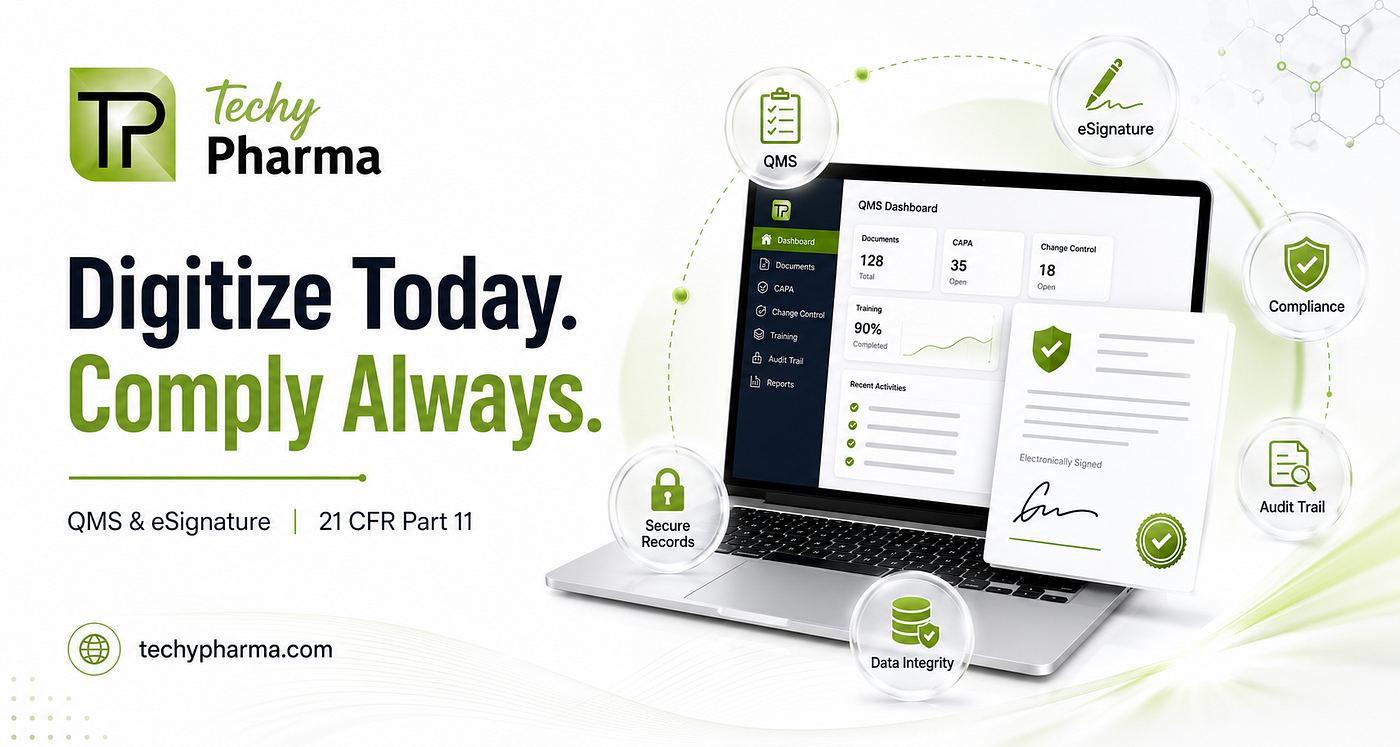
• Document Control: Version-controlled SOPs, policies, and templates with e-signatures (21 CFR Part 11 compliant).
• CAPA Management: AI-assisted root cause analysis, automated escalation, trend detection, and CAPA closure tracking.
• Deviation Management: Real-time deviation logging, risk classification, and impact assessments with full audit trail.
• **Audit Management: **Internal & external audit planning, supplier qualifications, and inspection-readiness dashboards.
• Training Management: Role-based training curricula, automated assignment, competency tracking, and compliance reporting.
• Change Control: Structured change requests with risk assessments, cross-functional review, and regulatory impact analysis.
The AI Revolution: From Reactive to Predictive Quality
The most consequential shift in pharmaceutical quality management today is not simply digitization — it is the move from reactive compliance to predictive quality assurance. This is what separates a basic eQMS from an AI-powered QMS.
1. Predictive Deviation Detection
Machine learning algorithms trained on historical quality events can identify early signals of an impending deviation before a formal deviation even occurs. Pharma facilities deploying predictive models report 47% reductions in unplanned equipment downtime within their first four months of deployment.
2. AI-Assisted Root Cause Analysis
AI systems can cross-reference historical events, identify analogous failure modes, and surface candidate root causes within minutes — cutting CAPA investigation timelines from weeks to days. This directly addresses the most consistent FDA finding: incomplete CAPA closure and inadequate investigation documentation.
3. Intelligent Document Management
NLP enables the system to auto-classify incoming documents, flag regulatory change impacts on existing SOPs, and suggest required SOP revisions when regulatory guidance updates. For organizations managing hundreds of controlled documents, this alone can save thousands of hours annually.
4. Real-Time Quality Dashboards
AI aggregates data across deviations, CAPAs, audits, training, and supplier performance into unified executive dashboards that provide genuine operational intelligence — not just reporting.
AI Impact Across QMS Processes — Industry Benchmarks 2026
QMS Process
Efficiency Improvement
CAPA Investigation & Closure
72%
Document Review & Approval Cycles
65%
Training Compliance Tracking
80%
Supplier Audit Preparation
55%
Deviation Detection Time
68%
APQR Compilation
60%
⚡ Key Statistic
Pharma companies using AI-powered eQMS report reducing manual quality effort by up to 60% across training management, investigation workflows, documentation control, and APQR activities. The gains compound over time as AI models are refined on company-specific data.
CROs: The Unique QMS Challenge Nobody Talks About
Contract Research Organizations operate at the intersection of maximum regulatory scrutiny and maximum operational complexity. A mid-sized CRO might simultaneously be managing 30–50 active studies, each with its own sponsor requirements, GxP obligations, ICH guidelines, and audit schedules.
The consequences of quality failures for a CRO are uniquely severe. A pharmaceutical manufacturer that fails an inspection loses production time. A CRO that fails an inspection loses something more fundamental: sponsor trust.
What CROs Need From a QMS That Most Generic Systems Don’t Deliver
• 01 — Multi-Sponsor Isolation: Data, documents, and quality events for each sponsor must be hermetically separated with role-based access controls.
• 02 — Study-Level CAPA Linkage: CAPAs must be traceable to specific protocols, studies, and investigators — not just floating in a general queue.
• 03 — Inspection Readiness by Default: The eQMS must maintain continuous inspection readiness — not require a two-week sprint to prepare documentation packages.
• 04 — GCP/GLP/GMP Modularity: CROs spanning GCP, GLP, and GMP disciplines need one QMS that handles all — without duplication.
• 05 — Sponsor-Facing Audit Reports: Sponsors increasingly require real-time quality performance reports. A modern CRO eQMS should generate these automatically.
2026 Regulatory Landscape: What Changed and Why It Matters
The regulatory environment in 2026 is the most demanding in the history of pharmaceutical quality management. Key developments every pharma and CRO leader must know:
Regulation
Jurisdiction
Key Requirement
Status
FDA QMSR
USA
Risk-based QMS aligned with ISO 13485; replaces 21 CFR 820
Active Feb 2026
USA
Electronic records & signatures; must be built-in from architecture
Actively Enforced
EU GMP Annex 11
EU / EMA
Computerized systems: validation, data integrity, audit trail
Current
EU GMP Annex 1 (Revised)
EU / EMA
Contamination control strategy; sterile manufacturing revisions
Ongoing
FDA Quality Metrics Program
USA
Proactive data submission on lot acceptance, OOS, complaints
Evolving
ICH Q10 QMS
Global
Lifecycle-based QMS: product realization, knowledge management
Baseline Standard
⚡ Critical Point — 21 CFR Part 11
Any organization implementing pharma QMS software in 2026 needs to build 21 CFR Part 11 compliance into the system architecture from day one. Retrofitting it later is painful, expensive, and often requires revalidation of the entire platform. Demand to see a vendor’s Part 11 compliance matrix before signing any contract.
How to Implement an AI-Powered QMS: The Techy Pharma Approach
Successful QMS implementation in a regulated environment is not a technology project — it is a business transformation program that happens to use technology.
• Step 1 — Current-State Assessment & Gap Analysis: Map all existing quality processes, identify gaps against ICH Q10 and GxP, prioritize by risk, and document your current validation posture.
• Step 2 — Define Quality Policy & Objectives: Before selecting any platform, define measurable quality objectives — CAPA cycle time targets, deviation rate benchmarks, training compliance percentages.
• Step 3 — Platform Selection with Regulatory Lens First: Match your regulatory context to vendor strength. FDA-regulated US, EMA-regulated European, and PMDA-regulated Japanese markets have meaningfully different compliance requirements.
• Step 4 — Validated Implementation & Data Migration: Use a risk-based GAMP 5.0 validation approach. Develop IQ/OQ/PQ protocols and ensure complete audit trail integrity during data migration.
• Step 5 — Training & Change Management: Designate ‘quality champions’ in each department. Provide role-specific training. Measure adoption metrics, not just completion rates.
• Step 6 — Continuous Improvement Cadence: Establish a monthly QMS performance review. Use AI-generated trend reports to identify improvement opportunities. Treat your QMS as a living system.
The ROI Case: Quality 4.0 in Real Numbers
The total cost of poor quality (COPQ) in pharmaceuticals typically ranges from 5–25% of annual revenue, encompassing recalls, rework, regulatory action, batch failures, and the opportunity cost of delayed product releases. AI-powered eQMS directly attacks each of these cost categories:
• Recall Prevention: Predictive quality analytics identify systemic issues before batch release, reducing the risk of costly market recalls.
• Cycle Time Reduction: Automated workflows reduce CAPA closure times, change control cycles, and batch release cycles — directly accelerating time-to-market.
• Digital Twin ROI: Leading companies report 25–40% capacity improvements and 15–20% reduction in lead times via digital twins.
• Downtime Reduction: Predictive maintenance integrated with QMS data has demonstrated 47% reduction in unplanned equipment downtime within four months of deployment.
“By 2026, the pharma sector will have seen early-mover advantage in Quality 4.0 translate into tangible ROI. Those who delay risk falling behind in quality standards and economic performance.”
— IntuitionLabs Quality 4.0 ROI Analysis, 2025
Why Techy Pharma for Your QMS Journey
At Techy Pharma, we understand that quality management in pharma and CROs is not a technology problem to be solved with a software license. Our QMS solution is purpose-built for the pharmaceutical and CRO environment — with 21 CFR Part 11 compliance baked into the architecture, GAMP 5-aligned validation packages ready to deploy, and workflow logic designed around actual GxP processes.
Techy Pharma QMS vs. Generic eQMS
Capability
Generic eQMS
Techy Pharma QMS
21 CFR Part 11 Native
Retrofitted
Architecture-Level ✓
GAMP 5 Validation Package
DIY
Pre-built & Delivered ✓
CRO Multi-Sponsor Isolation
Not Supported
Native Feature ✓
AI-Powered CAPA Analytics
Basic Reporting
ML Trend Detection ✓
Regulatory Update Monitoring
Manual Review
Automated Alerts ✓
GxP Process Templates
Generic
Pharma-Specific ✓
The Bottom Line: Quality Is No Longer Optional Infrastructure
The pharmaceutical and CRO leaders who will define the next decade of drug development are making a strategic choice right now — to treat quality management not as overhead, but as a core operational capability and competitive differentiator.
AI-powered eQMS systems are not science fiction. They are deployed, validated, and delivering measurable ROI at pharma companies and CROs today. The question for every quality director, CRO operations lead, and pharmaceutical executive reading this is not whether to modernize — it is how quickly.
Regulators are not waiting. Sponsors are not waiting. Your competitors are certainly not waiting.
Ready to Transform Your QMS?
Book a personalized demo with the Techy Pharma team and see how our AI-powered eQMS delivers inspection-readiness, CAPA intelligence, and real-time compliance dashboards for Pharma and CROs.
메타데이터
- post_id
- 8082e0ad75cc
- slug
- why-ai-powered-qms-is-the-pharma-cro-game-changer-of-2026-8082e0ad75cc
- url
- https://medium.com/@bd_56967/why-ai-powered-qms-is-the-pharma-cro-game-changer-of-2026-8082e0ad75cc
- canonical_url
- https://medium.com/@bd_56967/why-ai-powered-qms-is-the-pharma-cro-game-changer-of-2026-8082e0ad75cc
- author_url
- https://medium.com/@bd_56967
- status
- ok
- fetched_at
- 2026-06-17 10:21:25