SWOT analysis for yourself: Build a P-SWOT that turns self-reflection into action
Most people already have a rough list of what they are good at and what they need to improve. The trouble starts when that list stays…
SWOT analysis for yourself: Build a P-SWOT that turns self-reflection into action
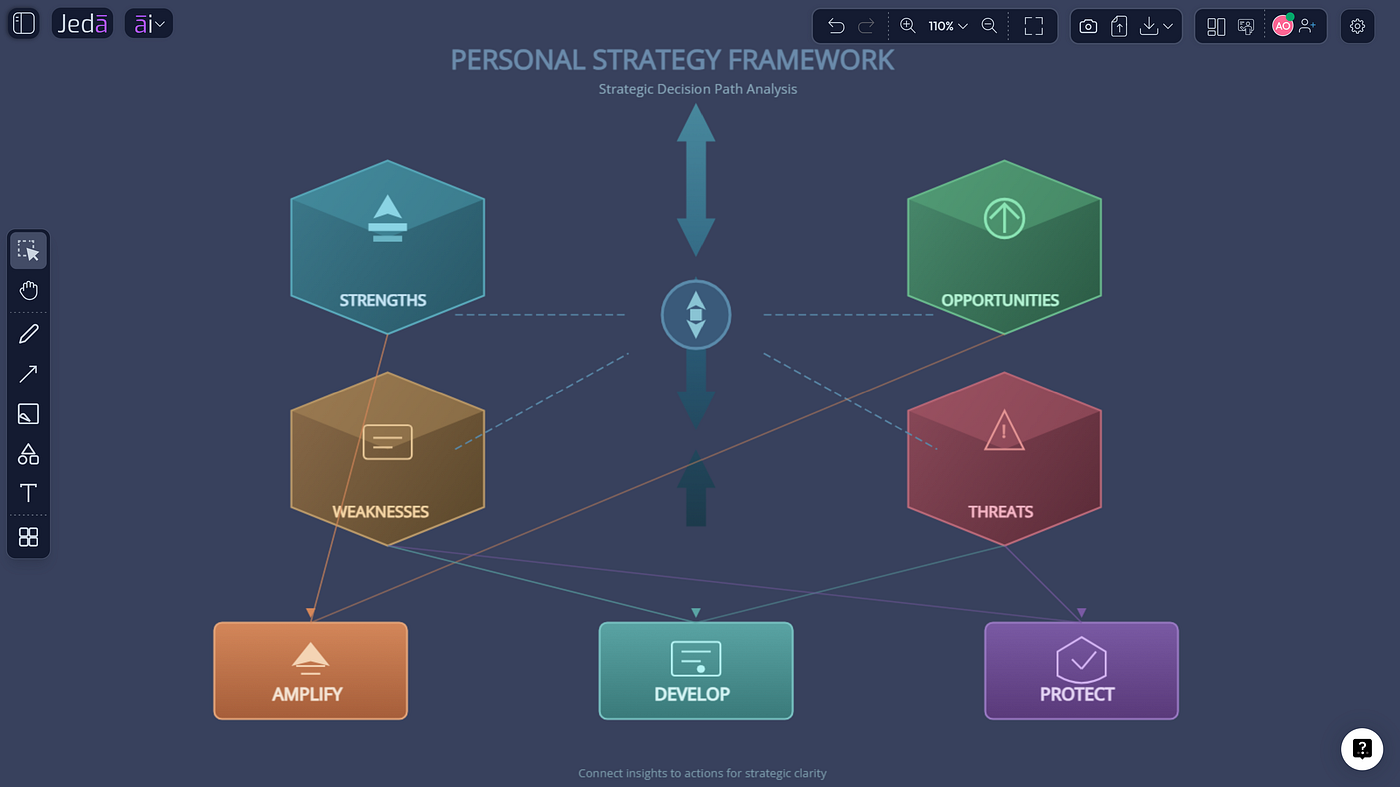
A P-SWOT turns a personal snapshot into a focused next move.
Most people already have a rough list of what they are good at and what they need to improve. The trouble starts when that list stays fuzzy. “I’m reliable” sounds nice. “I consistently turn unclear requests into usable plans” is evidence. One can guide a decision; the other mostly decorates your self-image.
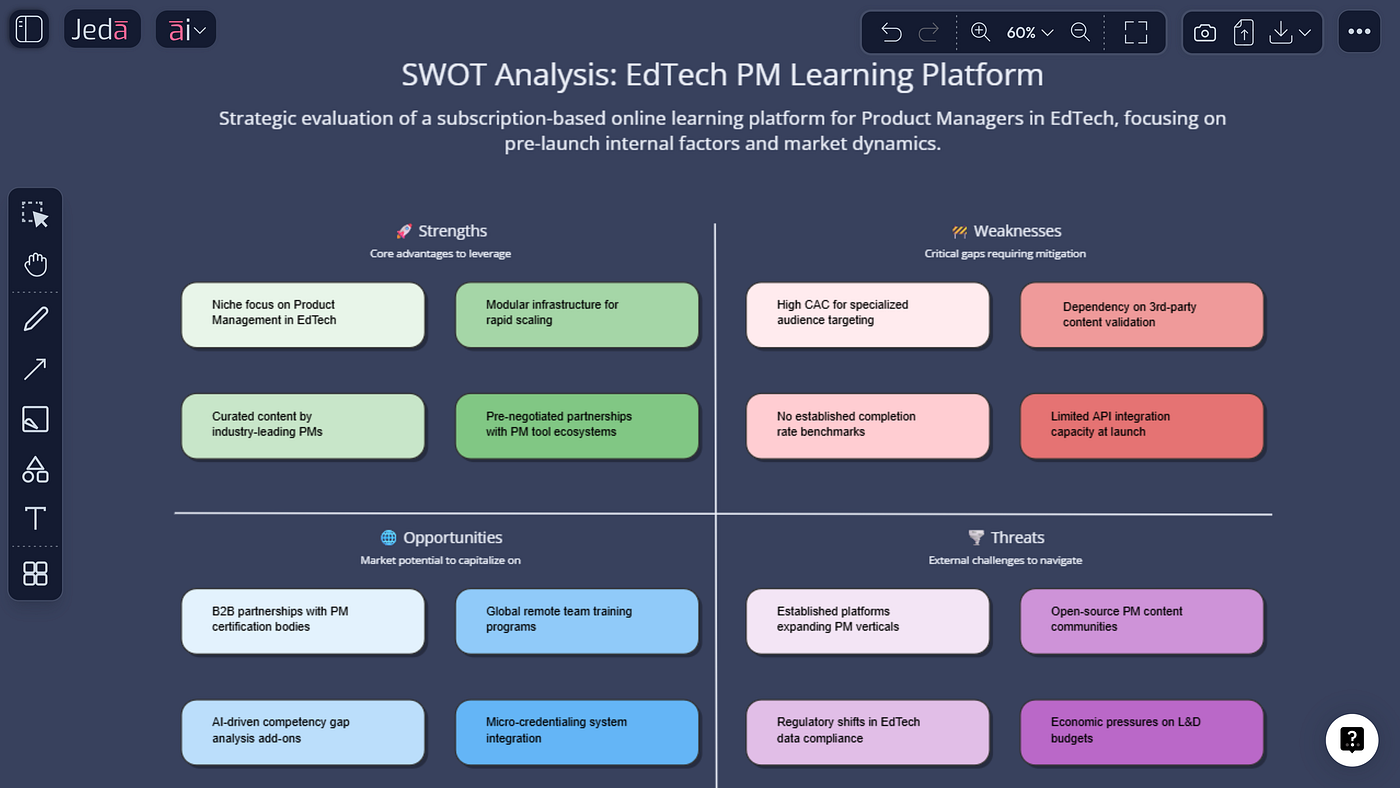
A SWOT analysis for yourself gives that reflection a structure. You sort internal factors into strengths and weaknesses, then examine external conditions as opportunities and threats. The result is often called a personal SWOT or P-SWOT. Used well, it becomes a clear snapshot of where you stand and what you should do next — not a four-box exercise that gets admired for twelve seconds and forgotten.
Jeda.ai brings this process into one editable AI Workspace and AI Whiteboard. You can generate a first draft, challenge vague entries, rearrange the matrix, and build an action layer on the same canvas. More than 150,000 users work with Jeda.ai across visual planning and analysis, with 300+ strategic frameworks available through its AI Recipes.

Start with questions that demand evidence, not flattering adjectives.
What is a SWOT analysis for yourself?
A SWOT analysis for yourself is a four-part self-assessment tied to a specific goal or decision. Strengths and weaknesses are internal: skills, habits, knowledge, resources, patterns, and choices that are largely yours to influence. Opportunities and threats are external: openings, expectations, timing, constraints, and changes around you. That internal–external separation is the backbone of the method.
The framework is simple on purpose. Reviews of SWOT research describe it as a widely used way to organize situational information, but they also warn that the matrix has limited value when it becomes a loose list with no prioritization or follow-through. A P-SWOT has the same weakness. It works as a starting point for a decision, not as the decision itself.
Why use a P-SWOT instead of ordinary self-reflection?
Because ordinary self-reflection tends to drift. You remember the loudest recent event, overvalue what feels comfortable, and skip the awkward evidence. A personal SWOT gives you four boundaries. Those boundaries make it harder to confuse an internal skill gap with an external obstacle — or to treat an attractive possibility as something you are automatically ready for.
Research on personal SWOT practice frames it as a structured route from awareness to an action plan. The key move is matching internal factors with external conditions rather than stopping after the four lists.
A P-SWOT is especially useful when you are:
· Choosing between two professional directions.
· Preparing for a larger role or a different kind of responsibility.
· Deciding which skill deserves focused practice next.
· Reviewing why a recurring project pattern keeps helping — or hurting — you.
· Planning a visible piece of work, a learning goal, or a portfolio update.
· Checking whether your current commitments still match your priorities.
University guidance on goal setting makes a similar point: the value comes from using the snapshot to set goals, then revisiting it as your circumstances change.
Before you fill the four boxes, choose one decision
“Analyze me” is too broad. A useful P-SWOT needs a target. Pick one goal, one transition, or one decision and give it a timeframe. For example: “What should I focus on to become ready to lead a cross-functional project within the next 12 months?” That question tells you what belongs in the matrix and what is just interesting background noise.
Use three filters for every entry:
· Relevance: Does this factor affect the chosen goal?
· Evidence: What behavior, result, feedback, or recurring pattern supports it?
· Control: Is it internal, external, or partly both? Put it where you can act on it honestly.
And be specific. “Good communicator” is fog. “Can explain technical trade-offs to mixed audiences without losing the main decision” is usable. Likewise, “lack confidence” may hide a more concrete issue such as limited practice presenting unfinished work. Name the behavior. The matrix gets smarter immediately.
How to identify the four P-SWOT quadrants
Strengths: What reliably helps you perform?
Strengths are internal advantages you can demonstrate and repeat. They may include skills, useful habits, knowledge, trusted relationships, working methods, or resources you can access. The test is not whether the trait sounds positive. The test is whether it helps you move toward the chosen goal.
· Which tasks do people repeatedly trust me to handle?
· Where do I produce a strong result with less friction than expected?
· What positive feedback appears more than once?
· Which habits make my work more dependable?
· What do I know, own, or have access to that supports this goal?
Weaknesses: What repeatedly creates friction?
Weaknesses are internal limitations, gaps, or patterns that reduce your effectiveness. Keep this section practical. It is not a confession booth. A useful weakness can be described as an observable pattern, connected to a consequence, and improved through a realistic action.
· Which important tasks do I delay or avoid?
· Where do I need too much time, help, or rework?
· What feedback do I tend to dismiss too quickly?
· Which missing skill blocks the next level of responsibility?
· What habit makes a small problem repeat?
Opportunities: What opening can you act on?
Opportunities are external conditions that could help you make progress. They are not wishes. Look for a real opening: an upcoming project, a learning path, a visible problem nobody owns, a mentor relationship, a new responsibility, or a change in expectations that rewards what you already do well.
· What upcoming work would let me demonstrate the next-level skill?
· Which learning path is accessible within my timeframe?
· Who could offer useful feedback, context, or sponsorship?
· What unmet need around me matches one of my strengths?
· Which change creates room for a different contribution?
Threats: What outside condition could slow or derail progress?
Threats are external pressures that may reduce your options or increase the cost of delay. Think about changing role expectations, limited time, crowded priorities, shrinking opportunities, dependency on other people, or a mismatch between your current evidence and what the next step requires.
· What change could make my current strengths less useful?
· Which deadline or busy period could crowd out development work?
· Where am I dependent on a decision I do not control?
· What are others demonstrating that I have not yet shown?
· Which weakness becomes more costly if nothing changes?
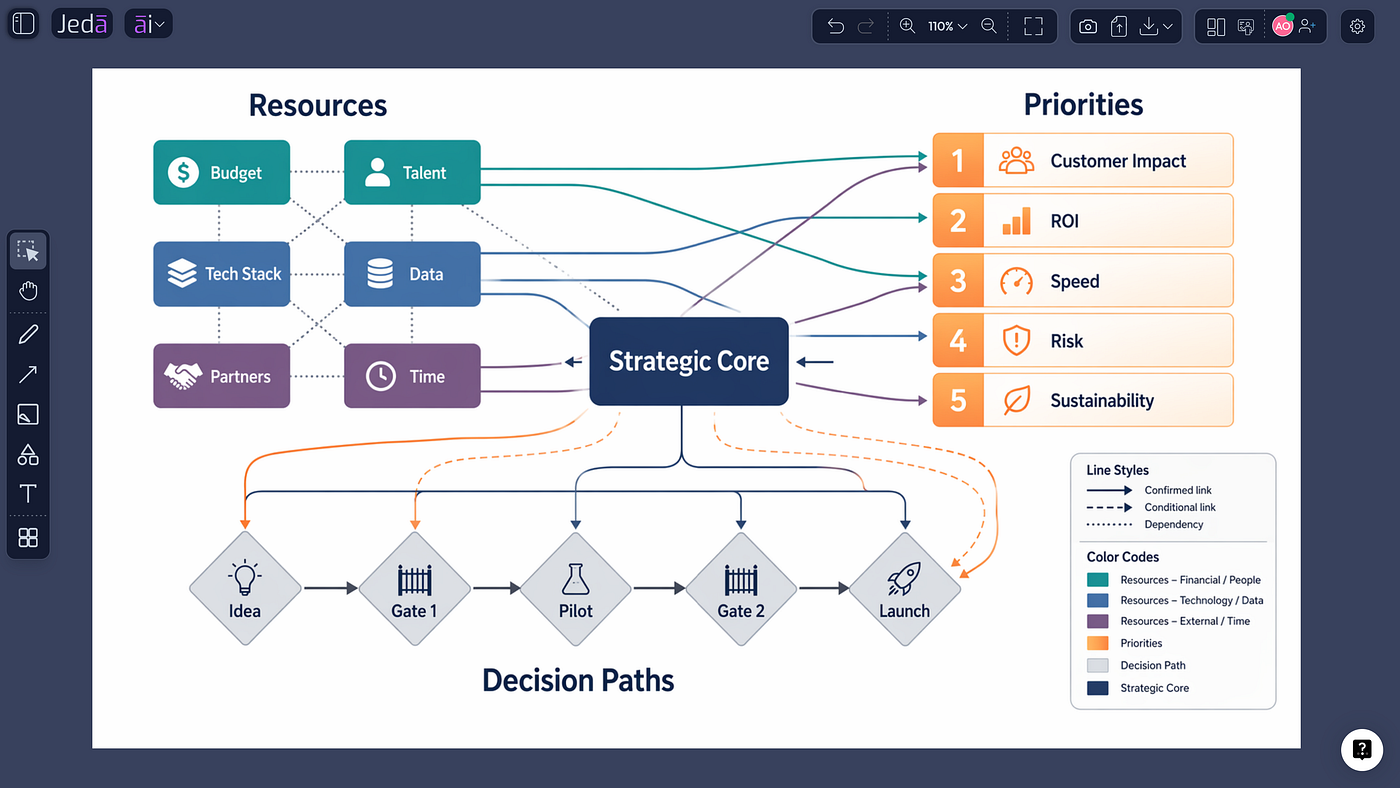
Turn the matrix into four kinds of action
Here is where a P-SWOT stops being stationery. Pair the quadrants and write one or two actions for each combination. This matching approach is a common way to move from analysis into strategy.
· Strength + Opportunity: Use an existing advantage to capture an opening. Example: use your clear writing to lead the plan for an upcoming pilot.
· Weakness + Opportunity: Use an opening to close a gap. Example: take a facilitation role in a low-risk recurring session to build practice.
· Strength + Threat: Apply a reliable capability to reduce exposure. Example: document results and decisions so your contribution stays visible during a shifting period.
· Weakness + Threat: Reduce the combination most likely to hurt progress. Example: limit low-value commitments before a demanding project begins.
Then choose five moves: one action to use a strength, one to improve a weakness, one to pursue an opportunity, one to reduce a threat, and one thing to stop doing. Five is enough. A twenty-two-item action plan is usually a creative way to avoid choosing.
How to create a SWOT analysis for yourself in Jeda.ai
Jeda.ai gives you two clean routes. The Analysis Matrix recipe is guided and fast. The Prompt Bar gives you tighter control over the framing. Both create an editable matrix on the AI Whiteboard, so you can rewrite, move, group, and expand ideas without rebuilding the work elsewhere.
Method 1: Use the Analysis Matrix recipe
1. Open the AI Menu. From the top-left of the canvas, open the AI Menu.
2. Choose the right category. Open Matrix, then go to the Strategy & Planning category.
3. Select the recipe. Choose “SWOT Analysis (Strengths, Weaknesses, Opportunities, Threats).”
4. Define the subject. Set the analysis subject as yourself and state the goal, decision, and timeframe you want the P-SWOT to support.
5. Add useful context. Include recent responsibilities, repeat feedback, skills you use often, tasks you avoid, upcoming openings, and external constraints. Keep private details out unless they are genuinely needed.
6. Generate and edit. Create the matrix, then rewrite vague entries, remove duplicates, and move any item that was placed in the wrong internal or external quadrant.
7. Extend selected items with AI+. Select a quadrant or smart shape and click AI+ to add related depth automatically. AI+ is not a prompt box, so you cannot ask it for a specific custom instruction. It extends the selected content based on context.

The guided recipe keeps the setup structured from the first click.
Method 2: Use the Prompt Bar
1. Open the Prompt Bar. Use the input area at the bottom of the canvas.
2. Select Matrix. Choose the Matrix command so the result is rendered as a four-part editable analysis.
3. Set the layout. Use Auto or Grid for a balanced P-SWOT view.
4. Paste a focused prompt. Name the goal, timeframe, internal areas to examine, external conditions to consider, and the action layer you want at the end.
5. Generate the first draft. Run the prompt and let Jeda.ai place the matrix on the canvas.
6. Challenge the output. Delete generic statements, add evidence, merge repeated ideas, and keep only the factors that affect the chosen decision.
7. Use AI+ selectively. Click AI+ on a selected item when you want automatic related depth. You do not type a separate instruction into AI+.

A focused prompt gives you more control over scope and action.
A P-SWOT prompt you can adapt
Example prompt for the Prompt Bar
Create a SWOT analysis for yourself focused on becoming ready to lead a cross-functional project within the next 12 months. Use four sections: Strengths, Weaknesses, Opportunities, and Threats. For strengths and weaknesses, examine repeatable skills, work habits, communication, decision-making, follow-through, and learning gaps. For opportunities and threats, examine upcoming projects, access to feedback, changing role expectations, time constraints, and visibility of results. Keep every item specific, evidence-based, and relevant to the goal. Finish with five actions: use one strength, improve one weakness, pursue one opportunity, reduce one threat, and stop one low-value habit.
Notice what the prompt does not ask for: a motivational speech, a complete life assessment, or a pile of flattering adjectives. It gives the matrix a decision, a timeframe, categories of evidence, and an action requirement. That is why the output is easier to edit into something useful.

The strongest output ends with choices, not just four lists.
Worked P-SWOT example: preparing to lead a cross-functional project
Suppose your goal is to become ready to lead a cross-functional project within 12 months. A focused matrix might look like this:
Strengths
· Turns unclear requests into written plans that others can follow.
· Keeps commitments and flags dependencies before they become surprises.
· Explains trade-offs calmly when the group does not yet agree.
· Learns new tools and processes quickly enough to support others.
Weaknesses
· Takes back delegated work when the first draft is imperfect.
· Has limited practice facilitating decisions among people with different priorities.
· Shares progress late because updates feel unfinished.
· Has not documented enough examples of leadership impact.
Opportunities
· An upcoming pilot needs someone to coordinate scope, owners, and decision points.
· A mentoring circle can provide feedback on delegation and facilitation.
· A recurring project review offers a low-risk place to practise leading discussion.
· A recent project contains useful lessons that can be turned into a visible case study.
Threats
· Role expectations may shift faster than the current evidence of leadership.
· Other capable people are already demonstrating stronger cross-team visibility.
· Too many individual tasks leave little time for deliberate leadership practice.
· A busy quarter could turn the development plan into “later,” also known as never wearing a calendar costume.
Five actions from the matrix
1. Use a strength. Volunteer to write the operating plan for the pilot and clarify decisions, owners, and dependencies.
2. Improve a weakness. Delegate one meaningful workstream and agree on review points instead of taking the work back.
3. Pursue an opportunity. Facilitate the recurring review twice, then ask for specific feedback on clarity and participation.
4. Reduce a threat. Create a short evidence log that records decisions led, obstacles removed, and outcomes supported.
5. Stop one habit. Decline or simplify one low-value recurring task to protect weekly practice time.
Best practices for a sharper personal SWOT
· Use evidence from the last 6–12 months. Old strengths can become stale stories.
· Ask one or two trusted people for examples, not labels. “When have you seen me at my best?” works better than “What are my strengths?”
· Limit each quadrant to the five factors that matter most. Prioritization is part of the analysis.
· Write factors as cause-and-effect statements. “Delays difficult conversations, which lets small misunderstandings grow” is clearer than “communication.”
· Separate a weakness from shame. A gap is information. Drama is optional.
· Review the matrix when the goal, environment, or evidence changes. A P-SWOT is a snapshot, not a permanent identity card.
· Keep the action layer on the same Jeda.ai AI Whiteboard so the reasoning stays connected to the next steps.
Common mistakes that make a P-SWOT useless
Turning strengths into compliments
Words such as “hardworking,” “creative,” or “good with people” need evidence and relevance. Replace each label with a repeatable behavior and the result it creates.
Putting everything inside your control
A delayed project can be partly internal and partly external. Name the pieces separately. Your planning habit may be a weakness; another person’s approval schedule may be a threat.
Treating opportunities as guaranteed outcomes
An opening is not a promise. “A pilot is available to lead” is an opportunity. “I will be selected” is an assumption. Write what exists, then decide how to improve your chance of acting on it.
Filling every quadrant equally
Reality is not obligated to produce four neat lists of the same length. A short, strong quadrant beats seven filler items added for visual symmetry.
Stopping at insight
Self-awareness without a next move can feel productive while changing absolutely nothing. Pick actions, owners — usually you — and dates. Otherwise, the matrix is just a stylish rectangle collection.
Frequently asked questions
What does P-SWOT mean?
P-SWOT is a convenient shorthand for personal SWOT analysis. It applies the four-part Strengths, Weaknesses, Opportunities, and Threats framework to an individual goal, role, transition, or development decision. The term is useful, but the quality still depends on specific evidence and action.
Is a SWOT analysis for yourself only for career planning?
No. You can use it for a learning goal, a creative project, a leadership transition, a change in responsibilities, or a personal productivity decision. Keep the scope narrow enough that every factor connects to one outcome and one timeframe.
How honest should a personal SWOT be?
Honest enough to describe real patterns, but not cruel or theatrical. A good weakness is observable and workable. Replace “I am bad at leadership” with something concrete, such as “I avoid delegating until the deadline is close.” Specific language creates options.
How many items should be in each quadrant?
Aim for three to five high-impact items per quadrant after brainstorming. You may start with more, but merge duplicates and remove anything that does not affect the chosen goal. The matrix should surface priorities, not preserve every passing thought.
Should I ask other people for input?
Yes, when they know your work well and can provide examples. Ask for situations they observed, patterns they noticed, and tasks they would trust you to own. Evidence from others can reveal strengths you understate and weaknesses you have quietly normalized.
How often should I update my P-SWOT?
Update it when the goal changes, new evidence appears, or the outside situation shifts enough to affect your options. For a 12-month development goal, a quarterly review is usually practical. Keep the original version so you can see what genuinely changed.
Can AI complete the whole personal SWOT for me?
AI can organize context, suggest factors, spot overlap, and create a useful first draft. It cannot verify every assumption about you. Treat the output as a structured hypothesis, then edit it with evidence, feedback, and judgment before choosing actions.
How does AI+ work on a P-SWOT in Jeda.ai?
Select a quadrant or smart shape and click AI+. Jeda.ai automatically extends that selected content with related depth. AI+ does not accept a custom instruction, so use it when you want the chosen item expanded — not when you need to ask a separate, highly specific question.
What should I do after completing the matrix?
Choose the few factors with the greatest impact, pair internal and external items, and write five concrete moves. Add dates and visible evidence of completion. Then keep the actions next to the matrix so your reasoning and execution do not wander into separate documents.
Make the next move visible
A useful P-SWOT does not tell you who you are forever. It tells you what is true enough, right now, to make a better next decision. Keep the scope narrow, demand evidence, and turn the four quadrants into a handful of actions you can actually complete.
You can start by exploring Jeda.ai’s visual AI workspace, then open the structured matrix generator when you are ready to build the board. For a wider look at the framework and its follow-through, read the broader AI strategy walkthrough. The same AI Workspace keeps your matrix, edits, and action paths on one collaborative AI Whiteboard.
Join 150,000+ users who use Jeda.ai to turn scattered thinking into editable visual decisions.
메타데이터
- post_id
- 809f2c6a12cd
- slug
- swot-analysis-for-yourself-build-a-p-swot-that-turns-self-reflection-into-action-809f2c6a12cd
- url
- https://medium.com/@ProductiveAiTools/swot-analysis-for-yourself-build-a-p-swot-that-turns-self-reflection-into-action-809f2c6a12cd
- canonical_url
- https://medium.com/@ProductiveAiTools/swot-analysis-for-yourself-build-a-p-swot-that-turns-self-reflection-into-action-809f2c6a12cd
- author_url
- https://medium.com/@ProductiveAiTools
- status
- ok
- fetched_at
- 2026-07-10 13:01:02