Designing Angular Features That Can Survive 10 Years
How to build Angular features that remain maintainable as requirements, teams, APIs, and framework patterns change.
Designing Angular Features That Can Survive 10 Years
How to build Angular features that remain maintainable as requirements, teams, APIs, and framework patterns change.
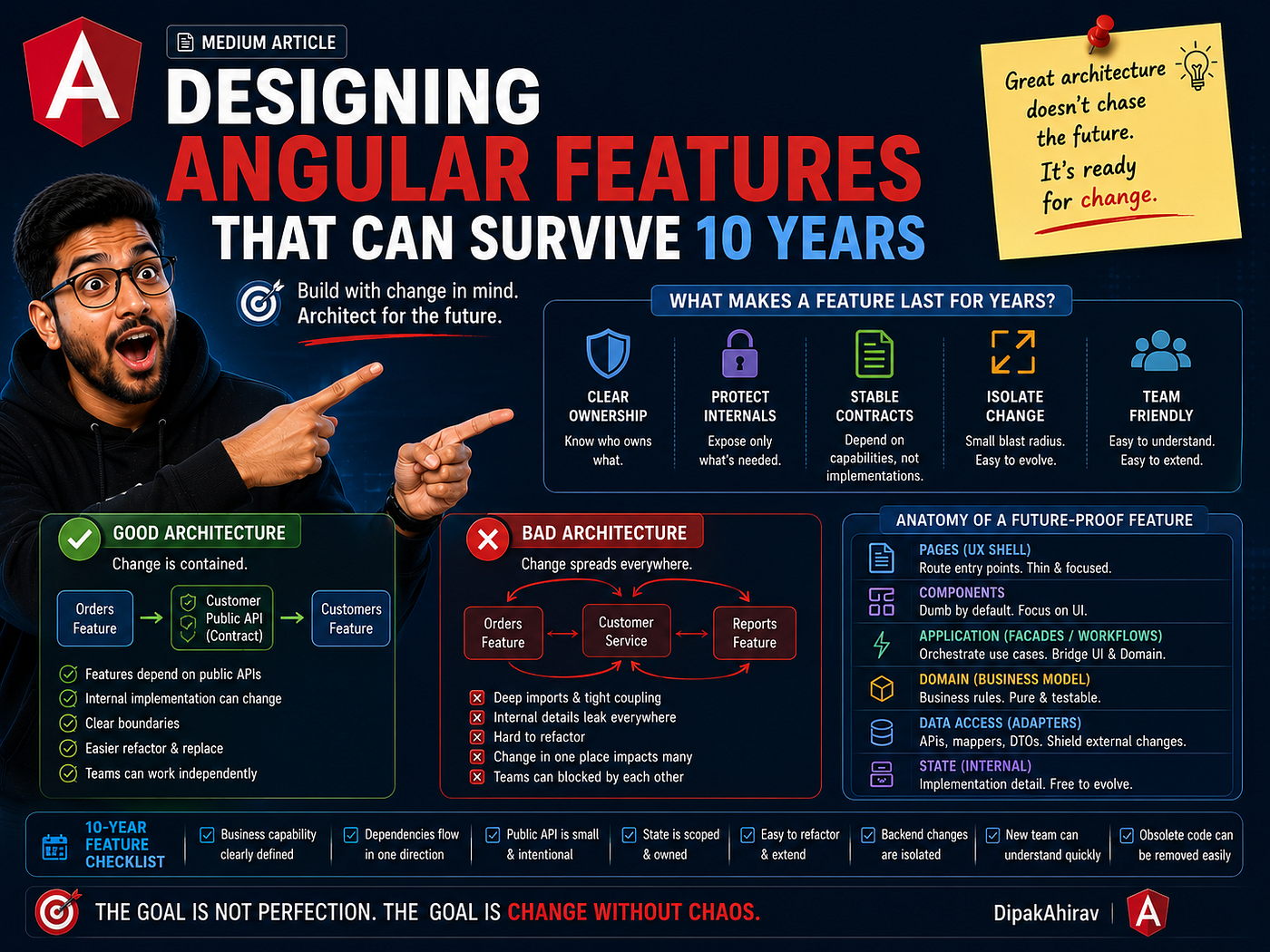
Ten Years Is a Long Time in Frontend Development
Think about how much frontend development has changed in the last decade.
We have moved through:
- Different rendering strategies
- New state management patterns
- Reactive programming
- Standalone components
- Signals
- New template syntax
- Zoneless Angular
- New build systems
- Different testing strategies
The Angular code we write today will not look exactly like the Angular code we write ten years from now.
But many enterprise applications will still exist.
Banks.
Healthcare systems.
Insurance platforms.
Government applications.
Internal enterprise tools.
Large business platforms.
These applications are not rewritten every two years.
They evolve.
That creates an important architectural question:
How do you design an Angular feature that can survive years of change?
The answer is not predicting the future.
It is designing the feature so that the future can change it safely.
Long-Lived Features Are Not Frozen Features
A feature that survives ten years does not remain unchanged.
Quite the opposite.
It may experience:
- Hundreds of requirement changes
- Multiple backend migrations
- UI redesigns
- New developers
- New teams
- New state management approaches
- New Angular versions
- New security requirements
- New business rules
Survival does not mean avoiding change.
It means being able to absorb change without collapsing.
The Biggest Mistake Is Designing for Today Only
Imagine building a Customer feature.
The initial requirement is simple.
Customer List
Customer Details
Edit Customer
So the team creates:
customer-list.component.ts
customer-detail.component.ts
customer-edit.component.ts
customer.service.ts
Perfectly reasonable.
Then the business grows.
Now Customers requires:
- Advanced search
- Customer verification
- Permissions
- Audit history
- Account restrictions
- Multiple addresses
- Customer documents
- Regional rules
- Feature flags
- Real-time updates
The original architecture was designed for three screens.
The business evolved into an entire capability.
The architecture did not evolve with it.
Design Around Business Capabilities
Long-lived Angular architecture should reflect the business.
Instead of organizing the application around technical file types:
components/
services/
models/
guards/
organize meaningful capabilities around features.
features/
├── customers/
├── orders/
├── billing/
├── inventory/
└── reports/
Inside the Customer feature:
customers/
├── pages/
├── components/
├── data-access/
├── state/
├── domain/
├── models/
├── customer.routes.ts
└── public-api.ts
The exact folders may change.
The important principle is ownership.
Everything that primarily changes because of Customer requirements should live close to the Customer feature.
Features Should Be Change Boundaries
A good feature boundary answers one question:
When this business capability changes, how much of the application must change with it?
Suppose the Customer team introduces a new verification workflow.
Ideally:
Customer Requirement
        ↓
Customer Feature
Not:
Customer Requirement
        ↓
Shared Components
        ↓
Global Store
        ↓
Orders
        ↓
Reports
        ↓
Application Shell
The smaller the blast radius, the easier the system is to evolve.
A feature is not just a folder.
It is a boundary around change.
Keep Internal Details Internal
A long-lived feature needs freedom to change its implementation.
Today it may use:
Signal-based ServiceTomorrow:
Signal StoreLater:
NgRxConsumers should not care.
If another feature imports:
import { CustomerStore } from
  '@features/customers/internal/store';
the internal architecture has leaked.
Now changing the Customer state implementation affects external consumers.
Instead, expose a stable capability.
export interface CustomerReader {
  getCustomerSummary(
    id: string
  ): Observable<CustomerSummary>;
}
Consumers depend on what the feature does.
Not how the feature does it.
Public APIs Give Features Freedom
A feature can expose a small public surface.
export { CustomerFacade } from './customer.facade';

export {
  CUSTOMER_ROUTES
} from './customer.routes';
export type {
  CustomerSummary
} from './models/customer-summary.model';
Everything else remains internal.
The feature can reorganize:
- Components
- Services
- Stores
- API clients
- Internal models
without forcing the entire application to change.
That freedom becomes increasingly valuable as the application ages.
Don’t Let the Backend Design Your Frontend
One of the easiest ways to create fragile Angular architecture is allowing API responses to flow directly through the entire application.
Imagine the backend returns:
interface CustomerResponse {
  cust_id: string;
  cust_status_cd: string;
  first_nm: string;
  last_nm: string;
}
The Angular application directly uses this model everywhere.
Templates.
Components.
Stores.
Business rules.
Then the backend changes.
Now the frontend changes everywhere.
Instead, create a boundary.
interface Customer {
  id: string;
  status: CustomerStatus;
  firstName: string;
  lastName: string;
}
Map external data at the edge.
Backend Response
       ↓
     Mapper
       ↓
Application Model
The backend can evolve.
The frontend retains its own language.
Your Domain Language Should Survive Framework Changes
Angular APIs will evolve.
Business concepts usually survive much longer.
Consider:
Customer
Order
Invoice
Payment
Approval
Eligibility
These concepts may remain relevant for decades.
Now compare them with:
Observable
Signal
Store
Effect
Reducer
Selector
These are implementation concepts.
Useful.
Important.
But not the business.
A long-lived architecture keeps business concepts visible instead of allowing framework mechanics to dominate the entire codebase.
Keep Components Focused on the UI
A component that owns everything is difficult to evolve.
CustomerComponentshould not be responsible for:
- API communication
- Permission calculations
- Customer eligibility
- Workflow orchestration
- State management
- Analytics
- Notifications
The more responsibilities it owns, the more reasons it has to change.
A healthier component might:
- Read presentation state
- Render the UI
- Forward user actions
For example:
@Component({
  selector: 'app-customer-page',
  templateUrl: './customer-page.html'
})
export class CustomerPage {
  private readonly facade =
    inject(CustomerFacade);

readonly vm = this.facade.vm;
  editCustomer(id: string): void {
    this.facade.editCustomer(id);
  }
}
The component remains focused.
The feature owns the complexity.
Don’t Let Templates Understand the Entire Domain
Long-lived templates should remain readable.
Avoid making HTML responsible for interpreting business rules.
Instead of:
@if (
  customer.status === 'ACTIVE' &&
  customer.balance > 0 &&
  permissions.includes('EDIT') &&
  !customer.restricted
) {
  <button>Edit</button>
}
Expose presentation intent:
@if (vm().canEditCustomer) {
  <button>Edit</button>
}
The template now understands:
Can the customer be edited?It does not need to understand every rule behind the answer.
That makes future changes safer.
ViewModels Protect the Presentation Layer
A ViewModel can create a stable contract for the UI.
interface CustomerPageViewModel {
  fullName: string;
  statusLabel: string;
  canEditCustomer: boolean;
  showRestrictionWarning: boolean;
  loading: boolean;
}
The domain can change.
The API can change.
The state implementation can change.
As long as the screen receives the information it needs, the template remains stable.
This separation becomes extremely valuable in applications that survive multiple redesigns and backend migrations.
Keep State Close to Its Owner
Long-lived applications often suffer from global state growth.
Everything becomes global because global access feels convenient.
Over time:
Global Store
├── Authentication
├── Customers
├── Orders
├── Search Filters
├── Modal State
├── Selected Tabs
├── Form State
└── Temporary UI Flags
Now unrelated features depend on one enormous state system.
Instead, scope state according to ownership.
Component State
      ↓
Feature State
      ↓
Application State
Keep state local until there is a genuine reason to promote it.
The smaller the scope, the smaller the blast radius of change.
Avoid Tool-Driven Architecture
A common mistake is designing the entire application around the current favorite library.
For example:
“This is an NgRx application.”
Or:
“Everything must use Signals.”
Or:
“Every feature needs a Signal Store.”
Tools are implementation choices.
Architecture should survive tool changes.
A better statement is:
“The Customer feature owns customer state and exposes a stable contract.”
How that state is implemented can evolve.
The ownership remains.
Don’t Build Abstractions for Imaginary Futures
Long-lived architecture does not mean making everything generic.
It is tempting to create:
BaseFeature
BaseFacade
BaseStore
BaseCrudService
UniversalTable
GenericFormEngine
because:
“We may need this later.”
But ten-year applications already accumulate complexity naturally.
They do not need speculative complexity added in advance.
Build abstractions around proven patterns.
Not imagined requirements.
Reuse Stable Concepts
Good candidates for long-term reuse often include:
- Design system components
- Accessibility primitives
- Logging infrastructure
- Authentication infrastructure
- Error handling
- HTTP utilities
- Stable formatting rules
Be more careful with:
- Business components
- Business workflows
- Domain state
- Feature-specific models
These often evolve independently.
Make Dependencies Obvious
A feature that survives years of development should have understandable dependency direction.
Healthy:
Customer Page
      ↓
Customer Facade
      ↓
Customer Domain / State
      ↓
Customer Data Access
Risky:
Customer Component
   ↕
Order Service
   ↕
Shared Store
   ↕
Billing Service
   ↕
Customer Service
The second architecture may work today.
But every future change becomes harder to predict.
Avoid Circular Feature Relationships
If:
Customers → Ordersand:
Orders → Customersyou have created a relationship that becomes increasingly expensive over time.
Instead, consider:
- Public contracts
- Higher-level orchestration
- Domain events
- Read-only interfaces
- Reconsidering feature boundaries
Long-lived architecture needs dependency direction.
Without direction, features slowly become one tightly connected system.
Design for Team Change
The developers who create a feature may not maintain it five years later.
That matters.
A future developer should be able to answer:
- Where does this feature start?
- Who owns this state?
- Where are API calls made?
- Where is business logic located?
- What can other features import?
- Which files are internal?
If understanding the feature requires tribal knowledge, the architecture is fragile.
Good architecture communicates through structure.
Make the Obvious Thing the Correct Thing
Developers usually follow the easiest path.
If deep imports are easy, they will happen.
If every service is globally available, it will be injected everywhere.
If Shared accepts everything, everything will move there.
A strong architecture makes the correct path convenient.
For example:
import {
  CustomerFacade
} from '@features/customers';
Easy.
Clear.
Intentional.
The architecture guides developers instead of relying entirely on documentation.
Enforce Important Boundaries
A rule that exists only in documentation will eventually be broken.
For important boundaries, consider enforcement through:
- ESLint rules
- Restricted imports
- Path aliases
- Workspace dependency constraints
- Library boundaries
For example:
Allowed:
@features/customersBlocked:
@features/customers/internal/storeThe purpose is not bureaucracy.
It is preventing accidental architectural erosion over thousands of commits.
Tests Should Protect Behavior, Not Implementation
Long-lived test suites often become obstacles when they are too tightly coupled to implementation details.
If every refactor breaks hundreds of tests, developers become afraid to improve the architecture.
Prefer testing:
- Business behavior
- Public contracts
- User-visible outcomes
- Important workflows
Be careful about over-testing:
- Private methods
- Internal implementation details
- Exact internal call sequences
Tests should give teams confidence to change the code.
Not prevent them from changing it.
Delete Code That No Longer Has a Purpose
Long-lived applications accumulate history.
Old feature flags.
Deprecated services.
Unused abstractions.
Temporary workarounds.
Compatibility layers.
The safest code is code that does not exist.
Architecture maintenance includes deletion.
A ten-year application should not contain ten years of every decision ever made.
Good teams continuously remove yesterday’s unnecessary complexity.
Document Decisions, Not Every Line of Code
Future developers rarely need documentation explaining:
getCustomer()They can read the code.
What they need to understand is:
Why is Customer state feature-scoped?
Why are deep imports blocked?
Why does this workflow live outside Orders?
Why does this feature expose a read-only contract?
Document architectural decisions.
Those are the things that code alone may not explain.
Refactor Continuously
The worst strategy for a long-lived Angular application is:
“We’ll clean it up later.”
Later rarely comes.
Architecture should evolve alongside the product.
When a feature grows:
Split responsibilities.
When an abstraction becomes painful:
Reconsider it.
When a dependency becomes unclear:
Fix the direction.
When state ownership changes:
Move the state.
Small continuous improvements are safer than waiting five years for a complete rewrite.
The Architecture Should Allow Replacement
One useful test is:
Could we replace the internal implementation of this feature without rewriting the entire application?
Could you replace:
- The state library?
- The API implementation?
- The internal component structure?
- The caching strategy?
If every consumer depends directly on those details, replacement becomes expensive.
If consumers depend on stable contracts, change remains manageable.
Replaceability is a powerful sign of healthy boundaries.
A Practical Feature Structure
There is no universal folder structure.
But a long-lived feature might look like this:
customers/
├── pages/
│   ├── customer-list/
│   └── customer-detail/
│
├── components/
│   ├── customer-card/
│   └── customer-status/
│
├── application/
│   ├── customer.facade.ts
│   └── customer.workflow.ts
│
├── domain/
│   ├── customer.model.ts
│   └── customer.rules.ts
│
├── data-access/
│   ├── customer.api.ts
│   ├── customer.mapper.ts
│   └── customer.dto.ts
│
├── state/
│   └── customer.store.ts
│
├── customer.routes.ts
└── public-api.ts
Do not copy this structure blindly.
A small feature does not need every folder.
The principle is more important than the template:
Separate responsibilities when the complexity justifies it.
Architecture should grow with the feature.
Not ahead of it.
A 10-Year Feature Checklist
Before calling a feature scalable, ask:
- Is ownership clear?
- Are dependencies directional?
- Are internal details protected?
- Is the public API small?
- Can state management change internally?
- Can the backend contract change without breaking every template?
- Is business logic independent from UI components?
- Are templates focused on presentation?
- Can features evolve independently?
- Are important boundaries enforced?
- Can a new team understand the structure?
- Can obsolete code be removed safely?
You do not need perfection.
You need the ability to change.
Final Thoughts
Nobody can predict what Angular will look like ten years from now.
And you should not try.
The goal of architecture is not predicting every future technology.
It is creating boundaries that give the application room to evolve.
Framework APIs will change.
State management patterns will change.
Build tools will change.
Teams will change.
Business requirements will definitely change.
But some principles remain remarkably stable:
- Clear ownership
- Small boundaries
- Intentional dependencies
- Protected internals
- Stable contracts
- Localized change
The Angular applications that survive are not the ones with the cleverest abstractions.
They are the ones that can change without requiring everyone to understand everything.
Because the real measure of enterprise architecture is not how elegant the system looks on the day it is created.
It is how safely the system can evolve years after the original developers have moved on.
Build Angular features for today’s requirements.
Design their boundaries for tomorrow’s change.
Connect with Me
If you enjoyed this post and would like to stay updated with more content like this, feel free to connect with me on social media:
- Twitter : Follow me on Twitter for quick tips and updates.
- LinkedIn : Connect with me on LinkedIn
- YouTube : Subscribe to my YouTube Channel for video tutorials and live coding sessions.
- Dev.to : Follow me on Dev.to where I share more technical articles and insights.
- WhatsApp : Join my WhatsApp group to get instant notifications and chat about the latest in tech
Email: Email me on dipaksahirav@gmail.com for any questions, collaborations, or just to say hi!
I appreciate your support and look forward to connecting with you!
메타데이터
- post_id
- 80afae57f950
- slug
- designing-angular-features-that-can-survive-10-years-80afae57f950
- url
- https://medium.com/angular-engineering/designing-angular-features-that-can-survive-10-years-80afae57f950
- canonical_url
- https://medium.com/angular-engineering/designing-angular-features-that-can-survive-10-years-80afae57f950
- author_url
- https://medium.com/@dipaksahirav
- status
- ok
- fetched_at
- 2026-07-16 18:03:01