The Sponge City Model: A Sustainable Solution to Urban Flooding
Outline & Essay
The Sponge City Model: A Sustainable Solution to Urban Flooding
Outline & Essay
Outline:
I. Introduction: Urban Progress and Rising Flood Vulnerability A. Modern cities appear highly developed, yet heavy rainfall repeatedly exposes their environmental fragility. B. The replacement of natural land with concrete surfaces has made urban areas more prone to flooding. C. The Sponge City model has emerged as a sustainable response to this growing challenge.
II. Urbanization and the Loss of Natural Water Absorption A. Soil, vegetation, and wetlands once allowed rainwater to seep naturally into the ground. B. Rapid urban expansion has replaced these absorbent surfaces with roads, buildings, and pavements. C. This shift forces rainwater to remain on the surface and move quickly through the city.
III. Limits of Conventional Drainage Systems A. Traditional drains and sewer channels are designed to carry water away during ordinary rainfall. B. During intense storms, however, these systems become overloaded and unable to handle the volume of runoff. C. As a result, water accumulates in streets, underpasses, and low-lying neighborhoods.
IV. Climate Change and Intensified Rainfall Patterns A. Rising global temperatures have increased atmospheric moisture and made rainfall more concentrated. B. Monsoon systems and seasonal rain events are becoming heavier and less predictable. C. These changing conditions place additional pressure on already weak urban drainage infrastructure.
V. The Sponge City Model as a New Urban Solution A. The Sponge City model is based on the idea that cities should absorb and regulate rainwater rather than simply remove it. B. It treats stormwater as a manageable resource instead of an immediate urban threat. C. This concept represents a shift from rigid grey infrastructure to flexible ecological planning.
VI. How the Sponge City Model Works A. Permeable pavements allow rainwater to pass into the soil rather than collect on hard surfaces. B. Green roofs, rain gardens, bioswales, wetlands, and retention basins help store and filter excess water. C. Together, these systems reduce surface runoff and lessen the burden on conventional drains.
VII. Environmental and Economic Benefits of Sponge Cities A. Sponge Cities reduce flash flooding by slowing down the movement of stormwater. B. They also support groundwater recharge, urban cooling, and cleaner environmental conditions. C. In the long term, they reduce repeated repair costs caused by flood-related infrastructure damage.
VIII. Worldwide Application of the Sponge City Model A. China has widely adopted the Sponge City concept after repeated urban flood disasters. B. European and other international cities have also integrated blue-green infrastructure for stormwater control. C. These examples show that the model is a tested and practical urban planning strategy.
IX. Relevance to Rawalpindi and Islamabad A. Heavy monsoon rains regularly flood roads, underpasses, and residential areas in the twin cities. B. Rapid construction, reduced open land, and overloaded drains have worsened stormwater movement. C. The yearly flood situation highlights the urgent need for more absorbent and adaptive infrastructure.
X. Applying Sponge City Measures in Pakistan A. Permeable pavements, rain gardens, restored waterways, and retention parks could reduce runoff in urban zones. B. Green roofs and expanded planted areas could further ease pressure on drainage systems during monsoon rains. C. Such measures would help the twin cities manage rainfall more effectively rather than facing repeated disruption.
XI. Challenges and Opposing View A. Critics argue that Sponge City projects require high funding, technical expertise, and urban redesign. B. Limited land and strained municipal budgets make large-scale implementation difficult in developing countries. C. These concerns raise questions about immediate practicality but do not dismiss the value of the model.
XII. Response to the Opposing View A. Repeated monsoon flood damage already costs governments large amounts in repairs and emergency response. B. Preventive investment in Sponge City measures can reduce these long-term financial losses. C. Even gradual implementation can begin improving flood resilience without requiring instant total reconstruction.
XIII. Conclusion: The Need for a New Urban Water Philosophy A. Urban flooding is the combined result of impermeable construction and climate-driven heavier rainfall. B. The Sponge City model offers a more sustainable and effective response than conventional drainage alone. C. For cities like Rawalpindi and Islamabad, adopting such planning is becoming a necessity rather than a choice.
Essay:
In the twenty-first century, cities are often viewed as symbols of progress and human control over the environment. Expanding road networks, commercial centers, residential blocks, and drainage channels suggest that urban life is carefully organized and protected from natural disruptions. Yet heavy rainfall repeatedly proves otherwise. A few hours of intense rain can flood roads, paralyze traffic, damage property, and expose the inability of city infrastructure to handle stormwater. Urban flooding has therefore become one of the most visible consequences of modern planning that favors construction over ecological balance. In this context, the Sponge City model has emerged as an important alternative because it proposes a shift from simply removing rainwater to absorbing, storing, and managing it through sustainable urban design.
To understand the importance of this model, it is necessary to first examine why urban flooding has become so common. In natural landscapes, rainwater is absorbed by soil, vegetation, wetlands, and open ground. This slows down runoff and allows water to gradually enter underground reserves. Urbanization disrupts this process by replacing absorbent land with concrete roads, pavements, buildings, and parking areas. These impermeable surfaces prevent infiltration, forcing rainwater to remain on the surface and move rapidly across streets and low-lying areas. As a result, even moderate rainfall can produce large volumes of runoff, while heavy rainfall quickly creates water accumulation in places that were never designed to retain it.
This issue is closely connected to the limitations of traditional drainage systems. Most cities still rely on drains, pipes, gutters, and sewers to carry stormwater away. Such systems are based on the assumption that water can simply be redirected out of the urban area. However, during intense rainfall, the amount of water entering these channels becomes far greater than their carrying capacity. Drains overflow, sewer lines clog, and water backs up into roads and neighborhoods. The problem, therefore, is not just poor drainage maintenance; it is the fact that drainage systems alone do not reduce the quantity of runoff being generated. They only attempt to dispose of it after it has already accumulated.
Climate change has made this urban weakness even more serious. Rising global temperatures increase evaporation, which allows the atmosphere to hold more moisture. This leads to heavier and more concentrated rainfall events, often occurring within short periods of time. In many regions, monsoon systems and seasonal rain patterns have become less predictable and more intense than before. Cities that were planned according to older weather expectations are now facing storms their infrastructure cannot handle. This means that urban flooding is no longer only a planning flaw but also part of a broader climate challenge, where existing systems are repeatedly tested beyond their intended limits.
The Sponge City model was developed as a response to these overlapping problems of impermeable construction and climate-driven rainfall. The term refers to an urban planning approach in which the city is designed to behave like a sponge: absorbing rainwater, storing it temporarily, filtering it naturally, and releasing or reusing it gradually. Unlike conventional grey infrastructure, which treats rainwater as waste to be removed, this model treats it as a manageable resource. First widely promoted in China after repeated incidents of severe urban flooding, the Sponge City concept has since gained international attention as a practical method of climate-resilient planning.
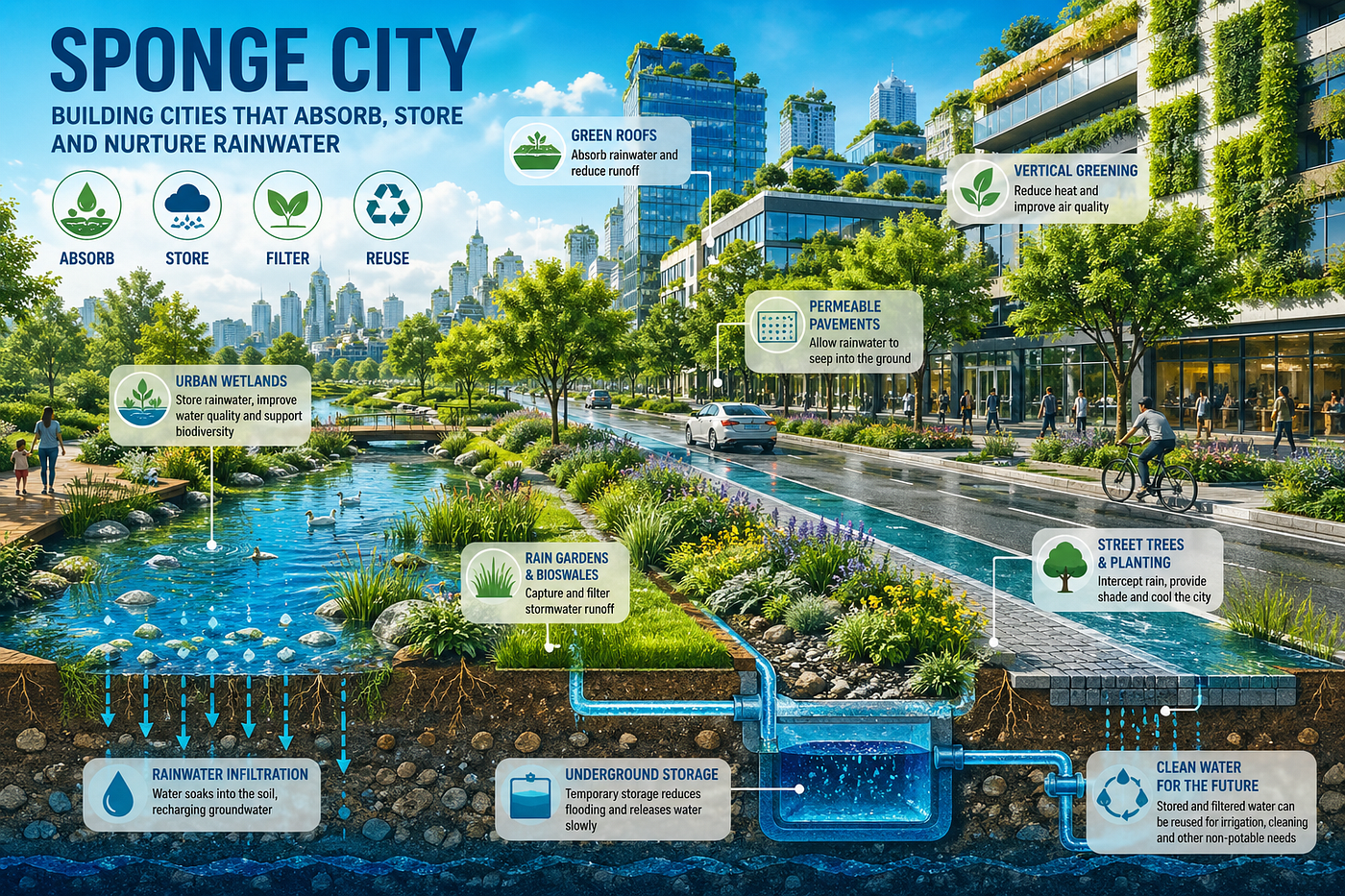
Its functioning depends on a combination of engineered and ecological features. Permeable pavements are used in sidewalks, parking areas, and roads so that water can pass through their surface into the ground below. Green roofs allow buildings to capture part of the rainfall instead of sending all of it directly to the streets. Rain gardens and bioswales, which are shallow vegetated channels, slow the movement of runoff and filter pollutants. Wetlands, ponds, and retention basins provide temporary storage spaces where stormwater can collect during peak rainfall and then be released later at a controlled rate. Together, these measures reduce the immediate burden on drainage systems by ensuring that not all rainwater becomes destructive surface flow at the same time.
Beyond flood control, the Sponge City model also offers broader environmental and economic benefits. Since a portion of the rainwater is absorbed into the ground, groundwater reserves are gradually replenished. Green surfaces and planted zones lower urban temperatures and help reduce the heat island effect common in densely built cities. Water filtered through vegetation is cleaner than untreated runoff rushing through concrete drains. In addition, cities spend less over time on emergency flood repairs, road reconstruction, and property damage compensation. This makes Sponge City planning not only an environmental adaptation strategy but also a long-term financial investment.
One reason the concept has gained credibility is its successful use in several countries. China remains the largest example, where dozens of pilot cities have integrated permeable surfaces, ecological parks, storage tanks, and urban wetlands into their planning. These projects have shown clear reductions in runoff pressure and improvements in stormwater retention. European cities such as Copenhagen have also redesigned roads and public parks after major flood events, creating spaces that can temporarily store excess rainwater during storms. Similar blue-green infrastructure projects are now visible in Singapore, Germany, and parts of Australia. These examples show that the Sponge City model is not an abstract environmental theory but a tested urban response to changing rainfall patterns.
The relevance of this model becomes especially clear in Pakistan, particularly in Rawalpindi and Islamabad. During heavy monsoon rains, both cities regularly face flooded roads, submerged underpasses, traffic paralysis, and water intrusion into residential areas. In Rawalpindi, drainage channels such as Nullah Lai become overwhelmed because surrounding urban development has increased runoff while narrowing the natural pathways of stormwater. Islamabad, though originally planned, has undergone rapid commercial and residential expansion that has reduced open green land and replaced it with paved surfaces. As construction has intensified, the ability of the land to naturally absorb rainwater has sharply declined, leaving the drainage system under constant seasonal stress.
Applying Sponge City principles in these twin cities could significantly reduce this recurring flood burden. Permeable pavements in parking areas, public walkways, and market zones would allow water to infiltrate rather than collect on the surface. Rain gardens along roads and medians could intercept runoff before it enters storm drains. Restoring natural waterways and creating retention spaces in parks could provide temporary storage during monsoon cloudbursts. Green rooftops on commercial buildings would further reduce the immediate flow of rainwater into already overloaded streets. Such measures would not eliminate rainfall, but they would change the way rainfall moves through the city, making heavy storms less disruptive and less destructive.
Despite these advantages, critics argue that Sponge City projects are expensive and difficult to implement, especially in developing countries. Installing permeable materials, redesigning roads, restoring wetlands, and coordinating large-scale urban ecological projects require substantial funding and technical planning. In already crowded cities, land availability can also become a challenge. These concerns are valid, particularly where municipal budgets are already strained and immediate urban problems demand attention.
However, the opposing view often overlooks the long-term cost of relying solely on conventional flood response. Every year, governments spend large amounts on clearing drains, repairing roads, compensating damage, and restoring infrastructure after monsoon flooding. This repeated spending does not solve the root issue; it only addresses the aftermath. Sponge City measures, even if introduced gradually, shift investment from temporary repair to long-term resilience. Their added benefits—cooler urban temperatures, cleaner runoff, improved groundwater recharge, and greener public spaces—further strengthen the case for adoption.
Urban flooding today is the result of two connected realities: cities have become increasingly impermeable, and rainfall has become increasingly intense. Traditional drainage systems alone are no longer sufficient under these conditions. The Sponge City model offers a more practical and sustainable response by redesigning urban spaces to absorb and regulate stormwater rather than simply pushing it away. Its international applications demonstrate that it is both achievable and effective, while its relevance to Rawalpindi and Islamabad shows that such planning is urgently needed in Pakistan. As climate pressures continue to grow, urban resilience will depend less on adding more concrete and more on restoring the city’s management of water.
메타데이터
- post_id
- 80c1868c99a4
- slug
- the-sponge-city-model-a-sustainable-solution-to-urban-flooding-80c1868c99a4
- url
- https://medium.com/@zznaqvee/the-sponge-city-model-a-sustainable-solution-to-urban-flooding-80c1868c99a4
- canonical_url
- https://medium.com/@zznaqvee/the-sponge-city-model-a-sustainable-solution-to-urban-flooding-80c1868c99a4
- author_url
- https://medium.com/@zznaqvee
- status
- ok
- fetched_at
- 2026-06-22 05:41:33