I Stopped Using AI to Write. I Started Using It to Think.
ix months ago I handed an AI a half-formed idea and asked it to write the article. It came back polished, structured, grammatically…
I Stopped Using AI to Write. I Started Using It to Think.
ix months ago I handed an AI a half-formed idea and asked it to write the article. It came back polished, structured, grammatically immaculate, and completely hollow. Every sentence was technically correct. None of it sounded like something I would actually say. I published it anyway, tweaked a few lines, put my name on it. Three days later a reader replied: “This reads like every other AI article. Did you write it?” I said yes. I was lying by about 80%.
That reply stayed with me longer than it should have. Not because I was caught doing something wrong — using AI to write is not a crime. But because the reader noticed something real. The piece had no friction. No wrong turns that got corrected. No opinion that might make someone uncomfortable. It was the written equivalent of a very clean hotel room: nothing out of place, nothing that belongs to anyone.
I started paying attention to when AI made my work better and when it made it faster but worse. The pattern that emerged was uncomfortable. Every time I used AI to generate output, I got something usable. Every time I used it to pressure-test my thinking before generating output, I got something good. Those are very different results, and most people I talk to are only chasing the first one.
If you want more such information about AI, consider subscribing to my newsletter, where you will get noise-free AI information every week
Link for the newsletter: Newsletter
The thing most people get wrong about AI and thinking
There is a version of AI use that looks like thinking but isn’t. You open a chat window, describe a problem, read the response, nod, and move on. The AI did the thinking. You did the reading. That distinction matters more than people admit.
Real thinking has resistance in it. You hold an idea, push on it, find the part that doesn’t hold, rebuild. That process is slow and uncomfortable and it’s also where most of the actual insight happens. When AI removes that friction by giving you a finished answer, it also removes the part where you figure out whether the answer is actually right for your specific situation.
“AI used as a shortcut to answers is a productivity tool. AI used as a thinking partner is something else entirely. Most people only ever use the first version.”
The shift I made was small in description and significant in practice. Instead of asking AI what to think, I started using it to stress-test what I already thought. Instead of asking it to generate ideas, I started using it to poke holes in the ideas I already had. The output quality went up. My own thinking got sharper. The work stopped sounding like a hotel room.
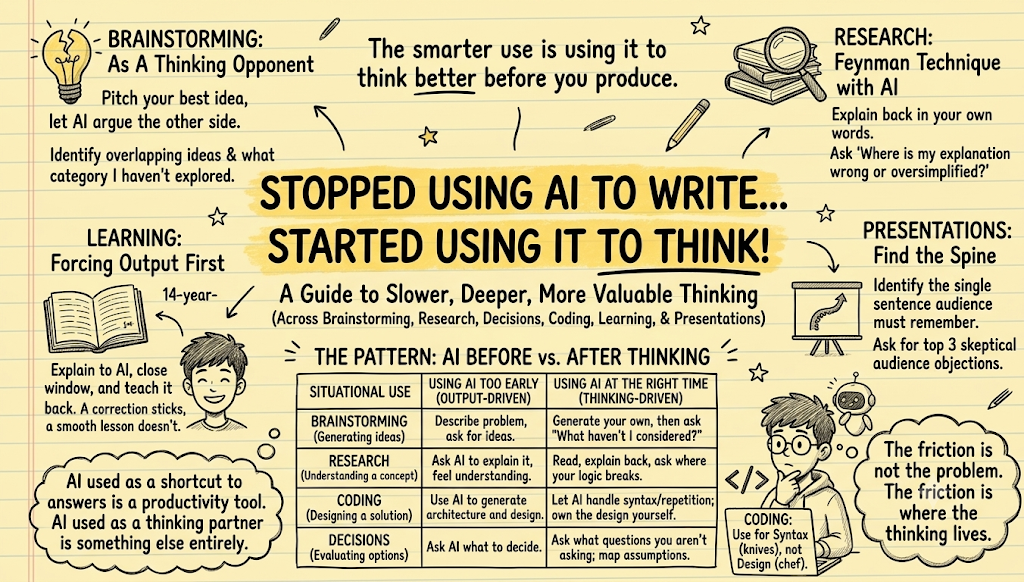
Brainstorming: using AI as a thinking opponent, not a ideas vending machine
The standard use of AI for brainstorming: describe a problem, ask for ideas, scan the list, pick a few. It works. It is also the laziest version of what brainstorming could be.
What I do now is different. I generate my own list first, without AI. Usually ten to fifteen ideas, some of which are bad and I know it. Then I give the AI my list and ask it to do two things: identify which of my ideas are actually the same idea wearing different clothes, and tell me what I haven’t considered.
That second instruction is the one that changed things. “What haven’t I considered” forces the AI to operate at the edge of your thinking rather than in the middle of it. It finds the adjacent territory you didn’t look at, not the territory you already mapped. The ideas that come back from that prompt are almost always more interesting than anything it would have generated from scratch.
The actual prompt that works
“Here are my current ideas on why our content isn’t getting traction. Don’t add more ideas yet. First, tell me which of these are essentially the same idea, which ones I’m probably overvaluing because they feel familiar, and what category of solution I haven’t explored at all.” Run that before you ask for more ideas. The diagnostic is more valuable than the list.
There is a version of brainstorming where you use AI as an opponent. You pitch your best idea. It argues the other side. You defend it. You find the parts you can’t defend. Those are the parts worth rebuilding before you spend six weeks on a plan that has a hole in the middle you didn’t see coming.
Research: the difference between reading and understanding
AI is very good at summarizing. It is less good at telling you what a summary means for your specific situation. Most people stop at the summary and call it research. That’s reading comprehension, not research.
The use of AI that changed how I work: after reading something, I explain it back to the AI in my own words and ask it where my explanation breaks down. This is the Feynman technique with a patient, always-available sparring partner. The gaps in your explanation are exactly the gaps in your understanding. Most of the time when I do this, I find at least one place where I had papered over confusion with plausible-sounding language.
“I think the way X works is Y. Where is my explanation wrong or oversimplified?” That question, asked honestly after you’ve read something, teaches you more than asking the AI to explain X in the first place. The first approach outsources the understanding. The second approach tests whether you have it.
The other research use worth naming: asking AI to steel-man the position you disagree with. If you’re researching a decision that has a clear “right answer” in your head already, ask the AI to make the strongest possible case for the option you’re planning to reject. Not a weak case. The strongest one. You will find out whether your conviction is based on a real analysis or on the fact that you stopped reading when you found something that agreed with you.
Coding: a thinking tool that writes the parts you shouldn’t spend your thinking on
I want to make a distinction that most “AI and coding” articles blur: there is a difference between code that requires thinking and code that is just syntax. AI is genuinely useful for the second category and genuinely dangerous for the first.
Setting up a boilerplate file, writing a test for a function you’ve already designed, scaffolding the repetitive parts of an API endpoint — none of that requires original thinking. Spending mental energy on it is like a chef sharpening their own knives from raw metal before every service. The sharpening is real work. It’s just not the work that matters.
Where people get into trouble: using AI to design the solution, not just implement it. I’ve watched developers take an AI-generated architecture, build on it for three weeks, and then hit a wall because the design had an assumption baked into step one that didn’t fit their actual use case. The AI didn’t know enough about the specific constraints to design correctly. The developer outsourced the part they needed to own.
The coding use that actually helps your thinking
Before writing any significant function, describe the problem to AI in plain English and ask: “What are three different approaches to solving this, and what does each one make easier or harder?” Don’t ask it to pick one. Make that call yourself after seeing the tradeoffs laid out. The choice is where your thinking happens. Let the AI write the implementation after you’ve done that work.
The other coding use that sharpens thinking rather than replacing it: ask AI to review code you’ve already written and tell you not just what’s wrong but what assumptions the code reveals about how you think the system works. The code is a mirror. The AI can read the reflection and tell you what it sees.
Presentations: thinking before you structure
Most people use AI to structure their slides. Give it bullet points, get an outline back, fill in the slides. The result is a presentation that is organized but doesn’t have a spine. There’s a difference between a presentation that covers a topic and one that makes an argument. AI can do the first automatically. Only you can do the second, because the argument requires knowing what you actually believe and what you want the audience to leave with.
The question I ask before touching any presentation now: “What is the one thing I want someone who was only half-listening to remember?” If I can’t answer that in one sentence, I’m not ready to structure anything. I use AI to pressure-test that one sentence before I build around it.
“Here’s my central claim: most teams don’t have a strategy problem, they have a prioritization problem — they’re working on the right things in the wrong order. Tell me the three most likely reasons a skeptical audience would reject this before I’ve finished the second slide.” That response shapes the entire presentation. You’re not building a slide deck. You’re building a counter to the objections your audience already has before you open your mouth. That’s a different design problem, and it produces a different kind of presentation.
“A presentation that covers a topic is an organized information dump. A presentation that makes an argument changes what someone believes when they leave. AI can help with the first. Only you can do the second.”
Learning: the mistake that makes smart people slower
There is a way of using AI that feels like learning and produces the sensation of understanding without the substance. You ask AI to explain a concept. It explains it well. You feel like you understand it. Two days later you can’t reconstruct the explanation without prompting the AI again.
This is not a criticism of AI. It’s a description of passive learning. The explanation was good. The retrieval was outsourced. Your brain never did the work that creates durable understanding because you never had to reconstruct anything yourself.
The learning use of AI that actually works is forcing output before input. Before asking AI to explain something, write down everything you already think you know about it, including the parts you’re not sure about. Then ask AI to respond to what you wrote, not to give a general explanation. The response will be more specific, and your engagement with it will be active rather than passive because you have something at stake in the answer.
The other technique: after AI explains something to you, close the window and teach it back to an imaginary 14-year-old. Write it out. Then ask AI to find the places where your explanation was wrong or where you skipped a step without knowing it. What comes back is not a lesson. It’s a correction. Corrections stick in a way that smooth explanations don’t, because they attach to something you actually tried to do.
Decision making: the use case most people haven’t tried
I started using AI for decisions about eight months ago and it is the use case I recommend most that gets the most skepticism. People feel that decisions are personal, that the variables are too specific to their life, that AI doesn’t know enough to be useful. All of that is partly true and mostly beside the point.
AI is not useful for decisions because it knows what you should do. It is useful because it forces you to articulate the decision clearly enough that you actually understand what you’re choosing between. Most decisions that feel hard are actually two or three unresolved questions wearing the costume of a single choice. AI will keep asking you clarifying questions until the costume comes off.
“I’m deciding between staying in my current role and taking a new job at a smaller company. Here’s what I know: the new role pays more and has more ownership, but the company is earlier stage and the team is untested. What I’m uncertain about: whether I actually want more responsibility right now, or whether I just want to feel like I do.” Give it that. Then ask: “What question am I not asking that I should be?” That single prompt has changed three significant decisions for me in the last year. Not because the AI knew the answer, but because it named the question I was avoiding.
The decision-making trap to avoidDon’t ask AI what to decide. Ask it what the decision reveals about your actual priorities, given what you’ve said. “Based on how I’ve described this, what do I seem to value most?” That response is often uncomfortable. It’s also usually accurate. The discomfort is useful data. It tells you whether your stated reasoning and your revealed preferences are pointing in the same direction or not.
The specific decision use that has saved me the most time: asking AI to map the assumptions baked into my current plan. “Here’s what I’m planning to do. What has to be true for this to work?” The list of assumptions is usually longer than I expected and at least one of them is one I haven’t verified. That is a better use of thirty minutes than optimizing a plan built on an untested foundation.
When to stop using AI and think alone
This matters as much as anything else in this article. There are things AI makes worse when you use it too early, and knowing where that line is will save you from a specific kind of problem: developing fluency in talking about things you haven’t actually thought through.
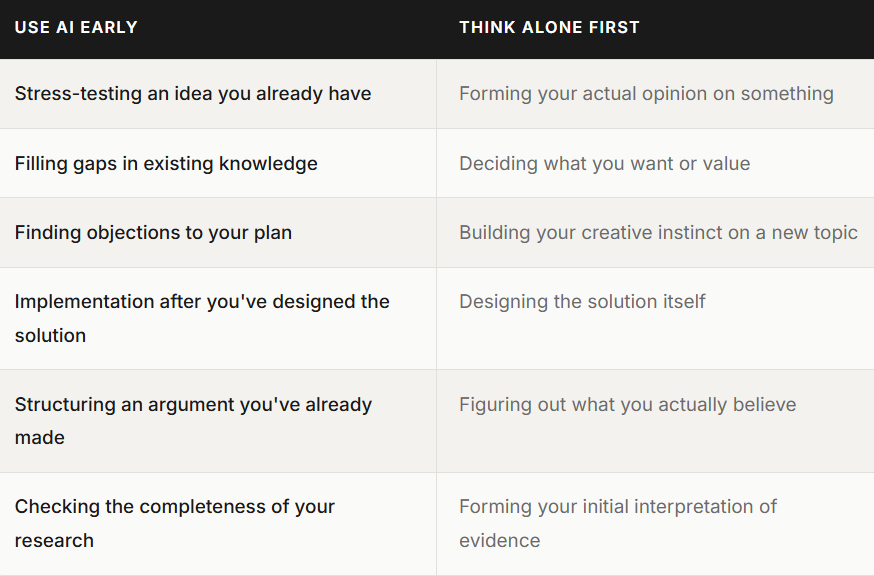
The pattern in that table is consistent: use AI after you’ve put something of your own on the table. Before that, the AI is doing your thinking. After that, it’s improving it. The difference between those two things is the difference between work that sounds like you and work that sounds like a hotel room.
What actually changed when I made this shift
I want to be specific here rather than vague, because the vague version of this argument (“use AI to augment your thinking!”) has been written many times and doesn’t tell you what to actually do.
My brainstorming sessions are shorter and produce better material because I stop treating idea generation as the goal and start treating idea evaluation as the goal. My research takes longer but I remember more of it, because I’m testing my understanding at every stage rather than just accumulating information. My code decisions are clearer because I separate the design thinking from the implementation, and the AI handles the second without touching the first.
Most significantly: my writing sounds like me again. Not because I stopped using AI in the writing process, but because the thinking that precedes the writing is mine in a way it wasn’t when I was using AI to generate drafts from underdeveloped ideas. The AI can help me structure something I’ve thought through. It cannot give me the thing I haven’t thought through yet, and it took me longer than I’d like to admit to stop asking it to.
“AI didn’t change how fast I can produce things. It changed how clearly I can think through things before I produce them. That second change is the one that matters.”
The reader who replied to my hollow article was right. It didn’t sound like something I wrote. It sounded like something that was generated efficiently from a prompt I wrote. Those are different things, and the difference is exactly the friction that gets removed when you let AI do your thinking for you.
The friction is not the problem. The friction is where the thinking lives.
메타데이터
- post_id
- 80cd40345fef
- slug
- i-stopped-using-ai-to-write-i-started-using-it-to-think-80cd40345fef
- url
- https://medium.com/ai-engineering-simplified/i-stopped-using-ai-to-write-i-started-using-it-to-think-80cd40345fef
- canonical_url
- https://medium.com/ai-engineering-simplified/i-stopped-using-ai-to-write-i-started-using-it-to-think-80cd40345fef
- author_url
- https://medium.com/@bhawnayv.08
- status
- ok
- fetched_at
- 2026-07-08 18:29:56