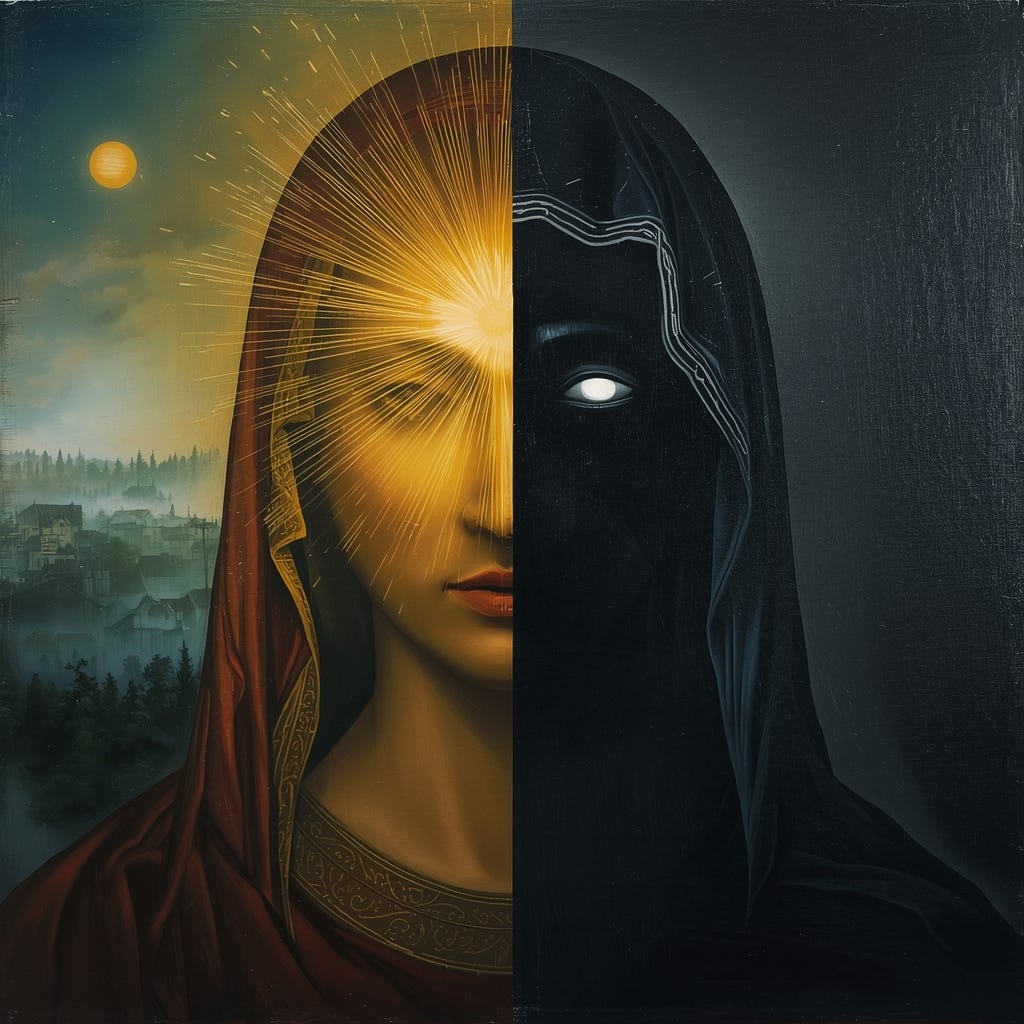
"The Land of Immortals — Thunder-Guest.” I Wrote This Before I Knew I Was Viewing Tunguska.
A Remote Viewing session, a”pre-briefing”, and a mystery that has resisted explanation for over a century
"The Land of Immortals — Thunder-Guest.” I Wrote This Before I Knew I Was Viewing Tunguska.
A Remote Viewing session, a”pre-briefing”, and a mystery that has resisted explanation for over a century
That morning, I didn’t know where the evening would take me
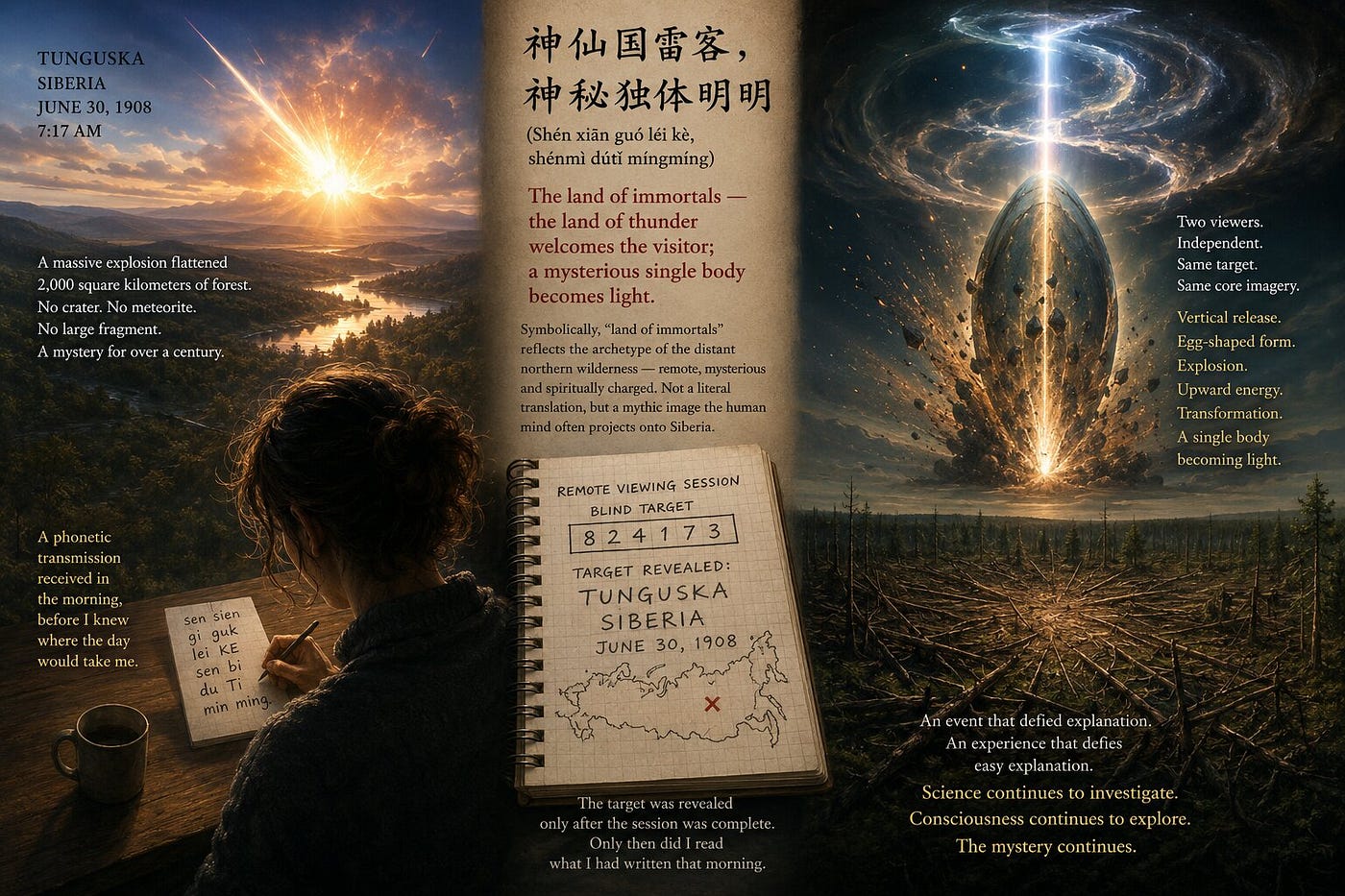
Before the workday had even begun, a few syllables arrived. I wrote them down mechanically, without analysis. This is what I wrote:
sen sien gi guk lei KE sen mi du Ti min ming
I didn’t know what they meant. I didn’t try to figure it out in that moment. I set things like this aside because it’s a practice in itself: receive, don’t interpret, let it rest. The card went face down.
A few hours later I received a target for a Remote Viewing session. In Remote Viewing, the target is always blind. You just receive only a string of five or six numbers. Nothing else. No context, no clues, no subject. During the session, each viewer works independently, communicating with the monitor one-on-one over a messaging app. The monitor works with several viewers simultaneously, but we don’t see each other’s impressions. Only after everyone has finished do we gather on a video call and it is only then, together, that the monitor reveals the target and we compare what we saw.
I worked. The session ended. The monitor revealed the target.
Tunguska. Siberia. June 30, 1908.
Only then did I pick up the card with the morning’s phonetic notes. Only then did I read it for the first time since writing it down.
Step 1 — my raw phonetic record: sen sien gi guk lei KE sen mi du Ti min ming
Step 2 — AI-assigned Chinese characters: 神仙国雷客,神秘独体明明
Step 3 — transliteration and translation: (Shén xiān guó léi kè, shénmì dútǐ míngmíng) The land of immortals — thunder-guest; mysterious singular body, bright-bright.
Goosebumps.
This is the sequence that matters: the phonetic transmission came first, in the morning, before I knew there would be a session. The session happened blind, with no knowledge of the target. The target was picked up just before session and revealed by the monitor only after the session was complete. And only at that point did I open the morning’s card and read what I had written hours earlier — without knowing where the day would take me.
A mystery that has lasted over a hundred years
To understand why that sentence might mean anything, you first need to know what Tunguska is — and why science is still arguing about it.
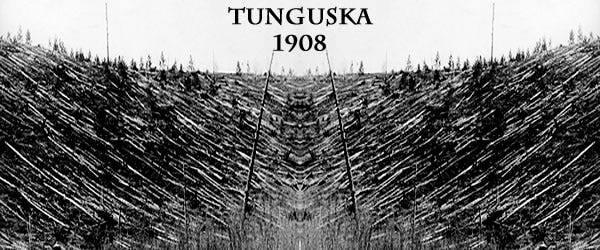
On June 30, 1908, at 7:17 in the morning local time, something happened over the uninhabited Siberian taiga near the Podkamennaya Tunguska river that defied explanation. A massive explosion, estimated today at the equivalent of 10 to 50 megatons of TNT, roughly a thousand times more powerful than the bomb dropped on Hiroshima, flattened approximately 2,000 square kilometers of forest. Trees knocked down like matchsticks, radiating outward from a single point in the air.
Witnesses from hundreds of kilometers away described a blinding flash like a “second sun” appearing in the sky. The shockwave circled the globe twice and was recorded by seismic stations across Europe and Asia. For nights after the explosion, the sky above all of Eurasia glowed unnaturally. It was the effect of dust thrown high into the atmosphere.
And yet: no crater was found. No meteorite. No large fragment of any object that could account for the scale of the destruction.
Over the following decades, Tunguska became a battleground of theories. A stony meteoroid that vaporized in the atmosphere. An icy comet that disintegrated without leaving physical trace. An antimatter body, in a theory from the 1940s. A natural nuclear explosion. And on the fringes: the German astrophysicist Wolfgang Kundt suggested the explosion resulted from the release and ignition of natural gas from within the Earth’s crust. Others pointed to the “verneshot” hypothesis. They said that a spontaneous volcanic eruption of magma or gas from the ground, though no shattered rock or gas vents supporting this have been found at the site.
Most scientists today lean toward an asteroid or stony meteoroid that exploded in an airburst at around 5–10 km altitude before reaching the surface — hence no crater. Microscopic metallic particles recovered from the area are more consistent with asteroids than comets. But the case is not fully closed, and the precise nature of the object remains debated.
No single theory has gathered all the pieces of the puzzle.
Two viewers, one target, silence before the reveal
The session took place in a group. Viewers worked independently — each of us saw only the blind target number, with no clues of any kind. No contact between participants during the work. The Remote Viewing protocol is strict at this point: neutral, objective impressions first, verification later. Below is what we saw.
RV1 — impressions:
Something enormous, vertical, rounded in shape. Like a great rift you could fly into — hard on the outside, hollow inside, like a portal in rock. A pyramid shape with a vertical slit in the hard surface. An opening in the object draws in air and releases it upward in a spiral. Something floats above the top, swirling. Association: volcanic eruption, upward energy release, accumulation and discharge, apocalyptic event. I see only the laws of nature — ordinary events, geology, physics. Chemistry, magnetism: the laws of thermodynamics. This volcano: gathers energy, draws in, accumulates and releases, throws it upward. An object flies out from the ground — like a ball, a gas bubble. It sprays to the sides like fireworks. The ball, the gas, glows — and a small grain falls into it from below, perhaps triggering the explosion.
RV2 — impressions:
Something large, spacious, occupying a vast area. A sense of a colossus. A zeppelin-like shape moving majestically through space. Rocks, craters or ravines, the sound of moving colossi, as if mountains were rising. An egg-shaped form floating in space, as if subjected to a force lifting it upward. Some kind of gravitational shift, as if volcanoes were involved. A polarity reversal brewing. It has to do with forces of nature, two different worlds concentrated in one place. Orogenic processes or something similar: slowly but surely, like that zeppelin at the beginning. Changes were pushing forward, some friction, a rumble, maybe a volcano and some mega-eruption that caused changes in the terrain. As if something had cracked, something had fallen apart, and from it a new one emerged. A sense of enormous accumulated energy held back by this “plug” — and when it exploded, it was a real explosion. Something that could shake the planet’s gravity — a super hyper mega turbo volcano, in fact. A large plug, something egg-shaped, pushed out from the Earth’s interior, like a giant pimple beneath it. Enormous energy accumulated, but this plug seemed to disappear — either shattering into pieces or being launched into space. It disintegrated. As if it were made of some kind of metal.
A myth that may not be a myth
While researching the Tunguska event after our session, a reader( kudos to John Annesley) drew my attention to something I had not encountered before — and it stopped me in my tracks.
In the remote regions of northwestern Yakutia, Siberia, indigenous Yakut and Evenki folklore describes mysterious metallic domes half-buried in the swampy permafrost. They call them Olguydakh — cauldrons. Large, smooth, reddish-metal hemispheres that resist all cutting and scratching, stay unnaturally warm through freezing Siberian winters, and according to local legend, cause dizziness, hair loss and death in those who linger near them. Modern researchers compare these symptoms to radiation exposure. The surrounding vegetation, the stories say, grows to monstrous sizes.
The region is known as the Valley of Death — Yelyuyu Chörköçüökh in Yakut. The first written record comes from explorer Richard Maack, who documented a giant buried copper cauldron in 1853. In the 1930s, a traveler named Mikhail Koretsky claimed to have found seven hidden domes.
But here is what I cannot easily dismiss.
RV2 described “a large plug, something egg-shaped, pushed out from the Earth’s interior” — metallic, accumulating enormous energy, then disintegrating. RV1 saw “a small grain falling into a glowing ball from below, perhaps triggering the explosion.” Neither viewer knew the target. Neither had any reason to describe an upward discharge from within the earth rather than an object falling from the sky.
And the indigenous people of this region — centuries before 1908, centuries before Remote Viewing as a methodology existed — were telling stories about metallic objects buried in the permafrost, warm to the touch, connected to fire columns shooting upward into space.
Myth or memory? Independent perception or convergent imagination? I don’t know. But the overlap is not nothing.
Synchronism: the same place, different words
When these two descriptions are placed side by side, something strikes me that in Remote Viewing methodology is called a synchronism — an independent convergence on the same image by different viewers.
Both of viewers saw energy expelled vertically upward. Both of them saw something egg-shaped or spherical, launched from within or from the surface. Also they associated the event with a volcano even though there is no volcano at Tunguska. This is not a mistake. This is exactly what the RV method tends to reveal: the energetic character of an event, not its literal description. An explosion with the force of a volcano, a vertical discharge, accumulation and sudden release is a coherent image that both of viewers received independently.
RV1 additionally saw something that can be read as the moment of initiation: a small grain falling from below into a glowing ball. This resonates with hypotheses about the Tunguska event that propose an external body as a trigger for a reaction with energy already present in the system — in the atmosphere, in the ground, in accumulated gas.
RV2 received an impression of a metallic composition of the object. That’s an interesting divergence from the icy comet theory — and a convergence with meteoroid models. Notably, microscopic metallic particles recovered from the Tunguska site are indeed associated more closely with rocky asteroids than with comets.
Where the sentence came from
Let’s return to the morning transmission.
sen sien gi guk lei KE sen mi du Ti min ming — 神仙国雷客,神秘独体明明 — (Shén xiān guó léi kè, shénmì dútǐ míngmíng) The land of immortals — thunder-guest; mysterious singular body, bright-bright.
I didn’t drive the interpretation. I gave the AI the syllables and it returned the characters. The meaning followed from there.
I don’t know Chinese. I never studied it. There is nothing in my environment that could have “inserted” that sentence into my mind as an echo of something I’d read or heard. I checked: this phrase does not appear in any publicly available source in this form. It is not a quote. It is a transmission or at least, something that arrived outside the ordinary stream of thought.
And this transmission maps onto Tunguska with a precision that relly strikes.
The land of immortals: the explosion over Siberia was heard as a series of massive detonations hundreds of kilometers away. Witnesses described the sound like artillery salvos, like thunderstorms, like nothing natural. (Author’s note: “The land of immortals” is not a literal translation of Siberia, but symbolically it resonates with an archetype found across cultures: the distant northern wilderness as a place beyond ordinary civilization, remote and spiritually charged. The phrase may reflect not geography, but the mythic quality the human imagination has long projected onto Siberia itself.)
Thunder-guest: something arriving from outside. An object from beyond Earth entering its atmosphere.
Mysterious singular body, bright-bright: this is the heart of the mystery. Researchers have argued for over a hundred years about whether it was one object or many fragments. The majority of eyewitness accounts point to a single fireball that at some moment exploded — became blazing, blinding, before it vanished. “A second sun” — that’s how it was described. One. Single. That suddenly becomes light.
This is not a coincidence — but what is it?
In consciousness research and extended perception, there is a concept called pre-target impressions, perceptions that arise before a target is formally opened. Sometimes they are loose images, sometimes phrases, sometimes sounds. They are usually dismissed as “noise before the work.”
Rarely do they turn out to be this precise.
What I received in the morning as a meaningless phonetic string turned out, that evening after target reveal to be a concise, poetic condensation of an event I had no knowledge of. Not a scientific report. An archetypal image: thunder, a visitor, a single body, light.
I can explain it in several ways, and each of them leads somewhere interesting.
The first: the unconscious doesn’t sleep, and sometimes “extracts” information before conscious awareness catches up. This would be a case of spontaneous, unstructured RV — contact with a target before the briefing. Research at Princeton’s PEAR laboratory documented exactly this kind of precognitive remote perception, where viewers described targets before they were selected.
The second: there is something that can be called an information field that is a record of events accessible outside of linear time, and my perceptual field maybe touched it at the right moment.
The third, perhaps the most quietly radical: the human mind may be capable of forming symbolic summaries of information before conscious awareness fully understands the context. Dreams, intuitions, sudden metaphors, creative insights often work this way — meaning appears first in symbolic form, and only later becomes intellectually recognizable. If that is what happened here, then the most interesting part of this experience is not whether the source was paranormal. It may be that the unconscious mind can organize perception into coherent symbolic structures before the analytical mind catches up. The phonetic transmission may not have been a supernatural message. It may have been the mind speaking in the language of archetype, compression and intuition.
I don’t know which explanation is true. Perhaps all of them. Perhaps none. I only know that this was my first experience of pre-target transfer this precise, and I’m not willing to ignore it.
Languages we don’t know
This story doesn’t exist in isolation.
Throughout history, people have spoken or written down sounds and words from outside their own language. In the 12th century, Hildegard of Bingen created Lingua Ignota (the unknown language) which is a glossary of over a thousand invented words she used for mystical purposes, written in her own invented alphabet. Whether it was a spiritual language, a secret code, or something else entirely, scholars still debate; what’s undisputed is that it arose from a place beyond ordinary composition. In the 16th century, John Dee, advisor to Queen Elizabeth I, together with the medium Edward Kelley, recorded the Enochian language — a complete phonetic system that emerged in sessions with beings both men described as angelic. In the 19th century, the Spiritualist movement filled with cases of automatic writing, where a hand would write out full sentences in languages the medium had never learned.
In the 20th century, Jane Roberts transmitted philosophical texts from an entity called Seth. She wrote sentences she could never have constructed in her ordinary state. Today, thousands of people practice Light Language — phonetic strings whose meaning emerges only in interpretation.
The common thread, at least phenomenologically: something arrives from outside the ordinary stream of thought and carries an internal structure that resists reduction to simple association. Whether interpreted spiritually, psychologically, artistically or as anomalous cognition, these experiences continue to challenge simple explanations.
My experience fits within this lineage. But something distinguishes it: this time, the transmission could be cross-referenced. Not as a symbol open to interpretation, but as information connected to a specific historical event that, a few hours later, became the subject of a blind Remote Viewing session.
What we know. What we don’t.
Tunguska remains an open case.
The dominant scientific hypothesis today points to an asteroid or meteoroid that exploded in the air at around 5–10 km altitude before reaching the surface, hence no crater. The object is estimated at roughly 50–80 meters in diameter, breaking apart violently upon entering the atmosphere and releasing its kinetic energy as a shockwave and thermal pulse.
This is the most parsimonious explanation. And probably correct in its broad physical outlines.
But what we saw in the RV session — energy expelled vertically, something egg-shaped launched from within or from the surface, a “plug” of accumulated energy — suggests a picture more complex than a classical meteoroid traveling in from space on a simple trajectory. As if the event had two components: an external trigger and an internal response. Something arriving from outside, and something waiting below.
That is a hypothesis, not a claim. A Remote Viewing session is not scientific evidence. It is an extension of the field of questions.
A note on the experiment
I want to be clear about the shape of this experience, because precision matters here.
I conducted this phonetic pre-briefing experiment twice — two sessions, two blind targets, two sets of syllables written down before I knew anything about what I was about to view. After the second session I spoke with the monitor. We looked at both results together. And then I stopped.
Not because something went wrong. Because something went right.
Two rounds was enough to suggest that this kind of pre-target phonetic reception is something I can do — that the impressions arriving before a session carry real signal, not just noise. That was the finding. I wasn’t trying to build a practice or prove a system. I was running an experiment, and the experiment gave me an answer I hadn’t expected: yes, this appears to work.
I closed that chapter with something close to quiet joy. A new door, noticed. Not forced open — just seen.
In the end
That morning I wrote a sentence I didn’t understand.
That evening I saw where it was pointing.
I don’t know who the sender of these transmissions is — whether it is my own perception extending beyond time, or something outside of me. I’m not trying to resolve that in a single article.
I know that Tunguska has resisted a definitive answer for over a hundred years. And I know that when I closed my eyes and stopped searching — something told me what to look for.
“The land of immortals — the thunder visitor; a mysterious singular entity, shining clearly (bright, bright)”.
Maybe that’s enough to know where to look next.
References and further reading
On the Tunguska event
- NASA (2023). 115 Years Ago: The Tunguska Asteroid Impact Event. nasa.gov/history
- American Physical Society (2018). June 30, 1908: The Tunguska Event. aps.org/apsnews
- Gasperini, L. et al. (2007). The Tunguska Mystery. Scientific American, June 2007.
- Boslough, M. & Crawford, D. (2008). Low-altitude airbursts and the impact threat. International Journal of Impact Engineering, 35(12).
- Kulik, L.A. (1927). First expeditions to the Tunguska impact site. Meteoritika.
- EBSCO Research Starters. Tunguska Event. ebsco.com/research-starters
- Bronshten, V.A. & Zotkin, I.T. (1995). Reconstruction of the Tunguska Event of 1908: Neither an Asteroid, Nor a Comet Core. arxiv.org/abs/1302.6273
On anomalous language, channeling and phonetic transmission
- Wikipedia. Lingua ignota. en.wikipedia.org/wiki/Lingua_ignota
- Higley, S.L. (2007). Hildegard of Bingen’s Unknown Language: An Edition, Translation and Discussion. Palgrave Macmillan.
- Schnapp, J. (1991). Virgin Words: Hildegard of Bingen’s Lingua Ignota and the Development of Imaginary Languages Ancient to Modern. Exemplaria, III(2), 267–298.
- World History Encyclopedia (2024). Hildegard of Bingen’s Unknown Language and Unknown Letters. worldhistory.org
- Roberts, J. (1972). Seth Speaks: The Eternal Validity of the Soul. Prentice Hall.
- Laycock, D. (1978). The Complete Enochian Dictionary. Askin Publishers.
메타데이터
- post_id
- 80da6923151f
- slug
- the-land-of-thunder-welcomes-the-visitor-i-wrote-this-before-i-knew-i-was-viewing-tunguska-80da6923151f
- url
- https://medium.com/@krindiri/the-land-of-thunder-welcomes-the-visitor-i-wrote-this-before-i-knew-i-was-viewing-tunguska-80da6923151f
- canonical_url
- https://medium.com/@krindiri/the-land-of-thunder-welcomes-the-visitor-i-wrote-this-before-i-knew-i-was-viewing-tunguska-80da6923151f
- author_url
- https://medium.com/@krindiri
- status
- ok
- fetched_at
- 2026-06-22 08:33:11