Quantum Computing Just Crossed a Real Threshold. Most Investors Are Still Treating It Like 2023.
Google’s Willow, Microsoft and Quantinuum’s 14,000 error-free instances, IBM’s Loon, the AlphaQubit decoder. The underlying technology…
Quantum Computing Just Crossed a Real Threshold. Most Investors Are Still Treating It Like 2023.
Google’s Willow, Microsoft and Quantinuum’s 14,000 error-free instances, IBM’s Loon, the AlphaQubit decoder. The underlying technology shifted in the last 18 months. The coverage hasn’t caught up.
The standard write-up on quantum computing has been roughly the same for the last decade. Fascinating technology. Transformative applications, if they work. Commercial usefulness always somewhere between five and ten years out. Pure-play stocks treated as a speculative sleeve, not a real allocation. Wait and see.
That framing was correct for a long time. It is no longer correct, and the gap between what’s actually happening in the labs and what most investors believe is happening has become genuinely large.
Here’s the parallel I keep coming back to. In late 2022, ChatGPT shipped and most serious technology investors spent the next eight months explaining why it was just an impressive chatbot. The doubters had real arguments: hallucination problems, no clear business model, models that would obviously commoditize, the inevitable plateau. The arguments were intellectually defensible. They were also, in retrospect, the last gasp of a consensus that was already wrong. The investors who looked stupid in mid-2023 for buying Nvidia, betting on the AI infrastructure thesis, or going long Microsoft on the Copilot story turned out to be the ones who saw the curve before the consensus did.
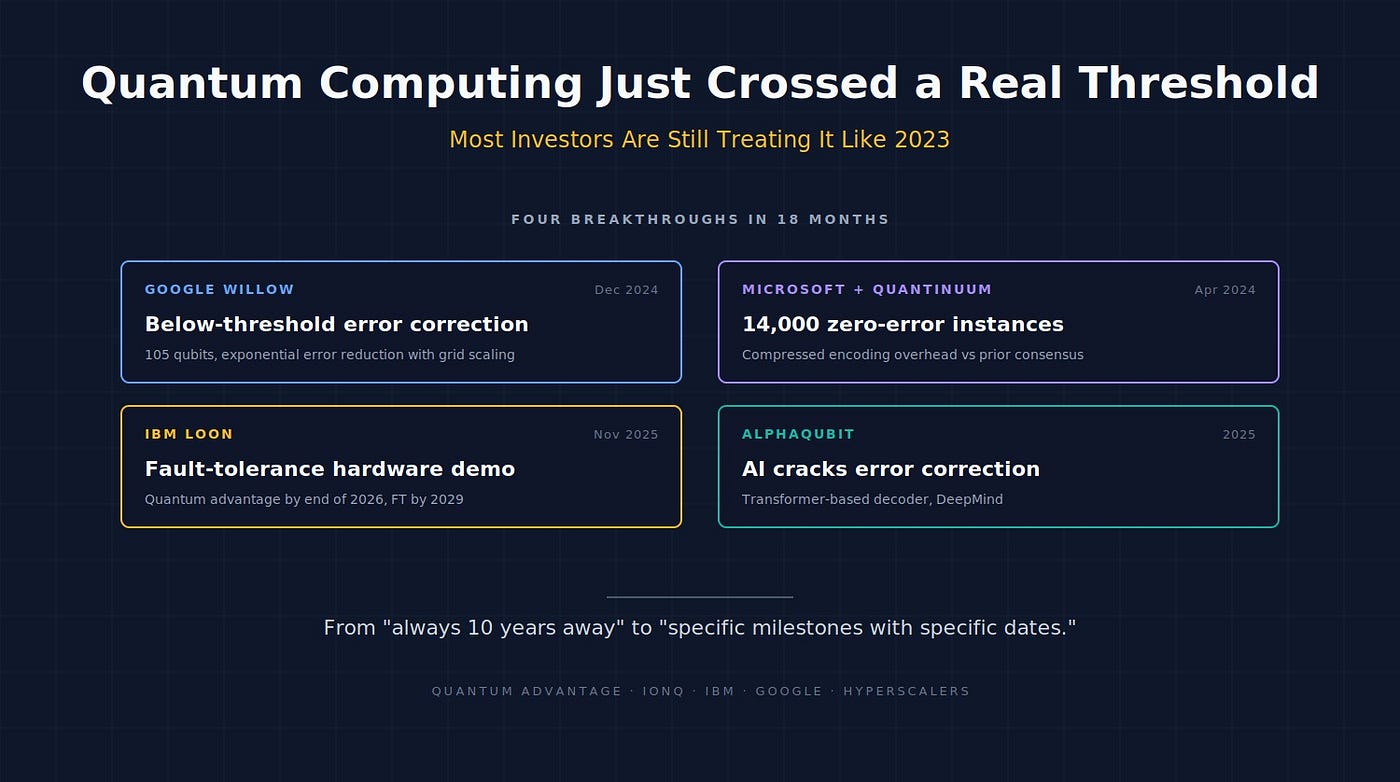
Quantum computing in 2026 is in roughly the same position. Four meaningful breakthroughs have happened in the last 18 months. Google’s Willow chip demonstrated quantum error correction below the fault-tolerance threshold for the first time. Microsoft and Quantinuum together ran 14,000 instances of a quantum circuit with no errors. IBM unveiled its Loon processor in November 2025 with all the hardware elements needed for fault-tolerant quantum computing, and publicly committed to delivering verifiable quantum advantage by the end of 2026 and fault tolerance by 2029. And Google DeepMind’s AlphaQubit decoder used AI to crack the quantum error correction problem in a way that didn’t seem possible a couple of years ago.
The doubters have real arguments. The technology is still pre-commercial. The pure-play stocks have run hard. The hyperscalers might capture most of the value. The timeline could still slip. These arguments are intellectually defensible, the same way the AI doubter arguments were in early 2023. They might also turn out to be the last gasp of a consensus that’s already wrong.
This is a piece on what actually changed in the science, what the major labs are publicly committing to, why the AI parallel is the right frame, and how to position around a thesis that hasn’t fully entered the consensus yet.
The four things that actually shifted
Worth getting these on the table specifically, because the breakthroughs are often described in vague terms that don’t capture what’s new.
Start with Google’s Willow chip, because everything else in the field traces back to it. Quantum error correction has always been the central problem in this work. Qubits are fragile, environmental noise destroys quantum states, and conventional wisdom for decades held that adding more qubits made systems worse, not better. Then in late 2024 Google published a Nature paper on the 105-qubit Willow chip showing the opposite. By arranging qubits in 5x5 and 7x7 grids and adding their improved error correction, error rates dropped exponentially as the number of qubits scaled up. Each grid expansion roughly halved the error rate. The technical milestone is called clearing the “fault-tolerance threshold,” and it’s the result the field has been chasing since the late 1990s. Willow finally got there. Everything that follows in the breakthroughs cycle is downstream of that paper.
Then there’s the Microsoft and Quantinuum result from April 2024, which got less press but might matter more in the long run. Together they ran 14,000 individual instances of a quantum circuit with zero errors using a reliable logical qubit. The headline number is impressive, but the underlying claim is bigger than that. For years the consensus has been that fault-tolerant quantum computing would require hundreds or thousands of physical qubits per logical qubit, which makes the engineering challenge enormous. The Microsoft-Quantinuum encoding compression challenged that consensus directly. If the more efficient encoding generalizes to larger systems, the entire timeline to commercial usefulness compresses.
IBM’s November 2025 announcement was the moment the conversation moved from research to commitments. At their annual Quantum Developer Conference, IBM unveiled the Loon processor, which demonstrates all the hardware elements needed for fault-tolerant quantum computing. They also publicly committed, in front of customers, to delivering verifiable quantum advantage by the end of 2026 and fault tolerance by 2029. Specific years. Specific milestones. The same conference disclosed something less flashy that I think matters more: IBM doubled its development speed by shifting to 300mm wafer fabrication, the same process used for advanced classical semiconductors. Quantum chip manufacturing is starting to inherit the scaling advantages of the rest of the semiconductor industry, which is the kind of detail that compounds over a decade.
And the AlphaQubit story is the one that closes the loop. Google DeepMind built an AI decoder using a transformer architecture trained on noise patterns, and it cracked the error correction problem at the scale required for practical quantum computing. The first time an AI system has solved a long-standing physics problem at that level. The result itself is impressive, but the broader implication is bigger. Quantum is now benefiting from the same AI tooling that’s reshaping every other technical field, which means the two trajectories are no longer independent. AI is accelerating quantum, and quantum will eventually accelerate AI back.
Put those four together and the picture is meaningfully different from what it was 24 months ago. Quantum error correction works. The encoding overhead is much lower than expected. The hardware elements for fault tolerance exist. The major industrial players are publicly committing to specific timelines. Manufacturing is scaling. AI is compressing development cycles. The remaining work is engineering and scale, not basic physics.
The investment landscape in 2026
Here’s where the divergence between the science and the market gets interesting.
The pure-play quantum stocks (IonQ, Rigetti, D-Wave, QUBT) have been on a tear. From late March 2026 through early May 2026, IonQ rose 98%, D-Wave rose 84%, Rigetti rose 56%. In a roughly seven-trading-day window in April, IonQ rose 72%. IonQ now trades at a market cap of approximately $19 billion on management’s 2026 revenue guidance of $225–245 million. Rigetti reported full-year 2025 revenue of $7.088 million, a 34% decline from 2024, and the stock still trades on multi-billion-dollar valuations. D-Wave’s stock surged 345% in 2025 alone.
The hyperscalers (Google, IBM, Microsoft) are quietly doing the heavy lifting. They have the balance sheets to fund decade-long quantum programs, the existing hyperscale cloud infrastructure to deliver quantum-as-a-service when it’s ready, and the AI tooling to accelerate quantum software development. They also have something the pure-plays don’t: real revenue from non-quantum businesses that funds the quantum work. This is the same dynamic that played out in early-stage AI, where the pure-plays got the early excitement and the hyperscalers captured most of the long-term value.
Worth flagging, because it complicates the easy version of that argument: IonQ announced in January 2026 that it is acquiring SkyWater Technology for $1.8 billion, in a cash-and-stock deal that closes Q2 or Q3 of this year. SkyWater is the largest pure-play U.S.-based semiconductor foundry, and the acquisition would make IonQ the first vertically integrated, full-stack quantum platform company, with its own onshore manufacturing capacity. IonQ has publicly tied the deal to a roadmap of 200,000-qubit QPUs delivering 8,000 ultra-high-fidelity logical qubits, with functional testing slated for 2028, and a 2,000,000-qubit chip target that the company says is now up to a year closer than before. The strategic logic is direct: stop being a pure-play software-and-trapped-ion-research company that buys foundry services, and become a vertically integrated company that owns the foundry too. Whether that escapes the structural hyperscaler problem or not, it’s the most ambitious move any pure-play has made in this cycle and it deserves attention separately from the stock price.
The Boston Consulting Group estimate that gets quoted in the space is $450 billion to $850 billion in global economic value by 2040. That number is a useful anchor but worth treating as one of many possible scenarios rather than a forecast. The honest read is that nobody knows the addressable market because the killer applications haven’t been demonstrated yet. Drug discovery, materials science, financial optimization, and cryptography are the most-cited candidates, but the timing on each of them moving from “possible in theory” to “deployed in production” is genuinely uncertain.
What’s worth sitting with is this. The technology trajectory has accelerated, the corporate commitments have firmed up, and the timeline to fault tolerance has compressed from “always 10 years out” to “specific companies committing to 2029.” Meanwhile, the pure-play stock prices have risen at a pace that already prices in much of the upside even under optimistic scenarios. The market is partially right about the technology and largely wrong about who captures the value.
What the doubters will say, and why most of it is wrong
A piece with conviction on a contested thesis has to take the counter-arguments seriously, because they’re real and the people making them are smart. Here’s what the doubters will say about quantum in 2026, and the honest read on each.
The first argument is insider selling. Insiders at the pure-play quantum companies have been net sellers of their shares over the last five years, with virtually no insider buying. The doubter reads this as “the people who know the most don’t believe in their own stock.” It’s worth taking seriously, but it’s also the same pattern that played out at every successful technology company through its early scaling phase. Microsoft insiders sold heavily through the 1990s. Amazon insiders sold heavily through the early 2000s. Nvidia insiders have been net sellers throughout the AI boom. Insider selling at pre-profit growth companies tells you about personal liquidity, not about company fundamentals. It’s a signal, but it’s a noisy one.
The second argument is valuation math. IonQ trades at roughly 80x its 2026 revenue guidance. Rigetti trades at several hundred times revenue. These are the kinds of multiples that “obviously can’t be justified.” Except this is exactly the argument people made about Nvidia at $300 a share, about Microsoft at every multiple expansion of the last 20 years, about every transformative technology company during the phase when the addressable market is still emerging. The honest read isn’t that the multiples are reasonable on current revenue. They aren’t. The honest read is that current revenue is the wrong denominator if the addressable market is what BCG and the major labs are saying it could be. Valuation discipline matters, but valuation discipline applied to the wrong base case produces the wrong answer.
The third argument is the hyperscaler problem. Google, IBM, and Microsoft are all investing seriously in quantum, and any one of them could capture the bulk of commercial quantum revenue. The doubter reads this as “the pure-plays are dead, just buy MSFT.” It’s a defensible position, and it’s also the same position people took in 2017 saying “just buy Google for AI, the OpenAI thing is a research project.” Sometimes the platform owners win. Sometimes the focused pure-plays win because they’re better aligned, they ship faster, and they don’t have other priorities. IonQ’s $1.8 billion SkyWater acquisition is an explicit attempt to escape the hyperscaler dynamic by owning its own foundry, becoming the first vertically integrated full-stack quantum platform company. Whether it works is open. That it’s being attempted at all changes the structural argument.
The fourth argument is timeline risk. Even if quantum delivers, it might deliver in 2028 instead of 2026, and two extra years of cash burn could compress prices substantially. This one is real. It’s also a reason to be measured about position sizing rather than a reason to dismiss the thesis. The same argument applied to AI in 2022 would have kept you out of a 5–10x move in the names that compounded. Timing risk in a transformative technology cycle is real, but the bigger risk in transformative technology cycles has historically been getting it wrong on direction, not on timing.
None of this is to say the pure-play stocks are obvious buys at current prices. They aren’t. What it is to say is that the doubter case requires you to believe quantum will fail to deliver, or that the pure-plays will fail to capture any of the value, and both of those positions are getting harder to defend as the technology proof points stack up.
A framework for thinking about this as an investor
Rather than picking between “buy IonQ” and “wait it out,” the more useful exercise is to map the space against three dimensions that the breakthrough cycle is stress-testing.
The exposure path is the most consequential of the three. Pure-plays (IonQ, Rigetti, D-Wave, QUBT) give concentrated exposure to the quantum thesis but with binary outcomes per company and high valuation risk attached. Hyperscaler exposure (Google, IBM, Microsoft) gives diversified exposure where quantum is a small percentage of total business but with much lower downside if the technology timeline slips. The adjacent picks (specialized hardware suppliers, cryogenics companies, quantum software startups likely going public over the next few years) sit somewhere in between, with their own specific risks. Most sophisticated investors are constructing positions across all three rather than choosing one.
Then there’s the timeline horizon question, which is genuinely uncertain. If you believe IBM’s 2026 quantum advantage timeline, current pure-play valuations could prove conservative. If you believe the historical pattern of “always 10 years away” continues, the pure-plays look like a bubble. The honest answer is that the technology has shifted in a way that makes the optimistic timeline more credible than it was two years ago, but the precise dating is genuinely impossible to forecast. Sizing positions for both scenarios is the disciplined move, even if it feels less satisfying than committing to one view.
And risk concentration is the dimension most retail investors miss. The pure-play rally has been driven by sentiment, milestones, government contracts, and capital raises, not by underlying revenue. Stocks at this stage tend to experience violent reversals on disappointing milestones or earnings. Treating quantum as a few-percent speculative allocation rather than a core position is what most sophisticated investors are doing, and it’s probably right for most reasonable risk tolerances.
The most important framing point in all of this is that the technology bet and the stock bet are not the same bet. Believing in quantum computing as a transformative technology doesn’t require believing that IonQ specifically captures the value. The history of transformative technologies usually rewards the platform owners and infrastructure providers more than the pure-play first movers, and there’s no obvious reason to expect quantum to be different. That said, IonQ’s SkyWater move is at least a credible attempt to position the company on the infrastructure side rather than only the pure-play side, which makes the company harder to dismiss than it was a year ago.
How to position without overcommitting
Practical observations, since the question most readers will have is what to actually do.
A defensible diversified position in quantum at this stage probably looks like a small allocation across hyperscalers (where quantum is upside without being the whole thesis), a smaller allocation to pure-plays sized to weather a 50–70% drawdown (because the historical base rate for emerging-tech bubbles includes that kind of correction), and patience to add to positions when sentiment unwinds rather than chasing rallies.
The pure-plays specifically are a trading vehicle more than a long-term hold at current valuations. They will move on milestones, government contracts, capital raises, and sentiment shifts in a way that has only a loose relationship to the underlying business fundamentals. Investors who want exposure to that volatility should size positions accordingly. Investors who want exposure to the technology should consider whether the hyperscalers don’t capture most of the value on a longer horizon.
Worth keeping an eye on for catalysts: IBM’s next quarterly updates on the 2026 quantum advantage timeline, any major industrial customer announcement (a pharmaceutical, materials science, or financial services firm publicly committing to quantum workloads), continued progress on AlphaQubit-style AI-assisted error correction, and any major capital raise or M&A activity in the pure-play space.
The conviction take
Quantum computing in 2026 is in a different place than it was in 2023. The error correction problem has been demonstrably cracked at small scale. The encoding overhead is much smaller than the field expected. Manufacturing is scaling. Major industrial players are committing to specific timelines. AI tooling is compressing the development cycle. The technology trajectory has moved from “always 10 years away” to “specific milestones with specific dates.”
The pattern of what’s happening is familiar. AI looked like a research curiosity in 2022 and looked like the defining technology cycle of the decade by 2024. The investors who got it right in 2023 were the ones who took the bet while the doubters were still arguing about whether ChatGPT was a real product. Most of them looked premature for about a year. Then they looked prescient.
Quantum is closer to that 2023 inflection moment than the consensus has registered. The breakthroughs have already happened. The corporate commitments are public and specific. The vertical integration plays (IonQ-SkyWater, IBM’s 300mm wafer shift) are the kind of structural moves you only make when you see the commercial timeline clearly. The retail rally in pure-plays is loud but it’s the symptom, not the cause. The cause is that the underlying technology actually shifted, and the people working in the labs know it even if the broader market hasn’t fully absorbed it yet.
The doubter arguments are intellectually defensible. They’re also exactly the kind of arguments that get made in the last year before a technology transitions from “speculative” to “obvious.” Insider selling concerns, valuation multiples, hyperscaler competition, timeline risk. All real, all worth weighting, none of them dispositive when set against the proof points that have actually shipped.
If you believe quantum is genuinely closer than the consensus thinks, the move isn’t to chase the recent rally. It’s to build a thoughtful position across the layer cake: meaningful hyperscaler exposure (where quantum is upside on top of an already-strong business), a sized pure-play allocation that can weather a 50% drawdown without forcing you out, and an eye on the adjacent picks that haven’t been bid up yet. Treat the pure-plays as the high-conviction speculative sleeve, not as a casino, and let the position compound over the years it takes the broader market to figure out what’s already happening in the labs.
The technology has already crossed the threshold. The investment landscape hasn’t priced that in yet. Both of those things will be true on different timelines, and the gap between them is where the returns live. The investors who do well from here are the ones who hold the conviction that the technology is real and the discipline to position around it without overcommitting at any single moment.
Quantum computing is one of the two or three technology stories that will define the next decade. It’s already real. The breakthroughs happened. The commitments are public. The doubter consensus is going to look the way the AI doubter consensus of early 2023 looks now, which is dated and embarrassing. The decision in front of investors right now isn’t whether to engage with the space. It’s whether you’re going to be one of the people who saw it while it was still controversial, or one of the people who tells the story of why you waited.
If you’re modeling quantum positioning ahead of the IBM 2026 quantum advantage milestone, drop a comment. The “what catalysts are you watching” question is the most useful one in this space right now.
📩 Join Investor’s Handbook Digest — get the best investing, markets, and wealth-building insights each week.
메타데이터
- post_id
- 80dee90dba85
- slug
- quantum-computing-just-crossed-a-real-threshold-most-investors-are-still-treating-it-like-2023-80dee90dba85
- url
- https://medium.com/the-investors-handbook/quantum-computing-just-crossed-a-real-threshold-most-investors-are-still-treating-it-like-2023-80dee90dba85
- canonical_url
- https://medium.com/the-investors-handbook/quantum-computing-just-crossed-a-real-threshold-most-investors-are-still-treating-it-like-2023-80dee90dba85
- author_url
- https://medium.com/@y.raj1457
- status
- ok
- fetched_at
- 2026-06-09 14:34:10