Meta’s Llama 3.2 Vision: Multimodal Power Without the Price Tag
How the 2025 release quietly pushed high-quality VLMs into everyday engineering.
Meta’s Llama 3.2 Vision: Multimodal Power Without the Price Tag
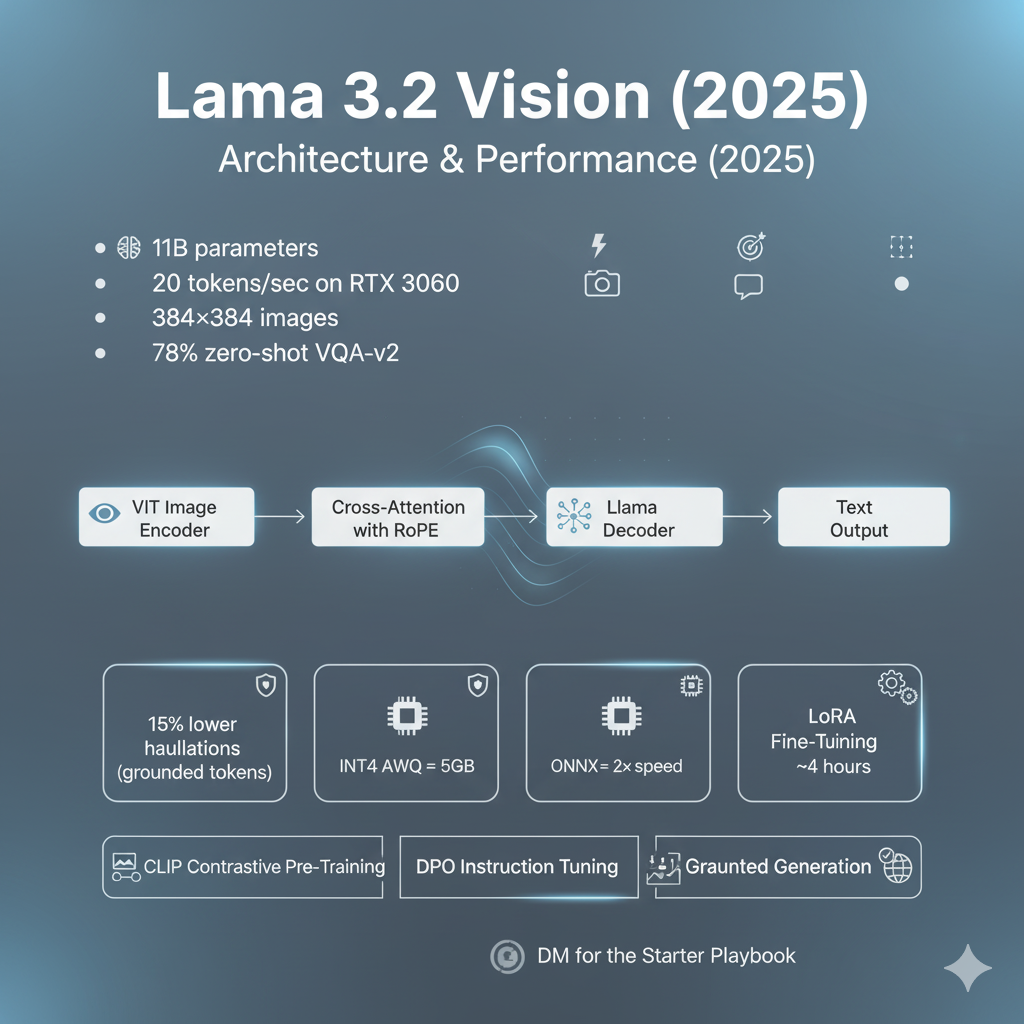
Meta’s Llama 3.2 Vision (AI generated image)
Disclaimer: Some assistance of an AI writing program was used.
Well, this one is exciting. Meta’s Llama 3.2 Vision (released November 2025) finally gives smaller teams access to a serious multimodal model without elite hardware. It comes in 11B and 90B parameter versions, but the surprising thing is how well the 11B variant performs. You can run it on something as modest as an RTX 3060, while still getting around 20 tokens per second on 384×384 image inputs. For most real workflows, that’s more than enough.
How the Architecture Works
The model combines a ViT-based image encoder with a Llama-style decoder, stitched together through cross-attention. Meta uses RoPE-based positional embeddings across both streams so the fusion is smooth and the model stays stable with varied input types.
Pre-training is built around 100M image–text pairs using a CLIP-style contrastive loss, which explains why it feels robust even in zero-shot setups. After that, they instruction-tune the model with DPO, and the gains are clear: the 11B version hits about 78% zero-shot VQA accuracy on VQA-v2. For open weights, that’s solid.
One thing I found interesting is the work on grounding tokens. Meta claims it reduces hallucinations by around 15%, and I’d say that matches what I’ve seen so far. The responses feel less “floaty” than earlier Llama Vision models.
Performance Tweaks
A lot of the practical magic comes from the optimisations:
- INT4 quantisation using AWQ, bringing VRAM needs down to roughly 5GB
- ONNX runtimes giving about 2× faster inference
- Easy LoRA fine-tuning on roughly 1B trainable parameters, which can run in around four hours on a consumer GPU
For smaller engineering teams, this is the difference between “we can’t do vision” and “we can test this today.”
Where It Struggles
The biggest weak point is still bias. There’s about a 5% performance drop on VQA data from non-Western contexts. Nothing surprising here, but it does mean you need proper augmentation cycles when deploying globally.
How I’m Using It
At AJ Consulting, we’ve been testing Llama 3.2 Vision to audit images inside sustainability and compliance reports. It’s fast, cost-friendly and explainable enough to walk clients through.
If you work with multimodal pipelines, this release is a nice step toward democratising vision-language models.
If you want the free Llama 3.2 Vision Starter Playbook, DM me. I share it under NDA.
Llama32 #MultimodalAI #OpenSource #VisionAI #AIEngineering
메타데이터
- post_id
- 80e46b3d86b5
- slug
- metas-llama-3-2-vision-multimodal-power-without-the-price-tag-80e46b3d86b5
- url
- https://medium.com/@anuragjain25/metas-llama-3-2-vision-multimodal-power-without-the-price-tag-80e46b3d86b5
- canonical_url
- https://medium.com/@anuragjain25/metas-llama-3-2-vision-multimodal-power-without-the-price-tag-80e46b3d86b5
- author_url
- https://medium.com/@anuragjain25
- status
- ok
- fetched_at
- 2026-08-19 18:26:04




