The Crack Was Already There
On Permeation, Structure, and the Moment Things Become Visible
The Crack Was Already There
On Permeation, Structure, and the Moment Things Become Visible
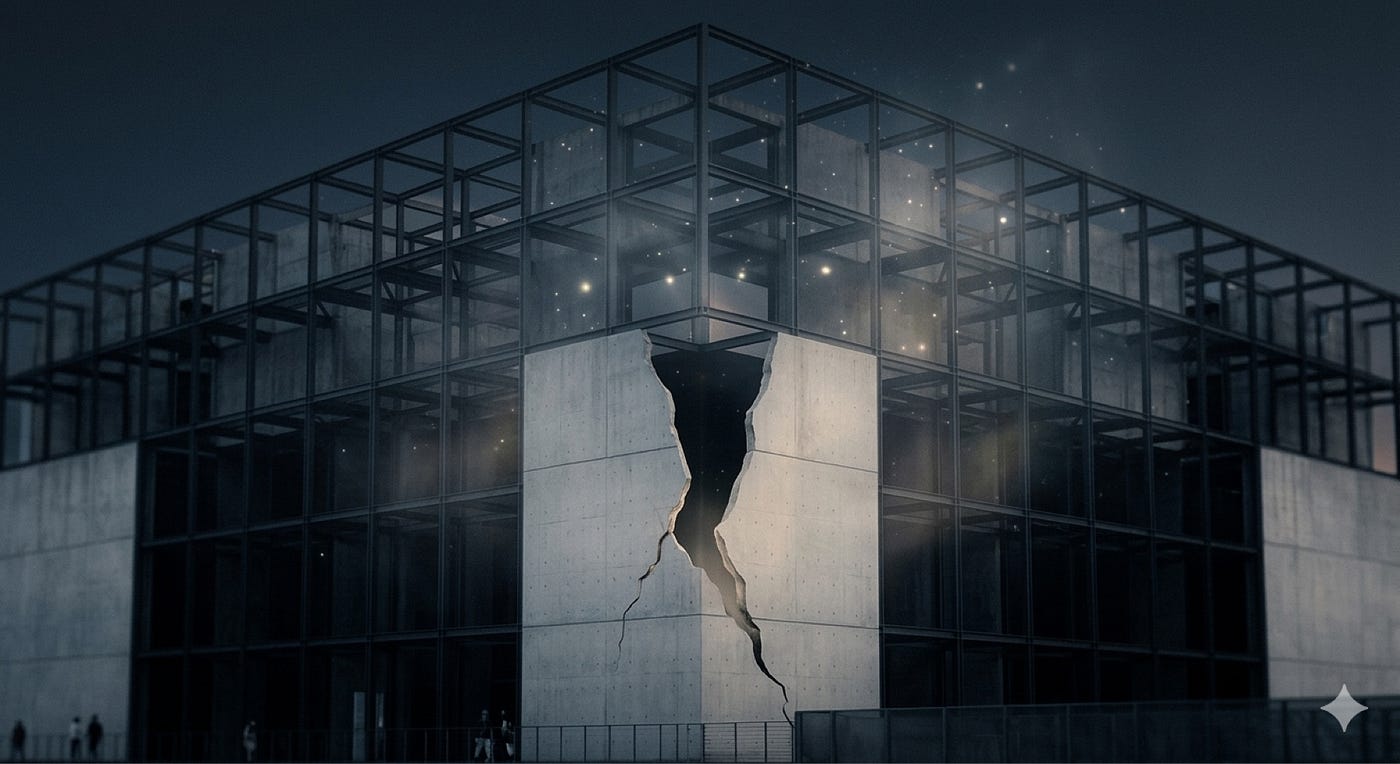
We tend to tell the story of change as if it were a drama – a revolution, a rupture, a moment when everything tilted.
But this is mostly a story we construct afterward.
What actually occurs is quieter. Slower.
Civilization does not suddenly collapse.
It permeates first.
– -
Three Fields, Not Three Forces
There is a useful way of thinking about this that borrows from the sky.
Orion is the familiar. The everyday. Human life as it is actually lived: commutes, conversations, habits, schedules, the texture of ordinary days. Orion is the majority – not the exceptional or the avant-garde, but the vast middle of how existence proceeds. Orion changes, but slowly. It resists abstraction. It is always specific. Always local. Always now.
Sirius is structure. Infrastructure, systems, the underlying architecture through which human activity flows: roads, languages, legal frameworks. And increasingly, artificial intelligence – not as a character in a story, but as a substrate.
Sirius does not replace Orion. It supports it, constrains it, enables it. The two alternate. When infrastructure changes, everyday life adjusts – not immediately, but inevitably. When everyday life demands something new, infrastructure eventually responds.
And then there is the Pleiades.
Pleiades is harder to locate because it is not an actor. Not all permeation behaves the same.
Some forms are coarse, moving quickly across the surface – visible, reactive, and short-lived. They resemble trends, bursts of attention, or sudden shifts in discourse that appear intense but do not settle.
Others are finer.
They move quietly, almost imperceptibly, entering through multiple layers at once. Over time, they alter habits of thought, expectations, and assumptions – not by force, but by becoming indistinguishable from what feels natural.
By the time these finer forms of permeation are noticed, they have already taken hold.
The crack does not mark their arrival.
It marks their visibility.
It is a field. It is permeation – the invisible movement of meaning, usage, culture, and feeling that occurs before anyone has named what is happening.
Fashion shifts. Language softens or sharpens. What felt embarrassing becomes acceptable. What felt permanent begins to feel optional.
Pleiades is not the revolution. It is the atmosphere in which the revolution becomes possible.
– -
The Entry Point Is Everywhere
What makes permeation so difficult to track is that it has no single point of entry.
It arrives through language first, often – new words, new rhythms, new ways of framing ordinary problems. Then through aesthetics: what looks modern, what looks dated. Then through expectations: what we assume a tool should do, what we assume a person should be capable of, what we assume an institution owes us.
By the time permeation reaches the level of explicit opinion – by the time people are arguing about it – it has already been underway for years.
The argument is not the beginning. It is the first moment of visibility.
This is the structural pattern: permeation moves beneath the threshold of attention until it reaches a saturation point. Then it surfaces. And because it surfaces all at once, we mistake the surfacing for the cause.
We call it a crisis. A disruption. A collapse.
But the crack was not sudden.
It was already there.
– -
A Crack
A crack is both collapse and release.
– 亀裂は、崩壊であると同時に、解放でもある。
This is the part we tend to miss when we focus on what is breaking.
Something held for a long time has been holding under pressure. The crack is the visible evidence of that pressure – but it is also the moment of release, the beginning of a new equilibrium.
Collapse and release are not opposites. They are the same event, viewed from different positions in time.
Civilizations carry enormous amounts of tension that are not legible until they resolve. The resolution looks like failure. Sometimes it is.
But often it is also the structure rearranging itself into something with more room.
– -
AI Is Infrastructure, Not Revelation
There is a temptation to cast artificial intelligence as the protagonist of this moment – the agent of change, the revolution itself. This misreads the structure.
AI belongs to Sirius.
It is infrastructure.
It does not transform meaning on its own. It transforms the conditions under which meaning is made, stored, transmitted, retrieved.
What it does to everyday life – to Orion – depends entirely on how meaning and usage shift around it. And that shift is happening, slowly and without announcement, in the Pleiades field.
The real change is not that machines can now generate text, images, code, and analysis.
The real change is subtler: how people relate to their own thinking, how institutions recalibrate expertise, how the threshold for what counts as skilled labor quietly moves.
These are cultural questions. They are questions of meaning.
And they are already being answered – not in policy documents or industry announcements, but in small adjustments to daily practice, in the shifting sense of what feels necessary, in what we now reach for without thinking.
That is permeation.
– -
The Threshold
At a certain point, the invisible becomes visible.
Permeation reaches a level of saturation that the existing structure cannot absorb without reorganizing. This is the threshold moment – and it is the moment that history tends to remember as the event, even though the event was only the appearance of what had already occurred.
Orion and Sirius do not replace each other. They alternate.
Infrastructure shifts; daily life adjusts. Daily life demands; infrastructure responds.
But the rhythm of this alternation can be disrupted when the Pleiades field – the field of meaning, culture, invisible change – moves faster than either Orion or Sirius can integrate.
That disruption is what we are in now.
Not a crisis of technology.
A crisis of integration – the work of making meaning out of a structure that has already changed.
The crack appears at the point of maximum tension between what the structure is becoming and what the culture still expects it to be.
– -
Recognition, Not Resolution
This is not an argument for optimism or pessimism. Both framings over-dramatize what is actually a structural process.
Change of this kind does not require our emotional verdict. It only requires our attention.
The work – if there is work – is to watch the Pleiades field carefully: where meaning is shifting, where usage is quietly reorganizing, where old assumptions are still being maintained by habit rather than necessity.
To observe where the tension is highest between everyday life and its underlying structure.
Not to predict.
Not to warn.
Simply to recognize what is already underway.
The transformation feels gradual. Then it appears suddenly.
The structure was changing the whole time.
We were just waiting for a crack wide enough to see through.
Nothing breaks suddenly.
It only becomes visible.
– -
Lena Tatsumori is an independent writer based in Japan exploring AI, esoteric philosophy, and long-cycle patterns of civilization.
메타데이터
- post_id
- 810b3b8b8e4e
- slug
- the-crack-was-already-there-810b3b8b8e4e
- url
- https://medium.com/@lenatatsumori/the-crack-was-already-there-810b3b8b8e4e
- canonical_url
- https://medium.com/@lenatatsumori/the-crack-was-already-there-810b3b8b8e4e
- author_url
- https://medium.com/@lenatatsumori
- status
- ok
- fetched_at
- 2026-08-08 22:49:35