Death By Government: 1776 or Bust
Test Your Foundational Full Democracy Reading Skills
Death By Government: 1776 or Bust
Test Your Foundational Full Democracy Reading Skills
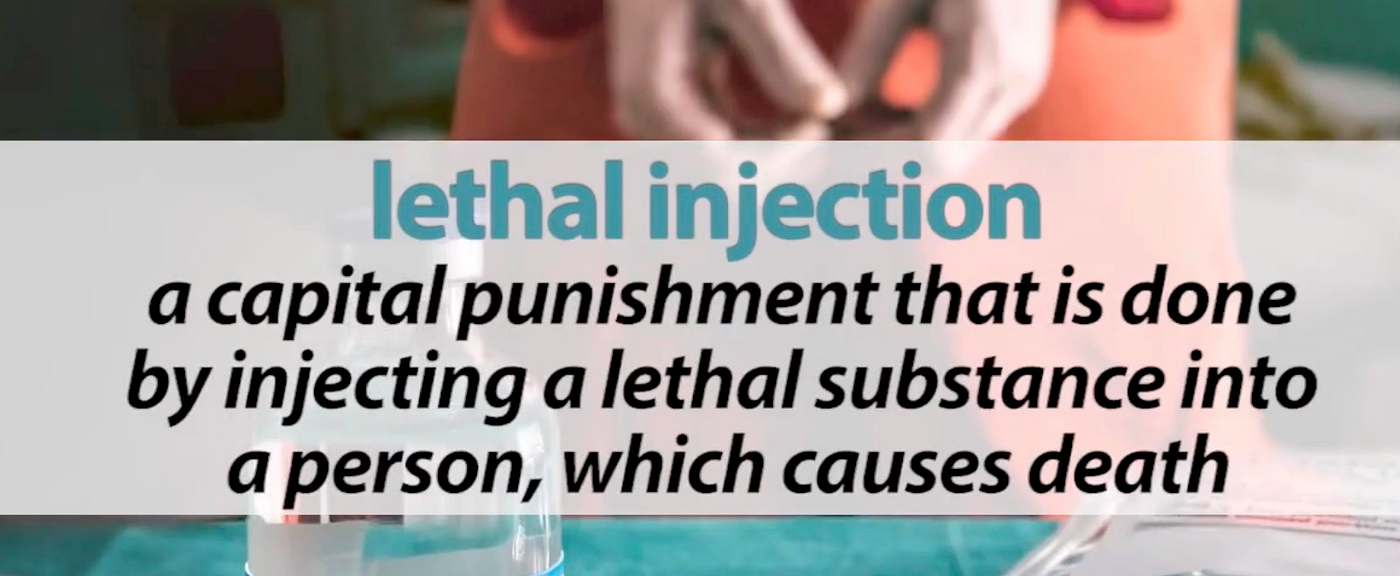
The Government's power to Aleinate “Life” is much more reasonable when done by Lethal Injection by Government
I. Pass or Fail American Democracy
If you, like me, failed to teach you anything basic about America. 250 years later, after the declaration was signed, reading a couple of sentences is still not standard. Failure to understand a few simple sentences is actually shocking but not really surprising when you think about it.
The principle I’m talking about, if you’re not aware of it, is called “certain unalienable rights,” and it says everybody is endowed with them by their creator. Such rights include “Life,…” I’m gonna stop at “Life” for a second.
A certain unalienable right is “Life.” That’s it, that’s the key sentence you need to see, which is one of the “certain” rights. There are others. Here, we just consider this obvious one. You, as a citizen of America under the Declaration of Independence, have a right to “Life.”
So, what does that mean?
II. The Guardrails in a Full Democracy
A “certain unalienable rights” is a right that the government cannot take away from you under any condition.
Why do we have the death penalty? Doesn’t the government take away your right to “Life” under the death penalty? Does that contradict the first two sentences of the Declaration of Independence?
Yes, it 100% does. That’s the answer. It took me decades to get there. It’s that simple to answer, too. Don’t worry, I know you’re not there either. But neither is the Supreme Court. However, unlike the divided court, where 6 of them don’t want to get there, you might. You might already think the death penalty is wrong. However, even if you do, you still haven’t connected it directly to the ultimate and opening foundational principle of a full democracy, that of the first two sentences of the Declaration of Independence.
Chances are, you don’t believe that is the intended meaning either. It is the inherent meaning, though, even if not fully intended. That is what I struck on as the true discovery. I get it. I’ve been thinking about the guardrails on our country and how this expression is it. But because half the political elites, or slightly more, are conservative white men who believe in the power of autocracy to create and preserve their wealth, they have prevented us not only from understanding and implementing it but also from believing it.
So why is it that a foundational document setting up America with guardrails against government overreach and autocratic abuse, in this case by taking away your “Life” as your individual, one of your certain unalienable rights, is not understood, even though it is so simple to grasp, unlike other ones? How did we end up with a death penalty in some states? Why are we, as the first country founded on this “complete” principle of a full democracy by elected officials in 1776, still debating it in America, while the vast majority of other countries have moved on and surpassed us?
III. Rational versus Reasonable
Everyone is reasonable, but not everyone is rational. As I’m using it here, rational means the ability to understand and apply a clear mechanism of the mind to a situation under analysis to arrive at a clearly logical conclusion. You may not agree with how I construct the mechanisms of reason, but I am describing their clarity. In this case, I stole the mechanism from Declaration and clarified it thus:
“The government cannot alienate the right to Life from a citizen.”
Is that clear to you? Like law and principle, I’ve created a mechanism for action to occur under or to prevent it from occurring.
Here’s the official definition of rational, just so you know I’m refining it for my discussion.
“based on or in accordance with reason or logic: I’m sure there’s a perfectly rational explanation.”
Also, under that:
“(of a person) able to think clearly, sensibly, and logically: Andrea’s upset — she’s not being very rational.
-endowed with the capacity to reason: man is a rational being.”
I highlight the definition of rational to make a critical distinction from the concept of “reason.” Reasonable is to act “sensibly” with others. Thus, I can reason with Andrea, who is not acting rationally, to calm her down.
In the second example, “man is a reasonable being” means that a group can use reason to reach a decision that seems fair to all or most people, and some members of the group may have to make compromises or concessions. “Man is a rational being” means that an individual may arrive at a clear idea, but that idea is not implemented in reality or rejected by the group because no concession is allowable that others, even the majority, reasonably want. That is the case with this particular unalienable right.
Here’s the main difference I see in my definition: people are conditioned to be reasonable, which is a necessary skill for getting along, navigating social relationships, compromising, and submitting to centralized authority. Rationality, or being rational, is not based on conditional reasoning but on a principle that can be expressed formally and used to judge a given situation at all times, such as death as punishment for a crime. It’s not based on social conditioning over time or on agreement with a group.
IV. The Current Case
Here’s the latest case we can take based on the social formula derived from the first few sentences I summarized above:
“Supreme Court Clears Way For Execution Of Texas Man
“By Brandon Lowrey [from Law360]
“The U.S. Supreme Court on Thursday lifted the Fifth Circuit’s stay of execution for a man who sought to challenge the constitutionality of his death sentence on grounds that he was intellectually disabled, granting an emergency petition filed by Texas, which went on to execute the man later Thursday.”
I don’t think you may need the latest case if you are firmly against the death penalty, but people often are. Because we don’t need any cases. Killing somebody by the government is against their unalienable right. A death sentence or capital punishment means that the government is killing people. Yep, that’s what it means.
There’s no need to talk about the constitutionality of this situation. It’s against the foundational principle of America. Without their foundational principle, you don’t have any constitution, and you don’t have a basis for constitutional rights and equality.
Therefore, the principle I expressed in the Declaration is this: Either the government is prevented from enacting laws that alienate certain rights, such as those you have by nature or inherent right, or it isn’t. There’s no middle ground.
That’s the meaning of it. The meaning of a permission structure: The government in a state is permitted or not permitted to make a law that abridges or alienates a certain natural right, like “Life,” of any citizen under certain conditions set out in the law in that state, which in this example is Texas. Texas has made laws and taken action to alienate a person’s right to “Life.” Rationally, that is clear.
V. The Hard Truth About Binary Principles — Democratic Monarchy
Why is it so difficult to understand something so simple and black-and-white then?
That’s because people in certain states have never followed that law, and the general population is conditioned to be reasonable. White people in the South, led by their state governments, have never followed that principle. It just remained on the page for them, and they had no desire to do so.
They lied from the beginning in the southern states and didn’t even bother to take any steps to turn this foundational principle into state law. They ignored it 100%. They didn’t want to fold democracy into this law, and they don’t have one based on it. Once established, the Supreme Court followed that reasoning rather than rationality. It may have seemed “reasonable” at the time to lynch a person as a punishment for a crime, which did happen after 1776 in northern states, but it wasn’t rational.
Laws, if they are to conform to the foundational and radical principle of “certain unalienable rights” that each citizen naturally possesses at birth, and to “obey” the social contract that democratically elected representatives signed in the Congress they decided to form, must be rewritten to conform to that permission structure that disallows capital punishment and any government law or action that alienates the “Life” of any citizen, ever.
“Certain unalienable rights” is a significant improvement over the underlying principle of the Magna Carta, which was itself radical at the time. One main principle underlying various aspects was that the people could have a voice in government, recognized through the exchange of paying taxes. The monarch could not simply demand more taxes without the people’s say in government. That led to a democratic system of voting that formed Parliament in 1265, and that franchise expanded under this British Monarch for the next 550 years up until the American Revolution.
The system was a “democratic monarchy,” but it was not fully democratic, as rights such as voting were not extended to every single “subject,” or citizen, in an absolute sense. Certain unalienable rights, logically and rationally, expanded that system of voting to be, in principle, absolute.
But not in practice. Instead, the lords and dukes, who first voted in 1265, expanded the franchise in coordination with the Monarch, from classes of people who were pushing back against the government. The barons and aristocrats, once conditioned to using their voice in government, were accustomed to exercising political power and didn’t want to yield it to the people they ruled, such as workers. This conditioning made them reluctant to expand the franchise.
Southern whites in control of states like South Carolina certainly did not want to expand the franchise to negroes, women, or poor whites. That’s how we find it in 1790, with only 1–3% of the state’s population able to vote. Even after accepting pushback from “the people,” the legislatures still did not expand the franchise to poor whites by 1860, leaving about 80% of the population disenfranchised, so no real “full democracy” was achieved. Only a partial democracy, or a “degraded autocracy,” was achieved.
And, needless to say, the state used capital punishment constantly, as a right of the slaveholders, not just for criminals. It never recognized anything close to the right to enact a law based on the legislature’s inability to impose capital punishment as a crime. Ever.
VI. Absolutist Democracy Does Not Compromise
So why are you forced to call this American system a democracy when it’s so easy to prove it isn’t?
We want to be reasonable. We are so accustomed to accepting these states that use capital punishment and still call them a democracy, even though they’ve never practiced it and refuse to. But we still call them a democracy.
In 1860, Senator Charles Sumner, an Abolitionist and “Radical” Republican from Massachusetts, spoke to the Young Republicans club in New York City and called the Southern Democrats Pro-Slavers, people for Slavery, and reviled and ripped them to shreds, showing not only the type of feigned and staged political opposition we see today but also genuine hatred for those white male slave owners and their political allies. He detested them for betraying equality and justice for all.
In other words, he was unreasonable. But he was highly rational. He adhered to liberty and justice for all as a principle and detested those slave-holders and their political allies for not being rational and for being anti-equality. He showed that he could not reason with them, and indeed, he should not.
The point is that he knew the principle that “certain unalienable rights” are endowed by nature to everyone was paramount and foundational. Autocracy is the opposite. That principle allows the government to enact laws that alienate the right to “Life.” It thus allows for capital murder or the death penalty, where the government alienates the right to “Life” through killing that person.
Texas is not a democracy. That is the rational conclusion. But it is not the reasonable one, and no one will want to agree with you if you say, logically, that it is a representative autocracy. The vast majority of Americans will hesitate and not feel comfortable calling Texas an autocracy, even though it directly defies the most basic unalienable rights. Most people are not rational. Their will is bent to the long arc of autocratic reasoning in that state, because many can vote, making them less opposed to autocracy, not more. By participating and giving their vote, they don’t want to admit they are participating in a system that champions the government killing people and alienating the right to “Life.”
“Saudi Arabia cuts off heads for the death penalty, but we fry them and poison them with chemicals, so we are not cruel and autocratic.” The method does not change the autocratic power the people give the government to kill citizens on arbitrary grounds that alienate “Life.” The cruelty isn’t in the sword at the neck but in the power to kill. Voting for leaders in Texas makes people’s minds more receptive to the Texas Governor’s method, as voters use reason to vote. The Texas system of representative autocracy seems more reasonable than one where people can’t vote for their leader, as in Saudi Arabia, where autocracy seems less reasonable. It’s not the method; it’s voter participation in the system that makes it more acceptable and reasonable in Texas.
Driven by a national desire to include Texas in a reunited America after the Civil War, politicians in the 20th century merely capitulated to calling that state a democracy because citizens voted. Whites accepted that change of title from pro-slavery autocracy to democracy not because of any change in the practice of using the death penalty, but merely through repetition of the word and the state’s continued existence in the Union. It was clear the state wasn’t going to change, ever. Better to accept it than continually reject their resistance to democracy and the foundational principle.
VII. American Autocratic Voting Had Deep Roots
The people also forgot through the 20th century that before the American Revolution, British America was already an electoral autocracy, that is, it had representative voting with a franchise since the first votes were cast in 1607 in Jamestown. The truth, or the logical conclusion, is that an electoral representative autocracy is better than the phrase “partial democracy.”
Democracy is inherently and foundationally against the government inflicting the death penalty as punishment for a crime. This absolutist guardrail is hard to admit, people and governments leaders especially like choice. It is harder to change practices heads of governments are unwilling to change.
The continued repetition of the death penalty has never made it right and is still inherently in conflict with the full democracy proposed by the Declaration. We want to naturally get along with each other, which is reasonable, but reasoning is not acceptable under the rationality of this democratic principle that prevents the death penalty. Liberals don’t want to tell the truth, that conservatives have totally compromised the Declaration and don’t obey the foundational principle. They aren’t rational, but reasonable, and want to go along to get along. Getting along is more important than the truth or taking a stand against a bullying party. Therefore, the truth has become the overall reality that we don’t care about alienating certain rights.
We are focused only on the process of voting now, in calling America a democracy, because it has been practiced for so long. Voting for 160 years or so before 1776 and continuing after it shows that voting does not mean democracy. You, like me for decades, have simply not been trained to comprehend the fullness of the foundational principle. Northern liberal politicians in the Republican Party knew what that principle meant ten years before and ten years after the Civil War. They are gone now, wiped out. The twentieth century wiped them out, and we now suffer from historical amnesia by design.
VIII. The Slippery Slope in Only in Representative Autocracy
The Supreme Court’s decision is irrelevant to me. More than half the court does not care about the foundational principle and never has. To you, that might sound harsh, disrespectful, or highly unreasonable. Too bad. I respect the foundational principle when it comes to the death penalty, which, in the first two sentences, tells us that the government will stop being an autocracy, or even an electoral autocracy, and stop alienating the right to “Life” from all citizens.
Many male conservative Southerners will never comply. They are not on the side of democracy but of a controlled electoral autocracy. What are we going to do about it?
Nothing. They’re completely on the opposite side, unwilling to budge an inch. Liberals, or at least those who believe the Democratic Party is liberal, are rendered irrelevant because they are always willing to compromise with white conservatives on a principle they don’t share, don’t recognize, and won’t implement. They have not done so for 250 years.
Yet we’re stupid. We remain reasonable enough to call Texas a “democracy” because we have to bow to their wishes to avoid offending conservative white men, who exist in both parties. We are using reason, and in this case, it is autocratic reasoning, which is flexible.
If you’re black and truly liberal, as most are, like Martin King, Malcolm X, Fredrick Douglass, Ida B. Wells, and hundreds of thousands, or millions, of others, you should no longer be reasonable but rational. White conservatives justify the death penalty as a form of governance to kill “negroes,” though they will gladly kill poor whites and Latinos.
Autocratic reasoning is flexible. Democratic reasoning, grounded in the foundational principle, is not. It is rational. Reason does not allow compromise and eliminates the slippery slope when it comes to the death penalty and other unalienable rights. It prevents laws from being enacted that would allow the government to kill people for a crime, and it stops this perversion of government from abusing the power of life over death. Killing, alienating “Life,” is a crime. But it is not a crime that the government should commit. When a citizen commits this crime, they are punished for violating the rule that protects certain unalienable rights, such as Life.
But when the government does it, they too violate it, and that violation is what separates an autocracy, or a flexible representative autocracy, from a full democracy that prevents all branches of government from considering or imposing the death penalty under any circumstances.
No slippery slope allowed. That’s only for reasonable people in an electoral autocracy, which is, I suppose, still a step away from a complete autocracy. At least people still push back, even though it’s less effective now, since we don’t see any change in Texas and all the white conservatives behind it, whatever state or party they are in.
메타데이터
- post_id
- 810f2de389d8
- slug
- death-by-government-1776-or-bust-810f2de389d8
- url
- https://medium.com/@brenkelly1970/death-by-government-1776-or-bust-810f2de389d8
- canonical_url
- https://medium.com/@brenkelly1970/death-by-government-1776-or-bust-810f2de389d8
- author_url
- https://medium.com/@brenkelly1970
- status
- ok
- fetched_at
- 2026-06-09 15:37:30