What is Higgs? and… what is Mass??
A Mechanical Post-Mortem of the Vacuum: From Elastic Pre-Stress to Volumetric Impedance.
What is Higgs? and… what is Mass??
A Mechanical Post-Mortem of the Vacuum: From Elastic Pre-Stress to Volumetric Impedance.
This article is a continuation of “**What is Mass? and… what is Higgs**”
For over half a century, physics popularizers have relied on a comfortable, highly misleading metaphor to explain how fundamental particles acquire mass: the “molasses pool”. We are told that the Higgs field is an invisible, syrupy ocean filling the void, and as particles wade through it, they experience a form of drag. The more they interact with the syrup, the heavier they become.
It is a charming visual. It is also completely wrong.
Drag is a dissipative force that drains kinetic energy, eventually bringing moving objects to a halt. If mass were caused by mechanical drag against a background syrup, every electron in the universe would radiate its energy away and spiral into immobility within fractions of a second.
To understand why things weigh what they weigh — and why the universe doesn’t instantly collapse — we must bury the molasses pool. We need to strip away the abstract quantum jargon of “scalar fields floating in empty space” and analyze the vacuum for what it truly is: a pre-stressed elastic solid operating at ultra-high frequencies.
To answer What is Higgs? is to define the background state of space itself. To answer …and What is Mass? is to calculate the mechanical toll required to deform it.
1. The Unreachable Foundation: The Planck Scale Lattice (40⁴³ Hz)
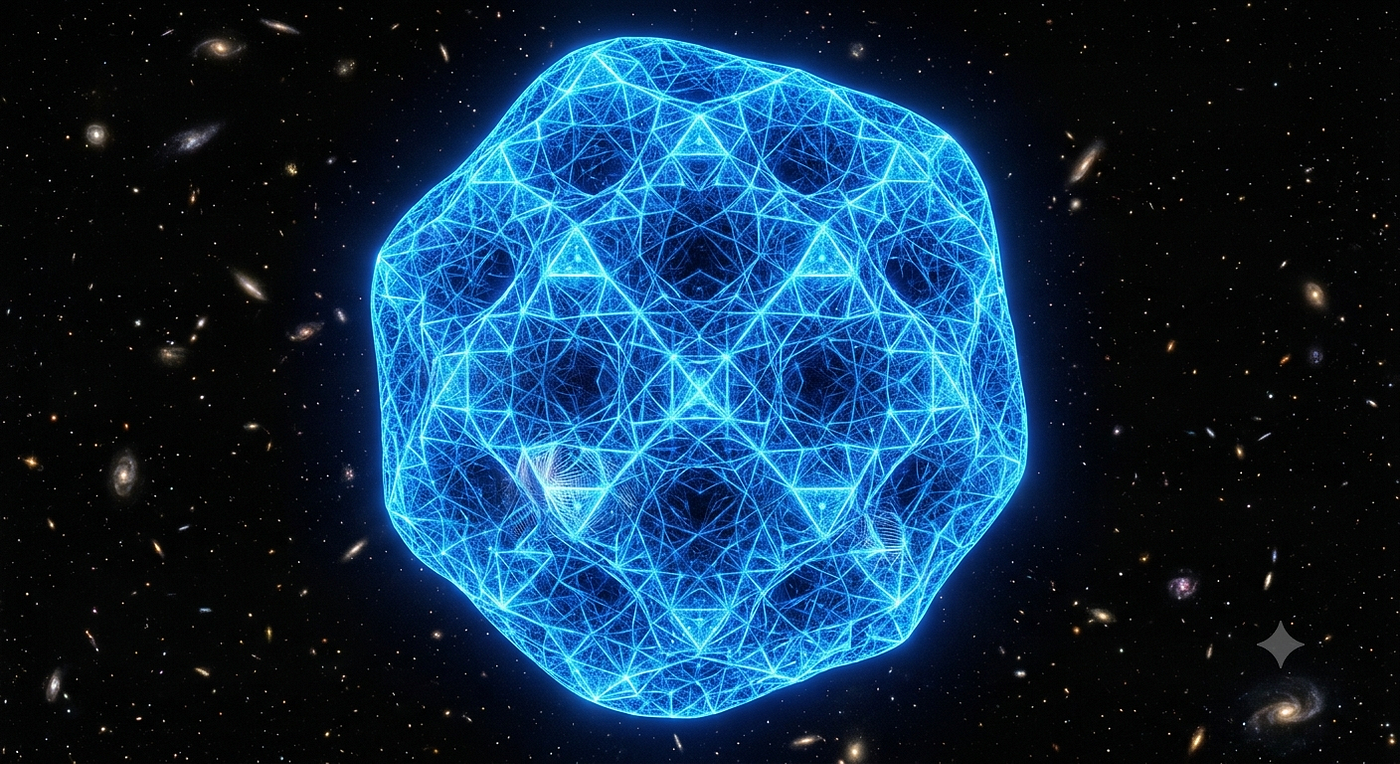
Before we can analyze the Higgs, we must establish the physical substrate it inhabits. As detailed in our structural analysis of the spatial cell, space is not a passive, continuous vacuum. It is a face-centered, 4-neighbor elastic crystalline solid: the Mesh.
At the absolute microscopic limit, the fundamental building block of this substrate — the tetrahedron — is a closed 3D standing wave oscillating at the Planck frequency:
ν₀ = ν_P = E_P / h ≈ 1.85 × 10⁴³ Hz
This hyper-vibrational state (~10⁴³ Hz) is the ultra-rigid, inaccessible baseline of reality. It sets the granular scale of the 3-sphere (S³) without interacting directly with sub-atomic particles. A single isolated cell vibrating in free space has no “mass” in the particle sense — it is simply the structural matrix of space itself.
Where, then, does mass enter the equation? It enters when the entire 3-sphere crystal is subjected to background mechanical tension.
2. What is Higgs? Part I: The VEV as Cosmic Pre-Stress (246 GeV)
In the Standard Model of particle physics, the Higgs field is defined as a scalar field with a non-zero Vacuum Expectation Value (VEV ≈ 246 GeV). In traditional textbooks, this scalar value is treated as an abstract number assigned to every point in space.
In the continuum mechanics of the Mesh, a scalar value assigned to a spatial cell has a direct physical meaning: it is its state of volumetric compression, dilatation, or pre-confinement strain.
The Higgs VEV (v ≈ 246 GeV) is not an external entity floating in the void. It is the static pre-stress state of the Mesh itself.

Think of a steel wire on a guitar or a pre-stressed concrete beam:
- An unstressed medium (soft/squishy): If a string has no tension, it cannot sustain stable standing waves, offers zero mechanical resistance to deformation, and possesses no characteristic impedance.
- A pre-stressed medium (the VEV): During the expansion/exhalations of our 3-sphere universe, the Mesh is locked into a static background tension of 246 GeV.
The Higgs field is simply the measure of this background elasticity. The vacuum is not empty; it is pre-loaded with 246 GeV of elastic rigidity before a single particle is ever placed inside it.
3. And… What is Mass? Part II: Volumetric Breathing Against Zmesh
Once we realize that the space substrate is pre-tensioned to 246 GeV, the nature of matter and mass becomes transparent.
Particles are not solid marbles, nor are they point-like singularities. As established in our topological framework, leptons are localized standing waves hosted inside geometric cavities (knots) within the Mesh.
For a standing wave to exist as a stable particle (such as an electron, e⁻), it must continuously pulsate within its host cell. It forces the tetrahedral cavity to expand and contract — it forces the cell to “breathe.”


The Origin of Characteristic Impedance (Zmesh)
A cell cannot expand or contract in isolation. Because every cell is face-coupled to four neighbors, any attempt to alter its local volume forces it to push against adjacent cells. But those neighboring cells are not soft — they are pre-tensioned by the Higgs VEV (246 GeV).
The resistance that a pre-tensioned elastic medium opposes to dynamic volumetric deformation is its characteristic impedance (Zmesh):
Zₘₑₛₕ ∝ √(Pre-Stress (VEV) · Cell Density)
Mass as an Elastic Toll
Mass (m) is not an intrinsic “stuff” stuffed inside a particle. Mass is the work required to force a cell to breathe against the elastic impedance Zmesh of the pre-stressed vacuum:
m = ∫ Zₘₑₛₕ(v) · (dV/dt)² dt
- Untethered Photons (Zero Mass): A photon is a pure torsional shear wave propagating through the Voronoi dual network. Because shear waves twist the cell corners without changing the volumetric size of the primary tetrahedra, they do not push against the background pre-stress 246 GeV. They experience Zₘₑₛₕ = 0 for shear modes → Zero Mass.
- Trapped Electrons (Non-Zero Mass): An electron is a localized standing wave hosted inside a single, minimal tetrahedral cavity (n=1). Its existence is a pure, isotropic volumetric pulsation — forcing its four face-coupled neighbors to continuously compress and expand.Because this “breathing” must overcome the pre-stressed impedance Zₘₑₛₕ(v) of the adjacent cells, the wave pays a continuous mechanical energy toll → Rest Mass (mₑ = 0.511 MeV).
Note: Higher-generation leptons like the Muon and Tau are hosted in multi-cell knot clusters. Their masses arise from a complex interplay of volumetric breathing AND internal inter-cell torsional shear across the cluster framework.
Mass is simply the elastic energy toll paid to overcome Zₘₑₛₕ to keep the spatial cavity breathing.
4. What is Higgs? Part III: The Boson as a Lattice Shock (125 GeV)
If the VEV (246 GeV) is the static background tension of the spatial crystal, what is the famous Higgs Boson (mₕ ≈ 125.1 GeV) discovered at CERN in 2012?
The Higgs boson is not the “particle that gives mass.” The boson does not float around handing out inertia to electrons.
The Higgs Boson is the acoustic shock response — the volumetric “crack” or compression pulse — of the pre-stressed Mesh when struck with extreme energy.
When particle accelerators smash protons together at multi-TeV energies, they inject a violent, localized shock into the spatial lattice. The pre-stressed Mesh (246 GeV) responds by ringing at its lowest collective volumetric compression harmonic: 125.1 GeV.
The frequency of this global elastic shock is:
νₕ = mₕ c² / h ≈ 3.02 × 1⁰²⁵ Hz
The Higgs Boson (~10²⁵ Hz) is a macroscopic, coherent sub-harmonic elastic response of the fundamental Planck-scale cell frequency (ν₀ ∼ 10⁴³ Hz). It is the acoustic signature of the spatial lattice ringing under an explosive load.
5. The Cosmic Bell: The Finitely Fractal Mesh and the Global “Hum”
To fully grasp how local particles interact with the global Higgs background, we must understand the topology of the substrate: the universe is a closed, finitely fractal resonator shaped as a 3-sphere (S³).
Because the Mesh is finite and face-coupled, it behaves like an enormous, ultra-rigid acoustic bell. It does not merely possess a single ultra-high frequency at the Planck scale (ν₀ ∼ 1⁰⁴³ Hz); through its internal fractal self-similarity, it supports a cascade of coupled harmonic modes — harmonics within harmonics, scales within scales.

- The Fundamental Tone (The Higgs Hum): The background pre-stress (246 GeV) sets a global, omnipresent harmonic “hum” across the entire S³ lattice at approximately νₕ ∼ 10²⁵ Hz. This is the characteristic background vibration of space itself — the resonant frequency of the pre-stressed bell.
- The Acoustic Shock (The Boson): When CERN smashes protons, it strikes this cosmic bell. The 125 GeV Higgs Boson is simply the localized, transient “ringing” or compression shock wave propagating through this 10²⁵ Hz global hum.
- Local Particles as Resonant Nodes: An electron (νₑ ∼ 10²⁰ Hz) does not breathe in a silent environment. It is a sub-harmonic standing wave locked into the fractal cascade of the Mesh. It breathes against the background hum of the bell.
Without the finitely fractal structure of the Mesh, there would be no mechanical bridge between the inaccessible 1⁰⁴³ Hz Planck frequency and the 1⁰²⁰ Hz scale of everyday matter. The global Higgs “hum” is the acoustic bridge that unites the microscopic cell with the macroscopic universe.
6. The Cosmic Phase: What Happens if the Higgs Changes?
This mechanical model allows us to perform thought experiments that are mathematically rigorous and physically intuitive:
Case A: Early Universe / High-Stress Era (Near the Great Knot)
In the early stages of cosmic expansion, the 3-sphere was hyper-compressed, resulting in a much higher VEV (v ≫ 246 GeV).
- The spatial crystal was vastly stiffer → Zₘₑₛₕ skyrocketed.
- A breathing standing wave had to perform immense work to deform the hyper-tensioned cell
- Result: Particle masses were proportionally higher, preventing early matter from easily dispersing.
Case B: Vacuum Relaxation (v → 0)
If the cosmic VEV were to decay to zero:
- The pre-stress of the spatial crystal vanishes → The Mesh becomes mechanically “slack.”
- Without background tension, Zₘₑₛₕ → 0 for volumetric deformations.
- Result: Trapped standing waves no longer experience resistance. Cavities collapse, particles lose their rest mass instantly, and all matter dissolves into free-traveling radiation moving at c.
7. The Unified Mechanics of the Mesh
By replacing abstract quantum field formalisms with continuum elastic mechanics, we can synthesize the hierarchy of reality into a single, elegant structure:

Conclusion: The Vacuum is an Instrument, Mass is its Resonant Toll
Physics did not need a magical molasses ocean to explain inertia. It only needed to understand the continuum mechanics of a pre-stressed solid.
The Higgs is not an additive force or a fluid; it is the fundamental tuning of the cosmic instrument — the static pre-stress (246 GeV) that gives space its structural integrity. Mass is not a mysterious internal property of matter; it is the mechanical impedance (Zₘₑₛₕ) that a localized standing wave must overcome every time it forces the pre-stressed universe to breathe.
Space is not an empty stage populated by point particles. Space is a living, pre-tensioned resonator — and mass is simply the price of making its cells vibrate.
📚 For the Full Theory
This article is a simple introduction. For the full mathematical framework, including the discrete tetrahedral Mesh, the Jussà-Vila Ansatz, and the Scale Bridge Hypothesis, see:
- Full mathematical derivation of lepton masses: “THE BREATHING UNIVERSE: A Torsional Solid Machine” DOI: 10.5281/zenodo.18394459
- Article “The Cosmic Mesh: the Fundamental Substrate of Reality” at MEDIUM
- Geometric derivation of the fine-structure constant: “Mechanical derivation of the fine-structure constant” DOI: 10.5281/zenodo.19063834
- Quantum Mechanics without collapse, without probability, without mystery: “Quantum Mechanics: The Interpretation of Barcelona” DOI: 10.5281/zenodo.19231246
- Article “What is Mass? and… what is Higgs” at MEDIUM
Sci-Fi book: “El Universo Herido”
About the author: Alex Bertran is an independent researcher at the Institut d’Astrofísica de Badalona (IABDN). His work replaces dark matter, dark energy, and quantum mysteries with a single mechanical substrate: the Mesh.
alex.bertran@iabdn.cat
메타데이터
- post_id
- 8114bc02fd0e
- slug
- what-is-higgs-and-what-is-mass-8114bc02fd0e
- url
- https://medium.com/@abertranp_39945/what-is-higgs-and-what-is-mass-8114bc02fd0e
- canonical_url
- https://medium.com/@abertranp_39945/what-is-higgs-and-what-is-mass-8114bc02fd0e
- author_url
- https://medium.com/@abertranp_39945
- status
- ok
- fetched_at
- 2026-08-09 05:37:53