Once a technology has been developed, a question arises that did not exist before
In engineering, it is generally accepted that the most challenging part of the work is creating a new technology. However, once it has been…
Once a technology has been developed, a question arises that did not exist before
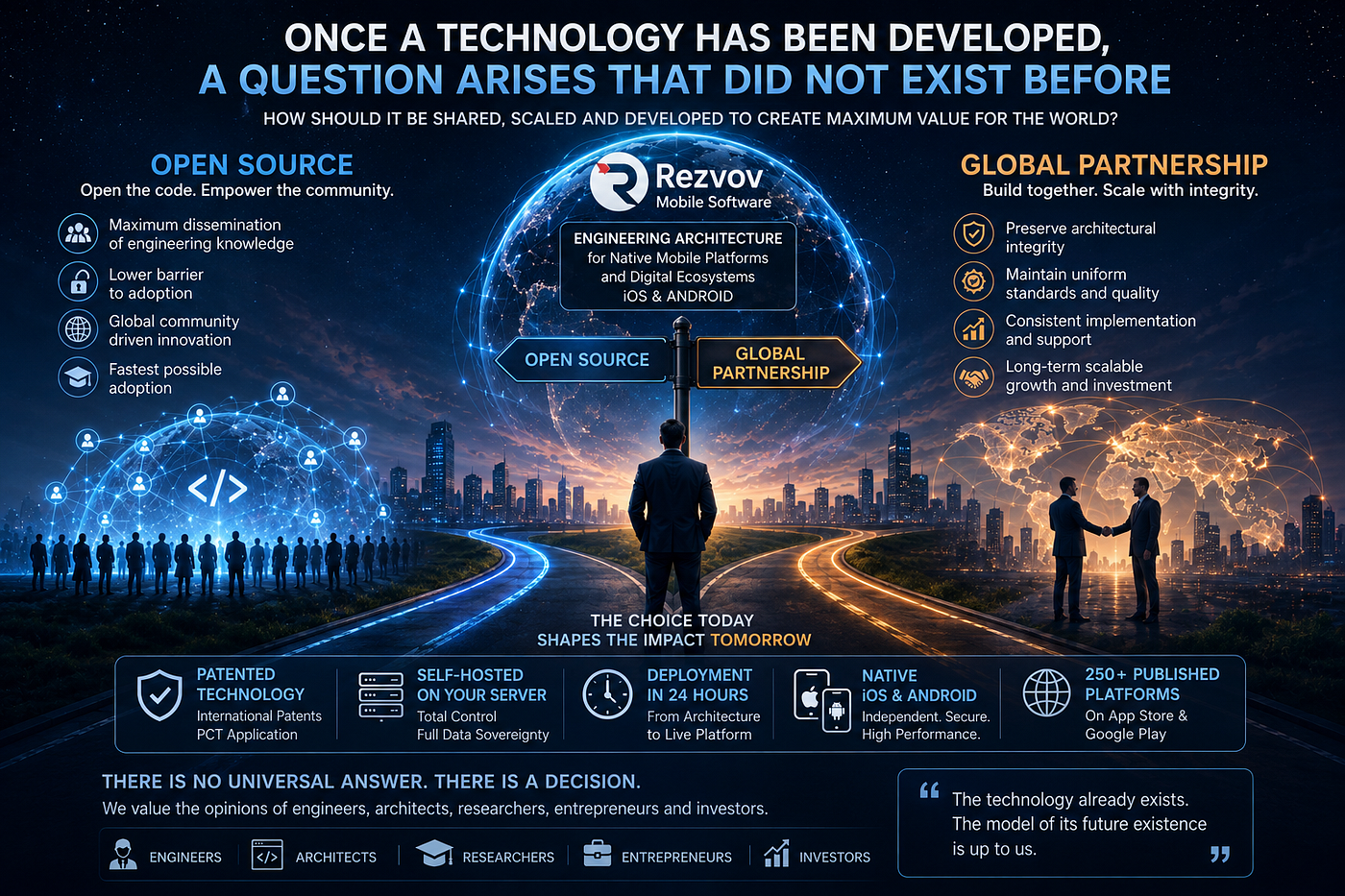
In engineering, it is generally accepted that the most challenging part of the work is creating a new technology. However, once it has been developed, a question may arise that can no longer be resolved using purely engineering methods.
Following several years of development, the Rezvov Mobile Software engineering architecture has emerged. It enables the deployment of independent, native, ready-to-use mobile platforms and digital ecosystems for Android and iOS directly on the customer’s server infrastructure within 24 hours.
Its key distinction lies in the fact that, for the first time, the technology allows the engineering framework itself to be transferred, scaled and deployed an unlimited number of times without having to redevelop it from scratch.
The architecture is protected by international patents, an international PCT application is pending, and its practical feasibility has been confirmed by more than 250 native mobile applications, social networks and social business platforms published on the App Store and Google Play. Some examples of realized projects: https://highs.tech/en/product/projects-all
Once the work was complete, it became clear that it was not just the engineering solution that had changed. Until then, the outputs of engineering work had been distributed: finished applications, source code or the expertise of the teams. Now, however, there was a practical opportunity to transfer not the end result of development, but the very engineering architecture for creating independent mobile platforms.
It was at this very moment that a question arose which had previously had no practical significance. How should such a technology exist once it has been created?
Should we make the entire source code open and entrust its further development to the global engineering community (Open Source)?
Should we build a global network of independent partners to ensure the implementation, support and development of the technology?
Or is there another approach that is better suited to technologies of this calibre?
Each approach has its own advantages. Open Source is capable of maximising the dissemination of engineering knowledge and lowering the barriers to adoption. The partnership model allows for the preservation of architectural integrity, the maintenance of uniform standards, and the consistent development of the technology. Perhaps there is another model that has yet to be formulated.
But for me, it is not the ready-made answer that is most interesting. The most unexpected outcome of this work was the emergence of the question itself. Before the advent of Rezvov Mobile Software technology, such a discussion had no practical significance. As long as each mobile platform was created as a separate engineering project, only the results of development were disseminated. When the possibility arose to replicate, transfer and scale the engineering architecture itself multiple times, the subject of discussion changed.
That is precisely why I genuinely value the opinions of engineers, software architects, researchers, entrepreneurs and investors.
If technology now, for the first time, allows the engineering architecture itself to be transferred, scaled and deployed an unlimited number of times, what should the model for its future existence be?
About the author:
Andrey Rezvov is an engineer and the holder of 37 patents. Based on the paradigm described in this article, Rezvov Mobile Software technology was developed, enabling the deployment of fully native, self-hosted mobile ecosystems (iOS/Android) on the customer’s server within 24 hours. The technology is protected by patents in the Russian Federation, the EAPO and an international PCT application.
This article is part of a series of publications on Rezvov Mobile Software technology.
We believe that technology only becomes truly valuable when it helps people do what they need to do. Not what the developer has come up with. Not what benefits the platform. But what the individual actually needs.
Originally published on my newsletter — subscribe here: https://open.substack.com/pub/rezvovmobile/p/after-the-launch-which-model-for
메타데이터
- post_id
- 8114f772df3c
- slug
- after-the-launch-which-model-for-technology-dissemination-is-more-effective-open-source-or-8114f772df3c
- url
- https://medium.com/@rezvovmobile/after-the-launch-which-model-for-technology-dissemination-is-more-effective-open-source-or-8114f772df3c
- canonical_url
- https://medium.com/@rezvovmobile/after-the-launch-which-model-for-technology-dissemination-is-more-effective-open-source-or-8114f772df3c
- author_url
- https://medium.com/@rezvovmobile
- status
- ok
- fetched_at
- 2026-08-06 12:45:20