Designing an Unconventional Promo Code Input Feature
Designing an input promo code feature might seem straightforward, but not for our unique transaction flow. It posed significant challenges…
Designing an Unconventional Promo Code Input Feature
Designing an input promo code feature might seem straightforward, but not for our unique transaction flow. It posed significant challenges. The process involved multiple steps, critical decision points, and a non-linear user journey. A traditional end-of-transaction promo code placement would disrupt this flow and prevents us on getting earlier data.
To address these complexities, I embarked on a design process to:
- Identify optimal placement by determine the most suitable location for the promo code field within the existing flow.
- Minimize user disruption by design the promo code feature to be easy to complete.
The Goals:
The primary goal of this project was to enhance our ability to track customer acquisition sources by designing an effective promo code input feature. By overcoming the challenges posed by our complex transaction process, we aimed to:
- Optimize marketing efforts: allocate resources efficiently by identifying high-performing campaigns and channels.
- Seamless user experience: integrate the promo code feature seamlessly into the customer journey without disrupting the user flow.
- Inform strategic decision-making: provide actionable data to support data-driven decisions and business growth.
Design Process
Initial Exploration
To determine the best placement for the promo code input field, I began by brainstorming various possibilities. These initial ideas were quickly sketched out to visualize potential solutions so I can share it quickly with stakeholder to gather feedback and insights.
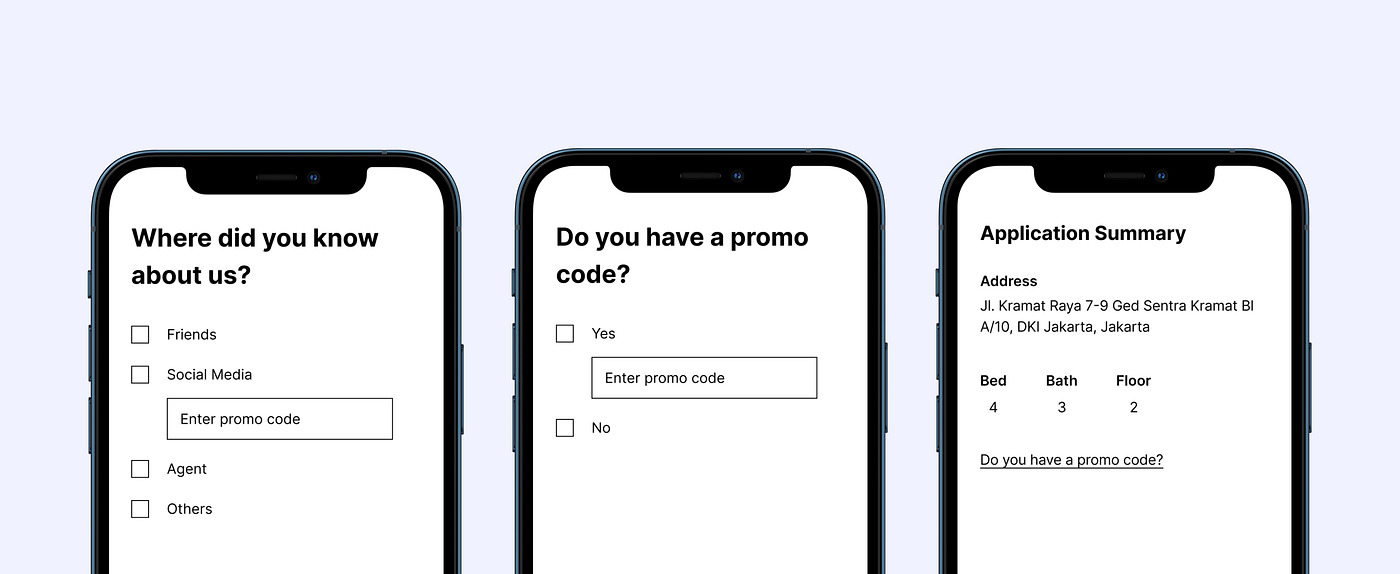
First, I began by exploring a conversational approach. I asked users “Where did you hear about us?” and placing the promo code input field directly after. While this seemed intuitive, this was more suited for first-time users. Since our users can submit multiple applications, this solution insufficient of our goal of capturing data for every submission. To address this, I moved on to exploring alternative placements.

Next, I considered adding a direct question about promo codes. While technically feasible, this would disrupt the existing user flow and contradict our goal of creating a seamless experience. Additionally, our submission process is already quite long, so adding an extra step would overwhelm the user.

Then, I explored placing the promo code input on the submission summary page. While intuitively appealing, this placement conflicted with our goal of collecting data as early as possible because we need to wait until the user completed their submission.

So, to achieve earlier data capture, I positioned the promo code input at the beginning of the submission process, before users entered required information.

Promo code input appears after user reads guidance and clicks “continue”
But, this unconventional placement make me ask:
- Would this disrupt the user flow?
- How could we encourage users to complete if the field was optional?
- Would this early placement generate significant data?
Final Design
To maximize data capture while providing a seamless user experience, we implemented a multi-step promo code input system. This involved placing the promo code field at the beginning, middle, and end of the submission process.
- Early placement allows for immediate data capture, but might surprise users because of the unconventional placement.

- Mid-process placement provides a second chance for users who may have missed the initial opportunity, seamlessly integrated into the existing user flow.

- Final placement aligns with user expectations and ensures data capture at the end of the process.

Additionally, we offer two convenient methods for applying promo codes:
- Automatic application: Users who click on a promo-specific URL will be automatically directed to the registration page with the promo code pre-filled.
- Manual input: Users can manually enter their promo code at any of the designated input fields within the submission process.
How we communicating promo benefits?
Unlike the others, our promotions required a unique approach. Because of our multi-step submission process, we can’t give the benefits like discounts or cash back directly in the system. So to ensure customers understood the value of their promo code, we created detailed explanations outlining how promotions worked and the steps needed to claim their benefits. This transparency was essential for managing expectations and providing a clear path to redemption.

How we measured it?
To evaluate the success of the promo code input feature and its impact on our marketing efforts, we employed the following metrics:
- Promo code usage rate: Measured the percentage of users who entered a promo code during the transaction process.
- Campaign performance: Compared the performance of different campaigns by tracking the number of new customers acquired through each promo code.
- Customer acquisition cost (CAC): Analyzed the cost-effectiveness of various acquisition channels based on promo code data.
Lessons Learned
We quickly realized that a standard approach wasn’t going to cut it for our project. Sure, there are standard ways to do things, but our system was different. By taking the time to truly understand our unique process, we were able to come up with a solution that not only worked but actually improved things. This experience taught us that knowing your business and system flow inside and out is the secret to creating truly effective solutions.
What’s next?
This initial implementation of the promo code input feature marks a significant step forward in our ability to track customer acquisition sources and campaign performance. By testing different placement strategies, we aim to identify the optimal location for the promo code input field.
But that’s not all! Analyzing the data collected will be crucial for understanding user behavior. These insights will inform future iterations and optimizations. Moreover, exploring how to leverage this data to refine marketing strategies and enhance customer targeting is a promising opportunities for growth.
Ultimately, our goal is to continuously improve the promo code input feature, maximizing its value for both users and the business.
메타데이터
- post_id
- 8144069644c1
- slug
- designing-an-unconventional-promo-code-input-feature-8144069644c1
- url
- https://medium.com/@satyacahyani/designing-an-unconventional-promo-code-input-feature-8144069644c1
- canonical_url
- https://medium.com/@satyacahyani/designing-an-unconventional-promo-code-input-feature-8144069644c1
- author_url
- https://medium.com/@satyacahyani
- status
- ok
- fetched_at
- 2026-06-26 06:47:43