Ghost Lineages: Ancient Proteins Reveal That Denisovans and H. erectus Interbred
A new protein analysis of H. erectus teeth from China identifies the first molecular signature unique to the species and provides evidence…
FOSSILS ET AL.
Ghost Lineages: Ancient Proteins Reveal That Denisovans and H. erectus Interbred
A new protein analysis of H. erectus teeth from China identifies the first molecular signature unique to the species and provides evidence of interbreeding with Denisovans
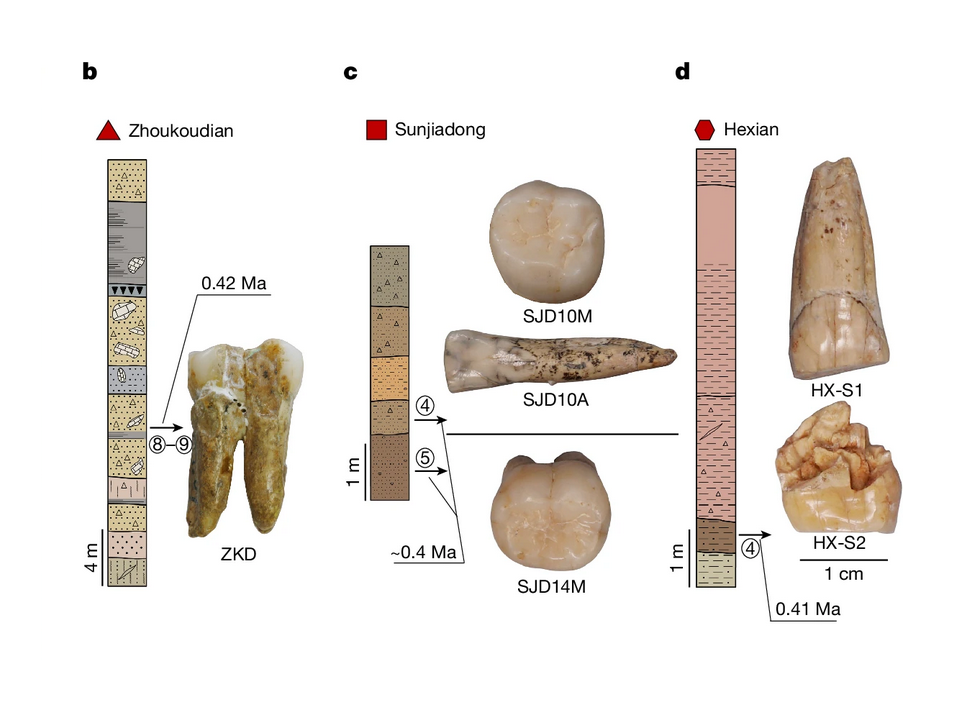
The six H. erectus teeth and their stratigraphic contexts from various sites (left to right): Zhoukoudian, Sunjiadong, and Hexian. Fu et al. 2026
“Ghost lineages”, it sounds almost supernatural. But I am not referring to a family of ghosts. Instead, I am referring to genetic mysteries, ancient extinct populations that left traces of themselves in our DNA, but whose remains we have not found: no bones, teeth, or nails; they are prehistoric enigmas.
One problem with these ghost lineages, however, is that they cannot always be tested with DNA, because DNA has a “shelf-life”, with the currently oldest DNA around 2.4 million years old. But that’s the exception, not the rule, and often fossils are found much younger than that with no viable DNA left.
This is exactly the problem faced by Homo erectus fossils: too old for DNA and yet critical for our understanding of human evolution and how they contributed not just to us but to all the hominin (humans and their extinct ancestors) species they encountered, including Denisovans and Neanderthals.
The oldest molecular data from H. erectus were recovered from a 1.77-million-year-old (Ma) tooth from Dmanisi, Georgia. However, the protein sequence lacked distinguishing features, limiting what it could say about H. erectus. It was like finding evidence of hair, but we already have hair evidence in Neanderthals, Denisovans, and all other hominin species, so it isn’t particularly insightful.
However, a recent study by Dr. Qiaomei Fu and her colleagues has changed that. They managed to extract ancient protein from not one but six H. erectus teeth from China, dating to around 400,000 years ago (400 ka), and identified two unique protein variants, one of which may have finally revealed the origin of an ancient ghost lineage.
Homo Erectus in China

Pleistocene H. erectus sites in China, sites used in the study are red. Credit: Fu et al. 2026
H. erectus is one of the most widespread and longest-lasting human species. It existed in Africa, Europe, and Asia, and lived for nearly 2 million years; we (H. sapiens) have only been around for around ~400 ka. Named the ‘upright man’ for being the first of our relatives to have a modern human-like upright body posture, with shorter arms and longer legs. It is also the first hominin to have left Africa.
The earliest fossil evidence indicates H. erectus evolved in East Africa ~ 2 million years ago (2 Ma), before migrating out of Africa around 1.8 Ma, spreading as far as Spain, China, and Indonesia. In China, it persisted until around 400–300 ka, while in Java it survived until as recently as 100 ka.
In China, a number of sites are known to have contained H. erectus fossils, including Zhoukoudian (780 to 300 ka), Hexian (~410 ka), Nanjing (ca. 580 ka), and Sunjiadong (ca. 400 ka).
One puzzling aspect about the fossils recovered from these sites is that, while Nanjing, Zhoukoudian, and Sunjiadong fossils resemble one another, the Hexian fossils resemble those on Java, which had historically been thought to belong to apes before being confirmed to belong to H. erectus. Similarly, they also share some features with Denisovans from Taiwan. The morphological (physical) differences have raised questions about whether these fossils were truly all H. erectus or if some other hominin species is responsible for these remains.
To better understand the molecular history of H. erectus and the relationship between the different Chinese fossils, researchers Dr. Fu and her colleagues analyzed six fossil teeth from three sites (one from Zhoukoudian, two from Hexian, and three from Sunjiadong), all dated to roughly 400 ka. A Denisovan tooth from Harbin was also included for comparison ca. 150 ka.
Analyzing Ancient Teeth

a) Peptide–spectrum matches (basically the peptide fingerprints) b) single amino acid polymorphisms compared across human lineages, highlighting the two variations (253 and 273). Credit: Fu et al. 2026
I am noticing my last three stories were all about teeth, so it seems May is the month of teeth studies. Anyway, to determine the molecular history of H. erectus, the researchers decided to conduct a protein analysis. Protein is made up of chains of amino acids, which survive the ravages of time much better than DNA. Scientists can analyze these sequences and compare them to known protein sequences of different species.
However, as with many analyses, these can be rather destructive, and thus the researchers first tested whether any protein had survived in animal bones and teeth (dentine and enamel) from the same sites. While proteins did not survive in bone and dentine, they did survive in the animal’s enamel, and thus the researchers went ahead with their analyses of the H. erectus and one Denisovan fossil.
They found that five of the individuals were male, and one was female. They determined this by looking for proteins that exist only in males. Thereafter, they compared the protein sequences to those of other human lineages and discovered two particularly interesting sequences. One is shared among various human lineages, and one is unique to H. erectus.
The Molecular History of H. erectus

How the AMBN(M273V) protein variant may have been passed from H. erectus to Denisovans to H. sapiens. Credit: Fu et al. 2026
It is rather well known that different human species interbred, for example, H. sapiens with Neanderthals, Neanderthals with Denisovans, and Denisovans with H. sapiens. However, whether Denisovans and H. erectus ever interbred has remained a mystery, and until now, there has been no concrete evidence to confirm otherwise.
However, upon analyzing the H. erectus fossils’ proteins, the researchers noted two key differences in a tooth enamel protein called ameloblastin (AMBN). One, AMBN (A253G), which exists in no other species, and another, AMBN (M273V), which appears in Denisovans and has traces surviving in modern humans (e.g., ~21% frequency in the Philippines).
What does this mean? Well, the unique AMBN (A253G) protein variant confirms that all fossils belong to H. erectus, settling the debate about whether the Hexian specimens were H. erectus in the first place or some other species. It also makes it the first and only known molecular signature that can distinguish H. erectus from all other known human lineages.
As for AMBN (M273V), well, its presence in both H. erectus and Denisovans strongly suggests the two interbred, which would make sense considering both populations co-existed in the same region around 400,000 years ago. Meaning H. erectus likely passed down this protein variant to Denisovans.
Additionally, the protein variant provides a clue. Remember that ghost lineage I mentioned, well, previous genetic studies had noted that Denisovans had an unknown, ‘super-archaic’ ancestral population. But no one knew what it was; it was the Denisovan ghost lineage. However, this study indicates that ghost lineage may have been H. erectus, given that these Chinese specimens all share the same unique variant and lived in the same region around the same time as the Denisovan, making them an evolutionary match.
Further molecular and genetic analyses are needed to confirm this, but maybe one ghost lineage in our ancestral tree is no longer quite so mysterious.
In a recent study, Dr. Fu and her colleagues analyzed ancient proteins from six H. erectus fossils and compared them with known protein sequences from different human lineages. What they found was not only a unique protein found only in H. erectus, settling a long-held debate about the identity of some of the teeth fossils, but also another protein. One that indicates H. erectus and Denisovans interbred and may make H. erectus responsible for the genetic ghost lineage seen in Denisovans.
I find ghost lineages so fascinating; the mystery behind what species they could have been and how they shaped our evolution truly intrigues me. There are still many other ghost lineages for which we have no idea who they were, but at least one has possibly been solved.
I am not surprised that Denisovans and Neanderthals interbred, but I do wonder what it must have been like to live in a landscape with creatures almost exactly like you, yet so different that thousands, if not millions, of years of evolution separate you.
What do you think such encounters would have been like, were they as curious about each other as we are about them?
Let me know your thoughts, and if you’d like to support the countless hours I pour into researching, writing, and bringing these hidden corners of history to life, why not Buy Me A Coffee
References
Fu, Q., Wu, Z., Bennett, E.A. et al. Enamel proteins from six Homo erectus specimens across China. Nature (2026). https://doi.org/10.1038/s41586-026-10478-8
Hendry, L. (2018). Homo erectus, our ancient ancestor. Natural History Museum. https://www.nhm.ac.uk/discover/homo-erectus-our-ancient-ancestor.html
Published in Fossils et al. **Follow **to learn more about Paleontology.
메타데이터
- post_id
- 815beba3fd49
- slug
- ghost-lineages-ancient-proteins-reveal-that-denisovans-and-h-erectus-interbred-815beba3fd49
- url
- https://medium.com/fossils-et-al/ghost-lineages-ancient-proteins-reveal-that-denisovans-and-h-erectus-interbred-815beba3fd49
- canonical_url
- https://medium.com/fossils-et-al/ghost-lineages-ancient-proteins-reveal-that-denisovans-and-h-erectus-interbred-815beba3fd49
- author_url
- https://medium.com/@sandeeoster17
- status
- ok
- fetched_at
- 2026-06-09 15:37:30