Murderers of Melody Part 2
A Lifelong Chronicle of Lyric Mutilation, Classroom Parodies, and Musical Defiance
A TRUE CRIME MEMOIR
Murderers of Melody Part 2
A Lifelong Chronicle of Lyric Mutilation, Classroom Parodies, and Musical Defiance
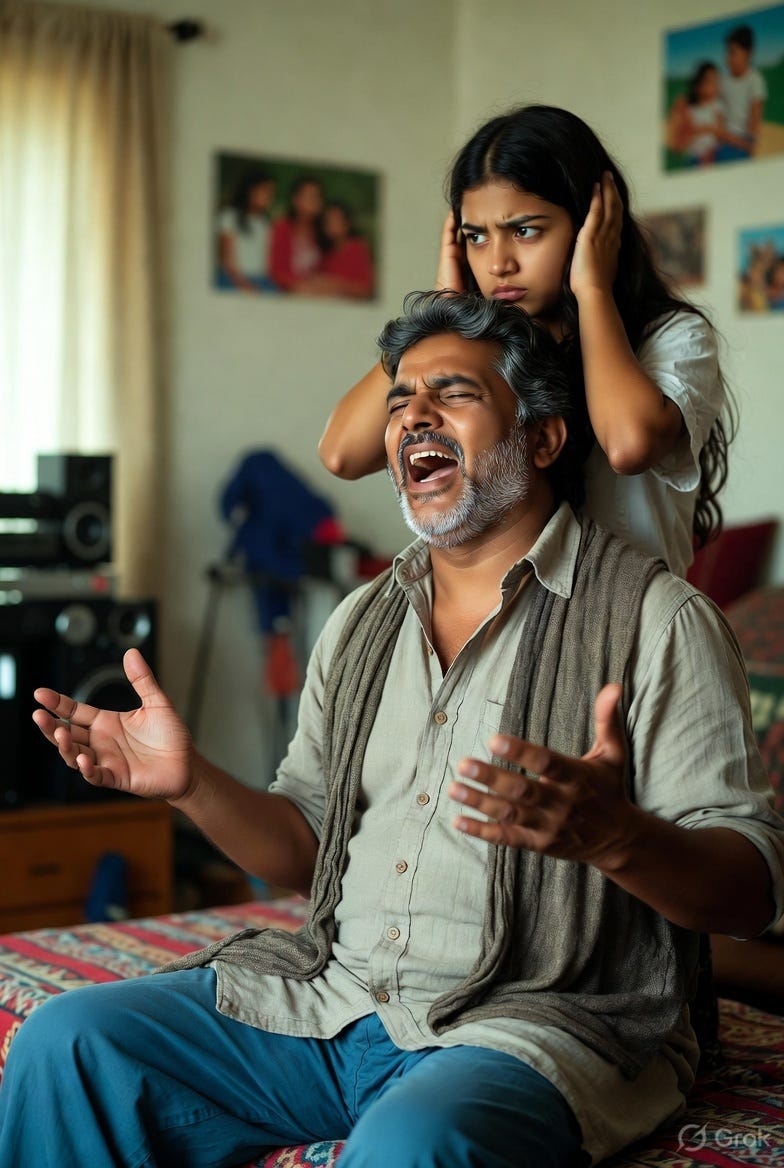
When Dad decides to perform — Volume 100, Accuracy 0. The household critic is not impressed. (Image generated by Grok Imagine)
The Household Critic
She made me repeat the words until I got the lyrics right.
Then came the song “Tanha Tanha” from Rangeela.
I used to belt out, “Tanha… Tanha… kisi ka jaan lele… kisi par jaan de de,” driving my elder daughter up the wall.
“You are not content with killing songs? You want to kill people too? Where did you get ‘kisi ka jaan lele’ (kill someone)? Lyricists would commit suicide if they could hear the way you mutilate their work,” she admonished me.
Similarly, “Jaane kyon log pyaar karte hain” from Dil Chahta Hai became “Jaane kyon log mujhe pyaar karte hain.” This prompted my elder daughter to remark caustically that people would not “love” but “hate” me if they heard me butchering that song.
Another melody that I mercilessly slaughtered was “Sarke jo sar se dheere, dheere… pagal hua re mein dheere, dheere… teri chunariyan meri dil legayi.”
I sang it as “Sarsoan ke sar se dheere, dheere…” driving my daughter mad, “How can you even think of roping in mustard in the lyrics?”
When the Mind Alters the Music
Once the mind decides, the ears stubbornly interpret the sounds to fit the narrative. Consequently, Mohammed Rafi’s soulful track “Ek hasean sham ko dil mera kho gaya” was registered by my ears as “Ek hasean sham ko din mein raat ho gaya.”
My elder daughter was utterly flabbergasted. “Dad, I salute you. You have no reservations. I thought you only killed songs of our generation, but you didn’t even spare Rafi. How can day become night in the evening?”
My protests that day naturally began to turn into night during the evening did not cut any ice with her.
The Classroom Gladiators
In our college days, we “killed” music in a completely different and novel way.
We had a lecturer named Ganapati Rao, who was incredibly strict — or perhaps just stingy — while correcting exam papers. I remember once he actually started awarding fractions as tiny as ⅛th of a mark, though he stopped after realizing the final addition was becoming too tedious. We, not being greedy for gold medals or any such nonsense, never really fought with him over marks.
However, our friend Pavan used to fight tooth and nail for every single ¼th of a mark. Ganapathi Rao and Pavan would battle like gladiators, acting as if their very lives depended on that minuscule fraction.
Pavan would fiercely argue that he deserved a full mark, while Ganapathi Rao would flatly refuse to budge from the ¼th mark he had originally awarded. The rest of us used to watch the entertainment and place bets on who would win. If Ganapathi Rao was feeling weary, Pavan would secure his full mark. Other times, Pavan would grow exhausted, accept defeat, and settle for the quarter mark. On a few rare occasions, a draw would result, and Ganapathi Rao would compromise by awarding a ½ or ¾th mark.
The Student Anthems
Because of this, my friends and I composed a song. (An individual cannot take credit for a group effort, but I believe Eashwar should be given full credit for this particular innovation.)
During those days, M. Balamuralikrishna’s classical rendition “Paluke Bangaaramayera…” was a massive hit.
Our parody lyrics, meant to be sung precisely to that classical tune, went like this:
“Marke Bangaaramaayera…. O Ganpathi rava……. Marke Bangaaramayera…… Subjectemo bodhapadadu, bodha padina gurtundadu, Gurtunna raayalemu, Raasina mari markuliyavu……. Marke Bangaarammayera….”
Translated into English:
(Has a mark become as precious as gold? O Ganapati Raava… We can’t understand the subject, and even if we understand it, we can’t remember it… Even if we remember it, we can’t write it, and even if we write it, you refuse to award the marks… Has a mark become as precious as gold? O Ganapathi Raava…)
When the movie Bobby became a blockbuster hit, we promptly adapted one of its popular songs as our collective plea to the faculty.
Our college utilized a grading system spanning A, B, C, D, and F. If you unfortunately landed an “F,” you were forced to repeat the entire subject. The original track was “Na chahoon sona, chandi, na mangoon hira, moti….. ee mere kis kaam ke….”
Our version became:
“Maaku “A” grade vaddu, maaku “B” grade vaddu, okka “C” grade chaloooo. “D” Grade aina emi paravaaledu, “F” Grade matram chaste ivvaddu, Malli repeat cheyyalem…”
Loosely translated into English:
(We don’t want an “A” Grade, we don’t want a “B” Grade, we are perfectly happy with a “C” Grade. We don’t even mind a “D” Grade… but please, never give us an “F” Grade, because we absolutely cannot repeat the subject.)
Theory of Machines (T.M.) was the one terrifying subject that gave us consistent nightmares, filled with incredibly complicated cam design profiles and convoluted problems. On the day of the exam, our anthem was lifted directly from the song “Yaad nahin ab kuch” from the film Julie.
Our rendition was:
“Yaad nahin ab kuch, bhool gaya sab kuch……. oho…. aha…. lekin ek baat na bhooli, Teeee Emmm….. aaaaaaaa… …I hate you………”
Loosely translated into English:
(Don’t remember anything, forgot everything, ….. oho…. aha………… but I can’t forget one thing…. Teee Emmmm……. aaaaaa….. I hate you…)
We proudly sang these parodies at our farewell party to thunderous applause. Fortunately, all the lecturers took it sportingly.
The Defense of Melody Murderers
In defense of melody murderers, the only redeeming factor that can be said in their favor is that they are die-hard music lovers. A minor handicap like not understanding or catching the exact lyrics will never stop them from singing.
A few years back, the music video “Ai Se Eu Te Pego was immensely popular. My daughters could effortlessly mimic the entire Portuguese lyrics of that track. Meanwhile, if you held a gun to my head and demanded I learn them, I simply could not have done it.
That, right there, lies the generational difference.
A Bull in a China Shop
When it comes to singing, I am like a bull in a china shop. Even if the bull desperately wants to tread carefully, it cannot help dislodging and shattering a few precious artifacts purely because of its sheer size and large horns.
Here are a few more instances of my musical “killings.”
I realized the extent of this trait recently when I was humming “Aasaan nahin yahan Aashiq ho jana, palkon ko kaanten pe sajaanaa…,” a hit song from Aashiqui 2. Having heard this melody many times, I confidently wanted to impress my elder daughter with my vocal prowess — hoping to prove I could sing melodies without actually murdering them.
Instead, she clutched her forehead and implored me to stop butchering the song.
I felt rightfully indignant and told her haughtily that I was singing the lyrics perfectly.
She sighed and countered, “Just think for a moment. Palkon means eyelids and kaante means thorns. How on earth can you put eyelids on top of thorns? Are you going to peel them off your face and place them there?”
I paused and thought about it for several moments. The only logical explanation I could come up with was that the lyricist must have had many drinks to get into the creative mood.
I told her, “Not necessarily. One can simply lie down face first and place their eyelids on the thorns.”
She explained patiently, “The actual lyric is palkon pe kaanton ko sajaanaa…. and not palkon ko kaante pe sajaana. What the lyricist is trying to say is that to be a passionate lover is not easy; it involves decorating your own eyelids with thorns… ”
Tail Piece: A Hereditary Condition
My elder daughter frequently wonders why, with so many thousands of songs available to choose from, I continuously hum only a select few, such as “Teri zulfon se…,” “Jo tum ko ho pasand…,” and “Maasi maasam…”
Personally, I think the habit is hereditary. My own father used to have two or three pet poems that he would sing relentlessly. One was from the Mahabharata, where Arjuna asks Krishna how he could fight Bhishma, a veteran of countless battles, when he himself was merely a young novice:
“Aatadaneka yuddhamula ariyu terina vruddha moorthi, yeno tarununda….”
Another favorite of his was “Janda pai kapi raaju…….” His third staple was “Oho, vinu Mister….” from the movie Chivaraku Migiledi.
Back then, I also used to wonder why, with so many brilliant songs by Ghantasala, P.B. Srinivas, and others to choose from, he kept singing those same lines over and over again.
The Legacy of Demolition
Years ago, my eldest sister-in-law sang a beautiful song on the eve of her engagement: “Padamule chalu Ramaa…… ni pada dhulule padivelu..”
I instantly mutilated that elegant piece by singing a literal English translation over it: “Words are enough, Ramaa…… your feet dust is ten thousand….”
Instead of laughing and encouraging me in my lifelong pursuit of the demolition of melodies, my parents and elders really should have reined me in. Perhaps they, too, are entirely guilty of omission, if not outright commission.
Thanks for Reading!
⚔️ Love Audio Dramas? Immerse yourself in a gripping world of kings, vows, and empires. Stream my hit fantasy audio series, Hasten-Gard, on Pocket FM! 👉 Listen Here
Explore My Collections:
- 📜 **The Legend of Bhishma:** The full, chronological epic saga.
- 🎭 **Wit & Wisdom:** Satire and humor in the spirit of Mullapudi and Wodehouse.
- ⚓ Crossings: Reflections on sea life, schooling, and life’s journeys.
- 🏺 **Ancient Echoes:** Reimagined tales from Indian Folklore and Epics.
📬 Never Miss a Story: If these reflections on life, sailing adventures, and ancient wisdom resonated with you, click here to visit my profile, follow, and enable email notifications.
📬 Stay Updated: Subscribe to my Substack to get every new story delivered directly to your inbox.
Author’s Note: This story is an excerpt from my book, “Merry Mariner and His Rudderless Boat.” Please find the full collection of maritime memoirs and life lessons from the high seas on Amazon here. Amazon here.
Support the Journey
If these stories resonate with you, consider supporting my work:
- ☕ International: Buy a Coffee on Ko-fi
- 💳 India (UPI):
raoos45-1@okhdfcbank - 🎨 Art: View My Painting Collection
© A.K. Girisam 2026. All rights reserved.


New Literary Society
메타데이터
- post_id
- 818a3d41e302
- slug
- murderers-of-melody-part-2-818a3d41e302
- url
- https://medium.com/new-literary-society/murderers-of-melody-part-2-818a3d41e302
- canonical_url
- https://medium.com/new-literary-society/murderers-of-melody-part-2-818a3d41e302
- author_url
- https://medium.com/@akgirisam
- status
- ok
- fetched_at
- 2026-07-13 06:23:13