Is There a Link Between Ultra-Processed Foods and Chronic Insomnia?
Sleep and nutrition are often discussed separately, but growing research suggests that what we eat may be connected to how well we sleep. A…
Is There a Link Between Ultra-Processed Foods and Chronic Insomnia?
Is There a Link Between Ultra-Processed Foods and Chronic Insomnia?
Sleep and nutrition are often discussed separately, but growing research suggests that what we eat may be connected to how well we sleep. A recent study explored this relationship by examining whether higher consumption of ultra-processed foods was associated with chronic insomnia.
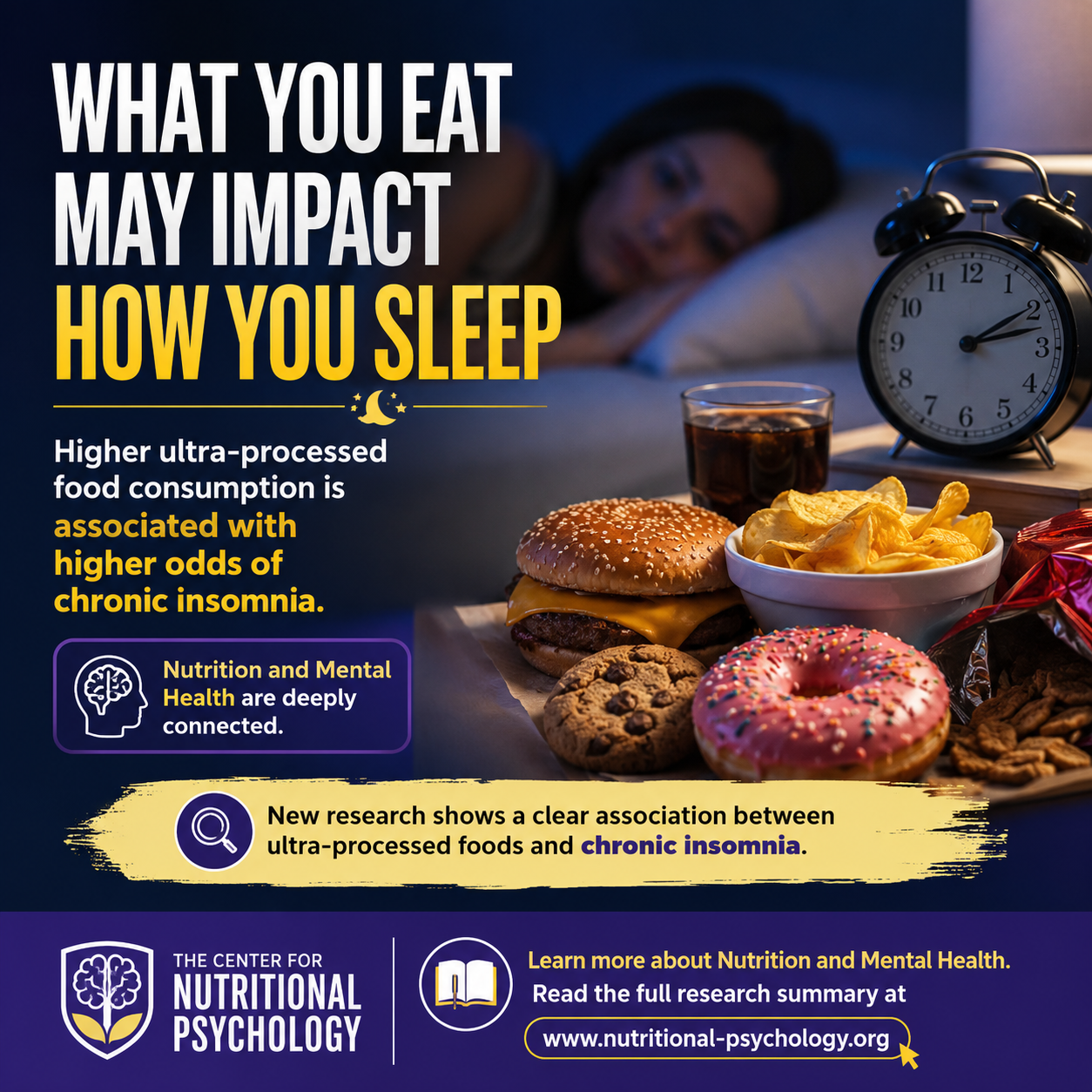
The findings, based on data from more than 38,000 adults in France, found a significant association between greater ultra-processed food intake and chronic insomnia. However, the researchers did not establish that ultra-processed foods cause insomnia.
What Is Chronic Insomnia?
Chronic insomnia is a sleep disorder involving ongoing difficulty falling asleep, staying asleep, or waking earlier than intended. For chronic insomnia, these problems occur at least three nights a week for three months or longer.
Poor sleep can affect more than energy levels. Chronic insomnia may interfere with concentration, mood, productivity, and daily functioning. It can also occur alongside mental health concerns such as anxiety and depression.
Because sleep and psychological well-being are closely connected, understanding the relationship between diet and sleep may be an important part of exploring Nutrition and Mental Health.
What Did the Study Examine?
The study by Pauline Duquenne and colleagues used data from the NutriNet-Santé study, an ongoing online cohort in France.
Researchers analyzed information from 38,570 adults, with an average age of about 50 years. Approximately 77% of the participants were women.
Participants regularly provided information about their dietary intake, lifestyle, health, and other characteristics. Their dietary intake was assessed using multiple 24-hour dietary records.
The researchers then examined whether the proportion of ultra-processed foods in the participants’ diets was associated with chronic insomnia.
What Are Ultra-Processed Foods?
Ultra-processed foods are generally made from substances derived from foods and often contain several additives, with few intact or minimally processed food components.
Examples can include:
- Packaged sweet and savory snacks
- Sugary cereals
- Soft drinks
- Instant noodles
- Some ready-to-eat or microwaveable meals
- Reconstituted meat products
- Artificially sweetened beverages
Ultra-processed foods have attracted considerable research attention because their consumption has been associated with several health outcomes.
What Did Researchers Find?
Around 19.4% of the participants had symptoms of chronic insomnia.
Ultra-processed foods accounted for approximately 16% of the total amount of food consumed per day in the study population.
More importantly, people who consumed greater amounts of ultra-processed foods tended to have higher odds of chronic insomnia.
A 10-percentage-point increase in the proportion of ultra-processed foods in the diet was associated with 6% higher odds of chronic insomnia.
The association differed slightly by sex. Among men, the same increase was associated with 9% higher odds, while among women it was associated with 5% higher odds.
The researchers also found that participants with chronic insomnia were more likely to experience symptoms of anxiety and depression.
Does This Mean Ultra-Processed Foods Cause Insomnia?
Not necessarily.
This is one of the most important points when interpreting the study.
The research was based on a cross-sectional analysis, meaning that the researchers examined associations between dietary intake and insomnia rather than following participants over time to determine what came first.
It is possible that greater consumption of ultra-processed foods could contribute to poorer sleep. However, it is also possible that people experiencing chronic insomnia may be more likely to choose convenient, readily available, or highly palatable foods.
Other factors could also influence both eating habits and sleep.
Therefore, the findings should be understood as an association rather than proof of causation.
Why Does This Matter for Nutrition and Mental Health?
Sleep plays an important role in emotional and psychological well-being, while food choices are also increasingly being studied in relation to mental health.
The connection between nutrition, sleep, mood, and behaviour is complex. Research such as this helps broaden our understanding of how different aspects of health may interact rather than looking at diet or sleep in isolation.
The findings also highlight the importance of continuing to investigate how dietary patterns may relate to sleep health and psychological well-being.
The Takeaway
A large study of more than 38,000 adults found that higher consumption of ultra-processed foods was associated with greater odds of chronic insomnia.
The association was relatively small, and the study does not show that ultra-processed foods directly cause insomnia. More longitudinal and experimental research is needed to understand the direction and mechanisms of this relationship.
Still, the findings add to the growing research exploring the connections between nutrition, sleep, and mental health.
To read the original CNP research summary, visit the Center for Nutritional Psychology: https://www.nutritional-psychology.org/chronic-insomnia-is-associated-with-higher-ultraprocessed-food-consumption/
Reference
Duquenne, P., Capperella, J., Fezeu, L. K., Srour, B., Benasi, G., Hercberg, S., Touvier, M., Andreeva, V. A., & St-Onge, M.-P. (2024). The association between ultra-processed food consumption and chronic insomnia in the NutriNet-Santé Study. Journal of the Academy of Nutrition and Dietetics, 124(9), 1109–1117.e2.
메타데이터
- post_id
- 81a22706ceb8
- slug
- is-there-a-link-between-ultra-processed-foods-and-chronic-insomnia-81a22706ceb8
- url
- https://medium.com/@aasmakausar786/is-there-a-link-between-ultra-processed-foods-and-chronic-insomnia-81a22706ceb8
- canonical_url
- https://medium.com/@aasmakausar786/is-there-a-link-between-ultra-processed-foods-and-chronic-insomnia-81a22706ceb8
- author_url
- https://medium.com/@aasmakausar786
- status
- ok
- fetched_at
- 2026-08-05 22:46:39