Netherlands 5–1 Sweden: How One Formation Switch Turned the First Half Into a Chess Match Before…
Post-Match Tactical Notes #10 — Sweden’s first half rescue act, the Isak free role, and why the scoreline exaggerated the gap
Netherlands 5–1 Sweden: How One Formation Switch Turned the First Half Into a Chess Match Before Dutch Quality Took Over
Post-Match Tactical Notes #10 — Sweden’s first half rescue act, the Isak free role, and why the scoreline exaggerated the gap
This was not a 5–1 in the way the scoreline suggests.
The first half alone was one of the most enjoyable tactical contests of the tournament so far, a genuine chess match in which control changed hands more than once. For the opening stretch, the Netherlands dominated. But after the cooling break, Sweden completely reversed the flow and took command of the game.
You could almost split the first half into black and white: two distinct phases within the same half, each belonging to a different team.
The Netherlands eventually pulled away through ruthless individual quality and a devastating start to the second half, but the performance gap was nowhere near as wide as five goals to one. Sweden played an even game for long periods, and the underlying numbers agree. This was a match decided by Dutch sharpness in both boxes rather than sustained territorial superiority.
Data snapshot
The numbers show why the match was more balanced than the scoreline.
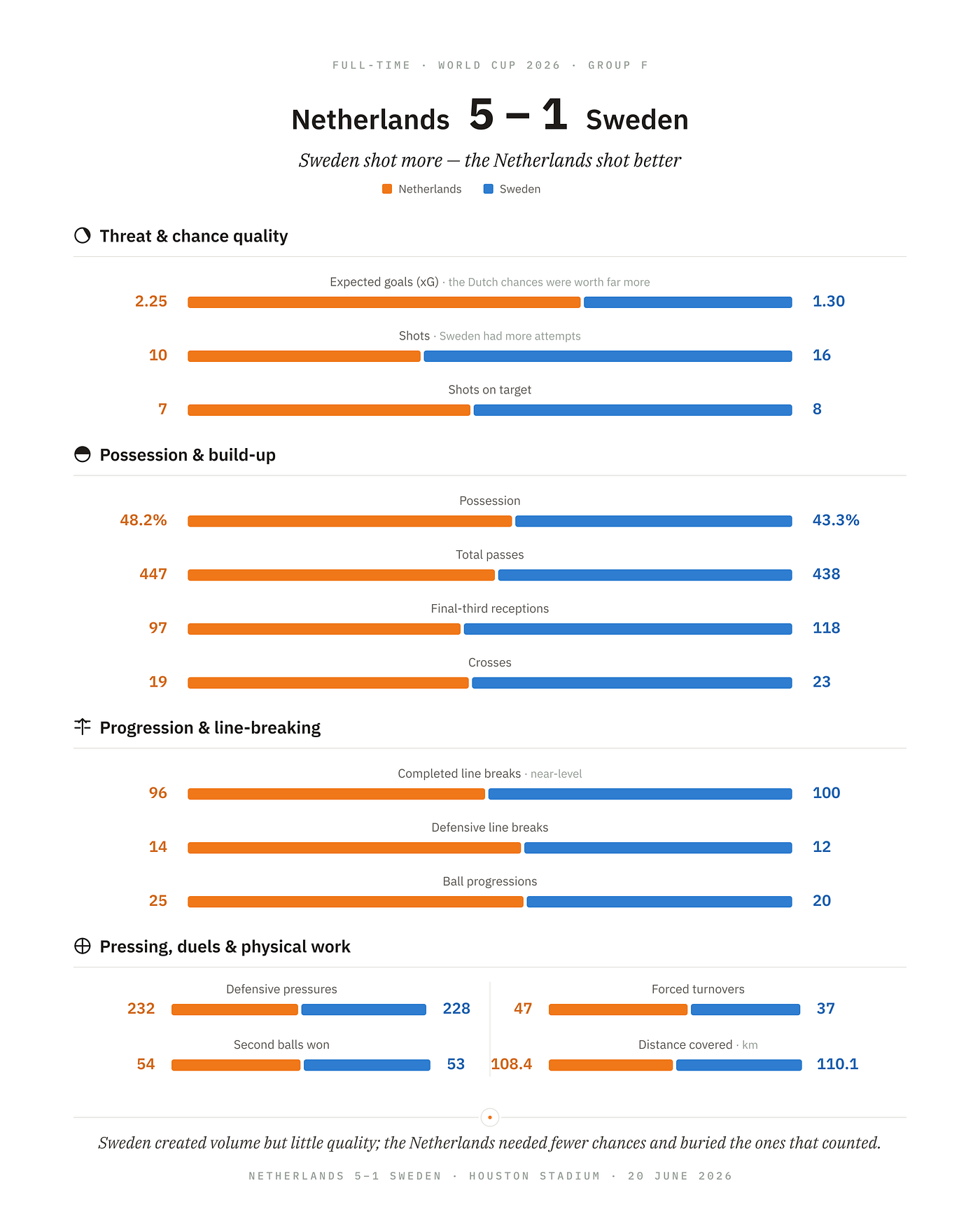
Sweden had more shots, more shots on target, more completed line breaks and more final third receptions. The game was not as one sided as 5–1 makes it look.
But the Netherlands had the higher xG, the better finishing and the better individual execution in the moments that mattered. My Layer Break Score also reflected how close the game was overall: the Netherlands led only 60 to 57 across the match.
The difference was not constant dominance.
The difference was quality at decisive moments.
1. Sweden’s opening shape struggled against the Dutch wide attack
Sweden set up to face the Netherlands in something close to a 5–3–2, and at the start of the match that structure had real problems dealing with the Dutch wing attacks.
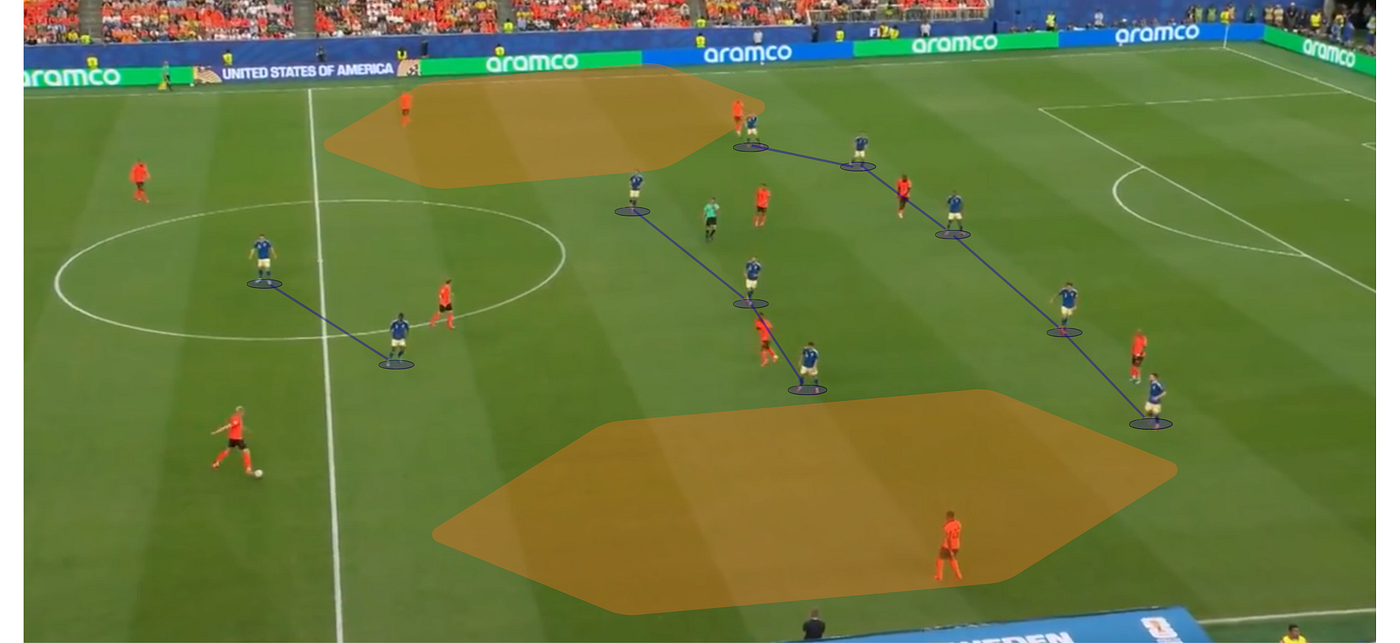
The issue was mainly about the source of support in wide areas.
When the Dutch full-backs or wide players attacked the flanks, Sweden could not consistently organise who would provide cover. If the outside centre back stepped across to help, space opened up inside. If the support came from central midfield, the three man midfield line became stretched, and because that line was relatively narrow, the Netherlands could switch play and expose the far side.
Either solution created another problem.
This was especially visible in the opening phase. Sweden’s 5–3–2 protected the centre on paper, but it did not defend the width cleanly enough. The Netherlands could either find the wide player, attack the channel or use Brian Brobbey as the next connection inside.
2. Brobbey’s link play set the tone for the Dutch opening
In that first Dutch spell, the biggest single factor was Brobbey’s connection play.
Whenever he matched up against Isak Hien, he gave the Netherlands a strong reference point. He could receive with his back to goal, set the ball, connect with the midfield and allow the Dutch attack to move up the pitch.
This link play made a huge difference.
The Netherlands did not need to force every attack through individual dribbles or wide overloads. They could play into Brobbey, use him as a wall and then attack the next action. His connection with the midfield helped the Netherlands access Sweden’s defensive structure and arrive in dangerous areas.
The early goals came from exactly the kind of wing attack pattern Sweden were struggling to contain. Brobbey was not only a finisher in this period. He was the reference point through which the Netherlands connected the attack.
In the first 20 minutes, the Layer Break Score reflected the difference: the Netherlands led 26 to 6. They were not only having good moments; they were breaking Sweden’s structure with much more value.
At that point, Koeman’s plan was working almost perfectly.
3. The Dutch build-up was a clean 4–3–3 with asymmetric full-backs
In possession, the Netherlands lined up as a true 4–3–3.
The two centre-backs formed the base, Frenkie de Jong played ahead of them, and Gravenberch and Reijnders operated as the two higher midfielders. The asymmetry came from the full backs.
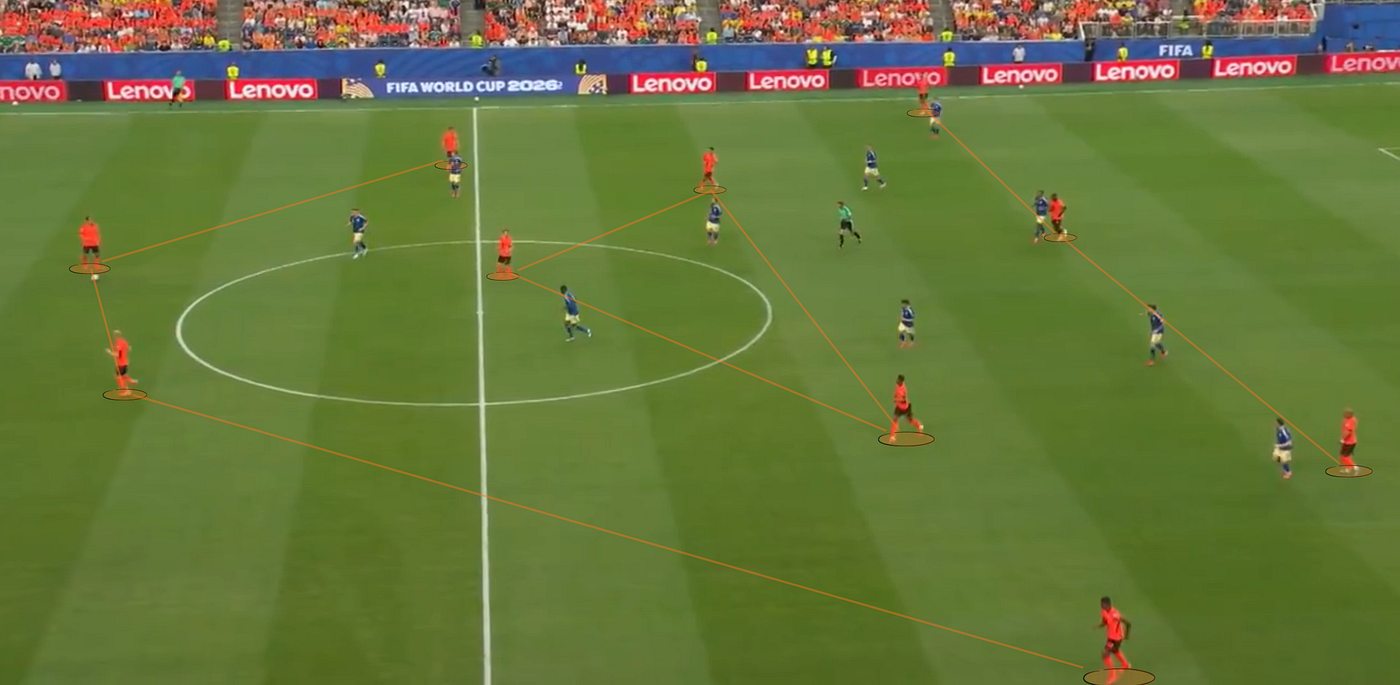
Dumfries on the right used the touchline fully. At times he dropped closer to the defensive line, but in other moments he became a genuine fourth attacker high up the pitch. Van de Ven, on the left, took a more balanced approach. He stayed closer to the back line and gave the structure more defensive security.
That structure gave the Netherlands serious control until around the midpoint of the first half.
The right side was especially important. Dumfries’ positioning and repeated involvement gave the Netherlands a clear route down that flank, while Brobbey’s link play inside gave those attacks a central reference point.
4. Potter’s single switch flipped the first half
Then Sweden changed, and it was the moment the first half turned.
Rather than continuing to defend mainly in the 5–3–2 shape, Sweden shifted toward a 4–4–2 in the middle block and a 5–4–1 when defending deeper.
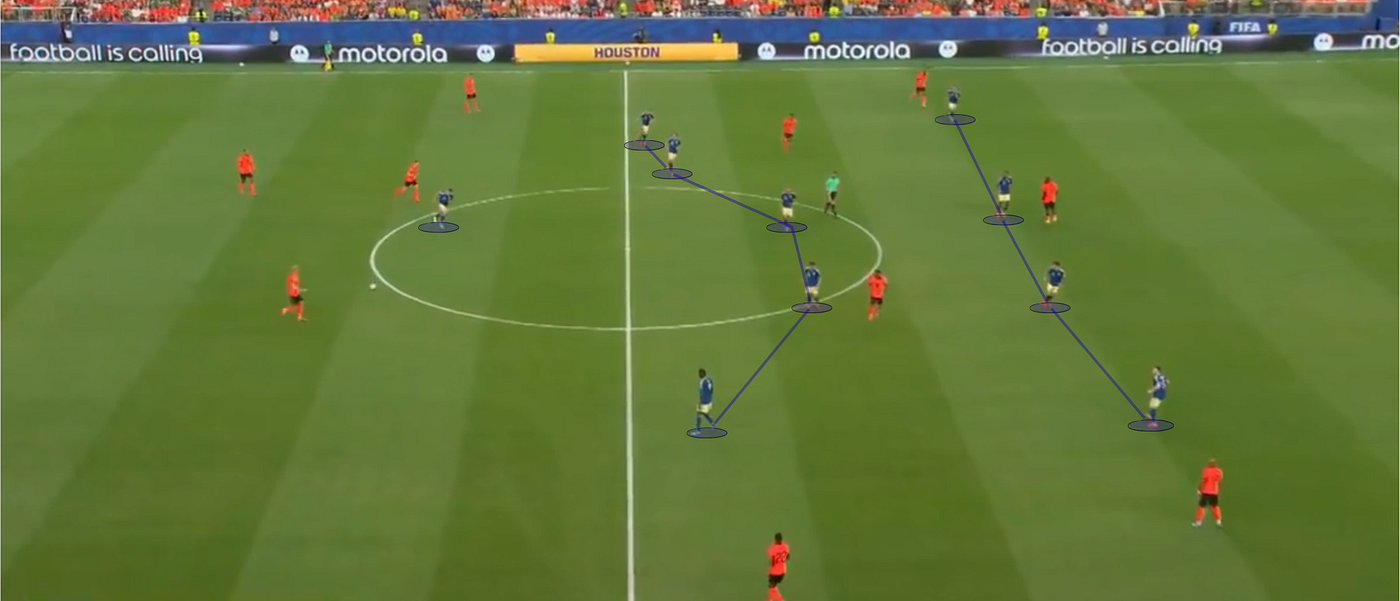
That one adjustment allowed them to defend the wide areas far more cleanly.
With the 4–4–2 in the middle block, Sweden could support the flanks with wide midfielders instead of constantly asking the central midfield three or outside centre backs to solve those situations. When they dropped deeper, the 5–4–1 gave them a second line of four in front of the back five, making it harder for the Netherlands to find the same wide to inside rhythm.
This was a very good in game adjustment.
Sweden did not just change the shape. They changed the way the game was being played. With one structural switch, Graham Potter solved the problem that had been hurting Sweden early and flipped control of the half.
The contrast with the opening phase was striking. Koeman’s plan had been ticking over perfectly at the start. Then Potter’s adjustment changed the terms of the game.
5. The Isak free role rebalanced Sweden going forward
Sweden’s improvement was not only defensive.
Their biggest attacking improvement came from how they used Alexander Isak.
He played in a very roaming, free role. He did not stay fixed as a traditional striker. In both fast attacks and settled possessions, he dropped into deeper areas and operated almost like a number ten. He received between the Dutch midfield and defensive lines, turned, connected play and helped Sweden bring Gyökeres and the midfielders into the game.
His understanding with Gyökeres was especially important. Gyökeres provided depth and power, while Isak connected the phases. When Ayari joined those central combinations, Sweden began to find better routes through the middle.
This allowed Sweden to attack the space between the Dutch midfield and defensive lines. They were no longer relying only on wide balls or isolated forward runs. They had a player who could receive, connect and accelerate the attack.
Isak’s positioning also helped Sweden in transition. When he received wider or deeper after defensive actions, he could carry the team forward and turn recoveries into attacks more cleanly.
The movement data captured his role well. Isak led Sweden in “in between” movements to receive, and across the team Sweden produced more of these movements than the Netherlands. That reflected how often they were finding pockets between the lines after the tactical adjustment.
This was how Sweden balanced the game and, for a spell, took the upper hand.
6. Sweden cut the Brobbey supply line
Sweden’s shift had a second effect: it disrupted the source of the Dutch attack.
They reduced Brobbey’s connection with central midfield, and from that point the Netherlands found it much harder to use him as the clean link they had relied on early. The Dutch attack became less fluid, and their most consistent route to influence was Gakpo beating his man one-v-one down the left and cutting the ball back inside.
Sweden, meanwhile, started getting into better positions more consistently.
The Layer Break Score shows how clearly the control changed. The Netherlands led 26–6 in the opening 20 minutes, but Sweden led 27–6 in the remainder of the half. That was not a minor shift. The control had genuinely changed hands.
What Sweden could not do was convert that control into goals.
Despite repeatedly getting into good areas, the final action did not arrive with enough sharpness. They had structure, rhythm and access into dangerous zones, but the finishing and last decision were not at the Dutch level.
7. The Netherlands ripped the second half open inside ten minutes
If the first half was a chess match, the second half started like a storm.
The Netherlands came out with real intensity and effectively snatched the game in the opening ten minutes after the restart, scoring twice in quick succession and breaking open a match that had been tactically balanced for long stretches.
Two things drove that surge.
First, Brobbey rediscovered the successful link play he had shown early in the first half. He again gave the Netherlands a strong connection point in the final third and helped them re-establish their attacking rhythm.
Second, Koeman’s half time change mattered. Summerville came on for Malen and immediately gave the Dutch attack a different profile. He was more effective in set attacks, more comfortable receiving in tight areas and also dangerous in transition.
The third Dutch goal showed this clearly. Summerville protected the ball intelligently, waited for the right moment and then found Dumfries’ run. That action summed up what he added: patience, timing and technical quality in the final third.
Sweden had adjusted well in the first half, but the Netherlands punished them immediately after the break.
8. Elanga’s introduction made the game a transition contest
From there, especially after Elanga came on for Sweden, the match became more open and transition heavy.
Elanga did two things for Sweden. He energised the attack and created a much faster front line. He also allowed Sweden to use the right flank far more productively than they had in the first half, when that side had been underused.
With Elanga, Sweden had more pace, more depth and more ability to attack quickly after regains. This changed the rhythm of their attacks. They were no longer only looking for Isak between the lines or central combinations with Gyökeres. They now had a wide runner who could stretch the Dutch back line and attack the space behind.
But the Netherlands were also dangerous in exactly this type of game.
Their fourth goal came from a transition after winning the ball near their own box. Gravenberch and Summerville helped carry the attack forward, and Gakpo finished with outstanding quality.
That moment was one of the clearest examples of the difference between the teams.
Sweden had threatening moments.
The Netherlands had ruthless execution.
9. Why the scoreline exaggerated the gap
The Netherlands won emphatically, but it is hard to argue that the performance gap matched the result.
Across the match, my Layer Break Score had it only 60 to 57 in favour of the Netherlands. The official line-break data was also extremely close, with Sweden completing 100 line breaks to the Netherlands’ 96. Sweden had more shots, more shots on target and more final third receptions.
So the match was much closer in process than it was on the scoreboard.
The Netherlands were not four goals better in general play. They were much more efficient in the decisive moments.
They had the better individual performances in the zones that mattered. Brobbey was excellent in the early Dutch spell. Gakpo’s second half performance was exceptional, especially in the way he turned promising attacks into goals. Dumfries gave the team constant right sided running power and produced decisive actions from wide areas. Summerville came off the bench and changed the attacking rhythm with his set attack quality and transition value.
That level of individual execution made the difference.
Sweden also had strong performers. Isak was excellent as a roaming connector, and Elanga gave them real speed and threat after coming on. But Sweden were not as sharp in the final action. Their attacking structure produced moments, but not enough goals.
10. Defensive quality also shaped the result
The defensive side of the game also mattered.
The Netherlands made mistakes and gave Sweden opportunities, but they still had enough individual defensive quality to survive the most dangerous moments. Sweden, on the other hand, struggled to contain the Dutch attackers once the game opened up.
Sweden’s defensive structure improved after the cooling break, but they could not maintain that level across the full match. Once the Netherlands scored early in the second half, the game became more open, and that openness suited the Dutch attackers much more.
After the match reached 4–1 around the hour mark, the tempo dropped. The result was effectively decided, and the tactical tension of the first half disappeared.
Analyst takeaway
This was a tale of two matches stitched together.
The first half was a high-quality tactical duel in which Potter out-thought the early Dutch dominance with a single, decisive formation change. Sweden shifted from the 5–3–2, defended the flanks much more clearly and used Isak’s roaming role to create a real route through the centre.
For a real stretch, Sweden were the better team without the reward on the scoreboard.
The second half was where Dutch quality became decisive. A two goal burst inside ten minutes, fuelled by Brobbey’s restored link play and Summerville’s set attack impact, broke a game that had been finely balanced. From there, individual brilliance, above all from Gakpo, turned a close contest into a comfortable looking win.
The lesson is the one the underlying numbers keep repeating. Sweden matched or even bettered the Netherlands on shots, line breaks and final third access, and still lost by four.
Against elite forwards, an even game is not enough.
You have to take your chances.
The Netherlands did. Sweden did not.
That, more than any tactical gap, is why the scoreboard reads the way it does.
Originally published at https://footballtacticalnotes.substack.com.
메타데이터
- post_id
- 81ade8792fba
- slug
- netherlands-5-1-sweden-how-one-formation-switch-turned-the-first-half-into-a-chess-match-before-81ade8792fba
- url
- https://medium.com/@mkubjk/netherlands-5-1-sweden-how-one-formation-switch-turned-the-first-half-into-a-chess-match-before-81ade8792fba
- canonical_url
- https://medium.com/@mkubjk/netherlands-5-1-sweden-how-one-formation-switch-turned-the-first-half-into-a-chess-match-before-81ade8792fba
- author_url
- https://medium.com/@mkubjk
- status
- ok
- fetched_at
- 2026-07-09 16:25:21