Finding my identity at the intersection of paintbrushes and pipettes
Long before I was a researcher, I was an art kid — growing up on my mother’s lap, watching her paint, absorbing the language of art before…
Finding my identity at the intersection of paintbrushes and pipettes
Long before I was a researcher, I was an art kid — growing up on my mother’s lap, watching her paint, absorbing the language of art before I could form coherent sentences. Not in a casual after school-hobby way but in a ‘art teacher’s favourite in art class’ and ‘art editor of my school magazine’-way, I used to be the one other kids came to beautify their notebook covers or artworks. My biology journals were immaculate — not just scientifically accurate but beautiful, with every diagram drawn with good technique, precision and shading that would often make it look more like a sketch book than a science lab book. This came, in no small part, from my mother and is a running joke in my family as this being my ‘greatest generational wealth’. My mother, an art educator-turned-photographer spent her entire career proving herself in spaces that at the time, were not built for women. Growing up watching her work was watching someone insisting daily, and quietly, that art was serious and that it was indeed important. That it was rigorous and worth a life. And so paradoxically, I decided not to pursue it. Not because I didn’t love it but more so because I was certain this path would be too personal for me where every step I took would be measured up against my mother’s and like any teen I questioned if this was really my identity that I would take on for life. If something I was good at school — because I was exposed to it at home — would be enough to justify my identity for the rest of my life. And like a teen who didn’t know any better I decided this to be ‘cringe’ and traded off my brushes for pipettes and pursue something else: Biology. I had already nailed the diagrams, the rest, I thought would follow.
The further I went into research, the more I believed that it was the correct space for me. Science was rigorous, peer-reviewed, credentialed. Art was personal, subjective, something I did on the weekends. The serious version of me, I assumed, would gradually set the sketchbook aside but kept surprising myself with how often I did the opposite. I couldn’t stop integrating my skills into my work and as a result there would presentations with more visuals than necessary. I saw myself volunteering to design for events or organizations that had even a tangential connection to research on top of my workload as a PhD student. The art wasn’t leaving, instead it kept finding crevices to seep into.
In 2021, during the COVID-19 pandemic, I stumbled upon a virtual event flyer on X by a group called the Student Network on Extracellular Vesicles (SNEV), a group of early career researchers from all over the world working on Extracellular vesicles. It was early in the morning when I joined the call and on the screen were young EV researchers from across the world, troubleshooting protocols, sharing findings, talking about a field most of our institutions hadn’t fully noticed yet. I had been studying EVs in relative isolation at my university in India, in a field that colleagues sometimes looked at with great scepticism. This call felt like walking into a room where everyone already understood the job. Shortly after that, I got the opportunity and was selected to join SNEV’s design team in 2022. What started as a practical contribution — making posters, building brand identity for a young scientific organization — became something I hadn’t expected to be: a place where the two halves of me were in synergy. The researcher and the artist were for the first time, working on the same team. My love for EVs and love for visual communication didn’t have to take turns. They could be simultaneous.
Five years later, I am now the design team manager for SNEV. The website banner for the International Society of Extracellular vesicles (ISEV)- the global body of the field — was designed by me.
The girl who thought she had to let go of her art to be viewed professionally now had them fused together and stood out because of it.
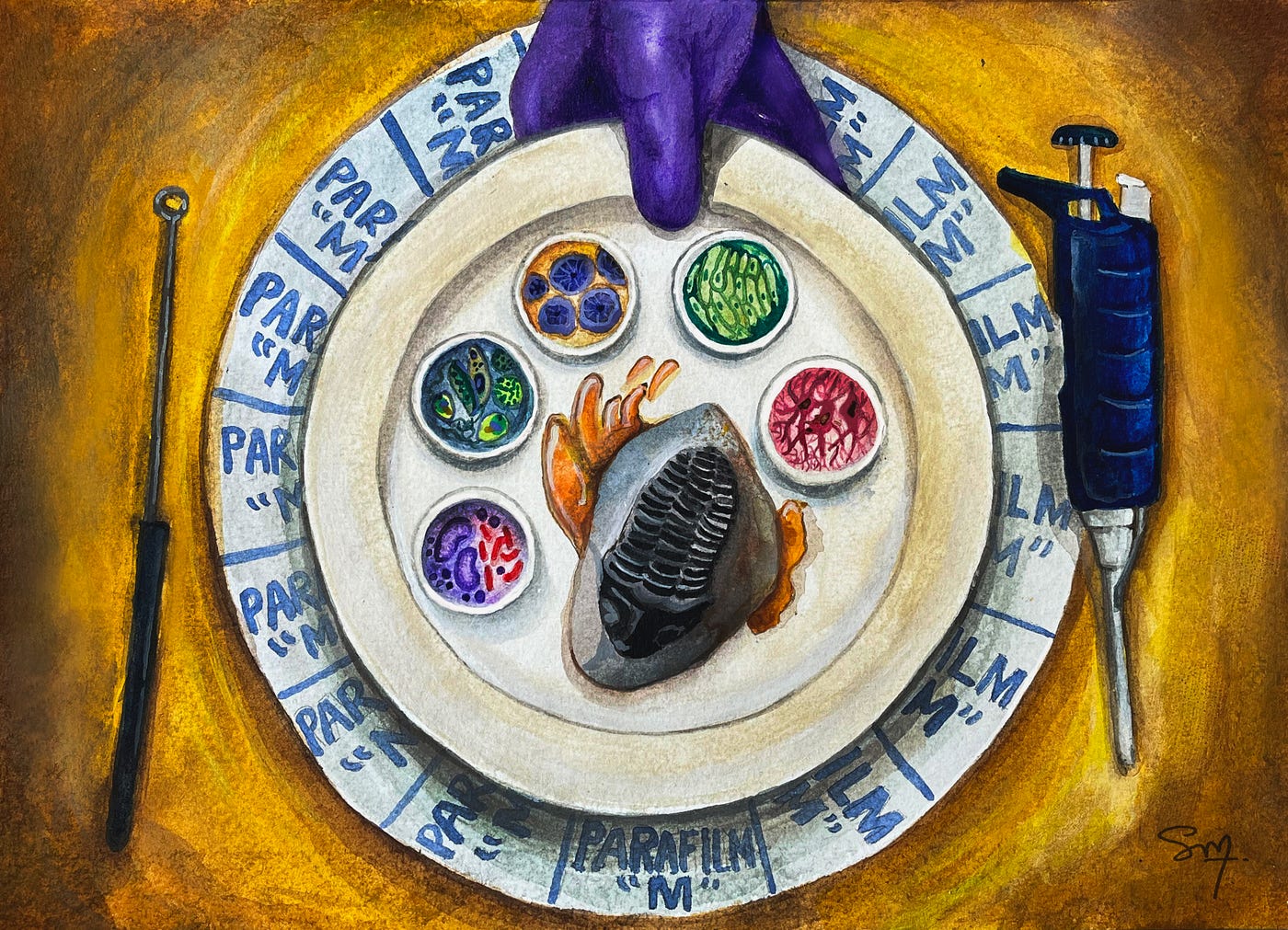
The paintings came more freely after that. I made ‘Biology on a Plate’ my artistic rendition of the evolutionary diversity represented with fine dining in acrylic with each element on a dinner plate represents a stage of biological evolution: Bacteria, Protozoa, Fungi, Plantae, Mammalian cells, arranged like courses in a meal. At the centre lies a trilobite fossil, smeared in petroleum biology’s ancient past sitting quietly in the middle of modern science. It won the Popular Choice Award at IndiaBioscience’s Create-it! competition in 2024. After that, science started trickling in more into my art where botanicals became fused with lab glassware, landscapes being painted into the silhouettes of brains and other organs and my personal favourite — an Extracellular vesicle as a Golden Snitch from Harry Potter; winged, luminous and carrying its cargo across biological boundaries.
While I was happy in my new found reassurance about being recognized now as a researcher who does art in my immediate community, I certainly did not think the extent of how far artworks tucked away in my sketchbook could go. In April 2025, an email arrived from the International Brain Research Organization (IBRO) informing me that my painting ‘Synaptic Symphony’ had won their NeuroArt Contest and would feature on the cover of IBRO Neuroscience Reports. I read it twice, then a third time; thinking to myself that prestigious organizations like IBRO and many others published fluorescence microscopy images or beautiful commissioned illustrations by actual artists with prestigious affiliations and not sketches I did in between lunch breaks to relax myself. I was wrong. And being wrong about where I was allowed to arrive was one of the better experiences of my research career. My mother was the first person to find out and she was beyond ecstatic. What I understood in that moment was that stepping away from her path was never about leaving art behind. It was about finding the version of it that was mine. When publications felt distant and peer reviews felt like an impenetrable wall, art was how I insisted the work was real. Designing for SNEV taught me the power of visual communication as a necessity and not decoration.
I was my art teacher’s favourite. A neuroscientist was not what anyone expected. It was not what I expected either. But here we are — sketchbook open, data running, both making sense of the same world.
메타데이터
- post_id
- 81aeee83dac2
- slug
- finding-my-identity-at-the-intersection-of-paintbrushes-and-pipettes-81aeee83dac2
- url
- https://medium.com/@swagatamamukherjee/finding-my-identity-at-the-intersection-of-paintbrushes-and-pipettes-81aeee83dac2
- canonical_url
- https://medium.com/@swagatamamukherjee/finding-my-identity-at-the-intersection-of-paintbrushes-and-pipettes-81aeee83dac2
- author_url
- https://medium.com/@swagatamamukherjee
- status
- ok
- fetched_at
- 2026-06-09 15:37:30




