Invisible Geomechanical Risks: Why Discontinuity Interpretation Matters for Aquifer Protection and…
Some of the most consequential risks in subsurface projects are the ones that never appear on the surface. Long before a well is drilled or…
Invisible Geomechanical Risks: Why Discontinuity Interpretation Matters for Aquifer Protection and Subsurface Integrity
Some of the most consequential risks in subsurface projects are the ones that never appear on the surface. Long before a well is drilled or a model is finalized, the subsurface already contains a network of natural fractures, subtle discontinuities, and structurally complex zones that quietly influence how the rock will behave. In the United States — where energy development, groundwater protection, carbon storage, and geothermal initiatives increasingly depend on reliable subsurface knowledge — understanding these invisible features is not optional. It is foundational.
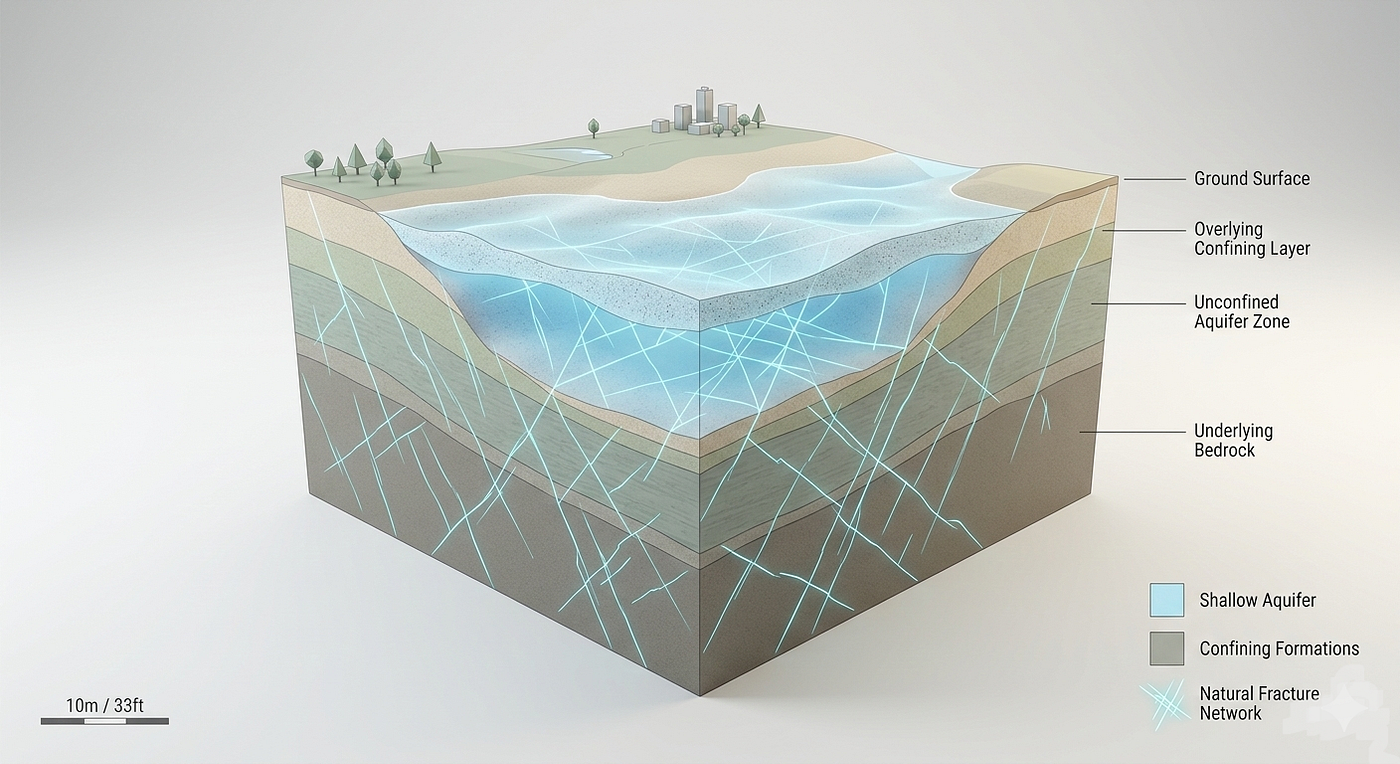
A conceptual 3D model showing a shallow aquifer, overlying formations, and a network of natural fractures.
Geomechanical risk is not a single phenomenon. It emerges from the interaction between geological structures, stress fields, lithological contrasts, and fluid pressures. A fracture corridor may act as a conduit in one direction and a barrier in another. A subtle discontinuity may concentrate stress in ways that affect casing integrity. A weak interval may compromise the sealing capacity of a formation that was assumed to be competent. These are not theoretical concerns; they are physical realities that shape the behavior of the subsurface in every basin, including those in the U.S.
My work over the years has focused precisely on these invisible elements. In the study I presented at the SEG Annual Meeting in 2019, I explored how discontinuity attributes can be used to characterize naturally fractured environments and support the design of intelligent wells. The objective was not simply to map fractures, but to understand their orientation, connectivity, and operational relevance. That experience reinforced something fundamental: in structurally complex settings, even small features can have large consequences.
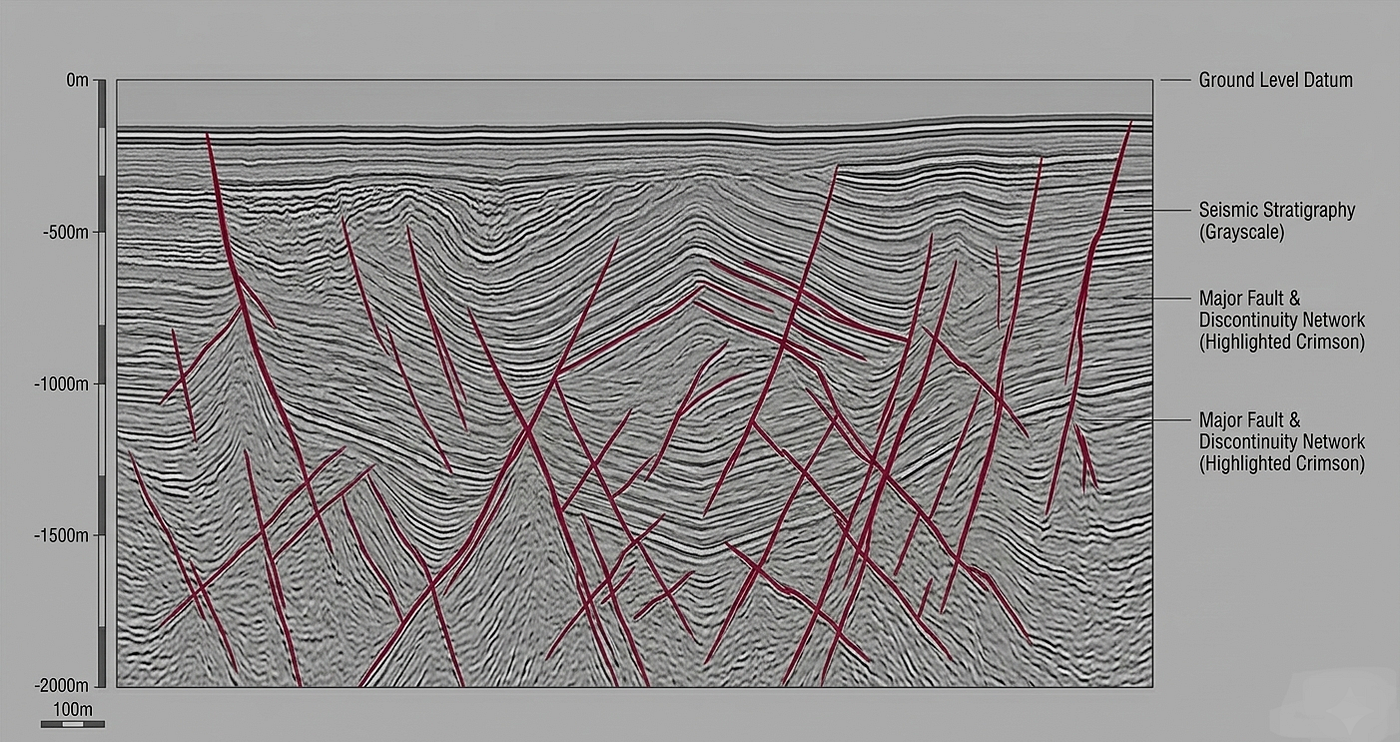
Conceptual seismic slice with major discontinuities highlighted
Reducing uncertainty in these environments requires more than a single dataset or a single technique. It demands a workflow that integrates seismic attributes, geological context, petrophysical information, and well data. The goal is not to eliminate uncertainty — an impossible task — but to understand it well enough to make informed decisions. When the subsurface is interpreted rigorously, models become more reliable and risks more manageable.
One of the most important implications of this work is its connection to aquifer protection. Natural fractures and discontinuities can influence vertical fluid migration, pressure communication, and the integrity of sealing units. When these features are not properly identified, the risk of unexpected connectivity increases. When they are understood, operators can anticipate how the subsurface will behave and design wells that respect the integrity of sensitive formations. In the U.S., where groundwater resources support millions of people and multiple industries, this understanding is essential.
Working in structurally complex environments has taught me that the subsurface rarely behaves in a simple or predictable way. It requires patience, technical judgment, and a willingness to question initial assumptions. It also requires acknowledging that the features we cannot see at first glance are often the ones that matter most.
As the United States continues to expand activities that depend on subsurface integrity — whether for energy development, carbon storage, geothermal projects, or groundwater management — the need for rigorous interpretation becomes even more important. Technology alone cannot mitigate geomechanical risk. Experience, discipline, and a clear understanding of how the subsurface behaves are equally essential.
Invisible risks are still risks. And in the subsurface, understanding them is not optional. It is the foundation of responsible decision‑making.
If you work in subsurface interpretation, drilling, geomechanics, or environmental protection, I invite you to reflect on how discontinuities and natural fractures are being incorporated into your workflows. The subsurface always has more to say — our responsibility is to listen with the right tools, methods, and level of technical rigor.
For readers interested in the technical foundations behind this discussion, several of my published studies explore discontinuities, natural fractures, and subsurface uncertainty in greater depth.
메타데이터
- post_id
- 81ccdbf519be
- slug
- invisible-geomechanical-risks-why-discontinuity-interpretation-matters-for-aquifer-protection-and-81ccdbf519be
- url
- https://medium.com/@rlizcar/invisible-geomechanical-risks-why-discontinuity-interpretation-matters-for-aquifer-protection-and-81ccdbf519be
- canonical_url
- https://medium.com/@rlizcar/invisible-geomechanical-risks-why-discontinuity-interpretation-matters-for-aquifer-protection-and-81ccdbf519be
- author_url
- https://medium.com/@rlizcar
- status
- ok
- fetched_at
- 2026-06-15 20:49:13