Power Comes First
REWIRING THE REPUBLIC · COLUMN ZERO · Before the ladder: the strongest case against this entire series—and why I am writing it anyway.
Power Comes First
REWIRING THE REPUBLIC · COLUMN ZERO · Before the ladder: the strongest case against this entire series—and why I am writing it anyway.
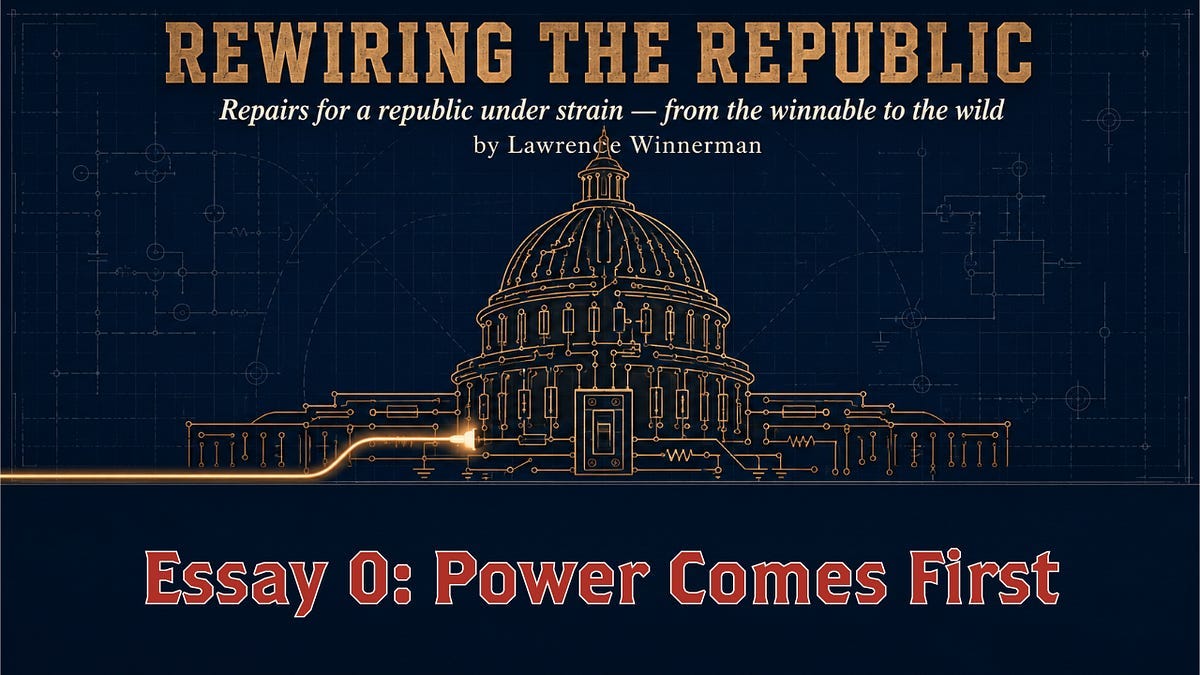
Rewiring the Republic is a field guide to every serious repair American democracy needs—all 43 of them, ordered from the winnable to the wild, from the bill Congress could pass this fall to the question of a second founding. Every reform gets the same honest scorecard: how much it fixes, how hard the lift, how long it takes, and what breaks it. Start anywhere. Climb as far as your politics will carry you. You are on Rung 0 of 13.
On the night of November 6, 2018, Florida voted to forgive.
Amendment 4 restored the vote to Floridians who had completed felony sentences—nearly 1.4 million people, the largest single expansion of the franchise in this country in half a century. It needed 60% to pass. It got 64.55%. In a state that decides presidencies by a single point, in a midterm, across every kind of county, close to two-thirds of voters looked at their neighbors and agreed on something simple: A debt paid is a debt paid.
Seven months later, the Florida legislature passed Senate Bill 7066, and the governor signed it. The bill declared that “all terms of sentence” included every fine, fee, and court cost ever attached to a conviction—money owed, in most cases, not to any victim but to the machinery of the court system itself, and money the state conceded in federal litigation it often could not even calculate. Roughly 774,000 of those 1.4 million people were disenfranchised again.
This time by an invoice.
The reform passed. The reform lost. And the gap between those two sentences is what this series is about.
The Series I Am Not Writing
There is a genre of democracy writing I have come to think of as the wish list. You have read it. I have read it. Ranked-choice voting, statehood, term limits, overturn Citizens United—each item worthy, each item floating free of every other, none of them weighted, none of them sequenced, as if a constitutional order were a gift registry. The wish list has two defining features: nothing in it is scored against anything else, and nothing in it explains why none of it has happened.
This series is the other thing. Over the past months I built a catalog of 43 serious reforms—everything from banning congressional stock trading to rewriting the Constitution itself—and stress-tested every one of them against the questions the wish lists skip. How much would it actually fix? How hard is the lift? How long would it take? Through what mechanism—a statute, a Senate rule, a state compact, an amendment? And the question the wish lists never think to ask, the one Amendment 4 answers with 774,000 invoices:
What breaks it?
Every essay in this series carries the same scorecard: Fix Power, Lift, Horizon, Mechanism, What Breaks It. The last box is the honest one, because the finding that kept recurring—across election law and court reform and money and maps—is that passing a reform is rarely the hard part. Keeping it, enforcing it, and stopping its capture is the war. Florida taught that lesson in seven months. The scorecard exists so we never have to learn it twice.
The essays run as a ladder, 13 rungs, from the winnable to the wild. Rung 1 is a set of bills Congress could pass this year with the members it already has. Rung 13 is the question of whether an eighteenth-century architecture can be patched at all, or only replaced. You can climb as far as your politics will carry you. I am going all the way up.
But before the ladder, this column. Column Zero. Because the strongest argument I encountered in months of stress-testing was not an argument for any reform on the list.
It was an argument against the entire frame.
The Dissenter
The argument goes like this. Every mechanism on my ladder—every statute, every rules change, every compact and amendment—quietly assumes something that does not currently exist: a legislature or an electorate already willing to pass it.
The scarce resource in American reform has never been the right idea. The scarce resource is organized people willing to spend years forcing the idea through, and then more years defending it from the people it disarmed.
Check the record. The Wagner Act did not create the labor movement; the strike waves of 1934—Toledo, Minneapolis, the San Francisco waterfront—created the Wagner Act. The Civil Rights Act did not produce the movement; Birmingham produced the Civil Rights Act, and Selma produced the Voting Rights Act, and the marchers were on the bridge before the bill had a number.
The Nineteenth Amendment arrived after 70 years of organizing, not before it. Reform, every time we have actually gotten it, has been a lagging indicator of power.
No mechanism organized the flying squadrons in Minneapolis. No scorecard walked across the Edmund Pettus Bridge. No white paper ever survived contact with a legislature that had no reason to fear the people proposing it.
The dissenter is right.
And I am writing the series anyway. Here is why.
Why Write the Wiring Diagram at All
This series is called Rewiring the Republic, and I mean the name literally enough to take its physics seriously. A wiring diagram does nothing on its own. Copper does not carry current because the blueprint is elegant. You can draw the cleanest schematic ever committed to paper, frame it, publish it, win awards for it—and the house stays dark until somebody generates power and pushes it through the wall.
But the reverse failure is just as real, and we have lived it more recently. In the summer of 2020, somewhere between 15 and 26 million Americans took to the streets—by most counts the largest protest movement in the country’s history. It produced city council resolutions, corporate pledges, a summer of promises.
At the federal level it produced one major bill, which died in the Senate, at 60 votes, the same place nearly everything dies. All that current, and it hit a wall nobody had mapped as immovable.
That wall is Rung 2 of this series.
So the two failure modes of American reform turn out to be mirror images. The wish list without a movement: a blueprint for a house with no power hookup. The movement without a blueprint: a million volts grounding out against a wall it did not know was structural. Power without a diagram gets spent badly. A diagram without power is just paper.
This series is the diagram drawn for the people building the current. It will tell you which walls bear load and which are drywall. It will tell you which repairs are cheap and real, which are expensive and transformative, and which beloved fixes are cosmetic. And at every rung it will point back to this column, because every “What Breaks It” box on every scorecard, traced far enough down, arrives at the same answer: Organized power showed up to defend the reform, or it did not.
The Rules of the Ladder
A few promises so that you can hold me to them.
I will score honestly, even when it hurts the cause. Some reforms progressives adore have modest ceilings, and I will say so. Early voting is good, and it is not transformative. Some reforms nobody marches for are so crucial to the engineering of our democracy we cannot skip them—who certifies your county’s vote count matters more than almost anything with a hashtag—and I will say that too.
I will name the three master locks now. The filibuster, which gates half of everything in this catalog. The Supreme Court, which hangs over every statute the way weather hangs over a picnic. And single-member districts, the quiet arithmetic that makes two-party trench warfare mathematically inevitable no matter how fairly anyone draws the lines. Three of the 13 rungs belong to these locks alone, and every other essay will link back to them.
And I will not hand you villains where the problem is structure. There are people behaving badly in this story—you will meet some of them—but the reason American democracy is failing is not that bad men exist. Bad men have always existed. The reason is that the architecture now rewards them, reliably, at scale, and architecture is something you can fix.
This is not partisan cheerleading; half the reforms in this catalog were Republican ideas within living memory. It is not doomer despair either.
It is a field guide—the thing you could hand a skeptical neighbor without apologizing for it.
Back to Florida
Because the Amendment 4 story does not end with the invoice.
The people who ran that campaign—returning citizens, led by a man who had once slept on the streets of Miami and later stood in the well of a courtroom as a law school graduate—did not file a lament when SB 7066 came down. They raised money, tens of millions of dollars, and started paying off court debts, one returning citizen at a time, and registering them, one returning citizen at a time.
The state changed the rules after losing the game. The organizers absorbed the hit and kept working, because organizing is the one thing in this story that sabotage cannot repeal.
That is the posture this series assumes. Not optimism. Stubbornness with a blueprint.
Rung 1 is next: seven repairs Congress could pass tomorrow—a stock-trading ban that four out of five Americans want, a brain Congress amputated in 1995 for the price of a hundred seconds of federal spending, a fix for the courthouse where one judge in Amarillo gets to govern the country. Seven bills, seven scorecards, and seven small rooms where each of them goes to die.
Every rung on this ladder is copper until someone throws the switch.
Power comes first.
« Foreword: The Guardrails Were Us | Essay 0: Power Comes First | Essay 1: The Winnable Seven »
Originally published at The Hinge & Near Field.
Lawrence Winnerman is a science fiction novelist and essayist writing at the crossroads of culture, politics, and technology. He is the founder of Peptidings and COO of Blue Amp Media (with Cliff Schecter). After 25 years at Microsoft and Amazon, he now writes about what comes after the institutions break—in essays, near-future scenarios, and serialized science fiction—at The Hinge & Near Field. Find him at lawrencewinnerman.com.
메타데이터
- post_id
- 81ee90ef5c65
- slug
- power-comes-first-81ee90ef5c65
- url
- https://medium.com/@lwinner/power-comes-first-81ee90ef5c65
- canonical_url
- https://medium.com/@lwinner/power-comes-first-81ee90ef5c65
- author_url
- https://medium.com/@lwinner
- status
- ok
- fetched_at
- 2026-07-24 02:21:50