Noumenon and Phenomenon
The thing-in-itself and things as they appear to our thing-perceiving minds
Noumenon and Phenomenon
The thing-in-itself and things as they appear to our thing-perceiving minds
Humans are the storytelling animal. Animals construct stories, e.g. an amoeba blobs about sensing ‘eatable―engulf’ or ‘not eatable―blob on’. Humans with complex language needed to bewitch their intelligence TELL (using verbal and techno prattle, e.g. writing/screens) stories (and modern humans believe in them).
Some stories modern humans tell relate to sensory inputs, but many do not, hence (modern humans especially) have a fragile grasp of what is imagined to not go away when modern humans stop believing in it or perceiving it through a glass darkly.
To mostly borrow thoughts and words from Stanley Salthe, noted theoretical biologist whose merest operational parameters I am not worthy to alter:
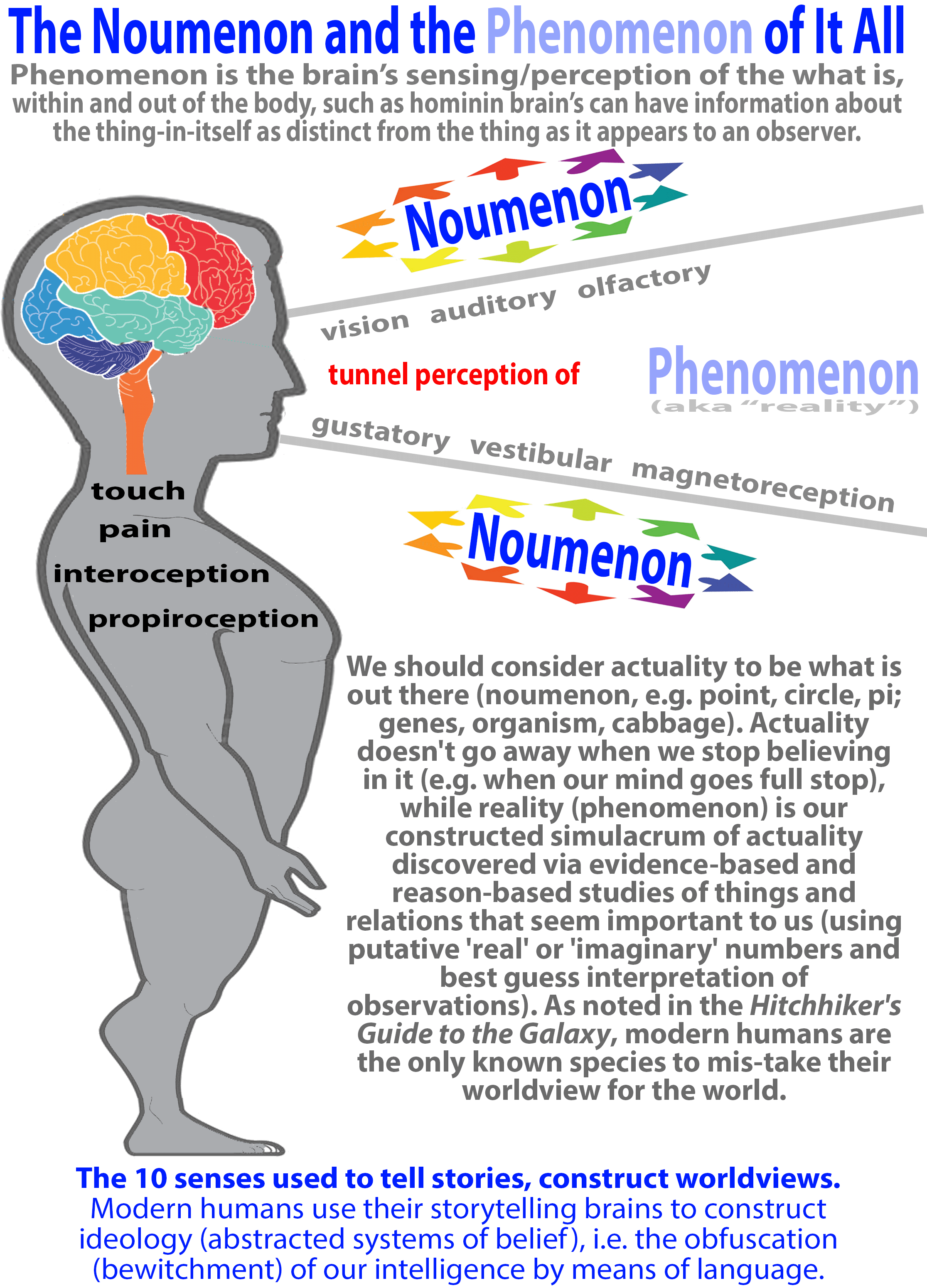
We should consider actuality to be what is out there (noumenon, e.g. point, circle, pi; genes, organism, cabbage). Actuality doesn’t go away when we stop believing in it (e.g. when our mind goes full stop), while reality (phenomenon) is our constructed simulacrum of actuality discovered via evidence-based and reason-based studies of things and relations that seem important to us (using putative ‘real’ or ‘imaginary’ numbers and best guess interpretation of observations). As noted in the Hitchhiker’s Guide to the Galaxy, modern humans are the only known species to mis-take their worldview for the world.
I’ve always viewed Plato as being in the ‘not even wrong’ category, but I also assume that I could be too. I came across the claim that pi is ‘out there’, part of noumenon, in that if mind arises on any of some septillion planets (1e24) within or beyond the observable universe, planets that could support life in the 1e13 galaxies I imagine are out there, then they could discover pi too (the same number). The concept of a ‘point’, a circle of equidistant points in the same plane from a given point, and of how many diameters are in the circle (circumference) is not just in my mind, but, yes Plato, is out there.
No mind creates the number, but could discover it as part of Cosmos. Some abstracted systems of stories are better (e.g. that π = 3.1415926535897932384626433832795 or 11.10001110111110001101011111010101100110000010101001000111001110001010100110000011000111011011101011011 in base two) than other stories (e.g. that π = 3 or 11 in base two)
But I could be wrong. I’m easily impressed, but some things that are not matter-energy are out there, e.g. relationships, principles, laws… things we prattling primates think we can tell true stories about.
That pi is out there and we primates can calculate its value to 105 trillion digits (or more if we wanted to) is the seeming exception to the rule that we know nothing with certainty (seeming exception — we cannot ever know all the digits of pi). We tell no true stories apart from tautologies (2+2=4) that tell us nothing in all desired certainty about the what is (noumenon). And rarely do any modern humans endeavor to tell the most likely story, a best-guess story about what is in front of their pug-nosed face as the norm is to rather believe than know.
We tell no TRUE stories, but some stories are better and others are less better, e.g. the amoeba whose ‘eatable’ story leads it to engulf a lethal toxin or modern humans who tell a story of ‘growth (expansion) is good’.
— — — — — — — — — — — — — — — — — —
Note from physicist:
The largest circle we might want to measure is the universe itself. If we use 63 digits of pi, we could get a precision of less than planck length. Any more digits are meaningless (to modern human except those who wonder if there is a message from Cosmos embedded in the seemingly random string of digits, i.e. pi = mind of God). Just because a computer can turn them out doesn’t give them any kind of reality.
So, to calculate the circumference to the nearest planck length of the universe once you know its diameter, you’ll need this number:
3.14159265358979323846264338327950288419716939937510582097494459
But you’ll never know the diameter of the universe to the nearest planck length (6.29921e-34 inches), so anymore that 3.14 is usually all primates need to ‘know’. If you want pretend certainty, become a pure mathematician (or theologian or neoclassical economist) and compute your value in growing the economy (in Europe, late middle ages, theologians were at the top of the list of those one high— now they meet in small rooms at Oxford and other universities as do astrologers in India).

Elsewhere (and India) people believe conventional economists.
Note: Six have PhDs in astrology from top universities (they use calculus as other scientist do) in India (by government mandate, astrology — Vedic of course, not the false Hellenistic astrology, is taught by all institutions of higher education and practitioners can participate in multidisciplinary teams just like neoclassical economists do everywhere).
메타데이터
- post_id
- 820e29ac491c
- slug
- noumenon-and-phenomenon-820e29ac491c
- url
- https://medium.com/@alysion42/noumenon-and-phenomenon-820e29ac491c
- canonical_url
- https://medium.com/@alysion42/noumenon-and-phenomenon-820e29ac491c
- author_url
- https://medium.com/@alysion42
- status
- ok
- fetched_at
- 2026-06-09 15:37:30